Summarize with :
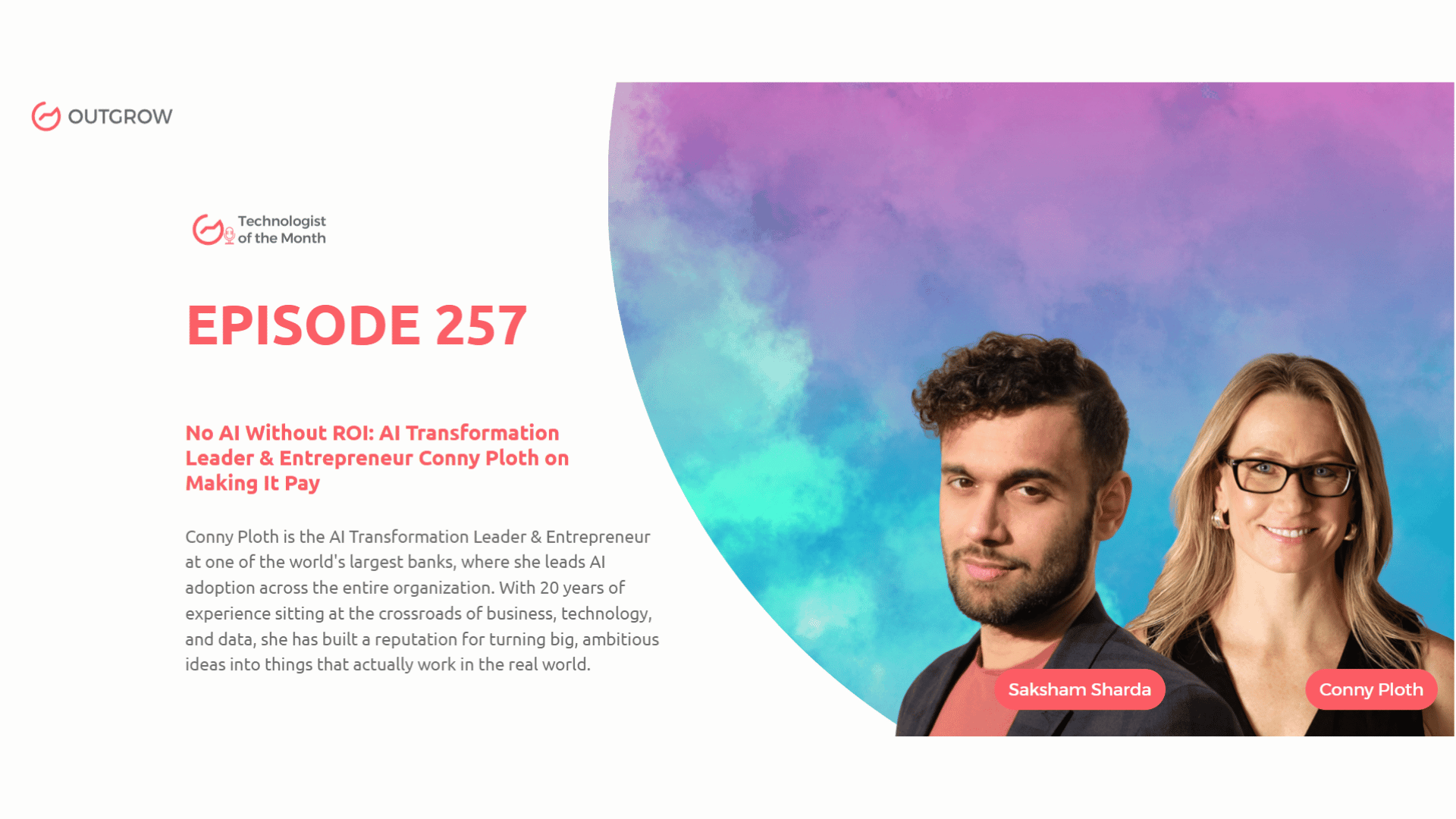
EPISODE 257: Marketer of the Month Podcast with Conny Ploth
Table of Contents
Hey there! Welcome to the Marketer Of The Month blog!
We recently interviewed Conny Ploth for our monthly podcast – ‘Marketer of the Month’! We had some amazing, insightful conversations with Conny, and here’s what we discussed about-
1. What happens when half the world sits out AI’s rise
2. The top 3 mistakes companies make rushing into AI
3. Why an ROI conversation matters before any AI investment
4. What small businesses get wrong chasing the AI hype
5. How mapping pain points comes before picking any AI tool
6. The moment a summit host called her bank “not AI-first”
7. How her mentee team built a dyslexia app in weeks
About our host:
Dr. Saksham Sharda is the Chief Information Officer at Outgrow.co He specializes in data collection, analysis, filtering, and transfer by means of widgets and applets. Interactive, cultural, and trending widgets designed by him have been featured on TrendHunter, Alibaba, ProductHunt, New York Marketing Association, FactoryBerlin, Digimarcon Silicon Valley, and at The European Affiliate Summit.
About our guest:
Conny Ploth is the AI Transformation Leader & Entrepreneur at one of the world’s largest banks, where she leads AI adoption across the entire organization. With 20 years of experience sitting at the crossroads of business, technology, and data, she has built a reputation for turning big ambitious ideas into things that actually work in the real world. She is recognized as an SW50 Spain Top 50 Female Leader and a member of the EWiT Diamond Club Europe, and she actively mentors young girls in STEM through programs like Technovation Girls.
No AI Without ROI: AI Transformation Leader & Entrepreneur Conny Ploth on Making It Pay
The Intro!
Saksham Sharda: Hi, everyone. Welcome to another episode of Outgrow’s Marketer of the Month. I’m your host, Dr. Saksham Sharda, and I’m the creative director at Outgrow. co. And for this month, we are going to interview Conny Ploth, who is the AI Transformation Leader & Entrepreneur.
Conny Ploth: Great to be here. Thank you.
Don’t have time to read? No problem, just watch the Podcast!
Challenge yourself with this trivia about the exciting topics Conny Ploth covered in the podcast.
Or you can just listen to it on Spotify!
The Rapid Fire Round!

Saksham Sharda: All right. So let’s start with the rapid-fire round. The first question is, how long does it take you to get ready in the mornings?
Conny Ploth: 45 minutes, out of which 30 minutes is a coffee break.
Saksham Sharda: Favorite color?
Conny Ploth: Blue.
Saksham Sharda: What time of day are you most inspired?
Conny Ploth: Midday.
Saksham Sharda: How many hours of sleep can you survive on?
Conny Ploth: 6.
Saksham Sharda: The city in which the best kiss of your life happened?
Conny Ploth: Madrid.
Saksham Sharda: Pick one, Mark Zuckerberg or Elon Musk?
Conny Ploth: Neither.
Saksham Sharda: How do you relax?
Conny Ploth: CrossFit.
Saksham Sharda: How many cups of coffee do you drink per day?
Conny Ploth: 3.
Saksham Sharda: A habit of yours that you hate?
Conny Ploth: Overthinking.
Saksham Sharda: The most valuable skill you’ve learned in life?
Conny Ploth: Communication.
Saksham Sharda: Your favorite Netflix show?
Conny Ploth: Emily in Paris.
Saksham Sharda: Are you an early riser or a night owl?
Conny Ploth: Night owl, for sure.
Saksham Sharda: One-word description of your leadership style?
Conny Ploth: Fun and open.
Saksham Sharda: Coffee or tea to kickstart your day?
Conny Ploth: Coffee.
Saksham Sharda: Top priority in your daily schedule?
Conny Ploth: Exercise.
Saksham Sharda: Ideal vacation spot for relaxation?
Conny Ploth: Australia.
Saksham Sharda: Key factor for maintaining a work-life balance?
Conny Ploth: CrossFit.
Saksham Sharda: A recent business innovation that caught your attention?
Conny Ploth: Oh my God, AI, agents all over your place.
The Big Questions!

Saksham Sharda: All right, so that was the end of the rapid fire. Now we can go on to the longer questions, which you can answer with as much time and ease as you like.
Conny Ploth: All right.
Saksham Sharda: The first one is, only about 20% of people working in AI today are women, and Reese Witherspoon recently urged women to start using AI so they’re not left behind. Why does the gap in usage and confidence matter just as much as representation?
Conny Ploth: It’s so important because it really reflects society, right? And I think if women don’t use it actively, proactively, and if women are not represented basically within the engineering world, I think those models, they are really biased. And you can already see it right now, because if you ask simply questions like around typical jobs that are more related probably to the female population, it would always give you those responses. So I think it is super important that women really they jump over this barrier, they use it, and let it just be really for daily use in their daily work or daily personal lives. But they really must use it. There is no barrier really to just really download the app and start using it for your day-to-day family logistics, right, or whatever you want to get out of it. But to be honest, it’s so important that these opinions and as well those questions and their concerns, they are really reflected, they are embedded in those models, because otherwise, you will always get bias, and bias is already there.
Saksham Sharda: So if half the population is sitting out of the biggest technological shift in human history, what does that actually do to the future we are all building together?
Conny Ploth: I think it doesn’t really leave out the half the population, but I don’t think it just reflects fairly on properly on the concerns and as well on the activities that as well that are driving the world. So I think it is super important to have a very balanced approach to this, and both for companies that are selling products and services as well to this population, but also just for your own personal use.
Saksham Sharda: And many organizations are investing heavily in AI, yet struggle to see a real impact. What is the most common mistake companies make when trying to embed AI into their processes?
Conny Ploth: There are plenty, actually, and not just one. I think probably the big 3, the 1st 3 or so, they would be for me just really jumping right into it. And it’s okay to experiment, right? But I think if you just put an AI layer on top of what is really a messy process, you really need to fix the process 1st. And I’ve seen it very often, that we really just do the things that we used to do legacy-wise, and we don’t really question if it’s the right thing to do, and we just really want to put an AI layer on top. So everything it does, it just speeds up the inefficiencies, but it doesn’t really resolve them and their root cause. So I think that is definitely a problem, and I’ve seen it. Just give you an example. If you produce a 120 pages slide pack and you essentially just need to extract one or 2 relevant data points from it, and you put AI on top to read this document to extract those data points, why in the 1st place have you actually produced this pack, right? And I think that’s a valid question that we need to ask ourselves. The 2nd point for me would be to get your data in order, because AI is only as good as the data underneath. And if you are not having very well-structured data and data sources identified, I think you’re not getting the right results out of it. And number 3, I would say, is jumping right into it without actually thinking about the return on your investment, because it’s not free. So there’s definitely an investment that needs to be made. There are data consumptions, right, that would need to be factored in. And if you are not having a good business case for it, then you will be probably be surprised by what you expect versus what you get out of it.
Saksham Sharda: You’ve recently launched your own firm helping small businesses implement practical AI solutions. What really makes or breaks AI adoption in smaller organizations, do you think?
Conny Ploth: So smaller organizations, they don’t have the capabilities that larger institutions have. They don’t have an AI team, right? They don’t have AI engineers. They don’t have sometimes an IT department. And what they just see outside is this entire hype that is getting towards them, and they really think they can just run their own company as well built on AI. It’s very much as well very similar to big organizations. They just need to get the foundations right. So very often I see, “We want to use AI. I want to get AI.” And it’s like, “That’s fine, but let’s go back to the basics.” It’s like, “Where is your data? Do you have good data foundations?” And if not, 3 steps back, get your data in order, sort out the process, then let’s put AI again and on top of it. And also always make sure what’s the problem I actually want to resolve. And so, they see all this hype probably as well on their social media feed. They think it’s the art of the possible, and there are great things you can do with AI. But again, very often I see not very well-managed data and processes, and this is what you need to fix 1st, and then you can come in with the AI. And it takes a little bit of talking through it, but in the end, it makes absolute sense to have this approach.
Saksham Sharda: At the same time, you’re running AI transformation at one of the biggest banks on the planet. But honestly, what does that even mean in real life? Like, when you walk into work on a Monday morning, what are you actually doing?
Conny Ploth: Whenever it is. I don’t think there’s ever like a Monday morning like the other. I think everything is very much project-driven, right? But typically, what we are doing when we look at transformation, we really look end-to-end at the entire process that we are trying to transform, but also what’s essentially the pain points that we are trying to resolve. Is this an operational process that’s running in the backend? Is this a customer-facing process? And based on this, what you do is you really map out, you reimagine what this process should look like with AI. You map the potential solutions to it. Not everything needs to have a very sophisticated AI solution. Sometimes it’s really just fixing the process in its own that’s sufficient. However, so you really look at the end-to-end process, look at the pain points you’re trying to resolve, match the solutions to it that you have available at this point of time. If it’s becoming too complex, maybe you just want to park it and put it on hold until a solution comes out that you would want to use. And always, always look at the data underneath. So I think this is one of our biggest, let’s say, attention points is, do we have good data to run this process with AI? Where is those data sitting? How do we plug them in? Are they sitting in emails? Are they sitting on someone’s spreadsheet, right? Are they available in a system or in a data lake? You really want to have this mapped out because without this, the process won’t be running. So basically, on a typical Monday morning, I would basically look, so my internal clients, what are problems that they’re trying to solve? How can I support them with the process engineering part and as well with matching the right technology and helping them basically with the end-to-end project management?
Saksham Sharda: And what does it look like when AI transformation is not working for some solution?
Conny Ploth: Then it becomes really costly because you’re trying to build something that doesn’t really resolve the problem, or you would say you could have solved it with a different approach or with a different technology. Or sometimes, and I’ve heard it as well today on a panel here in the conference, sometimes even AI solutions are more expensive than just having the humans still running it. So I think there’s always this opportunity cost for having AI, and if there’s a good business case behind it and if you have analyzed the pain point really well, it would work. But however, if you’re just trying to put AI on top of something that is not actually presenting a good business case for you, then it’s not working.
Saksham Sharda: Speaking of panels, at a big summit in London, the host looked at you on stage and said, “You are not an AI-1st company,” and you just agreed. Most executives would have dodged that. Why did you own it?
Conny Ploth: Because he’s right. I mean, basically, I was on this panel together with I think 4 other corporate companies. I was the only financial institution there, and none of us were AI-1st. And he said it, and I was like, he was absolutely right, right? We’re speaking about being AI native, and what does this mean? And yes, it’s hard to transform a legacy institution into an AI-1st bank. And if you compare it to those AI-native unicorns, like if you created a company today, you would do it in a very different way than you did 150 years ago, right? You have all those solutions and tools available, and you probably, instead of hiring straightaway a team, and this is what a lot of founders do, they set up agents, right, managing the processes for them, and even client outreach and marketing and sales. And look, this is what we have teams for, and those teams right now, they will get empowered and amplified with AI. But that’s an entire transformation process and a cultural shift that needs to happen. And we have to own it because this is where we are. This is our departure point. We know where the ambition is going, where we want to be in 3 years time, and this is exactly what we need to drive right now. But it’s a cultural change that needs to happen because between legacy institutions and an AI-native company that has basically been created with those tools, there is a gap, and we need to close this gap.
Saksham Sharda: You pair senior executives with what you call AI buddies.
Conny Ploth: Yeah.
Saksham Sharda: Basically someone who sits with a top leader and helps them actually use AI themselves. That sounds simple, but it is kind of radical. Why does that matter so much?
Conny Ploth: I think it’s super important that our leaders, they really are AI-savvy themselves. They understand and they use those tools on a day-to-day basis, because they need to lead this cultural shift that I just mentioned and the transformation that’s sitting behind it. And if you’re not a user and you don’t really grasp what’s the art of the possible and where it is limitations, super important as well, where are the limitations, then I think it is difficult to lead this change. So, what we suggested, and I think it’s really working very well, we have AI buddies, really AI-savvy people from our teams, from our data and AI teams worldwide, helping and supporting and teaching our global executives how to use ChatGPT and Copilot. And to be honest, it’s opening up an entire world, right? So it’s really about their day-to-day productivity. Let’s be honest, this is what we are starting with, using it really to read and scan your emails, to summarize reports, to prepare for board meetings. And this is really important because then once… It’s like a stepping stone, and once you’re there, then I think they develop really the understanding, to grasp the entire understanding of what’s the art of the possible, what can be done, and they’re driving then this transformation in a more, let’s say, proactive way. And it’s working super well. And I think also for the buddies, it’s a great experience.
Saksham Sharda: You qualified for the OCR World Championships in Australia while you were in the middle of physio for an injury. You had basically forgotten you even competed. What does sports teach you about pressure and setbacks that no boardroom ever could?
Conny Ploth: So I think sports for me is really an essential part of my life and part of my identity, I would say. So I’m really blocking out time in my calendar, and I’m organizing my entire life around this time block, which is happening around lunchtime, and I’m off to the gym and I’m training and I’m kind of resetting basically my entire body and my brain again. So, what happens if you’re injured? I won’t lie to you, it sucks because you cannot perform anymore as you used to do. But you know what? What it also helps you is, going on a recovery journey and say, “Okay, you cannot train like this anymore,” and see it as an opportunity basically to do other things and embrace it. Your body needs to recover, right? It needs time to recover and to heal. And the same thing is, while it’s doing this, you can embrace other ways of training, and you become stronger. So I think it’s all about resilience. I don’t know any athlete that hasn’t gone through injury and recovery, but it’s all about visualizing and having this mindset of resilience and grit and knowing you will get out of it eventually. And during this time, just be patient with yourself, but also, there are so many alternatives that you can embrace. So it’s all about mindset, strength, and mental strength as well, and especially your resilience, because it’s not a setback. It’s actually just a time that your body needs to recover. And I think this helps me a lot as well in other parts of my life, and it can be work or it could be other parts of my personal life. But just basically reframing a setback as an opportunity to learn other things and to focus on other stuff. And it’s all about how you reframe this story to yourself. And same what happens at work. You might have a bad day, someone else is having a bad day, right? And you’re kind of crossing their ways. Just reframe it, see it as opportunity, and move on. So it’s about resilience, really, and about mental strength.
Saksham Sharda: Speaking of devoting your time to other stuff, your team built an app for kids with dyslexia through a program called Technovation Girls and placed 3rd out of 220 teams. Now, you’re running a massive bank transformation, so why are you spending your energy here too?
Conny Ploth: So I think this program, Technovation Girls, is really a good one too. It’s dedicated to girls, young girls, I think, between the age of 8 up to 18, to build tools that are resolving real-world problems. And it’s all about encouraging to embrace STEM, so like science and technology and mathematics, because… And it has very much to do as well with your 1st question about why it’s important that women are using AI tools and they’re working in this space, because they’re representing half of the population. And very often already in school, it starts, “Math is not really for girls. Tech is not for girls.” I’ve got an 8-year-old daughter, and I’m telling her, “You can do everything that you want in your life,” right? And it doesn’t matter if it’s math or tech or science or languages or sports. Just embrace it and go for it. And I think just the evolution of having… I was mentoring a group of 5 girls between the age of 8 and 13, and they built an app for children with dyslexia because they have got family members that are having dyslexia, and they really wanted to help them overcome some of those hurdles that they are facing in their day-to-day. And so they built, with the tools that they had available, an app in a very short period of time. They pitched it to a jury, and they came out 3rd. And I think this is such an empowering message for them, that they can really build this in a very short period of time, an app with a technology that they had never actually used before. And then, I mean, just the results speak for itself. They came out 3rd in this regional finals, which was absolutely amazing. And I think it’s really empowering and something… It’s a clear message as well to the rest of the world, just go for it and don’t be afraid. Embrace it as an opportunity for growth.
Saksham Sharda: All right, so the last question for you is of a personal kind. What would you be doing in your life if not all this?
Conny Ploth: I don’t think I would change anything of what I’ve done or what I’m doing. But if I wasn’t doing this, I would probably be a professional athlete or work in sports or something. But no regrets. I’m happy absolutely with the journey I was going through. And so sports is still a very important part of my life, and I’m just embracing it.
Let’s Conclude!
Saksham Sharda: Thanks, everyone for joining us for this month’s episode of Outgrow’s Marketer of the Month. That was Conny Ploth, who is the AI Transformation Leader & Entrepreneur.
Conny Ploth: Great to be here. Thank you.
Saksham Sharda: Check out the website for more details and we’ll see you once again next month with another marketer of the month.

I am a Digital Marketing Enthusiast with a passion for optimizing content and paid marketing strategies. Continuously seeking innovative approaches to boost ROI and engagement at Outgrow.