Summarize with :
EPISODE 255: Marketer of the Month Podcast with Louise Beaumont
Table of Contents
Hey there! Welcome to the Marketer Of The Month blog!
We recently interviewed Louise Beaumont for our monthly podcast – ‘Marketer of the Month’! We had some amazing, insightful conversations with Louise, and here’s what we discussed about-
1. Why banks lose visibility once data leaves their perimeter
2. What happens to open finance if Invela didn’t exist
3. The “brain worm” moment that gets budgets approved
4. Why bilateral agreements can never scale in open finance
5. What category creation really means with zero benchmarks
6. Why regulators are cautious by design, not by choice
7. The real reason fintechs are investing cautiously in open finance
About our host:
Dr. Saksham Sharda is the Chief Information Officer at Outgrow.co He specializes in data collection, analysis, filtering, and transfer by means of widgets and applets. Interactive, cultural, and trending widgets designed by him have been featured on TrendHunter, Alibaba, ProductHunt, New York Marketing Association, FactoryBerlin, Digimarcon Silicon Valley, and at The European Affiliate Summit.
About our guest:
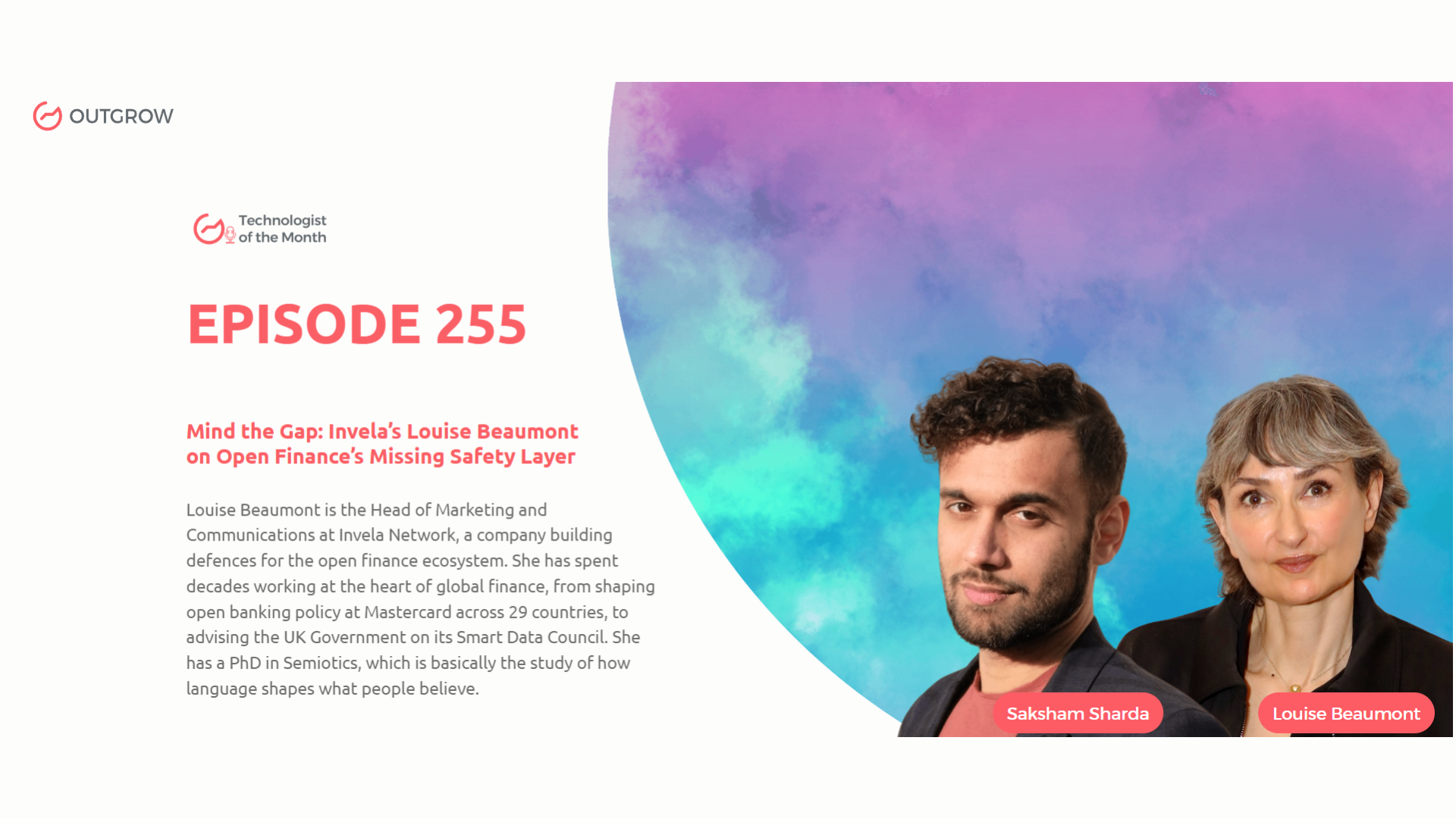
Louise Beaumont is the Head of Marketing and Communications at Invela Network, a company building defences for the open finance ecosystem. She has spent decades working at the heart of global finance, from shaping open banking policy at Mastercard across 29 countries, to advising the UK Government on its Smart Data Council.
Mind the Gap: Invela’s Louise Beaumont on Open Finance’s Missing Safety Layer
The Intro!
Saksham Sharda: Hi, everyone. Welcome to another episode of Outgrow’s Marketer of the Month. I’m your host, Dr. Saksham Sharda, and I’m the creative director at Outgrow. co. And for this month we are going to interview Louise Beaumont, who is the Head of Marketing and Communications at Invela Network.
Louise Beaumont: Great to be here. Thank you.
Don’t have time to read? No problem, just watch the Podcast!
Challenge yourself with this trivia about the exciting topics Louise Beaumont covered in the podcast.
Or you can just listen to it on Spotify!
The Rapid Fire Round!

Saksham Sharda: Let’s start with the rapid-fire round. The first question is, at what age do you want to retire?
Louise Beaumont: Never.
Saksham Sharda: How long does it take you to get ready in the mornings?
Louise Beaumont: about 20 minutes.
Saksham Sharda: Most embarrassing moment of your life?
Louise Beaumont: Yet to come.
Saksham Sharda: Favorite color?
Louise Beaumont: Oh all the colors, all the colors. I’m a gardener, all the colors.
Saksham Sharda: What time of day are you most inspired?
Louise Beaumont: Inspiration can strike at any time. I’m ready for it first thing in the morning.
Saksham Sharda: How many hours of sleep can you survive on?
Louise Beaumont: I’m a middle-aged woman. Sleep is a precious commodity. I’m pleasant on seven hours. I can survive on six.
Saksham Sharda: The city in which the best kiss of your life happened?
Louise Beaumont: Well, I can’t say yet to come because I’m married. so, and my husband’s a great romantic. I’d say New York City.
Saksham Sharda: Pick one, Mark Zuckerberg or Elon Musk.
Louise Beaumont: Neither.
Saksham Sharda: How do you relax?
Louise Beaumont: Oh, I have a dog called Daphne Buttercup, and she is the best dog in the world. Every dog owner will tell you their dog is the best dog in the world. My dog is the best dog in the world. Daphne Buttercup, cuddling Daphne Buttercup. Best relaxation ever.
Saksham Sharda: How many cups of coffee do you drink per day?
Louise Beaumont: One.
Saksham Sharda: The most valuable skill you’ve learned in life?
Louise Beaumont: People are wonderful. Together we’re better. Be kind and be wonderful.
Saksham Sharda: Your favorite Netflix show?
Louise Beaumont: Oh, whatever the next one is.
Saksham Sharda: Are you an early riser or a night owl?
Louise Beaumont: Oh, both to my detriment.
Saksham Sharda: One-word description of your leadership style?
Louise Beaumont: No, I can’t do that. But what I will tell you something is something about leadership, which is really important. Everybody thinks leadership is amazing. There’s tracts are written about it. Theses are written about it. Books are written about it. Only one thing matters. And we’ll tell you whether somebody is a leader or not. And I can define that in one word. Followers. No followers, whatever you’re doing, it’s not leading.
Saksham Sharda: Coffee or tea to kickstart your day?
Louise Beaumont: Um, decaffeinated coffee.
Saksham Sharda: Top priority in your daily schedule?
Louise Beaumont: Get shit done.
Saksham Sharda: Ideal vacation spot for relaxation?
Louise Beaumont: Um, I’m going to go with Miami.
Saksham Sharda: Key factor for maintaining a work-life balance?
Louise Beaumont: Love work. Love life. Balance comes.
Saksham Sharda: Memorable career milestone?
Louise Beaumont: Yet to come.
Saksham Sharda: A recent business innovation that caught your attention?
Louise Beaumont: Oh, it’s why I work at Invela. That’s open finance risk management. That’s why I work at Invela.
The Big Questions!

Saksham Sharda: All right, that was the end of the rapid-fire round. Now we’ll go on to the larger questions, which you can answer with as much time and ease as you like. The first one is you describe open finance as having a confidence gap, but whose confidence is missing? The banks, the consumers, the fintechs, the regulators, or someone else?
Louise Beaumont: Oh, all of them, but for different reasons. Banks can see data and payments leaving their perimeter, but they can’t see the journey that it goes on. So they know the liability lands on them if something goes wrong downstream at the intermediary, the aggregator, for example, or the fourth or the fifth party, regulated or not, but they have no real-time visibility into any of that. So it’s not an irrational fear. It’s bang on as a concern. They lack confidence for that reason. Fintechs, they also lack confidence because the regulatory foundation isn’t fully set. In Europe, we’re still talking about PST3. We’re still talking about FIDA. In the UK, we’ve got the long-term regulatory framework. It’s on its way, but it’s not here yet. And so they’re investing cautiously, and that drags out the timeline to impact because they’re questioning the liability as well. Intermediaries, well, that’s aggregators and people like that, they lack confidence for a different reason. They sit in the middle of all of these different open finance chains. They’re connecting banks to third parties, and they’re caught between two sets of really conflicting pressures. Banks are tightening their restrictions, their requirements. They need more evidence that risk is being managed. Third-party providers want simpler, faster access. Intermediaries get squeezed from both sides. They’ve got mounting compliance costs, and they’ve got no way of managing the risk they’re being asked to manage by the banks. So that’s a problem for them. And they certainly can’t manage that continuously, and they’ve got no way of compelling remediation if something goes wrong. It’s not so much that consumers are lacking confidence, it’s more that they’re ambivalent. They’ll share data when the value exchange is really confident, it’s really obvious, but they’ve no way of knowing who’s really got access to their data because of the journey that the data goes on. And they don’t know what to do if something goes wrong other than go to their bank. So the confidence that they’re missing is the kind of confidence that we all have in electricity, right? We know the standards exist, we know that companies must comply, we know that it’s being regulated and monitored, and so we don’t panic when we plug in the kettle, and that’s really what we need with open finance. And it’s not that regulators lack confidence, they’re just cautious, right? It’s in the DNA, they’re cautious creatures. They can see the problem, but they have to regulate vertically, and data moves horizontally in open finance. So they can only supervise what sits within their defined remit of regulated organisations within their defined area. They can’t regulate beyond their remit, and so that makes them cautious as well. So what we really need is a way that manages that data as it moves through the different slats in the white picket fence of regulation. If every regulator is a white, is a slat in that white picket fence, we need to actually manage the data as it crosses those regulatory boundaries or moves above them in the unregulated space. That’s a role for the market.
Saksham Sharda: So is open finance really that risky? And why build a network, the hardest possible thing to build?
Louise Beaumont: Yes, it is risky, and I say that as someone who worked for 15 years in this space, right? And I’ve worked really hard over a really long period of time to make this expansion into open finance happen. I believe it’s the right thing to do, but that doesn’t mean that we don’t get to manage the risk. Of course, we have to manage the risk. And the problem is most institutions think about risk as something they need to manage within their boundaries, within the boundary of their own organization. But risk is as mobile as the data, and data’s on the move. So liability is literally on the move as that data hops from bank to third-party provider to aggregator and around. So, and it’s because this data doesn’t stay within the bank that it has to be managed differently. So a breach or an incident that happens at a fifth-party or a seventh-party or an nth-party is still one that needs to be tracked and managed. And it’s just that the risk isn’t where most people are looking for it, within the boundary of their organization. So why a network? We think that’s the only way to manage the problem because the data’s on the move. So you have to manage it where that data is moving. Nothing else solves it. Point solutions don’t solve it. Bilateral agreements just don’t scale. Regulation can set some rules, but it can’t measure or monitor beyond the remit of the regulator. And arguably, they can’t monitor real-time, live, dynamically anyway. They certainly can’t do it beyond that remit of the regulated participant, not when it goes out there into the unregulated space. What you need is a network that sees the whole chain, the bank, the aggregators, the third-party providers, the wealth managers, the accountants, the merchants, sees the whole chain, whether those are regulated or unregulated entities, and can monitor it continuously. It’s about keeping bad actors out of the network, but it’s also making sure that all of those good actors within the network are having a good day. So make sure the good actors make it into the network and the bad actors are kept out. Make sure every good actor has a good day. And if they don’t, if something happens, if some liability splashes about the place, be able to identify who caused the problem and make sure the liability lands in the right place.
Saksham Sharda: So we’re talking here about category creation with no benchmark. What does success look like, and how do you measure it?
Louise Beaumont: Okay, so this is category creation. Open finance, risk management, it’s us, it’s Invela. Nobody else has created the category. We’re having to do that too. And of course, because it’s category creation, there aren’t any benchmarks. It’s a new thing. There’s no established benchmarks. So success looks like the market accepting that the problem exists. That’s the first hurdle. It’s higher than it sounds. So you’re not trying to win some kind of competitive evaluation. You’re trying to get a chief risk officer, for example, to walk into a board meeting and say, do you know what? We’ve got an open finance risk management problem and we need to solve it, because before that moment, the reality doesn’t exist in their head. The brain worm hasn’t set up home in their mind and no budget exists. So no deal is possible. Category creation is about manufacturing that moment of mass realisation at scale. So you don’t lead with, I’m creating a new category. You lead with the problem that you’re trying to solve. We open up with, do you know how many third parties or intermediaries or other people are touching your customers’ data? Not today, the day that the customer requested it, or today, the day that you onboarded that third party. Do you actually know how many are in your finance chain? And do you know how they’re behaving? Could you answer that question tomorrow in a board meeting? That’s the conversation. That’s the establishment of the brain worm. And so the category is the solution to the problem that you’ve surfaced in their minds. So how do you measure this? Well, you have to build your own measurements. That’s the obvious and first thing to say. And the number of MQLs that you deliver, clearly that matters. But that’s a lagging indicator. That’s what happens when it’s real, when the category is accepted. So I look for, when do the people that we’re talking to start using our language? When that CRO asks the question in the board meeting that he wouldn’t have asked or she wouldn’t have asked six months ago or 12 months ago, when a regulator publishes a consultation that uses our framing, our logic, when the market starts thinking in your terms, that’s when you’re building a category. That’s when you’re creating awareness of a problem that exists. And with it, the solution that brings resolution.
Saksham Sharda: So you’re talking here about conferences, government councils, startup marketing. Is all of this really necessary?
Louise Beaumont: Well, I guess you’re asking me if this is all just a horrible distraction, right? You’re doing this thing, you’re doing that thing, you’re doing the other thing. How does it all make sense? And it only makes sense if those things are connected. So I sit on the Smart Data Council in the UK. That’s run by the Department of Business and Trade, which owns smart data. It owns the Data Use and Access Act. So that helps inform the debate. So it’s a really important place where we can all, as council members, come together and inform the debate. The conference chairing, well, that stress tests the argument because the panellists push back, the audience pushes back. If people don’t get it, they tell you. So that’s a great stress test. And the marketing lands the argument. So I’ve got one job, it’s just several incarnations. And why does it work? It works because I’ve been in the market for 15 years. So I’m not learning the subject while trying to run the marketing. I am the subject matter expert running the marketing. And that changes the calculation entirely. So you’re looking for a compounding effect, not a disparate set of activities. And so far, so good. The compounding effect is in full effect.
Saksham Sharda: So if after all this, let’s say if Invala didn’t exist, what would Open Finance look like in five years?
Louise Beaumont: So without that risk management infrastructure, you get all of those liabilities coming home to roost, right? You get the data breaches, you get the data misuse, you get the unauthorised access. And it all involves your data, my data, consumers’ data, businesses’ data. And it could be caused by a party four, five or six down the Open Finance chain that the bank has no visibility into, or the aggregator, the intermediary has no visibility into. So the bank takes the reputational hit, it always does, because the liability lands on them regardless of who caused it. And everybody then starts pointing fingers. Why didn’t we know? Who is this fourth or fifth or seventh party? Why have they got the consumers’ data? Why does nobody accredit them? Why is there no financial backstop? Who’s managing the risk? And some version of this is already happening, right? Let’s be absolutely clear. It’s happening quietly. It’s happening in disputes which are settled before they become public, in breach notifications that never quite make the front page. But the difference between now and in five years’ time, or three years’ time, or two years’ time, is scale. It’s the scale at which all of this happens. So Open Finance is expanding, right? It’s gone from Open Banking to Open Finance. It’ll expand further into energy, into telecoms, into property and beyond. That means the chains are going to get longer. They’re going to get more complex. The participants multiply. At the moment, we’ve got a couple of hundred regulated participants and maybe a thousand, ten thousand unregulated participants. It’s going to be many multiple of that in five years’ time. So the wake-up call is inevitable. It’s just a matter of time. And it will be those incidents that just can’t be contained. And that’s that consumer harm which is really clearly traceable. Everybody will want to know, why did nobody solve this problem? So it doesn’t have to come to this. It’s why Envelo is doing what we’re doing now. It’s why we’re building the Open Finance Risk Management Network. Because we need the infrastructure layer that makes everything that we’re building as an industry in Open Finance and beyond safe. Safe for the consumer, whether that’s a business, whether that’s your mum or mine, and safe for every participant in that Open Finance chain, no matter how complex.
Saksham Sharda: So the last question for you is of a personal kind. What would you be doing in your life if not all this?
Louise Beaumont: I’ve tried doing different things. I’ve tried spending more time in the garden. I’ve tried spending more time with my husband. And my husband came to the conclusion that perhaps he didn’t need to spend that much time with me and that I was better off fully employed. Listen, he tried to retire three times and failed three times, right? We come from, you know, we’re people who like to work because it’s not just about earning the money, right? It’s not just about earning a living. It’s about making a profound difference. And I believe if we can give people access to their data, to use it to power services that make their lives better, that make their businesses better, then that’s a good thing. It’s good for them individually. It’s good for society. It’s good for the economy. I just want all of that done safely, securely, and well.
Let’s Conclude!
Saksham Sharda: Thanks, everyone for joining us for this month’s episode of Outgrow’s Marketer of the Month. That was Louise Beaumont, who is the Head of Marketing and Communications at Invela Network.
Louise Beaumont: Great to be here. Thank you.
Saksham Sharda: Check out the website for more details and we’ll see you once again next month with another marketer of the month.

I am a Digital Marketing Enthusiast with a passion for optimizing content and paid marketing strategies. Continuously seeking innovative approaches to boost ROI and engagement at Outgrow.