Summarize with :
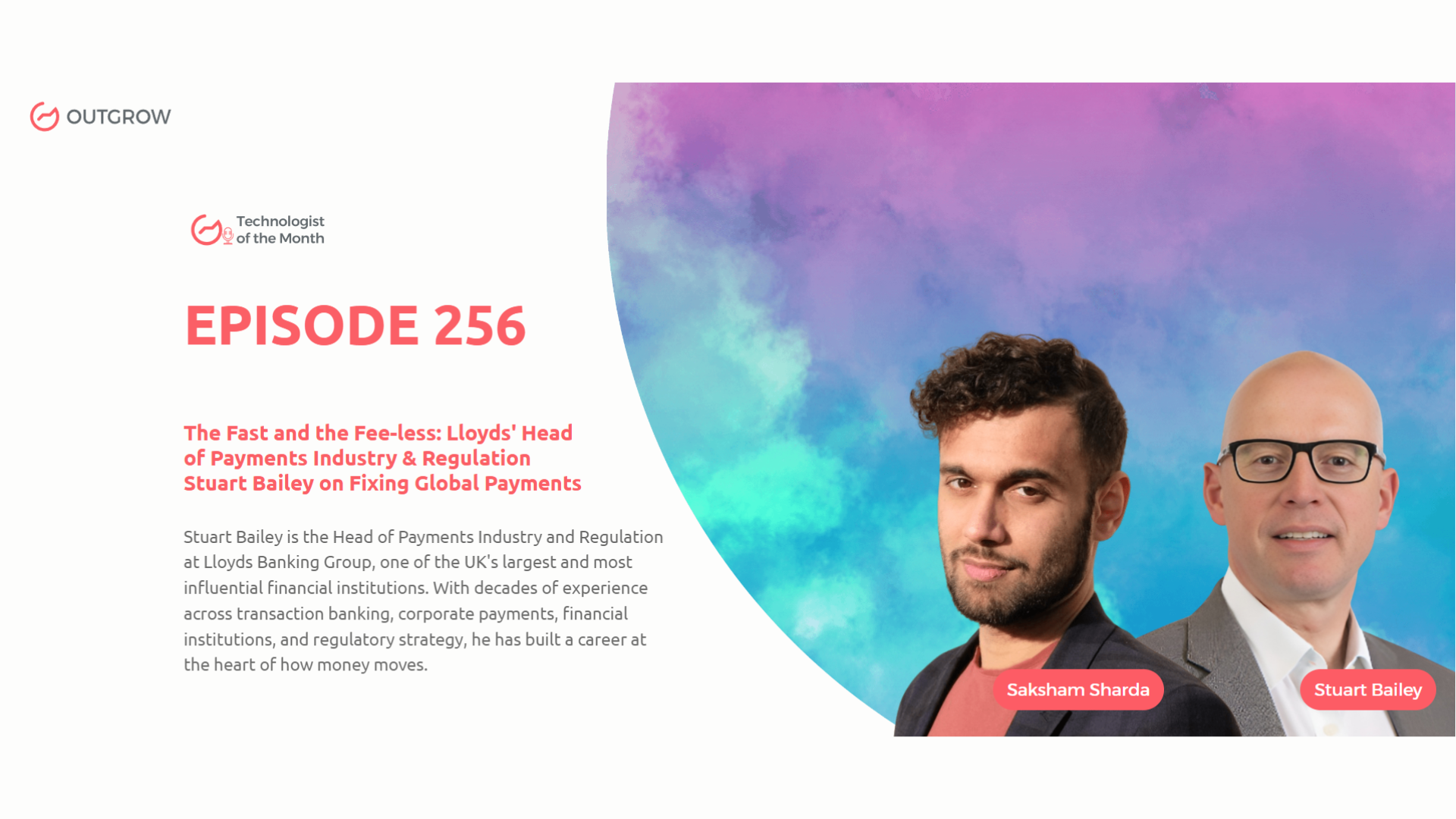
EPISODE 256: Marketer of the Month Podcast with Stuart Bailey
Table of Contents
Hey there! Welcome to the Marketer Of The Month blog!
We recently interviewed Stuart Bailey for our monthly podcast – ‘Marketer of the Month’! We had some amazing, insightful conversations with Stuart, and here’s what we discussed about-
1. Why cross-border payments still lose money in transit today
2. Who’s liable when an AI makes a bad payment
3. How verification of payee quietly stopped fraud at scale
4. What entrepreneurship at Newcastle University taught him
5. How banks build trust customers don’t even notice
6. The four-part Swift scheme fixing international payments
7. Can a giant institution like Lloyds still move fast
About our host:
Dr. Saksham Sharda is the Chief Information Officer at Outgrow.co He specializes in data collection, analysis, filtering, and transfer by means of widgets and applets. Interactive, cultural, and trending widgets designed by him have been featured on TrendHunter, Alibaba, ProductHunt, New York Marketing Association, FactoryBerlin, Digimarcon Silicon Valley, and at The European Affiliate Summit.
About our guest:
Stuart Bailey is the Head of Payments Industry and Regulation at Lloyds Banking Group, one of the UK’s largest and most influential financial institutions. With decades of experience across transaction banking, corporate payments, financial institutions, and regulatory strategy, he has built a career at the heart of how money moves. Stuart plays a leading role in shaping the UK’s payments landscape, engaging with regulators, industry bodies, and global networks to drive better outcomes for customers and businesses alike.
The Fast and the Fee-less: Lloyds’ Head of Payments Industry & Regulation Stuart Bailey on Fixing Global Payments
The Intro!
Saksham Sharda: Hi, everyone. Welcome to another episode of Outgrow’s Marketer of the Month. I’m your host, Dr. Saksham Sharda, and I’m the creative director at Outgrow. co. And for this month, we are going to interview Stuart Bailey, who is the Head of Payments Industry and Regulation at Lloyds Banking Group.
Stuart Bailey: Great to be here. Thank you.
Don’t have time to read? No problem, just watch the Podcast!
Challenge yourself with this trivia about the exciting topics Stuart Bailey covered in the podcast.
Or you can just listen to it on Spotify!
The Rapid Fire Round!

Saksham Sharda: All right, let’s start with the rapid-fire round just to break the ice. The first question is, at what age do you want to retire?
Stuart Bailey: I don’t want to retire.
Saksham Sharda: How long does it take you to get ready in the mornings?
Stuart Bailey: Far too long.
Saksham Sharda: Favorite color?
Stuart Bailey: Blue.
Saksham Sharda: What time of day are you most inspired?
Stuart Bailey: About 7:34 in the shower.
Saksham Sharda: How many hours of sleep can you survive on?
Stuart Bailey: No less than 8.
Saksham Sharda: The city in which the best kiss of your life happened?
Stuart Bailey: Madrid.
Saksham Sharda: Pick one, Mark Zuckerberg or Elon Musk?
Stuart Bailey: Nelson Mandela.
Saksham Sharda: How do you relax?
Stuart Bailey: Look at good art.
Saksham Sharda: How many cups of coffee do you drink per day?
Stuart Bailey: Not enough.
Saksham Sharda: A habit of yours that you hate?
Stuart Bailey: I’m quite comfortable.
Saksham Sharda: The most valuable skill you’ve learned in life?
Stuart Bailey: Listening.
Saksham Sharda: Your favorite Netflix show?
Stuart Bailey: I’m never watching it long enough to have a favorite show.
Saksham Sharda: Are you an early riser or a night owl?
Stuart Bailey: Night owl.
Saksham Sharda: One-word description of your leadership style.
Stuart Bailey: Ask the team.
Saksham Sharda: Coffee or tea to kickstart your day?
Stuart Bailey: Coffee.
Saksham Sharda: Top priority in your daily schedule?
Stuart Bailey: Coffee.
Saksham Sharda: Ideal vacation spot for relaxation?
Stuart Bailey: Paris.
Saksham Sharda: Key factor for maintaining work-life balance?
Stuart Bailey: Sleep.
Saksham Sharda: Memorable career milestone?
Stuart Bailey: Oh, gosh. So many. So many.
Saksham Sharda: A recent business innovation that caught your attention?
Stuart Bailey: There are also too many to think of at the moment.
The Big Questions!

Saksham Sharda: All right, that was the end of the rapid-fire round. Let’s go on to the bigger questions, which you can answer with as much time and ease as you like. The first one is, every time you send money abroad, a chunk of it just disappears. Banks know it, customers hate it. Why has it taken this long to fix something so basic?
Stuart Bailey: It has taken a long time, and I think that’s because the system that was put in place in the 1970s as payments moved from telegraphic transfers into the SWIFT system, which was new and innovative at the time, the world was a bigger place, data was more expensive, communications were poorer. And so, when that system was put in place, knowing who was going to deliver in the final mile and how that was going to be done was probably a harder thing. So, it was permissible at that time for a deduction to be made so that the agent bank would make the payment. And it’s amazing to think that those processes and systems have just become embedded and became the way that things were done. But in a smaller world where communications are tighter and closer and more informed, it’s absolutely right that that system has to change. And the customer expectation is now that the payment is done in principle across border without unnecessary charges. So, I and my team was very, very passionate about changing that, and that’s a big project of ours this year to move that forward.
Saksham Sharda: And governments keep announcing big plans to modernize how we pay for things. Why do most of these plans die quietly and nobody notices?
Stuart Bailey: Well, I think they don’t die. I think nobody notices the success, because these systems change and progress happens, and they become embedded in the way we operate with payments. It’s not for customers to worry about the rails or the process. It should be the outcome that we focus on. So when we’re making payments now, we don’t think of the verification of payee process. That’s a fantastic success of regulators and industry coming together to prevent fraud. It just becomes another natural step when you make a payment that the beneficiary check is done. So that would be a really good example of industry and regulators coming together and having an outcome that’s seamless to the customer, yet creates really good outcomes.
Saksham Sharda: And you also spend a lot of time in rooms where banks and regulators are supposed to agree on things. How often does that actually work, or is it mostly just theater?
Stuart Bailey: It’s a really good question. The payments industry is complex because of the network effect, the fact that we’re on 2-sided platforms, the fact that we need rules of the road and guidelines to operate by. So we have to put quite complex structures in place to create those network effects. That takes time. So it’s not theater. Often it’s very, very deep thinking to create the schemes and create those outcomes. It can be incremental, it can take time, but we do achieve success.
Saksham Sharda: Have you ever walked in expecting a fight and walked out with something fascinating?
Stuart Bailey: I think it’s really important to be open-minded in these discussions and in a network business, hear the diversity of views. I think a really great example is the work that the UK industry has done on the next wave of open banking, where we have partners with really different incentives. The merchants that want the lower price, the third-party payment providers that want to intermediate and find a role in the market, and the banks that want safe access to their customers’ accounts and be recognized for their investment in the rails. These are very, very different drivers and very, very different incentive models. But as an example, we’ve been able to come together as an industry and create a new model for open banking in the UK, which will take enhanced APIs and enhanced services forward. So it can happen really, really well.
Saksham Sharda: Well, speaking of the future then, AI is about to start spending our money for us, making payments on our behalf without us pressing a single button. Should we be excited or terrified?
Stuart Bailey: It’s a really exciting time, and this is a big learning for me, that a lot of energy and focus and resource is going to be put into agentic payments. Again, we have that complexity of the network effect, complexity of the rules of the road, and one of my learnings is that I have to learn more. I have to learn very quickly, and I have to think about how I’m going to contribute to making a really safe and effective ecosystem that customers can participate in and how we can help our customers participate in this new opportunity. So, it’s not about stopping or protecting or preventing the rise of agentic payments. It’s about understanding how we’re going to do it safely. But we’re just at the very, very beginning of this journey. Lots of experiments happening, lots of standards and protocols being proposed. We need to test those, we need to join those experiments, and we need to learn and contribute to setting up a really, really good trusting framework for agentic payments.
Saksham Sharda: And if an AI makes a payment on your behalf and something goes wrong, who’s actually responsible?
Stuart Bailey: I don’t know the answer to that yet. [laughing] I think this is one of the things that we’ve got to work out. One of the things we do when we design systems is we look at the unhappy path, and that’s one of the unhappy paths that we’re going to have to understand and test. But I can’t give you that answer now.
Saksham Sharda: All right. Millions of people still do not have proper access to a bank account in 2025 with all this technology. Why is that still a thing?
Stuart Bailey: I think we have seen tremendous progress in financial inclusion. I don’t think that that’s necessarily needing to be a full bank account in the future. Clearly, we have an interest in encouraging inclusion into our services. More broadly and globally, we’ve just seen a fantastic rise in the provision of wallets through telecom providers and so on, and hundreds of millions of people have been brought into financial inclusion through stored value wallets. This is really, really interesting for the future of payments because we have been thinking about the account-to-account journey, and now we must think about the account-to-wallet journey and bring all those wallets into the ecosystem. I think there’s lots of opportunity to be explored here.
Saksham Sharda: Let’s change track a bit. Tell us a bit about your daily work. You wake up in the morning, and how much of it is meetings? How much of it is email? What is it like?
Stuart Bailey: The days can be really varied, and that’s what I love about my job. I can be meeting vendors. I can be meeting clients. I have internal meetings to move projects forward. So the days have huge variety, which make them really, really interesting.
Saksham Sharda: Your mentor broke students trying to start businesses. You work at one of the biggest banks in the world. How do those 2 worlds even talk to each other?
Stuart Bailey: It surprised me how they do. It’s been a very humbling experience for me to help ambitious students who want to start their own business. I have learned from them. I have learned also that in our working environments, we take on so much capability that we don’t realize, not through formal, not only through formal courses and education and learning, but in the simple processes of an organization, how it approaches change, how it approaches risk, how it approaches governance, what are the stages of innovation. We absorb these through our daily working lives, and I have found it absolutely fascinating that those skills can be shared with someone starting out on their journey. What I have learned is learn to listen well, and it has also helped me think about how I communicate and how I communicate perhaps complex work processes and complex ways we do business more simply so that the students who are starting up their business can understand the concepts and how to proceed. That’s helped me in my work life to communicate better with colleagues. So it’s been a hugely rewarding experience, and I hope some benefit has been enjoyed by those students, too, in their enterprises.
Saksham Sharda: Does big banking actually want more entrepreneurs, or does it just say that?
Stuart Bailey: Big banking is hugely innovative. Big banking is a big creative organization. An organization such as Lloyds is almost too big to comprehend internally, and I never cease to be surprised by the innovation and enthusiasm of different teams serving different customers with different product groups in the organization. So yes, we really are all into entrepreneurship, both supporting external entrepreneurs, but also supporting an environment of innovation and change internally.
Saksham Sharda: So we have a marketing-related question next. Nobody has ever loved their bank, so how does a bank actually get people to trust it, not just tolerate it?
Stuart Bailey: Trust is actually the fundamental topic here. We don’t, in many ways, want our customers even to think about their interaction with the organization, so trusting should it be. We don’t want you to go onto the app and think, “Do I trust Lloyds to make this payment today?” It has to be implicit. It has to be the experience that is repeated day in, day out, seamlessly. And in that way, we become the principal points of engagement for our customers. In that way, they naturally choose to come to us to do their everyday banking and hopefully also choose the other products and services that are made available there. So the trust and the experience of trust has to be there day in, day out. It’s so important.
Saksham Sharda: You’re also out there giving talks, shaping policy, building a public voice. At what point does that become the actual product that you’re selling?
Stuart Bailey: It’s never the product. The engagement has to be rooted in the needs of our customers, and it has to be rooted in how we do that best as an organization, having a custodial role in the industry to work together to create better outcomes, both for our customers and for the community. It’s never about the engagement itself. It’s always about the outcome.
Saksham Sharda: And can you actually say what you think in public when you represent a bank this big, or is it always kind of filtered?
Stuart Bailey: We have to be authentic. We have to say what we mean, and we have to really reflect on outcomes for our customers. So, we can be quite forthright at times in our views. I mentioned the open banking developments earlier. The organization was really forthright in making sure that the consideration of protection for customers was included in the plan. Fraud is another good example. We’re really focused on reducing fraud in industry and working collaboratively to get data sharing, to develop the rules, to bring other parties into the ecosystem to really tackle some of these important issues. So yes, I think we can really be forthright in representing the needs of our customers and the organization.
Saksham Sharda: People have been promising to fix international payments for 20 years. What is actually different about the moment we are in right now?
Stuart Bailey: You can see real action at the moment. I think Swift scheme is a really good way of proceeding to transform the industry at the moment. Some simple principles coming together of paying the full amount of the payment, making sure there are no deductions on that payment or unexpected fees, delivering it through an instant payment scheme where possible overseas, and having the payment fully tracked. Putting those 4 components together into a scheme which will become a network is a really, really strong outcome and will transform the way payments are made. That will have really, really good outcomes across the globe for families and communities. If you think about diaspora populations, funding, operations, education, the fact that the full amount of the payment will go quickly and less will be deducted from it is a real value outcome for communities. So we’re absolutely passionate adopting this scheme, and we’ll shortly be going live with our 1st payments through it.
Saksham Sharda: And what would have to go wrong for us to still be having this same conversation in 2035?
Stuart Bailey: It’s not going wrong. We’re delivering.
Saksham Sharda: Okay. You have spent your whole career inside big institutions. Does working inside a giant system ever make you feel like you cannot actually change anything?
Stuart Bailey: It’s really interesting to see how big organizations operate, and they do change at scale, and they do change at scale really well. What I have seen over the last few years is that pace of change increase as we become more agile, as we build our engineering skills, as we take on new capabilities. I think we’re actually making change faster and better than we ever have done before.
Saksham Sharda: All right, so the last question for you is of a personal kind. What would you be doing in your life if not this?
Stuart Bailey: I would probably be a curator of an art gallery.
Let’s Conclude!
Saksham Sharda: Thanks, everyone for joining us for this month’s episode of Outgrow’s Marketer of the Month. That was Stuart Bailey, who is the Head of Payments Industry and Regulation at Lloyds Banking Group.
Stuart Bailey: Great to be here. Thank you.
Saksham Sharda: Check out the website for more details and we’ll see you once again next month with another marketer of the month.
I am a Digital Marketing Enthusiast with a passion for optimizing content and paid marketing strategies. Continuously seeking innovative approaches to boost ROI and engagement at Outgrow.