Summarize with :
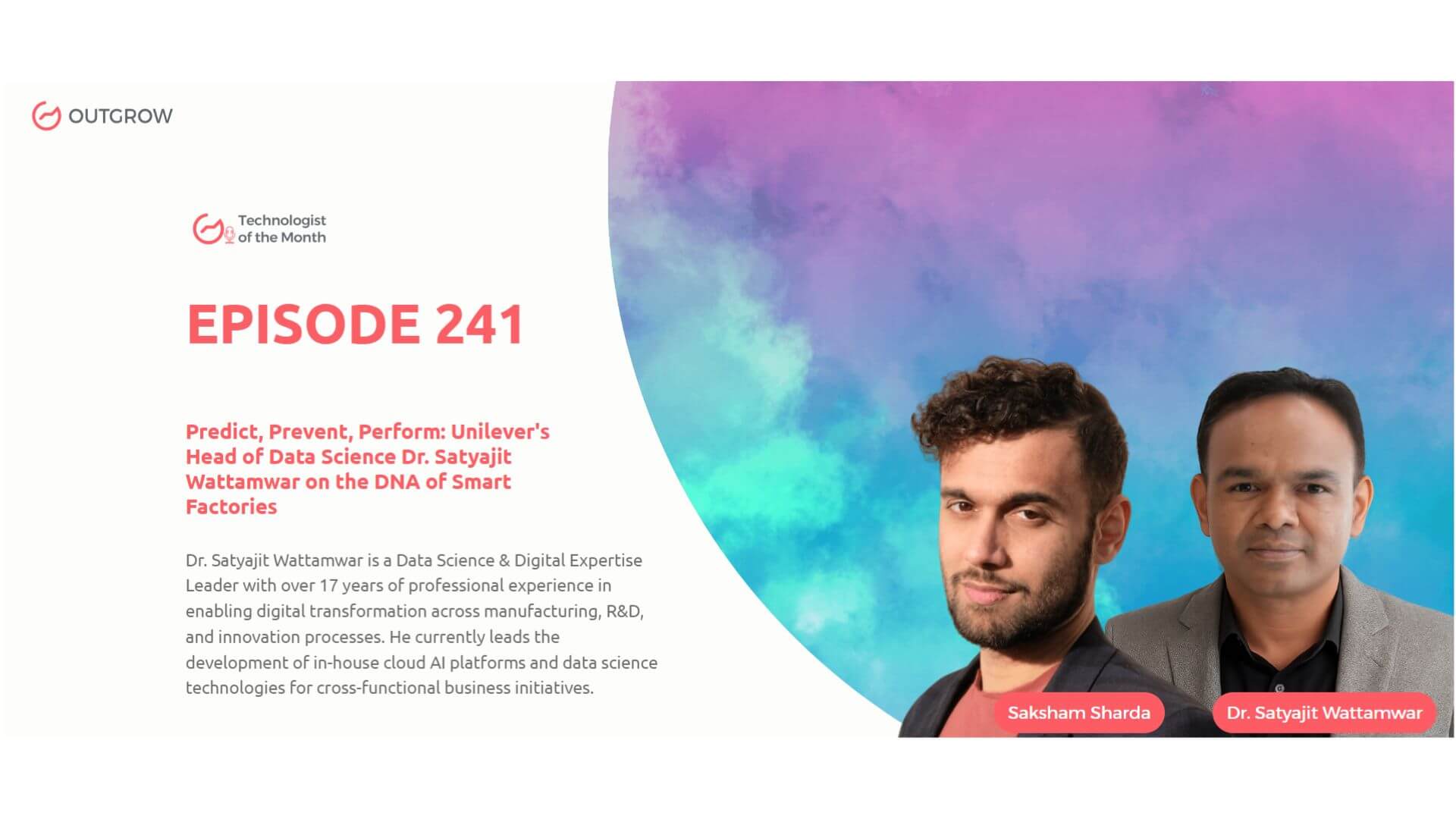
EPISODE 241: Marketer of the Month Podcast with Dr. Satyajit Wattamwar
Table of Contents
Hey there! Welcome to the Marketer Of The Month blog!
We recently interviewed Dr. Satyajit Wattamwar for our monthly podcast – ‘Marketer of the Month’! We had some amazing, insightful conversations with Dr. Satyajit, and here’s what we discussed about-
1. Data scientist empowerment through AI-powered digital assistants
2. Scaling digital solutions across 180+ global factories
3. Industry 4.0 ROI measurement strategies and KPIs
4. Digital twin technology revolutionizing manufacturing operations
5. Quantum computing’s potential impact on process optimization
6. Explainable AI methodologies for industrial safety applications
About our host:
Dr. Saksham Sharda is the Chief Information Officer at Outgrow.co He specializes in data collection, analysis, filtering, and transfer by means of widgets and applets. Interactive, cultural, and trending widgets designed by him have been featured on TrendHunter, Alibaba, ProductHunt, New York Marketing Association, FactoryBerlin, Digimarcon Silicon Valley, and at The European Affiliate Summit.
About our guest:
Dr. Satyajit Wattamwar is a Data Science & Digital Expertise Leader with over 17 years of professional experience in enabling digital transformation across manufacturing, R&D, and innovation processes. He currently leads the development of in-house cloud AI platforms and data science technologies for cross-functional business initiatives.
Predict, Prevent, Perform: Unilever’s Head of Data Science Dr. Satyajit Wattamwar on the DNA of Smart Factories
The Intro!
Saksham Sharda: Hi, everyone. Welcome to another episode of Outgrow’s Marketer of the Month. I’m your host, Dr. Saksham Sharda, and I’m the creative director at Outgrow. co. And for this month, we are going to interview Dr. Satyajit Wattamwar, who is the Data Science & Digital Expertise Leader at Unilever R&D.
Dr. Satyajit Wattamwar: Great to be here. Thank you.
Don’t have time to read? No problem, just watch the Podcast!
Challenge yourself with this trivia about the exciting topics Dr. Satyajit Wattamwar covered in the podcast.
Or you can just listen to it on Spotify!
The Rapid Fire Round!

Saksham Sharda: Let’s go. So let’s start with the rapid-fire round to break the ice. The first question is, at what age do you want to retire?
Dr. Satyajit Wattamwar: 62.
Saksham Sharda: How long does it take you to get ready in the mornings?
Dr. Satyajit Wattamwar: One hour.
Saksham Sharda: Most embarrassing moment of your life.
Dr. Satyajit Wattamwar: Can’t remember.
Saksham Sharda: Favorite color?
Dr. Satyajit Wattamwar: Yellow.
Saksham Sharda: What time of day are you most inspired?
Dr. Satyajit Wattamwar: Most of the days.
Saksham Sharda: How many hours of sleep can you survive on?
Dr. Satyajit Wattamwar: Eight hours minimum.
Saksham Sharda: The city in which the best kiss of your life happened.
Dr. Satyajit Wattamwar: It was small town, but somewhere on the Ker Mara border.
Saksham Sharda: Pick one. Mark Zuckerberg or Elon Musk.
Dr. Satyajit Wattamwar: Elon Musk.
Saksham Sharda: How do you relax?
Dr. Satyajit Wattamwar: Spending time with family.
Saksham Sharda: How many cups of coffee do you drink per day?
Dr. Satyajit Wattamwar: Probably the question is not that, but one cup of coffee and four cups of tea.
Saksham Sharda: A habit of yours that you hate.
Dr. Satyajit Wattamwar: I cannot tell that.
Saksham Sharda: The most valuable skill you’ve learned in life.
Dr. Satyajit Wattamwar: Continuous learning.
Saksham Sharda: Your favorite Netflix show.
Dr. Satyajit Wattamwar: Nothing special. Just, I watch almost everything, so it’s okay.
Saksham Sharda: Are you an early riser or a night owl?
Dr. Satyajit Wattamwar: Neither.
Saksham Sharda: One-word description of your leadership style.
Dr. Satyajit Wattamwar: Supportive.
Saksham Sharda: Top priority in your daily schedule.
Dr. Satyajit Wattamwar: Tangible outcomes every day.
Saksham Sharda: Ideal vacation spot for relaxation.
Dr. Satyajit Wattamwar: Camping.
Saksham Sharda: Key factor for maintaining a work life balance.
Dr. Satyajit Wattamwar: Limited work and family support.
The Big Questions!

Saksham Sharda: Alright, that was the end of the rapid-fire round. Now we’re gonna go on to the longer questions. Okay. Which you can answer with as much time and ease as you like. First question is with the rapid evolution of AI and machine learning in industrial settings, how do you see the role of data scientists changing from traditional analytics to more strategic business enablement, and what skills are becoming most critical for success in this transformation?
Dr. Satyajit Wattamwar: Good. Interesting question. Okay. But then I would not call data scientists. Data analyst. Data analyst job was more limited to analyzing the data. Data scientist goes few steps further. Yeah. Data scientist is the person who has two important hats. One is really understanding the business, and the second hat is about the technological algorithmic approaches to solve that business problem, if at all it can be solved. Yeah. And by understanding the data and then also algorithmic understanding. And again, yes. But that question is still valid. Yeah. That the AI is doing quite many jobs with respect to data analytics, analytics. Luckily they were not doing the data analytics, but then AI can also do the data, many part task of data scientists like getting insights into data, building the models or publish or building the wave applications, building the pipelines and many things. So in my opinion, a data scientist is more empowered, to be honest. Yeah. A big part of his job can be supported by AI. Yeah. He, and then a data scientist, is a community that is always in demand in almost every company. And they were always rushed to deliver their products on therefore, many times it was difficult for them to catch up with either the domain or business understanding or at the same time to produce the good quality content. But now a big part of their work can be supported by this digital AI assistant and they can deliver, therefore a better quality products as well as expand the scope of their delivery to address the complex use cases. So in my opinion, they’re very much empowered now.
Saksham Sharda: And how do you balance the need for technical depth with business acumen when building data science capabilities within organizations?
Dr. Satyajit Wattamwar: Naturally, the business understanding is really important because I would translate that data also into the problem understanding. Yeah. If you understand what is the business, if you understand the problem, and then if you under also understand what is the value unlock, many times the technology solutions are can be simpler one as well. Yeah. It can be simple mathematical equation or it can be a simple machine learning algorithm, or it can be a heuristic algorithm or it can be fancy AI solution. So the technology has to be mapped to the understanding the underlying problem. But that all depends on understanding the problem. And then only you can choose the technology. So I always, I like technology a lot, but then I learned that over the years that yes, it is the business and the problem, understanding that is primary important and then you ma need to map the technology to that. Yeah.
Saksham Sharda: You’ve worked extensively with IoT analytics and asset performance management. How has the integration of edge computing and real-time analytics changed the landscape of predictive maintenance, and what emerging technologies do you see as game changers in this space?
Dr. Satyajit Wattamwar: Yeah. I am kind of in a mood for my career to slow down because I’m chemical engineer, but then the data science, then the iot, and then now in the digital space. Yeah. But then I have seen this evolution very nicely. So this the a traditionally the H part was coming with the various kinds of software called MES manufacturing execution system, doing the job very wonderfully, but local what? Yeah. With cloud, a new field emerge, which was really iot that make that data available in the cloud. Why to go to the cloud when we can do the things in locally. The reason is that you can really scale the things in unimagined and unparalleled way. For example, just our company where a hundred 80 factories or something like that data coming from all these operations and the sensors in the cloud simply unlocks too many different things for us. Yeah. You name the digital twins, which is really the fancy thing, but then also understanding the, the OE efficiency are really about various factor or the bottlenecks. Yeah. Or you build one of the digital solution, then you can scale it. Yeah. And then all those avenues really open up when you marry this technology of the the h with the the cloud technology. Sometimes they call it OT and IT marriage. Yeah. And then indeed that open up the mini nice doors. Yeah.
Saksham Sharda: And given the consumer goods industry’s increasing focus on sustainability and personalization, how are you leveraging data science in Unilever to drive innovation in product formulation and packaging, particularly in addressing environmental challenges while meeting diverse consumer preferences?
Dr. Satyajit Wattamwar: Yeah. although we look these two things at at least the questions is sounding like as if they are two different things. But and even if they are different things they, they are not conflicting. So one doesn’t need to be making a trade off. Yeah. And then luckily the data science or AI support them both. Yeah. On one side you can make really good products because you narrow down your search of the formulations that can really build the superior quality product. Same applies with the packaging. Yeah. Just imagine you need to come up with alternative packaging solution or material, but then there is a big space of the material various material that can be available and synthesizing a new material that can support this ambition of sustainability, again, is supported nicely by exploring the AI for the new material innovation. So in both places you can make superior product at the same time, sustainable product by use, exploring these technologies like data science and ai, which result into finally building some nice mathematical models that you can leverage for the both ends.
Saksham Sharda: And besides this, is there any other role that AI plays in accelerating the R&D lifecycle for sustainable product development?
Dr. Satyajit Wattamwar: AI is playing role in unimaginable area almost everywhere. Yeah. You just start from very, very first basic thing in terms of for a new innovation, what is happening in the research world, millions of scientific journals and articles are there. Yes. The AI is there, which helps you to get collect and gather and synthesize some of the information next step, building some of the new formulations. Yeah. Using that information. Yes. AI helps you to try out various combinations of the materials molecules that I said earlier, or the reactions. And these are the, there are different foundational AI model may not be the charge GPD that we may be familiar with. Yeah. Which may help in the synthesizing or collecting required documented information. But then here, there come a new set of AI tools or AI models goes in the next pipeline in terms of once you build out these models, you democratize them further toward this decision making. So AI is playing role in almost all the areas. And of course in the consumer facing role and other in market role a l supplies. But then that’s not let’s say the area that I support mostly in the R and D that I work in. Yeah.
Saksham Sharda: In the context of global supply chain optimization, how is Unilever applying data science to improve operational efficiency and resilience, particularly given recent global disruptions and the increasing complexity of multi-tier supply networks?
Dr. Satyajit Wattamwar: Yeah. That’s a quite challenging task. Yeah. To be honest when it comes to the supply chain management, simply because of the, the size of the organization and then the footprints Yeah. In almost every country. But then luckily again the data science is wonderful thing to really support that. Yeah. Because data science starts with the data and Unilever had put big amount of efforts in collecting the right data from all the potential possible sources. If you have nice data availability in terms of who are your supplier, what in which countries, the task of really planning these resources and the supply chain management, to be honest, becomes simpler because you can come up with, there is already maturity in terms of algorithms, yeah. That and the use cases that can address that. The biggest bottleneck is do we have that data to make that decision? Yeah. And then there are these various algorithm tailored to this need of choosing the alternative suppliers in absence of the one or really hitting the cost effective supplier in times of such a disruption.
Saksham Sharda: And what predictive models have proven most effective for supply chain risk assessment and mitigation?
Dr. Satyajit Wattamwar: I would not really call the model I would call. Yeah. So it is rather the modeling class? Yeah. So the data scientist always looks into various modeling classes. Sometimes there is supervised at high level we call it supervised learning, and then unsupervised learning. Then you go a little bit deeper into predictive modeling or really the clustering classification. Now all of them, these are just the classes. Then you translate that like earlier example. Yeah. That predictive maintenance, one of the nice use case of the supply chain, it’s really boiled down into supervised learning. Yeah. And then there are various algorithms that really caters to that need. Same applies into the problem. So you identify the problem and then these problems can be called in different ways in different companies. But then which algorithmic solutions really map to address that need is what is important. And that’s what we use.
Saksham Sharda: Industry 4.0 initiatives often struggle with ROI demonstration. From your experience enabling digital transformation across multiple Fortune 500 clients, what metrics and KPIs have proven most effective in measuring and communicating the business value of data science investments?
Dr. Satyajit Wattamwar: There are various let’s say value unlock opportunities. Yeah. When it comes to really the iot projects, one of them is naturally the efficiency improvement Yeah. Or troubleshooting or the debottleneck without without data, it’s a little bit difficult, not little bit quite hard to pinpoint the root causes, but just imagine if you have all this data, various sensors available. In the early age stages of the iot, when the, it was just limited to collecting the data with various sensor and making it one place available. Again, the human beings were doing this dashboarding and things like that. Then came the data science work. Yeah. It could pinpoint so to various causes. So basically finding a needle in the haystack, and that was possible by the machine learning or the data science algorithm. If we can do that, then naturally that becomes a one of the indicator that how much time do you it? Yeah. Many times these were problems were simply unsolvable or one cannot get hold of them. So this time saving is very big factor there. Second thing about the things like predictability, no human being could predict what is going to happen. Maybe with a like year two process variable, you may be able to predict the outcome, but most of the time the number of parameters that are changing in any factory are far too many. Yeah. One cannot predict what exactly may happen with the respect to quality. So predictability of your product quality is one of the nice KPI when it comes the consistency, if you’re predicting it, you can predict the consistency. If you can predict the consistency, you go back and you can predict the required inventories that may be needed there, the equipment life cycle or the, it’s a degradation or the lifetime or how far it is going to stay alive. Yeah. So many of these things become the outcome of this the data science or machine learning activity that themself act as it then translate into the K in terms of the uptime? Yeah. Or really the product. Most of the KPR, in fact, to be honest, they’re coming up in the same world of manufacturing execution system that how long your ment is up what kind of a bottleneck you solve, how, how much increase in the production, what kind of quality consistencies there is there, quality improvement. So most of these KPIs are still old, but it is the new way to address them. And then if you can hit those KPIs, then basically you are able to sell that the value of the IOT devices.
Saksham Sharda: So, as data science capabilities mature, how do you approach positioning and marketing these technical solutions to business stakeholders who may not have deep technical backgrounds, and what storytelling techniques have proven most effective in securing buy-in for complex AI initiatives?
Dr. Satyajit Wattamwar: That’s always a big challenge. Rather than data science initiatives we would, I can call the infrastructure. Yeah. Because then both are valid. So your question is valid, like some that sounds like more of a project. Yeah. A data science project is also that demand some resources and activity, but then digital the technology stack capability that you build that is more investment demanding. Yeah. And that is hard to sell, but some common framework always works. What problem it is going to solve. Yeah. What value unlock it is going to create in what time? And if these three buckets are hit kind of bullet point are taken care of, then you go into the details about the execution strategy. Yeah. Do we have that? How many people are going to use it? What kind of resources it want? But then importantly, is it going to solve some problem? Is it going to create some value unlock for the company? Yeah. And in which time duration, and what is the cost for that? If this story is clear, like they, they call it like elevator pitch in the world of startups. Yeah. You need to be ready, explain what is the problem and how it can be solved. And then in addition, that what is the required resources that you expect for that, and in which duration, time, duration or the period that you are for, that becomes your gate opener. And then the rest of the things follows.
Saksham Sharda: So you mentioned the elevator pitch. Yeah. But what role does proof-of-concept development play in such a marketing strategy?
Dr. Satyajit Wattamwar: They’re very useful proof of concept. You cannot do without that. It’s very clear. And then it’s not a a big secret. Everybody knows that even with ai, when we started with let’s say understanding or extracting information with millions of literature or scientific resources, we start with small, is it possible? In fact, we don’t even build a ui. We don’t build any engine there. Just these are the sources. We know we are making shampoo. Okay. And these are the literature sources. What can we get there? Small PO Cs, it is, we go a bit further. Before that, we call it proof of idea. In fact, not the P-O-C-P-O-C goes a little bit like when we have some technology stack and things like that. But the proof of the idea goes a bit earlier than that, just to validate your idea and the concept. If it goes well, then you go to the POC, and then the POC is the door opener basically. Yeah. And then we applied almost all in the walks of new product the digital or the technology-led product innovation.
Saksham Sharda: The convergence of operational technology (OT) and information technology (IT) presents both opportunities and challenges. Based on your experience with SCADA systems and modern cloud technologies, how do you navigate the security, integration, and cultural challenges inherent in OT/IT convergence?
Dr. Satyajit Wattamwar: It’s quite a big question, to be honest. It itself goes with cybersecurity as well. Yeah. But then also with the security in the on-prem security. But then few principles work nicely. One of them is yes, protect your ground infrastructure at all costs. That’s very important. Then the cloud is a bit mature, in my opinion. Yeah. Again, it depends on the firewalls that you put in there. But then if the, your, most of the companies, they, they don’t build their own cloud basically. Yeah. They, they either go with one of the HyperCloud provider or like Google or AWS or the Microsoft Azure. Yeah. But then having some extra firewalls or the protection mechanism in the cloud and in your local infrastructure so that the pipeline that you have between OT and IT Yeah. Is protected. Then things go in your favor. But then the second part of your question was.
Saksham Sharda: How do you navigate the security integration and cultural challenges inherent in IoT convergence?
Dr. Satyajit Wattamwar: Yeah, exactly. Yeah. And then the second part about the cultural challenge. Yeah. You can simply imagine the OT part. Yeah. There was resistance. Just you, we, none of us would have seen that. It is like when the OT things came like 60 years ago. 50, 60 years ago. Yeah. A similar debate was there. Yeah. Fortunately or unfortunately, we were not there. I don’t know. But then similar things were there because the computer itself was a very big thing. Yeah. And then what is going to take the job. That was a very common thing there. Then came some of the software in the MES world, like scada. Yeah. But then they understood, Hey, I cannot run everywhere in the plant. I cannot monitor everything. Even if I do that, I need a hundred people to do that. And then they will also fail. But now with four people in the room, they can monitor their SC screen, which alert them what is going wrong. Their life has become so easy, the rest of the people can then really allocate their strength and the knowhow for some other problem. There was a big win there for them. Yeah. They immediately allowed it. That allowed them to sell it to the cultural, to these people. Similar things came, challenges came when it came to the IT or the cloud part. Yeah. But then now the predict and that I said, nobody can predict that none of the human being can predict what’s going to happen in terms of product quality or what is going to fail. But then IT, or the digital twin allowed that and the digital twin comes back with their UI part on their SCADA screen, Hey, this product is drifting or there is going to be fault that is going to happen. Or this product is drifting into it. Quality unique thing. Yeah. And then that unlocks them. Again, the same thing that the aha moment that had happened 50 years ago when the SCADA came. The same thing came again.
Saksham Sharda: So what does your typical day look like at work? You wake up in the morning and then?
Dr. Satyajit Wattamwar: The day starts, of course, at home, getting ready for work. And then I go for one hour. A big part of my work is from home our hybrid. Yeah. But then I go to the branch at L one. Yeah. And then the first part is really little bit on the, it’s bit when I flexible. Yeah. Given that I’m in the central team, and then I connect, I’m part of the digital. That means I connect with the business as well as the IT team. And the IT team many times is often India-based. So their time zone is there, and therefore, I make myself available in my early mornings for the IT colleagues from India. Whereas the afternoons are for the business side, which is more based in the Netherlands, or UK, and America. Yeah. But then half of the day goes mostly to be honest more than half to various meetings where I have to make many decisions every now and then. Yeah. The technical decisions. And then the other half is naturally to support various initiatives in the form of change management. Yeah. Building the strategic standard and guidance content, or if I am really lucky, then I also like to build some models every now and then. Yeah. And then also support our data scientist because every now and then people keep on asking me questions. Still now. Great. Yeah. And if I find some time every now and then, I do support them. So my day is very, very flexible. And then I take my freedom to really prioritize the thing that I think is really important.
Saksham Sharda: So let’s talk a bit about explainable AI (XAI), which is crucial for industrial applications where decisions have significant safety and financial implications. What methodologies and tools have you implemented to ensure AI model interpretability, and how do you balance model complexity with explainability requirements?
Dr. Satyajit Wattamwar: Yeah. That’s another nice technical question, but then the very reason for this explainability. As a notion came because people were started building very big deep learning models. Yeah. Where the model itself is a kind of neur lights. Yeah. And then one doesn’t get understanding of what happens within that model. However, if you build models with some other algorithmic approach, for example, traditionally this people have been building this model for few hundred years. Yeah. Newton had built is a model for the force equal to mass into acceleration. The same generation followed down now. But then there are very BS models, we call them first principle models are really transparent models as well. Yeah. Big part of the r and d relies on the these types of models because we need to understand what kind of equations goes in there. Yeah. Now this question is still valid for some of this deep learning model. And then because it falls into some of this class of the black box model, there are also some other algorithmic approaches that translate this kind of a ideas in terms of what is happening within the model. Different words are used there, root cause analysis or the shop play values or some other algorithmic approaches are there that helps you to foolproof your model. And then also even after that, many of these deep learning model are used within certain domains so that the product safety is never breached.
Saksham Sharda: And how do you approach explainability differently for different stakeholder groups, from operators to executives?
Dr. Satyajit Wattamwar: Yeah, so, the good thing is that explainability results into the same kind of a factors that are important. Yeah. The factors that an operator understands are something of his own wall. Yeah. For example, the temperature, some of these factors like temp, I can change this temperature. Okay, great. I can change this pressure. Great. Yeah. This is the wall that, if I change this, then this is the effect. If the model shows you the same thing and uses your language, then you get the buy-in from the operator. Now go into the world of business leaders. Yeah. The business leader would not care for these factors. Yeah. Which are determining at the shop factory shop floor. And therefore he’ll also not be interested in this model that may be ex doing this predictive maintenance. Yeah. Yeah. But the models that they may be interested in are some of the models that may be making financial decisions. Yeah. And then, but then I approached him in the same it as the drivers. Those are driving the model outcome. If you can get hold of the drivers. And show the potential various scenarios we call that simulation. Yeah. How these factors are influencing the outcome. And that helps you to gain the trust of all the stakeholders, but that really depends on their language and their understanding of that domain or that problem. Yeah.
Saksham Sharda: When building internal consulting capabilities for data science services, how do you develop compelling value propositions that differentiate your offerings from external vendors? And what marketing strategies help establish credibility and trust with internal clients?
Dr. Satyajit Wattamwar: Yeah. So to be honest, there is not that much, let’s say, competition between internal the external. However, what we do advocate to the various business groups is that there is this various know-how that we have built. Yeah. There are templated solutions. There are the templated products. Yeah. There is proof of concept. There are scaled solutions. For various classes of the problem. So naturally if there is this problem, then there has been this solution that you can simply scale up. Yeah. And if we have a good confidence because of the, whatever the maturity of that internal product is, we do recommend that. And that is also okay. To go with an external partner. But in fact, this is the code base that we give to our internal stakeholder so that they can solve their problem early at early stages. Yeah. However, there are not; there are always some situations that some of the problems that we may not have addressed internally and they’re wonderful opportunity then to go with the external partners. Yeah.
Saksham Sharda: So, looking toward the future quantum computing promises to revolutionize optimization and machine learning, how are you preparing your data science strategies and teams for the potential impact of quantum computing on industrial analytics and process optimization?
Dr. Satyajit Wattamwar: Quantum computing is arriving very fast. That’s clear. Yeah. And in fact, we are working with Microsoft. Yeah. And Microsoft’s coming up with a quantum. So they’re not commercialized fully. However, their cloud offering it’s coming up with a product. We are co-building that, which allows basically to perform scientific simulation, scientific modeling. And that will be one of the early unlocks for quantum computing because the scientific simulations, they demand huge horsepower. Yeah. Big GPUs, CPUs, and all the memory that you need for the big setup of the data center are required even after that. It takes quite some time. To really come up with this outcome. Some of these famous models, like AlphaFold, that people know about that protein structure from the Google or the deep mine. Yeah. But then something similar is required in almost every domain. Yeah. Coming up with new and there, I really see a big value of quantum computing coming into play because the outcome that that you get now with many hours or many days, sometimes, especially in the computational fluid dynamic or new modal simulation, potentially will be possible with quantum computing in much quicker. Yeah. So I see great value there, but we are not there yet.
Saksham Sharda: And how do you approach skill development and team preparation for emerging technologies like these with uncertain timelines and applications?
Dr. Satyajit Wattamwar: Yeah. Another challenge is true that but then the skill development, and we support that by first upskilling ourselves. Yeah. We have a strong partner network as well. These conferences, like this, really help us to understand what’s happening in the market together with our partners. Then we have skills ourselves in terms of what is needed. Yeah. We may not be really the pro become programmer, but we try to come to the point where we understand what the technologies are, what kind of problem it solves, what kind of investment it demands, what kind of skills it need, what is its the the resources in terms of time that we can expect. Yeah. That is our upscaling. Then we go a bit deeper for our data scientists towards understanding some of the tech stacks that may go in there. Maybe initially we will, we’ll work with some of the new partners when it comes to the new technology, and then we create a democratized tech stack that can allow us to replicate this capability for different problems within different groups by different data scientists. Yeah. So that’s how we kind of get hold of the new technologies.
Saksham Sharda: Alright. So the last question for you is of a personal kind. What would you be doing in your life, if not this
Dr. Satyajit Wattamwar: An archaeologist whom I wanted to do that. Yeah. So, wow. Yeah. But that’s a quite different world, but probably it has similarities. Trying to find a needle in the haystack. Same.
Let’s Conclude!
Saksham Sharda: Thanks, everyone for joining us for this month’s episode of Outgrow’s Marketer of the Month. That was Dr. Satyajit Wattamwar, who is the Data Science & Digital Expertise Leader at Unilever R&D.
Dr. Satyajit Wattamwar: Great to be here. Thank you.
Saksham Sharda: Check out the website for more details and we’ll see you once again next month with another marketer of the month.

I am a Digital Marketing Enthusiast with a passion for optimizing content and paid marketing strategies. Continuously seeking innovative approaches to boost ROI and engagement at Outgrow.