Summarize with :
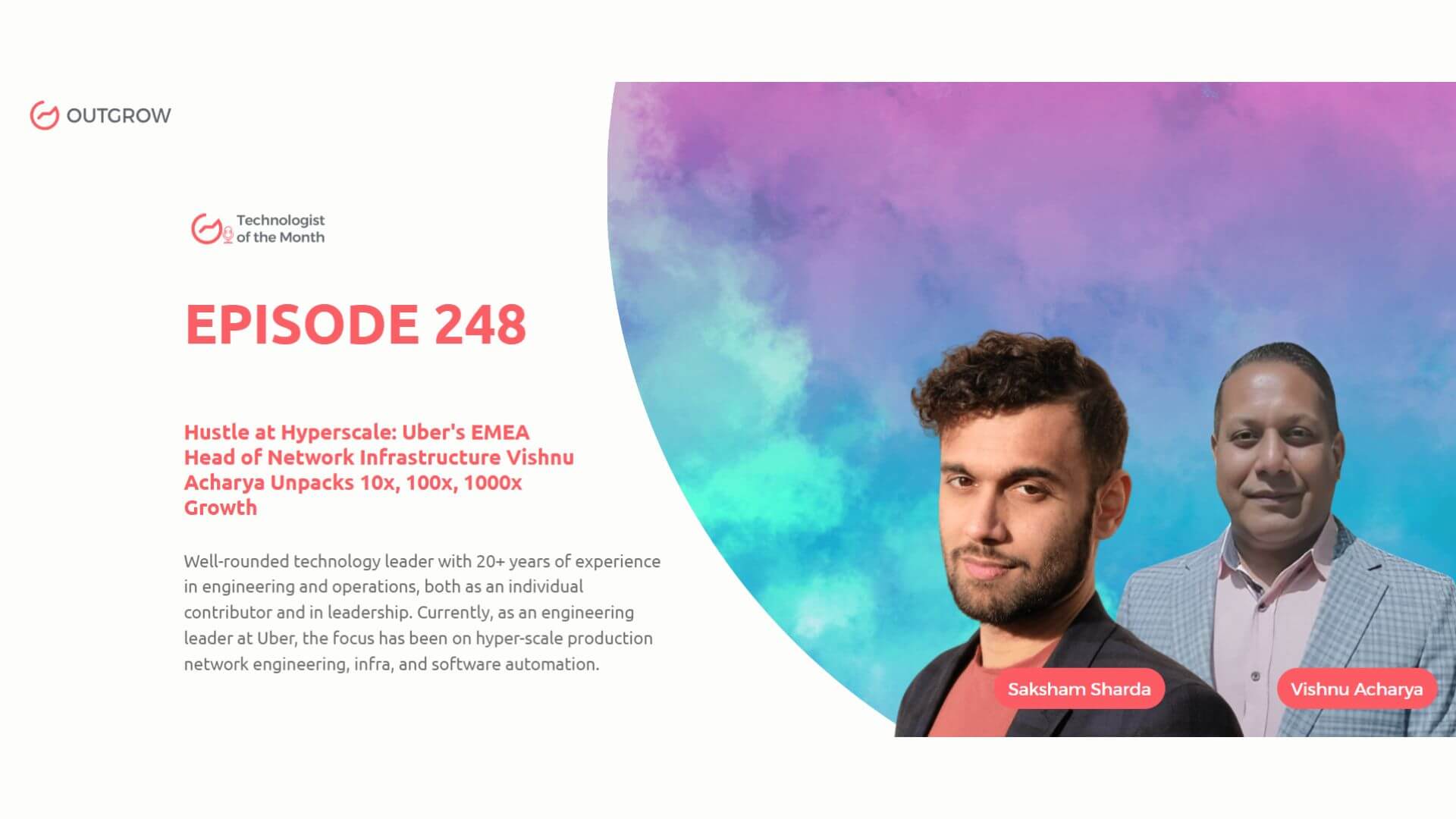
EPISODE 248: Marketer of the Month Podcast with Vishnu Acharya
Table of Contents
Hey there! Welcome to the Marketer Of The Month blog!
We recently interviewed Vishnu Acharya for our monthly podcast – ‘Marketer of the Month’! We had some amazing, insightful conversations with Vishnu, and here’s what we discussed about-
1. Scaling Uber’s infrastructure from 16 to 4,000 engineers
2. Building systems that survive 10x, 100x, 1000x growth
3. Network bottlenecks in AI factories and GPU connectivity
4. How Uber for Business started from a random networking request
5. Angel investing lessons: backing founders over trends and hype
6. China expansion: cranes, windows, and creative data center solutions
7. Autonomous vehicle push in 2016: when innovation moved too fast
About our host:
Dr. Saksham Sharda is the Chief Information Officer at Outgrow.co He specializes in data collection, analysis, filtering, and transfer by means of widgets and applets. Interactive, cultural, and trending widgets designed by him have been featured on TrendHunter, Alibaba, ProductHunt, New York Marketing Association, FactoryBerlin, Digimarcon Silicon Valley, and at The European Affiliate Summit.
About our guest:
Vishnu Acharya is a well-rounded technology leader and speaker with over 20 years of experience spanning engineering and operations. He has worked both as an individual contributor and in senior leadership roles. Currently, he is an engineering leader at Uber, where he focuses on hyperscale production network engineering, infrastructure, and software automation. Known for his natural curiosity to break and fix things, Vishnu is driven by a passion to learn, teach, create, and bring order out of chaos.
Hustle at Hyperscale: Uber’s EMEA Head of Network Infrastructure Vishnu Acharya Unpacks 10x, 100x, 1000x Growth
The Intro!
Saksham Sharda: Hi, everyone. Welcome to another episode of Outgrow’s Marketer of the Month. I’m your host, Dr. Saksham Sharda, and I’m the creative director at Outgrow. co. And for this month, we are going to interview Vishnu Acharya, who is the EMEA Head of Network Infrastructure at Uber.
Vishnu Acharya: Great to be here. Thank you.
Don’t have time to read? No problem, just watch the Podcast!
Challenge yourself with this trivia about the exciting topics Vishnu Acharya Top Explores covered in the podcast.
Or you can just listen to it on Spotify!>
The Rapid Fire Round!

Saksham Sharda: Alright. Let’s start with the rapid-fire round. The first question is, at what age do you want to retire?
Vishnu Acharya: 55.
Saksham Sharda: How long does it take for you to get ready in the mornings?
Vishnu Acharya: An hour and a half.
Saksham Sharda: Most embarrassing moment of your life?
Vishnu Acharya: Pass
Saksham Sharda: Favorite color?
Vishnu Acharya: Blue.
Saksham Sharda: What time of day are you most inspired?
Vishnu Acharya: 10:00 PM
Saksham Sharda: How many hours of sleep can you survive on?
Vishnu Acharya: Five.
Saksham Sharda: The city in which the best kiss of your life happened?
Vishnu Acharya: San Francisco.
Saksham Sharda: Pick one. Mark Zuckerberg or Elon Musk.
Vishnu Acharya: Neither
Saksham Sharda: How do you relax?
Vishnu Acharya: Friends, family, good food, good wine.
Saksham Sharda: How many cups of coffee do you drink per day?
Vishnu Acharya: Four to six, I think.
Saksham Sharda: A habit of yours that you hate.
Vishnu Acharya: Procrastination.
Saksham Sharda: The most valuable skill you’ve learned in life.
Vishnu Acharya: Negotiation.
Saksham Sharda: Your favorite Netflix show.
Vishnu Acharya: Top Boy
Saksham Sharda: Morning Routine. Are you an early riser or a night owl?
Vishnu Acharya: Night owl, for sure.
Saksham Sharda: One word. Description of your leadership style.
Vishnu Acharya: Easy-going.
Saksham Sharda: Coffee or tea to get started?
Vishnu Acharya: Coffee. Sure.
Saksham Sharda: Top priority in your daily schedule?
Vishnu Acharya: Getting through meetings and getting to actual work.
Saksham Sharda: Ideal vacation spot for relaxation,
Vishnu Acharya: South of France.
Saksham Sharda: Key factor for maintaining a work-life balance.
Vishnu Acharya: I think just keeping everything in perspective.
Saksham Sharda: Okay. That was good.
The Big Questions!

Saksham Sharda: Alright, so now we can move on to the longer questions, which you can answer with as much time and ease as you like. Sure. The first one is, you’ve been in the game for 20 plus years. What was the moment that took you from being a hands-on systems engineer to running massive network infrastructure at Uber?
Vishnu Acharya: Sure. So I think the moment happened probably in 2015, 2016. So I’d been at Uber for some time, and we had scaled up our infrastructure, basically starting from zero in 2014. And what we realized, and I remember, you know, very clearly, or my boss at the time, coming to me with a couple of my colleagues and saying, you know, you guys are not thinking big enough. You’re not building it big enough. He’s like, This is gonna be bigger than anything you imagined. And, you know, we thought he was sort of panicking and exaggerating, but he was absolutely right. So I’ve taken that to heart in my career at Uber, and, you know, we’ve spent the last 10 years making sure that we’re always building it bigger than we ever think we’ll need because we are gonna need it. And this company has sort of outgrown every expectation I had in terms of scale, size of the network, and the infrastructure. And it’s been, it’s been a great journey, you know, learning that curve, and riding that wave to where we are today.
Saksham Sharda: So if you had to go back, what advice would you give the young youth? You just started?
Vishnu Acharya: I think it’d be slowed down a little bit, which sounds counterintuitive, but we were, we were growing so fast that you know, we were so heads down on trying to build, and make sure we can keep up with the company growth. I think if we had slowed down a little bit at that point, we could have built perhaps more enduring architecture that would’ve lasted us longer instead of having to go back and redo things iteratively over and over to make sure we’re building the right architecture for Uber at the right time. I also would’ve tried to spend more time with my fellow engineers and other teams and really dig into and learn about other aspects of the Uber infrastructure stack in more depth than I did at that time.
Saksham Sharda: You’ve seen both Fortune 500 giants and scrappy startups. What’s the biggest difference in how they treat infrastructure?
Vishnu Acharya: Sure. So I think small scrappy startups, you know, a lot of it is, the intentional or unintentional trade-offs that you’re forced to make either for speed and velocity or for cost or for other reasons. And I think the trick is you have to think in terms of how can I do this in a scrappier way, but still maintain that quality? And I think when you’re in a larger enterprise, one of the challenges is when you have every resource available to you, you don’t have that same sort of ingenuity necessarily that goes into it. So you really have to train yourself to put that ingenuity into what you’re doing so you’re not getting stale in terms of your design, your architecture, your implementation, your operations, because it’s very easy to cover up that sort of staleness with, with the ease that you’re able to build things and you’re not necessarily building the most efficient architecture or high performing architecture that you could because it’s easy to not do that.
Saksham Sharda: And how do you mix these two worlds in how you lead at Uber?
Vishnu Acharya: Yeah, so, so it is a challenge. So as we’ve grown bigger and bigger, I mean, we’re a big company, we have 4,000 engineers today. But our principles and sort of our attitude is like when I joined, and we had 16 engineers and platform engineering or infrastructure, which is that, you know, we want to understand the business, we want to meet the needs of the business, and we want to deliver as quickly as possible while maintaining a high quality bar. Those things are intentional sometimes, but I think, you know, having that attitude of like, we are gonna be opportunistic, we’re gonna enable the business to be opportunistic, and we’re gonna keep sort of hustling to build in, you know, ingenious solutions at the right time that can deliver for the business is what we’re focused on. Now, as you get bigger, you know, there’s obviously multiple teams involved, there’s multiple leaders involved, so that negotiation becomes key. The ability to influence others to understand stakeholders, not just what they’re asking you, but why they’re asking you, what their constraints are, what they’re up against, and how to alleviate some of those for them so you guys can build successfully together, I think is is absolutely important.
Saksham Sharda: So, for someone who’s not an engineer, what’s the hardest part of building systems on an Uber scale?
Vishnu Acharya: Yeah,so one of the things that you’re never really prepared for unless maybe you’ve worked at, you know, there are companies much bigger than us, hyperscalers, cloud providers, but you start to realize that as you, let’s say you go from 10 to a hundred in anything or a hundred to a thousand or 10,000 or a million things break, right? People break processes, break the systems, break software, and it breaks in new and novel ways sometimes. So I think when you have a combination of all of those things breaking, it’s, it’s both where some of the biggest learnings you will ever have come from, but it’s also the biggest challenges you ever had. So, I think really focusing on how to build sustainable building blocks, whether it is in people processes or things that can then be extended out into systems, is really important.
Vishnu Acharya: So, you know, in the early days, like many companies, we had a high degree of craftsmanship. And what I mean by that is we had some brilliant engineers who were generalists and who could build almost anything, and they built special systems that made Uber run. Now, when you try to take that, and 10 x exit or a hundred x or a thousand x, you can’t 10 x that engineer. And so how do you build those things, and take the same level of care, but build it into systems rather than individual things, right? A system that works at scale. And so it’s difficult, it changes with everything you’re doing, but I think having that mindset of when you’re building something, you know, having that mental checklist of, okay, if I had to take this thing, and multiply it by a thousand, where would it break? And can I address those things now? Or does it make sense to address those things now? As you know, so.
Saksham Sharda: So, are there safeguards for failure at Uber that promote creativity without punishing it?
Vishnu Acharya: Yeah, I think it goes back to sort of our engineering culture. So our culture is, you know, we have a high degree of trust in our engineers. So we have a, we have a set of engineering principles that we all are not just, you know, it’s not just a poster on the wall or anything, it’s something that we truly believe in and we’re bought into. And so if you have that, you know that everyone’s operating from the same sort of engineering principles, you can kind of you can kind of let go, right? And let them be creative. Let them you have that trust that they’re gonna do the right thing for the company. And then on the flip side, you know, not everything goes right. We do, we make mistakes, things happen. We have a blameless postmortem culture where we go through and we try to identify not who did this, but how was this, how did this happen so we can prevent it in the future.
Vishnu Acharya: We also, you know, we’re pushing the edge in different technology areas where we allow people to really push the envelope in terms of, like, this is what, you know, be as, push it as far as you need to for Uber. And, you know, things like embracing the open source community, really understanding how people bigger than us are doing this, you know, the meadows, the Googles, or the world. Having that good engineer to engineer exchange with engineers from those companies and really understanding what is the state of the art and where it can, you know, and then taking what we want from there that can fit for Uber, and really giving engineers the, the space to both, you know, be creative, make mistakes, and, and keep pushing the mission forward. It works. It’s not perfect, but it works for us.
Saksham Sharda: So to add to all that, there’s now the perfect storm of edge computing, 5G AI. Where do you think global networks are headed in the next five to 10 years?
Vishnu Acharya: Sure. So, I think it’s a really interesting question. So I think what you’re seeing is, you know, this sort of bifurcation of infrastructure in general, but networks also in that you’re, you’re getting these larger and larger data center footprints that go, you know, go, when we were building five megawatt, you know, data center footprints, we thought that was large and it was large at the time and still is pretty big. But then you hear, and you see these AI factories being built at the gigawatt scale, a hundred gigawatts, etcetera, and you realize the scale of the infrastructure, scale of the network is getting concentrated into much, much larger deployments. I think the challenge is, at the same time, you’re having this concentration of infrastructure for AI, you’re also seeing this sort of disaggregation of network and infrastructure for every other use case.
Vishnu Acharya: So an example for Uber is, you know, autonomous vehicles. We partner with a few different autonomous vehicle companies, and really, the edge computing is moving from any sort of data center into a car, right? The car has a GPU and cars, local compute, the cars processing tons and tons of telemetry data, radar, lidar mapping video in real time. And it has, you know, that data has to get off that car into a cloud or into a data center for processing, and so on. So we can companies can improve their models and so on. So, you’re seeing this need for high bandwidth connectivity at the very edge, meaning cars or electric vertical takeoff aircraft or drones or delivery robots, you name it. And so you need the, you know, ultra-low latency bandwidth to those devices. And then you’re seeing massive, massive bandwidth needs for the backend of that, right? Which are the AI data centers, AI factories? And so, you know, the telecom industry with 5G and with other technologies, I mean, really, really has to push because at this point, even in the AI infrastructure, you know, the network right now is the bottleneck, right? So you know, having super high bandwidth connectivity between GPUs or within a rack, between GPO nodes or within, within the actual host itself becomes super important. So at every layer of the stack, the network connectivity, you know, becomes super critical.
Saksham Sharda: And so, how did the world move faster while you were away? Or were you surprised when you came back? Was there a lot of catching up to do after what happened?
Vishnu Acharya: It’s a great question. Yeah, so I took a month off. So Uber nicely gives us one month off every five years. So I hit my second one, so 10 years. It’s sort of like a weird time warp. So I noticed that it’s almost like I didn’t leaveand my teams, you know, continued without me with no problem. But there was a stack of problems also when I came back. And there had been a lot that had changed, but it’s, it felt like I had never left. So you sort of get caught in this situation where you’re like, you know, you’re catching up and you’re like, oh, I didn’t know that happened. Wow, that already, that’s already closed, or that it’s already taken care of, we already overcame this problem that I thought was this huge deal, or there’s this new stack of problems, right? So you get stuck in this kind of time war, which is really interesting.
Saksham Sharda: You’ve worked a lot on automating infrastructure. How is AI changing that game today?
Vishnu Acharya: Yeah, so that’s a very interesting question. So we’re, we’re still in the early days of that, I would say across the industry and at Uber. So what we’re looking at is ways that we can leverage AI not as a magic, you know, solution to everything, but where can we apply the strengths that it has to synthesize information, summarize a lot of different disparate data sources provide information to humans that is, that is, that is at a scale that humans wouldn’t be able to comprehend, you know, necessarily by themselves. So, where this comes into play for us, and it’s a very interesting use case for us, is really an incident and outage mitigation, right? So we have a lot of services at Uber, you know, 4,000 plus microservices. The network infrastructure, which I deal with, is very large. And when something goes wrong, we get a lot of signals from all over. It could be telemetry data from a network device, or it could be a service level indicator being breached. It could be service metrics, it could be logs, it could be all kinds of stuff, right? So an on-call engineer has to understand all of this information and synthesize it, and then take an action to mitigate the impact on our infrastructure. Because for Uber, every minute of downtime is actually measured in hundreds of thousands of dollars. It’s transactions we’ll never get back ‘because those people will take a ride somewhere else. So, for us, anything we can do to provide our on-call engineers with faster fault localization and knowledge of where something is broken or a suggestion where they can dig in and take a mitigation action, I think, is the first step for us. So we’re working on tools around that now. And I think very quickly, after that becomes what actions does an on-call engineer take that could then also be automated? And I think that’s a little bit of a further leap because we have to ensure, like with anything AI, that the data we’re putting in is a hundred percent accurate, a hundred percent actionable before you, before we entrust an AI agent to take an action that could either, you know, fix a, fix a potential incident or cause a potential incident. So those are the things we’re sort of grappling with. And then yeah, so it’s, really interesting area of investment. There are a lot of companies doing interesting things out there that we’re trying to learn from and take bits and pieces, and again, adapt to our needs and move forward.
Saksham Sharda: Automation and efficiency are one thing. Then what about jobs? Is AI gonna come after the Jobs?
Vishnu Acharya: Yeah, you know, I’m a little bit less worried about that, I think, than most people. So I do see, I do see a big risk here, right? And the risk I see is that, I think companies may be overbuying into the con, you know, the thought that, okay, I’m gonna replace all of my junior engineers with A, I, and I think we’re, we’re early for that. Right? No,w what I’m seeing this has potentially a bad impact, because that message is already out there, right? In the media, there have been companies that have said it, and some prominent tech people. And what that will do is that it’s gonna put a freeze on young people wanting to go into this industry. So already it’s gonna have an effect on uss graduates and STEM graduates in computer science potentially. And then on the flip side of that, from a company perspective, like we just had our biggest intern class ever here in Amsterdam, and we had a bunch of brilliant software engineering undergrads come and do amazing work, and we’re gonna try and hire as many of them as we can. So we’re not slowing down on that. But I do see, you know, two, three years from now, it could be, it could be an issue because we’ve, because of what’s going on in the industry, we’re gonna choke that pipeline off no matter what of talent coming in. And then also the technology may have proven enough where in fact, you can replace junior engineers with, with AI completely. Then the question in my mind is what happens, 10 years from now, 15 years from now, when you don’t have those, that pipeline of talent becoming your senior engineers or leaders, you know unless we go to a fully autonomous world and maybe they don’t need any of us, then, then it’s gonna be a problem.
Saksham Sharda: Uber’s both a tech company and a consumer brand from the inside. How much do engineering choices really affect the marketing and customer experience?
Vishnu Acharya: So I think it’s huge, right? So I think it has a, has a huge potential to really impact the customer experience, either in a positive or a negative way, right? So, many times, the business is actually moving faster than the technology. So I’ll give you an example. UI means, autonomous vehicles are a great example, just industry-wide. But also there’s, you know, specific products, let’s say that, that, that we could really do that, that, that could really, you know, turbocharge the business on the delivery front, etcetera. And it could be the business case is solved, right? But the technology behind it is complex or hard to implement. And so if we’re lagging too far behind what the bus, where the business wants to go, I think that’s an issue. And we’ve done a good job of keeping up with the business, but it’s always, it’s always a risk, right? We have to be able to deliver the right technology solutions to meet the business needs. Now, on the other side of that, I think technology, with large, there’s a tendency, as technologists, to want to use the newest, greatest thing. And without necessarily thinking of what the business case is? What is the ROI, so I always encourage everyone and my engineers to think of, like, we’re not in, we’re not doing technology for the sake of doing technology. Because it’s cool to us, right? We’re doing it to fill and meet a business need and see that ROI. And so I think you need to have that mutual understanding between business and engineering to really stay aligned. And it’s a challenge, it’s for sure a challenge. And I think if you can do that, the positive potential is huge. No, on the downside, you know, there are negative things that engineering can cause the business all day, all night, right? If we don’t do our job, if we don’t think about scale, we don’t think about reliability. If we don’t handle incidents properly if we don’t reduce our mean time to mitigation fanatically, then like we are gonna cost the business money, right? When things, when things break. So, it goes both ways. But I think,you know, , the really exciting part is like understanding like the cool business use cases that are there and be like, okay, what, what, what engineering do we need to do to meet that as quickly as possible?
Saksham Sharda: Do you have any interesting story around when infrastructure directly shaped the marketing campaign?
Vishnu Acharya: Yeah, so I think so I have sort of a personal story and I don’t want to take credit for it because there were a lot of people thinking about this, but I do remember,in the early days of Uber, I had a, a colleague or a friend of mine who was a, was a account executive at a, at a networking vendor company. And they’re having a big convention. They have a big convention every year. And, this is,015 or so. And he’s like, he called me up and he is like, Hey, you know I really wanna give Uber Uber credits to some of my clients. Like how can I, how can we do that, right? Can you make that happen? And on the engineering front, I’m like, I can’t do it, you know, personally from where I sat at that time. And then I looked into it and I’m like, actually, we don’t have a way to do this. We don’t have a system of like providing credits to a third person, either as a voucher or gift card and so on. And so that idea, I just connected people and then to the Uber people’s credit, who were there at the time, they took it and ran with it, and that, that turned into Uber for business. And again, they were already working on it, but it really catalyzed it because they were able to deliver both a business and an engineering solution in the week before that conference. And it turns out, you know, it, it resulted in, you know, a handful, 40, 40 rides maybe taken, but it proved out the use case of like, Hey, we can, we can provide credits to a third party through this mechanism on the engineering side, and there is a business case for it. And then they took it and ran with it. So that was pretty cool.
Saksham Sharda: You’re also an angel investor. What grabs your attention in a startup pitch?
Vishnu Acharya: Yeah, so I think for me, I mean, there’s always the, and I learned a lot the hard way, I’ll put it that way. So, you know, I started investing I think in 2020. I’ve had a few things that have worked out successfully and a vast number more that have not. And so I’ve learned a lot of lessons. I think for me it’s more than the like, sort of latest trend,is really the founders, right? So like, what I’ve found really cool about is just meeting founders or talking to founders and hearing about like the interesting problems that they’re trying to solve and the passion they have for that problem and how they’re solving it. Now, that may not be a good thesis for how to make money. I’m still trying to see if that works out. But to me, I learned a lot just from that part of it, which is understanding like,some of these founders think of problems that, that are amazing where you’re like, wow, that is a huge market, that is a huge opportunity for to go after. And it’s something I never thought of or I never would’ve thought of. So just seeing how people look at the world in a different lens,has been hugely rewarding for me.
Saksham Sharda: What’s a red flag you keep seeing in founders?
Vishnu Acharya: I think now it’s a lot of AI being thrown around when you dig under, when you look under the hood and it’s like not really AI or, or you think about it, and you’re like, you don’t really need AI to do this. Like, you’re so, so I think there’s this, and for good reason there’s this tendency of founders to like to follow the herd because that’s, the investors are following the herd, right? The,investors are investing in anything. Ai founders know that. So they’re trying to either retrofit what they’re doing to have some AI in it or kind of obfuscate what they are doing with AI and call it ai. So I’ve seen some of that, and that’s a, that’s a big red flag to me because like, there’s, there’s really good businesses to invest in that have nothing to do with ai. There always have been, and there always will be, right? So if, if that’s your business be proud of it, right? Own it. If anything, it would make you stand out from the crowd now as opposed to everyone else who’s doing AI.
Saksham Sharda: So,o as Uber’s head of network infrastructure for EMEA, what’s a day in your life actually look like?
Vishnu Acharya: It usually starts with a little spike in my cortisol level. So I wake up in the morning and I look in my phone and I usually have you know, at least five or 10 missed slack, not missed because I’m sleeping the slack messages from the US side, from the US team, I’ll have maybe a couple of automated alerts. I’ll have some other messages. So it’s probably not the best way to start your morning, but I usually, you know, I grab my coffee, I dig through those see what’s sort of on the schedule for the day. Usually, it’s, I try to spend as much time as engineers as possible. So there’s, there’s a lot of meetings that go on, but I also try to just dig in with engineers one-on-one understand what what changes we’re making, what code we’re pushing that day to kind of get in my head a a little risk assessment of how the day’s gonna look. Usually it’s totally smooth, but understanding what changes we’re making to the system in that day,then I look out like a little bit further. Like, okay, what’s, what’s, what’s coming to you this week, next week? What are the strategic things I need to think about? So I, I sort of start at the smallest or, or most,lowest level and kind of expand out as I go through my day. And then, you know, it is a lot of meetings and stuff, so I think I, I usually try to save the last part of my day to kind of,really,go through emails and answer people and connect with people.
Saksham Sharda: And how much of your time is taken up by meeting?
Vishnu Acharya: I would say probably too much. I mean, that’s probably like everybody, I think I think this is sort of a, an artifact of the COVID years and the pandemic where it’s like things before that would’ve been a quick message or an email or an, or figuring something out asynchronously. I think there’s a tendency for everyone to say, well, let’s just meet, right? And, and put a zoom on your calendar because we’re still in this weird,post pandemic world where we’re back at the office, but not fully. So there’s like a lot of the people you’re meeting with aren’t there, or you’re not there, so you’re on Zoom anyway, so you still have that pandemic era need to like just jump on a zoom with somebody. And the positive I’ve seen is like, I see a much, much less one hour meeting. So, like every meeting now, the default is 30 minutes, which I think is great. But yeah, there’s, there’s a lot. And I think, I think one of the ways that we try to encourage our teams to get out of this is, is really to work on their writing, right? I think technical writing is a skill that must be developed and it’s very important and it’s also part of the culture, right? So if you look at Amazon, Amazon has a very writing centric culture, right? Anything, you’ve gotta write a technical doc, you gotta get feedback. And, that whole mechanism is through the documentation. And that’s how you influence people. And so that’s what we’ve tried to recreate, you know, again, taking what parts work for us and leaving what doesn’t. But that can help reduce sort of the meeting load because it’s like, everything you want to know that you’re gonna ask me is in this doc. If you have questions, ask me there, I’ll answer because other people may have it. And I think you, you reduce some of this need to just meet. Now that being said we’re humans. We, we need to meet and I love to meet my team and meet in person, but I would much rather be hands heads down, like with a bunch of engineers or a couple engineers then in a big meeting talking about status of updates, right? That can be done, other mechanisms. Uso yeah,
Saksham Sharda: Uber’s in so many countries with totally different infrastructure challenges. How do you adjust your strategy across all those markets?
Vishnu Acharya: Yeah, that’s a great question. So I think early on in the early uber years we were very focused on our infrastructure in the us, right? So for example, if you were using the Uber application in India, which was one of our biggest potential markets it would, the latency was horrible. It would take two, three minutes for the app to load. And the reason is that network traffic was actually going to Santa Clara, California, right? From India. So it took us some time to figure, like, we know, we knew we needed to build infrastructure much closer to the customer. So, you know, through cloud provider partnerships, you know, we deployed our edge all over the world to have a better experience for customers. Now there’s delivery’s another one, right? Delivery’s sort of, there’s a, there’s a global platform, but it’s also very local, right? Like delivery modalities, like how people deliver stuff. It could be a two-wheeler in certain countries, it could be bicycle, it could be, I’ve seen people deliver like walking with a backpack in some very dense urban areas. So like the modalities are totally different. So the engineering solutions have to be flexible enough to support all of that, but also customizable enough for the, for the market leaders in those countries to be able to do and pick and choose what works for them the best.
Saksham Sharda: Are there any other stories around the regional challenge where you had to come up with a very unique fix?
Vishnu Acharya: Yeah, I mean, I think the biggest example of that iis China. So Uber you know, our CEO at the time, Travis rightly so, you know, China’s a huge market. We had a fierce competitor there in DIDI that was also trying to compete elsewhere in the world. So I think it’s sort of a little bit of a judo move is like, we’re gonna go compete with them on their home turf. So we launched in China and we had six months to do it, right? And nobody at Uber had any experience building data centers in China network procurement let alone like building services and so on, and customizing it for the Chinese market and all those things, right? So that was a whole company effort that was, again, done in about six months, which is which is pretty crazy. It was like really impressive thing to see happen. And, you know, our teams played a part in, in terms of building out data centers, building out networks, but it was hugely challenging. You know, everything from the standard size server racks that we use we shipped them all there, and then we realized the, the data center elevators aren’t big enough to carry our racks. So coming up with creative solutions I think they ended up taking out some of the windows on the data center and using a crane and putting the racks in on the second floor through the windows, which is something I, that we have, you know, it’s very interesting to see. So, you know, but you adapt and overcome. And I think that experience brought the whole engineering org organization much closer together. It sort of showed us like any, this engineering org could, could do anything.
Saksham Sharda: Uber has to be always on, but innovation moves fast. How do you balance pushing new stuff with keeping the lights on?
Vishnu Acharya: Yeah. So that is a great question, right? And so, I think you have to look at first of all, I go back to the business case, right? The ROI. So if we have some new features or something we have to push that’s gonna enable, you know, millions of dollars for the business, then that has to be a focus for us. But at the same time, you know,, we are paying the bills every single day, and our infrastructure today is paying these bills. So an example of that for us, I think is the migration from, you know, our on-prem data centers to the cloud. So this is an ongoing process. We’re in a hybrid cloud environment. We have our own infrastructure. We use third, you know, we use three different cloud providers. And, and the, you know, the question becomes like, we have to, like this, the uber owned infrastructure that we have, it’s still, you know, taking care of a, a big percentage of the rides and deliveries that’s happening today. But at the same time, we have to shift this to the cloud and we have to keep everything running at the same time, right? So we, like, we can’t ignore the infrastructure that we have today or that we’ve built because it is paying the bills, but it’s enabling us for the future. And so that balancing act is, is difficult. I think from, from an engineering perspective, you always have to focus on reliability modernization, quality of your platforms that you’re running. And I think the incentive system really matters, right? You have to incentivize your engineering leaders, your engineers to take smart risks, but also to care about the lights on work. Because that is the, that is paying the bills, that’s paying all the bills for me. So, it’s a challenge. I mean, it’s always a balancing act. You’re kind of always on this spectrum of like speed and quality. You’re always going back and forth, right? So you’re trying to find that balance of like, how do we push into the future while maintaining the present? And I think it’s something we’ve been able to do pretty successfully, but, you know, it is always a challenge for sure.
Saksham Sharda: Was there ever a time innovation pushed too fast and created risks?
Vishnu Acharya: Yeah, I think so. I mean I think a good example, a well-publicized example of this is our early push as a company into autonomous vehicles. So autonomous vehicles in 2016, the technology weremuch less mature than it is today, with companies like Waymo and others. Pushing ahead with a very high focus on quality and safety and those things which we also focused on. The technology wasn’t quite ready, I think. And so you’re pushing, you know, almost science fiction, right? The autonomous at that time, self-driving cars, they’re gonna drive around our cities. And we’re pushing very, very hard. And I think the technology wasn’t quite where it needed to be at that time to do that. And, the company paid the price for it, right? And publicity and everything else. And, you know, we end up selling that business and now we’re back into that business. But through a partnership model. Because these, in the intervening, you know, nine, 10 years, these other companies have continued to incrementally make it better and better and better every year. Whereas today, now it’s, you know, 25% of the rides in San Francisco are taken by autonomous vehicles on, on Waymo’s network, right? So I think the technology has caught up to the ambition, you know, eight, nine years after
Saksham Sharda: The fact, you’ve called yourself curious, someone who likes to break and fix things. How has that mindset helped you over your career?
Vishnu Acharya: Yeah, so I think, I think the best way to learn, and I think the way it’s helped me is to be curious and to break things, right? To try things out. Now I think I’m much more careful of it as, as I grow in my career and the older I get, but I think you know, it’s like if you buy something new at the store, some new electric gizmo, I never read the instruction manual, right? I just start messing with it, trying to figure out how it works, how it doesn’t work. And that’s how I sort of approach everything is like I don’t want guidelines or instruction book. I want to just dive in and see what I can learn myself. Now, that’s not always the best idea. You know, sometimes it is, you learn, you also learn from doing the other way. But I try to balance it now as I’ve, as I’ve moved in my career.
Saksham Sharda: And how do you pass this curiosity onto your team?
Vishnu Acharya: Yeah, so, so I think that’s key. So I think part of it is, you know, as humans, I think we are naturally curious people, and I think where that gets stifled in companies is that we don’t provide the opportunities for that to come out, right? So for the engineers, especially my junior engineers, I really want to challenge them, right? So like, I don’t want to give them stuff that I know they can do then, and that’s safe, right? I want to, I want them to stretch and be a little like scared, right? Like, hey, I want them to think like this is, this is way bigger than I think I can do, or way harder than I think i, I can accomplish. Uand what that does is it forces them to really stretch and it has to be a safe space for them to do that. You have, they have to have the support. They have to know that like, okay, I’m gonna try and figure this out. If I can’t, then there is, I’m help around me. But I think if you, and I think if you do that, if you challenge them, their natural curiosity is gonna take over andah they really dive in, at least the engineers that I want to have on my team or the engineers I try to hire. Now, that’s not for everybody, right? That may scare certain people away from, you know, where they want more certainty and they want more structure. We, we really try to like really try to encourage people to like where the business need meets, like your curiosity and like, and abilities. Like, let’s stretch it and let’s see what you can accomplish.
Saksham Sharda: Alright, so the last question for you is of a personal kind. What would you be doing in your life, if not this?
Vishnu Acharya: That’s a good question. I, I think owning a restaurant would be would be my answer. I don’t know. The restaurant, atmosphere, the interplay between sort of host and customer and chef and customer and, and really the act of feeding somebody is like an act of like you know, human love towards another. I mean that, like, there’s nothing better than that to me, almost that you can do where you’re, if you’re doing it right, you’re bringing people sort of pure joy. And I can’t really think of much else in the world that we do where you do that right day in and day out if it works out and it’s successful. So I don’t know anything about the restaurant industry, but I think if I was gonna do something else, it would be would be that.
Let’s Conclude!
Saksham Sharda: Thanks, everyone for joining us for this month’s episode of Outgrow’s Marketer of the Month. That was Vishnu Acharya, who is the EMEA Head of Network Infrastructure at Uber.
Vishnu Acharya: Great to be here. Thank you.
Saksham Sharda: Check out the website for more details, and we’ll see you once again next month with another marketer of the month.

I am a Digital Marketing Enthusiast with a passion for optimizing content and paid marketing strategies. Continuously seeking innovative approaches to boost ROI and engagement at Outgrow.