Summarize with :
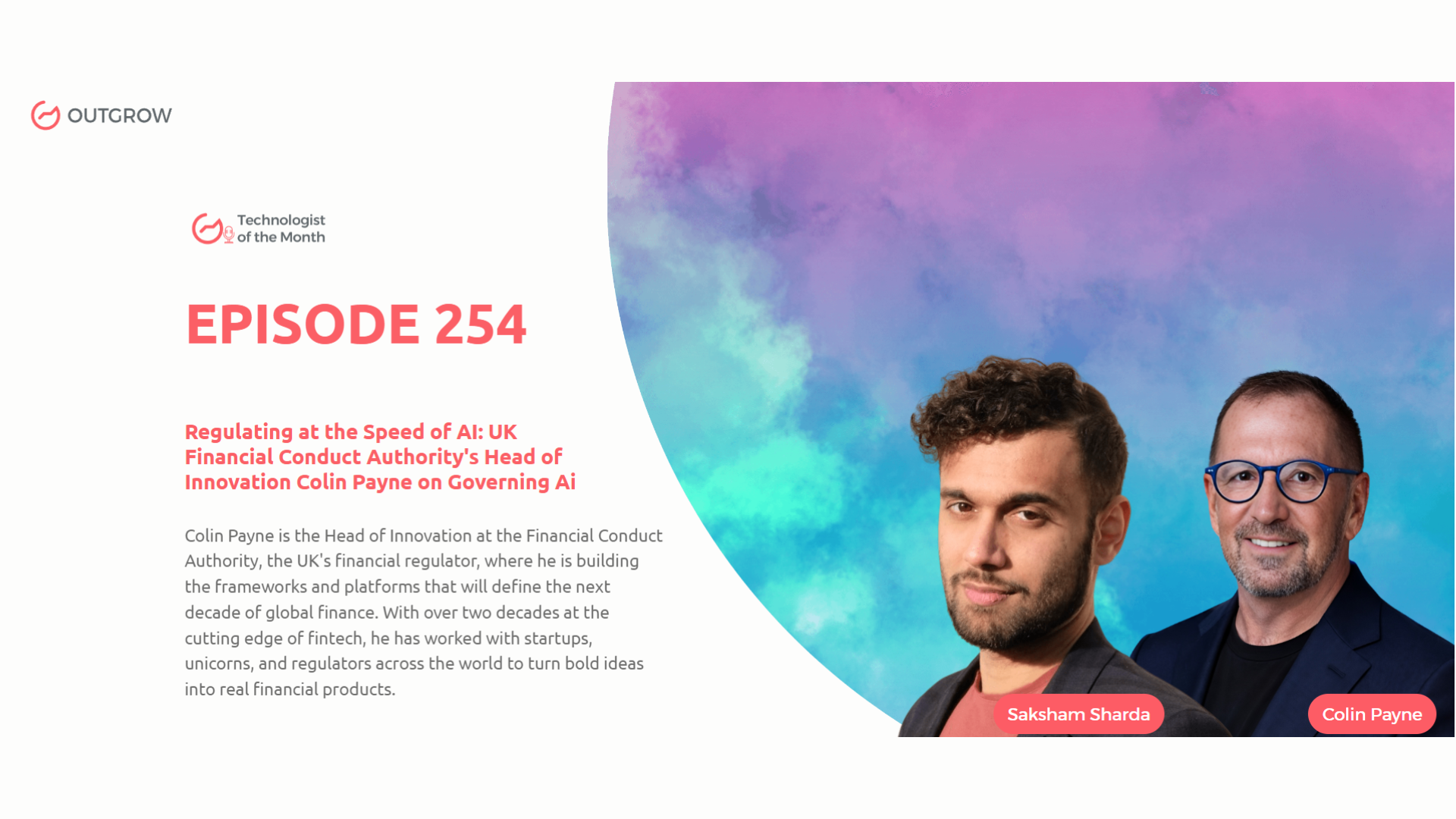
EPISODE 254: Marketer of the Month Podcast with Colin Payne
Table of Contents
Hey there! Welcome to the Marketer Of The Month blog!
We recently interviewed Colin Payne for our monthly podcast – ‘Marketer of the Month’! We had some amazing, insightful conversations with Colin, and here’s what we discussed about-
1. AI, data, and tokenization reshaping finance
2. FCA flexibility for fast-moving technology evolution
3. What regulatory credibility looks like globally
4. Transparency, traceability, and human oversight over machines
5. Companies compress development from years to months
6. Trust money without understanding the mechanics
7. Compute and expert guidance compress development
About our host:
Dr. Saksham Sharda is the Chief Information Officer at Outgrow.co He specializes in data collection, analysis, filtering, and transfer by means of widgets and applets. Interactive, cultural, and trending widgets designed by him have been featured on TrendHunter, Alibaba, ProductHunt, New York Marketing Association, FactoryBerlin, Digimarcon Silicon Valley, and at The European Affiliate Summit.
About our guest:
Colin Payne is the Head of Innovation at the Financial Conduct Authority, the UK’s financial regulator, where he is building the frameworks and platforms that will define the next decade of global finance. With over two decades at the cutting edge of fintech, he has worked with startups, unicorns, central banks, and regulators across the world to turn bold ideas into real financial products without ever compromising consumer protection.
Regulating at the Speed of AI: UK Financial Conduct Authority’s Head of Innovation Colin Payne on Governing AI
The Intro!
Saksham Sharda: Hi, everyone. Welcome to another episode of Outgrow’s Marketer of the Month. I’m your host, Dr. Saksham Sharda, and I’m the creative director at Outgrow. co. And for this month we are going to interview Colin Payne, who is the Head of Innovation at the Financial Conduct Authority.
Colin Payne: Great to be here. Thank you.
Don’t have time to read? No problem, just watch the Podcast!
Challenge yourself with this trivia about the exciting topics Colin Payne covered in the podcast.
Or you can just listen to it on Spotify!
The Rapid Fire Round!

Saksham Sharda: All right. We’re going to start with the rapid-fire round. The first question is, how long does it take you to get ready in the mornings?
Colin Payne: Five minutes.
Saksham Sharda: Most embarrassing moment of your life.
Colin Payne: There are so many to mention, I can’t even go there.
Saksham Sharda: Favorite color.
Colin Payne: Blue.
Saksham Sharda: What time of day are you most inspired?
Colin Payne: Probably something like 9:00 in the morning.
Saksham Sharda: How many hours of sleep can you survive on?
Colin Payne: Six or seven nowadays.
Saksham Sharda: The city in which the best kiss of your life happened.
Colin Payne: Definitely Barcelona.
Saksham Sharda: How do you relax?
Colin Payne: I play the piano.
Saksham Sharda: How many cups of coffee do you drink per day?
Colin Payne: One, and then matcha.
Saksham Sharda: A habit of yours that you hate.
Colin Payne: I’d say overthinking.
Saksham Sharda: The most valuable skill you’ve learnt in life.
Colin Payne: The piano.
Saksham Sharda: Your favorite Netflix show.
Colin Payne: Stranger Things.
Saksham Sharda: Are you an early riser or a night owl?
Colin Payne: Both.
Saksham Sharda: One-word description of your leadership style.
Colin Payne: Open.
Saksham Sharda: Coffee or tea to kickstart your day?
Colin Payne: Matcha.
Saksham Sharda: Top priority in your daily schedule.
Colin Payne: Creativity.
Saksham Sharda: Key factor for maintaining a work-life balance.
Colin Payne: I think love your work, love your life.
Saksham Sharda: Memorable career milestone.
Colin Payne: I guess sitting in Madison Square Gardens.
Saksham Sharda: A recent business innovation that caught your attention.
Colin Payne: Agentic.
The Big Questions!

Saksham Sharda: All right. That was the end of the rapid fire. Now we can move on to the bigger questions.
Colin Payne: That’s the toughest thing I’ve ever done all day.
Saksham Sharda: Everyone thinks regulators just show up and kill the fun, but you are literally called the head of innovation at a regulator. How does that job even exist?
Colin Payne: Yeah. It’s interesting, isn’t it? I always get asked this question. I think it exists because innovation done well is the unlock that we all need. So in a regulator, if you can balance that risk and the growth opportunity that good innovation gives you in a secure way, in a safe way for consumers, then you get the best of both worlds. I think everyone recognizes you need good regulation, but you also need good innovation to go with it. So that’s how it exists.
Saksham Sharda: Is protecting people and letting new ideas breathe a real tension, or just what companies say when they want to avoid accountability?
Colin Payne: I think it’s a real tension on the path to understanding what the product or the service is. It’s definitely real. Because actually you might start with the best of intention, but then as we’ve seen, products can evolve. And it’s not just the product evolving, it’s who’s using the product. So something like AI can be used for great good, but there are also bad actors that will employ it for something else. So that’s how the tension resolves out in the market.
Saksham Sharda: Crypto, digital wallets, tokenization, everyone throws these words around. What is actually changing for a normal person with a normal bank account?
Colin Payne: Yeah, I think it depends, really. It depends where you are, what you’re doing, what you’re interested in. For me, a lot of those terms are part of the digital transformation, so it’s still an arc that’s been going for many, many years. We’re now at a different point in that arc. But for areas like crypto, the FCA’s been very clear, we’re looking to have a safe crypto regime. And crypto is about offering opportunity to use digital banking services in different ways. It’s also about new products and services. So if we can deploy those safely, we’re happy for the man on the street then to look at those as options for his normal banking, his normal daily life, use, investment, or payments. I mean, that’s fine. But it has to be done safely.
Saksham Sharda: What is the one thing happening in digital finance right now that will actually matter in five years?
Colin Payne: I think it’s not just one thing. I think there’s a lot of things going on at the moment that are coming together. Everyone talks about AI. They have done for a year or two now, since obviously LLMs and those kind of open frameworks have come into play. I think it’s really important that exists and that continues to evolve. But if you add data and smart data and the unlocking of new ideas through good data, and then layer on top tokenization, you’ve got a very, very powerful change in those three technologies coming together. So I think that’s the stuff that’s going to really count. I think if you bring it together as something like agentic payments, that’s what you should keep your eye on over the next couple of years.
Saksham Sharda: You’ve sat across the table from garage startups and central banks. What does a founder in a basement understand about money that a central banker never will?
Colin Payne: I think sometimes it’s a bit of an unfair question in a way because the traditional banking capability has been established over 200, 300, 400 years, but has been willing to evolve and change very, very usefully over that period of time. It’s not as though it’s stayed static. And there’s been some great thinking in banking, traditional sense. But what a founder might do is just take a different perspective. Like any technology or like any new product, new service, if a genuinely entrepreneurial thought is in a founder’s mind They may come at it from a different angle. And I think that new angle, that new creativity, that new thinking just might unlock something for the customer in the future. And I think that’s where there’s a balance between the two. And often now you see entrepreneurs working within the banks, and I think that’s a great opportunity for the incumbent banks to think differently and think faster. And I think there are some examples that are just brilliant. So it can be done on both sides of the fence.
Saksham Sharda: So what do startups keep getting right about real people’s problems that big institutions keep getting wrong?
Colin Payne: I think startups tend to look at the customer experience first. So they’re very, very deeply concerned about what it feels like in the customer’s hand, what their product’s going to do, how it’s going to look, how it’s going to feel, how it’s going to be engaged with. Now, I think naturally, because they’re small and agile, they can respond very quickly to customer need and feedback. Now, that’s something more difficult for the larger established players to do. So again, learning from that, being able to look at a customer, look at what they’re looking for, respond to their needs, that’s something really as a lesson that’s being learned now from digital banking.
Saksham Sharda: AI is now deciding who gets a loan, who gets insurance, who gets flagged as suspicious. Nobody voted for that. Should people be worried?
Colin Payne: I don’t think it’s a necessary case of worrying about something like that. It’s a new technology. I think it’s fair to say that most of us are looking at that new technology as a positive in our lives. Certainly, most of the people that I know personally use it and get great benefit from it. I also don’t think it’s actually true that it’s making those decisions across the board. It’s very early days. We’re using AI, and we see the use of AI as a real benefit technology. But we’re definitely keeping an eye on how those decisions are made. So there’s often going to be a response where we want to understand why decisions have been made. We want to be able to track them. We want accountability. We want traceability. We want polarity. And in fact, we want the same outcomes. The FCA is an outcomes-based regulator, so we have principles like consumer duty, like the senior management regime. We hold those responsible in that chain for what the technology is doing. So we don’t expect people just to deploy AI and forget about it and to let all the decisions be made by a machine. It has to be quality decision-making, which is accountable, safe, and secure for the user. That’s what we’re really concerned about.
Saksham Sharda: And how do you even write rules for something that learns and changes faster than any rule book can keep up with, like AI?
Colin Payne: Well, it’s a great question. The beautiful thing about the FCA is we’re not a rules-based regulator. We’re a principles-based regulator looking at outcomes. So actually, we’re clearly saying we’re not writing new rules for these technologies because they’re changing so fast. Now, that’s a little different to some of our colleagues elsewhere in the world who do have rule sets around them. We believe to be sustainable in this new emerging technology, you have to be flexible. So that’s why we don’t write the rules in that way. We will offer guidance, we will allow those firms to come into our sandbox to experiment, and we will give them the regulatory comfort with what they’re doing to allow them to proceed. But it’s based on our principles-based analysis and the outcomes focus that we have.
Saksham Sharda: So as you say, you work for a regulator, but you have to convince the world’s best innovators to trust you. How do you sell a government body as the place to bring your wildest ideas?
Colin Payne: What a great question. Well, we’re obviously independent. We work with the government. So for us, having a little bit of that independence, those conversations are different. So for example, I’ve already mentioned the AI Lab. We went to industry, and we decided to work with industry to create the best AI lab a regulator has anywhere in the world. And we did that last year, and it continues to evolve. It continues to be the cutting edge. And actually, what we’ve found is when we’ve gone out to industry and said, “Look, come and work with us. We’ve got this great data set. We’ve got this great capability, fantastic compute that you can use,” we’ve had them knocking on our doors ever since. And we’ve just closed our second cohort of our AI lab, and it’s massively oversubscribed. And the names that are coming to us are really credible. So we have no difficulty attracting those who want to work with us because they see at the end of the day that quality regulations and working with the best regulator in the world is going to be a benefit to them.
Saksham Sharda: And what does it take to make a startup founder call a regulator before they launch something risky?
Colin Payne: Well, I think it’s an openness to the conversation. We’re clear that we have a risk tolerance, so our risk tolerance definitely is public. And we are prepared to have that discussion about where risk lies. But for us, the best way of understanding a new technology and whether there is a risk that’s real or not is to work with us in the lab. So if an innovator or someone who’s really interested in deploying a new technology wants to really get that benefit of our experience, we just invite them to come in and work with us. And they really appreciate that. So I think it’s the best way to do it.
Saksham Sharda: So speaking of the best way to do it, you call the FCA’s innovation team the gold standard globally. How do you back that up when Singapore, Dubai, and the EU are all saying the exact same thing?
Colin Payne: Yeah. We don’t need to necessarily shout about what we do. I do call us a gold standard because I do believe what we have done in the past speaks volumes about our capability. But you’ve seen what we’ve done in the last year, the deployment of AI labs, the deployment of the scale-up unit, all of these practical labs that we’ve actually announced and then delivered speak about our capability. The perimeter of the UK has been well known to be one of the best on the planet. So I have no hesitation in being able to back up with data what we do. And our friends in Singapore we work with a lot of the time, our friends in Dubai, you mentioned a number. I’m the chairman of GFIN, the Global Financial Innovation Network, so I’m constantly working with other global regulators as the chair of that body. So I’m quite confident in saying that we are one of the leaders in that pack. But it’s not a competition. It’s about bringing everyone with us. I can’t wait to see every regulator in the world operating at the gold standard because that protects everyone, it’s interoperable, and it makes life better for all of those entrepreneurs out there releasing their products.
Saksham Sharda: And what does global credibility actually look like in this space, and how do you even measure it?
Colin Payne: I think really it’s about the quality of firms that you authorize in your perimeter. It’s about the quality of the deployment technologies that you’re allowing to work with your firms. And absolutely essentialy for us, it’s the outcome at the end of the day. Are your consumers benefiting from all of those innovations? Are they getting a better experience? Are they enjoying their banking experience more? Is it safer for them? Are we doing the things that really consumers expect of us and firms expect of us? Ultimately, is the UK benefiting from the work that a regulator does? And that’s really going to be our data point.
Saksham Sharda: All right, let’s change track a bit. Tell us about your typical workday. You wake up in the morning, is it emails? Is it meetings? Is it exercise? What do you do?
Colin Payne: Yeah. It’s pretty varied for me. The interesting thing about my work is that it’s pretty intense. The diary is full, so there’s a lot of interaction with stakeholders, whether that be government, whether that be other regulators, whether that be firms. But generally, most of what I do is working with my team. I’ve got a great team, and of course, I’m trying to lead that team in a clear, responsible way to deliver services into our firms and into our customer base. So of course, my days vary. Probably every single day is different. There are a lot of emails that come to me. I’m sitting here at Money 2020 slightly terrified of looking at my email stack when I get home, because there will be hundreds. And they’re important. It’s not as though it’s spam. So they’ve got to be dealt with, but I’m really glad to say I’ve got the most fantastic team that support me. And really it’s them that do the hard graft, the real work. And what I can do is engage with the community, I can understand what the future needs are, and I can feed those back into the FCA and into my team and direct that for the future. So, every day is different, every day is a challenge, but I really love it.
Saksham Sharda: All right, so money is becoming invisible. You tap your phone and it’s done. Most people have no idea what is happening underneath it. Should they care?
Colin Payne: Well, I don’t think they should concern themselves with the mechanics underneath the money because I think probably for the last two or three decades, they won’t have understood what’s happening in the background. Because as digitalization has happened, there’s been a great deal of work in the background to make sure money moves seamlessly. I mean, the idea now that I can move money accounts to account within seconds, and I do it at very, very low fee, almost at spot rate if it’s going overseas, it’s incredible. It would’ve been unheard of two decades ago. Now, as a practitioner, as a user, of course, I understand the mechanics behind that. But if I were to be really concerned about that in my day-to-day, I probably don’t think I would be going into a coffee shop thinking, “What’s happening when I use my tap and go? What’s happening if I’m going to use another form of payment?” It really doesn’t care from my point of view. If I’m getting the product, the money’s coming from my account and it’s going to the right account, it’s safe, it’s secure, it’s authorized, and it’s consented. All of that I think is really something for the concern of the firm delivering it. So consumers, I think, would just want simplicity. They want clarity, and they want to understand where their money is going, and it’s going to the right people. So, I think it’s actually still as simple as it always used to be with money.
Saksham Sharda: So when payments become instant and invisible like this, who actually wins? The person spending or the system collecting the data?
Colin Payne: Well, that’s an interesting question. I would hope that the person who owns the data, which is the consumer, would benefit from the data. So we’re looking at the future of open finance at the moment. And that’s a really interesting one because open banking has shown that by connecting data and connecting transaction data, you get real benefit. So we are looking forward to a world where you can connect all of your financial data, whether that’s investments, pensions, mortgage, everything about your financial life. Can that open up opportunities for you to have new products and services that are more suited to what you need? And I think that’s going to be a massive benefit. It’s a quid pro quo, of course, because you do have to have a firm that is in business providing that service. So as long as we think there’s competition in the market, which is a healthy thing, we have got a competition mandate. And as long as the consumer is protected as that technology develops, then I’m perfectly happy for all of them to benefit from that. It’s the ultimate win-win in terms of financial services.
Saksham Sharda: So it seems that you say that the future of finance is not just coming, you are building it. What does that actually feel like for someone who just wants to pay their bills and not get ripped off?
Colin Payne: It should be transparent. That’s the key issue with finance. You should really understand how much is in your account. If you’re going to send it to someone, it should be quick, easy, low cost, and it should arrive at that other person’s account without any diversion or di- confusion, and you should be charged a fee that you recognize the fee structure, and you understand why it’s being charged for the action that you’re taking. So, it’s about transparency. It’s about consent. You should always have the consent behind anything you’re doing in financial services. Because as digitalization has taken over from most of our habits online, it does become faster, so you do have to have the right guardrails around things that are going on. But ultimately, if it goes wrong, what we’re concerned about is what are the firms doing to fix that? So if you have a mistake or if there’s an error in the technology, or worse, there’s a scam or a fraud, what steps are in place to protect you? How are you going to be safely taken through that response and the refund if necessary? So I think there’s a real balance where you’re using technology for good and it’s benefiting, again, it’s benefiting the consumer, and that it’s a completely transparent journey that they’re on.
Saksham Sharda: If you could guarantee one thing about the future of money that would make ordinary people’s lives better, what would it be?
Colin Payne: I think guaranteeing something about money is that it can always be safely and securely stored. You can get access to it when you need it, and it will be used in the best way possible for your situation. So in other words, if you can maximize and optimize the money that you do have, whether that be paying down debt, whether that be investing in the secure way that you are happy with, or whether that be indeed taking any element of risk that you are happy with. I think it’s down to education. I think we need better financial education. I would love to see people being more confident and aware of what they have as their money, how they use it, how they deploy it, how they invest it, and how they grow it. That’s what I’d like to see the future of money.
Saksham Sharda: You built something called a supercharged sandbox where AI companies can test their ideas inside a real regulatory environment. What happens in there and why does it matter that it exists?
Colin Payne: Yeah, the supercharged sandbox we called really because we’ve run sandboxes for some years, and they’ve been very successful. We have a regulatory sandbox, which is an environment where we can help firms understand the regulatory process. We can give them some testing structures where they can go to their customers, and they can test a new product or service, and they get the comfort from us that it can go forward. The digital side of our sandbox is really interesting. It’s where we can synthesize data, we can test proof of concept, pilots, prototypes, and we can really test those structures before they get to the market, before they get to customers. So we took the natural sort of path from our digital sandbox, and we supercharged it. That’s why we called it the supercharged sandbox. We gave it really good compute, so we worked with NVIDIA to improve the compute that we offer, which is GPU compute and CPU compute. We work with partners like AWS to give credits so that those firms that come in are on an equal playing field to the bigger firms that have bigger budgets. And we can use our data, which is obviously, you can imagine our synthetic data is pretty sophisticated. So they can really test an environment which it amplifies the work they’re doing to show if it’s going to work in the future or not. Now that’s a really beneficial scenario for most firms because it accelerates their route to live. Suddenly you get this situation where something that might have taken a year to develop in the background, we can accelerate and get it to a point where it’s ready for a live deployment or a live test in a matter of months. So I think that from a founder’s point of view, shortening the time to market is kind of key for them because that’s where they’re burning their cash. We can help them with that problem. We can also give them the expert advice from the regulator’s perspective.
Saksham Sharda: Is giving AI companies access to real financial infrastructure to experiment with a brave idea or a slightly terrifying one?
Colin Payne: I firmly believe that experimenting with environments that replicate where you’re going to end up is not brave and it’s not reckless. It’s neither of those things. It’s actually highly sensible, highly logical. Most of these firms haven’t operated in regulatory environments. So one of the biggest barriers to any firm coming into our world is dealing with the regulator, dealing with the regulation, dealing with our handbook. So if they can get exposure to that early and to understand the questions we might be likely to ask them, it really helps them. So it’s a conversation with those who are going to look after you in the future. I think because we do it safely, we do it within an environment which doesn’t touch the market, doesn’t touch real customers, you’re really in the safest world possible. It’s a little akin to testing medical devices and drugs in a similar kind of way before you get to human trials. So it’s part of that heritage of sensible experimentation.
Saksham Sharda: You judged the UK Fintech Awards and said the energy in the room reminded you why British Fintech is still special. What actually makes an idea stand out when you have seen thousands of them?
Colin Payne: Yeah, they do stand out. They stand out really clearly. The idea of creative thinking, it often shines above anything else. So the idea of taking a potential problem or a pain point for a consumer, when someone’s worked that through and come up with some kind of route through that where they might deploy actually quite common technologies. You might have seen elements of it before. But put together and then applied in a particularly new context, it’s just magical. And when you see the customer enjoy it, engage it, interact, and have that moment of truth, I don’t think there’s anything better than seeing that happen.
Saksham Sharda: All right, so the last question for you is of a personal kind. What would you be doing in your life if not all this?
Colin Payne: Well, I kind of joked that I’d already retired. It was a kind of semi-joke. I did retire. I’ve come back to this through choice. So I really, really enjoy what I’m doing. I really enjoy working with this industry. I love the people in it. I love the whole energy, the vibe.
Saksham Sharda: What’s there not to like about engaging in something that’s changing the world? And I see it happening, playing out with my friends and my family. I see them benefit from some of the stuff we do. And when you really are doing something of purpose, something that’s really important to you,
Colin Payne: There’s nothing else that touches it. So that’s why I’m back. That’s why I’m doing this. And I can balance my life. I can still do stuff that I love around the outside of this as well. But it’s about having a balanced life, doing what you enjoy, and doing something with a purpose.
Let’s Conclude!
Saksham Sharda: Thanks, everyone for joining us for this month’s episode of Outgrow’s Marketer of the Month. That was Colin Payne, who is the Head of Innovation at the Financial Conduct Authority.
Colin Payne: Great to be here. Thank you.
Saksham Sharda: Check out the website for more details and we’ll see you once again next month with another marketer of the month.

I am a Digital Marketing Enthusiast with a passion for optimizing content and paid marketing strategies. Continuously seeking innovative approaches to boost ROI and engagement at Outgrow.