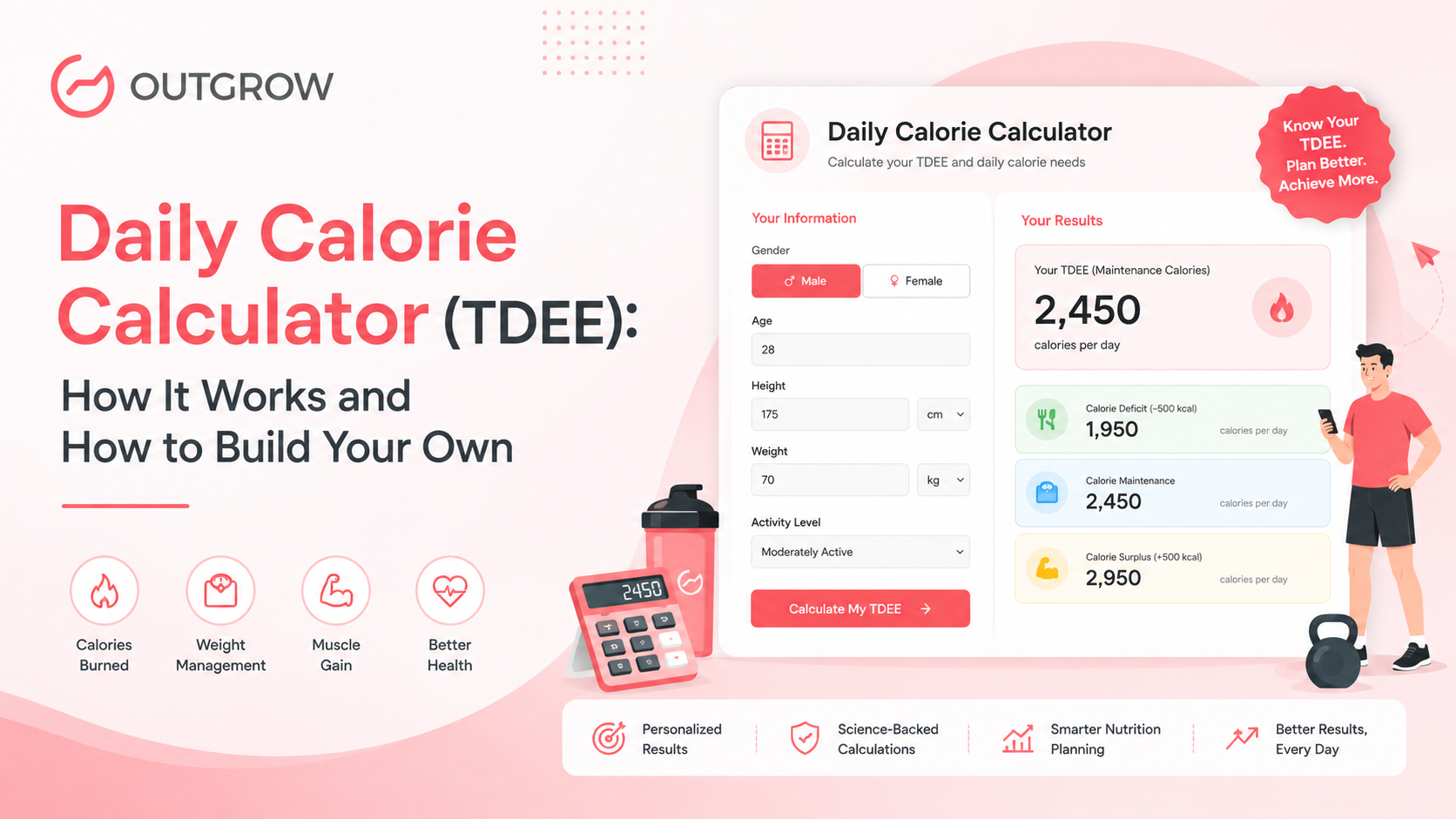
Total Daily Energy Expenditure (TDEE): How It Works and How to Build One With Outgrow
If you’ve ever searched for “how many calories should I eat,” you have probably found a Total Daily Energy Expenditure calculator, which is also called the daily calorie calculator. This calculator uses a few basic pieces of information, including your age, weight, height, and interest level, to estimate how much energy your frame needs each day.
In this guide, we’ll explain what TDEE means, how a daily calorie calculator works, the formula used to estimate daily calorie needs, and how you can create your own branded calculator with Outgrow.
What Is Total Daily Energy Expenditure (TDEE)
Table of Contents
TDEE stands for Total Daily Energy Expenditure. That’s all the energy your frame burns throughout the day, covering a lot from moving limbs to digesting food to climbing stairs and hiking in your car.
TDEE is made up of a few small parts:
- Basal metabolic rate (BMR): Calories burned at rest, just to stay alive
- Thermal effect of food (TEF): Calories burned by digesting and processing what you eat
- Non-Exercise Thermogenesis (NEAT): Calories burned through regular exercise such as walking, running, or standing
- Exercise Activity: Calories Burned Through Deliberate Exercise Programs
Add all of that up, and you get TDEE; that’s a variation most vitamin plans are made up of rounds.
What Is a Daily Calorie Calculator?
A Daily Calorie Calculator is a small, interactive experience that estimates how much energy a person wants to consume each day to reach a specific goal. Instead of counting on a simple recommendation like “eat 2,000 calories a day,” consumers get different things based on their own body and lifestyle.
The calculator above, from Calculator.net, is an awesome real example. It asks for a small set of inputs, produces results almost immediately, and requires no manual math.
Why TDEE Matters for Daily Calorie Needs
Registered dietitians, certified trainers, and fitness brands rely on TDEE as the place to start with nearly every nutrition plan:
- Losing weight
- Maintaining a modern weight
- Building muscle
- Improved Athletic Overall Performance
Once someone is aware of their TDEE, they have a wide range of base calories to build on. A caloric deficit for fat loss or a caloric surplus for muscle gain is calculated relative to that baseline and is no longer evaluated. Without it, most calorie goals are just harsh guesses that don’t account for the person’s weight.
BMR vs. TDEE: What’s the Difference?
These two terms are used interchangeably, but they are no longer the same.
- BMR (Basal Metabolic Rate) is the range of calories your frame burns at rest, just for organ function, breathing, and blood flow
- TDEE (Total Daily Energy Expenditure) only takes that rest and provides calories burned through daily movement, exercise, and digestion.
In short, BMR is the starting point, and TDEE is the complete picture. A calorie counter usually calculates BMR first, then multiplies it by the side of interest to get TDEE.
What Factors Affect Your TDEE?
TDEE is not always constant. It changes completely based on several individual factors, which is why a wide range of calories does not make the picture clear:
- Age: As people age, metabolism tends to happen gradually
- Gender: Men generally have excess muscle tissue, which increases BMR
- Height and weight: The larger our bodies, the more calories we generally burn at rest
- Muscle mass: Muscle burns more calories than fat at rest, so body composition has a lot like total weight
- Activity level: Every prioritized exercise and daily activity (NEAT) adds
- Sleep and stress: Poor sleep and ongoing stress can affect metabolism and hunger cues
- Genetics and hormones: Thyroid Traits and Various Hormonal Factors Can Shift Metabolism up or down
The calculator cannot measure all of this immediately, which is part of the reason why the result is handled as a strong guess instead of a satisfactory actual determination
How a Daily Calorie Calculator Works
The calculator gathers some key information and runs it through a long-term formula to estimate caloric requirements. Here’s what it usually asks for.
1. Basic Information
Age, gender, height, and weight. These are average intakes used to calculate BMR.
2. Activity Level
Users choose how active they are on a daily basis, from sedentary to very active. The final range of this term has one of the biggest implications of all because it determines the multiplier used in BMR.
3. Goal Selection
Some calculators even ask if the user wants to lose weight, maintain weight, or gain weight, and then modify the very last calorie recommendation accordingly.
Once the form is submitted, the calculator returns the expected calorie change per day, broken down into standard maintenance, soft deficit, and more competitive deficit or surplus options.
TDEE Activity Levels Reported
Activity level is usually the single biggest lever in a TDEE calculation. Most calculators use categories similar to these:
Activity level is generally the single biggest lever in the TDEE calculation. Most calculators use the same classes:
- Sedentary: Little or no exercise, a desk job, minimal daily movement
- Lightly active: Light exercise or sports activities one to 3 days a week
- Moderately active: Moderate exercise or sports activity four to five days per week
- Very active: Hard workouts six to seven days a week
- Extra active: Very hard daily exercise or physically traumatic work, mixed with education twice a day occasionally
Choose appropriate class topics. Someone who overestimates their amateur designation will have a TDEE that is excessive, which can lead to weight loss or sudden weight gain over the years.
The Formula Behind TDEE
Most current calorie calculators make use of the Mifflin-St Jeor equation, which is generally considered to be more accurate than the older Harris-Benedict components and is the equation increasingly supported by registered dietitians today.
For men: BMR = (10 × weight in kg) + (6.25 × height in cm) − (5 × age in years) + 5
For women: BMR = (10 × weight in kg) + (6.25 × height in cm) − (5 × age in years) − 161
Once BMR is calculated, it is expanded through the hobby factor to get TDEE:
- Sedentary (little or no exercise): BMR × 1.2
- Lightly active (1-3 days/week): BMR × 1.375
- Moderately active (4-5 days/week): BMR × 1.55
- Very active (6-7 days/week): BMR × 1.725
- Extra active (physical job or twice-daily training): BMR × 1.9
Displaying such a method in a transparent way, rather than treating the calculator as a black box, builds persuasive acceptance with visitors and gives a clear signal to search engines that the content is accurate and well-sourced.
How to Calculate TDEE Step-by-Step Guide
Here is the technique from start to finish, using Mifflin-St Jeor components above.
Step 1: Calculate BMR. Plug your age, gender, height, and weight into the Mifflin-St Jeor formula to get your baseline resting calorie burn.
Step 2: Be honest about how much you circulate in a typical week, not how much you suggest running.
Step 3: Multiply BMR by your element of interest. Use the multiples indexed in the Activity Levels section above. This gives you your TDEE, your predicted maintenance energy.
Step 4: Adjust for your goal
- To lose weight, subtract about 250 to 500 calories from TDEE for a moderate deficit to lose weight
- To gain weight or build muscle, add about 250 to 500 calories to gain weight and build muscle or get a moderate surplus
- Eat within your TDEE to maintain your goal
Step 5: Monitor your weight for 3 weeks and keep it stable. If things don’t go as planned, change your calorie goals in small increments rather than drastic restrictions.
What Your TDEE Result Means
A TDEE variation is automatically just a savings estimate, a calorie variation that should keep your weight somewhat stable. Which goal you approach depends on:
- Eating on TDEE has solidified weight loss over the years
- Eating less than TDEE leads to a calorie deficit, which ultimately leads to weight loss.
- Eating more than your TDEE creates a caloric surplus that helps you gain weight and muscle
It is important to remember that TDEE is an estimate, not a guarantee. Actual results depend on how the number is consistently monitored and how the frame responds over time.
TDEE for Weight Loss, Maintenance, and Muscle Gain
Once the TDEE is established, the next step is to figure out how to use it entirely based on the goal.
Weight loss: A small energy deficit of 250 to 500 below TDEE equivalent for the day generally helps with slow, sustainable fat loss without promoting asymmetric hunger or muscle damage
Maintenance: Eating at or near TDEE maintains weight. This is often the case when a person has reached a goal weight or really wants to maintain their contemporary body.
Muscle Gain: A slight excess of 250 to 500 energy above TDEE, combined with resistance training, helps with muscle growth while limiting excess fat gain
The exact method varies from person to person, and this is one case where working with a registered or licensed dietitian can help to quality-adjust the numbers
How Accurate Are Daily Calorie and TDEE Calculators?
TDEE calculators are estimates, not specific measurements. Mifflin-St Jeor components are considered one of the additional reliable predictive equations available, but still population-based, quite general, not a direct dimension of the metabolism of any single individual.
A few things that could make the estimate much less accurate:
- Abnormally excessive or decreased muscle tissue compared to normal
- Diseases affecting metabolism, such as thyroid
- Inaccurate Self-Adjusted Interest Title
- The natural daily variation of how the frame burns energy
The most accurate approach to the level of caloric burn is indirect calorimetry, a medical test that most humans do not have access to. For general use, the TDEE calculator provides a robust starting estimate that could then be adequately adjusted based primarily on actual results over several weeks.
How Often Should You Recalculate Your TDEE?
TDEE is not a disposable car. Under these circumstances, it’s worth recalculating:
- Weight changes every 5 to 10 pounds, taking into account changes in BMR as body mass changes
- When the level of play is significantly adjusted, such as starting or stopping training programs
- About every few months, even without significant changes, to account for the slow changes
- After a tremendous turnover of muscle tissue, given that muscle affects caloric burning at rest
Regular conversion is likewise one of the most important reasons why those tools see repeat visits as opposed to one-time use.
Why Interactive Tools Like a Daily Calorie Calculator Work So Well
1. Instant Personalization Calculators give customers a crowd built around their own framework and playing levels rather than a general guiding principle.
2. It takes much less than a minute to fill out a low-effort, high-value form, and its benefit is a completely useful solution. That ratio is tight.
3. Repetition: Weight, activity level, and desires change with age, so people come to count again and again. That repetitive behavior drives site visitors in the long run.
4. Natural lead generation: Health and fitness brands usually gate compliance plans on the back end to cope with special results, food signals, or email, making a simple calculator straight to a lead-generation machine.
5. Shareability: Calorie and TDEE effects are shared in health communities, sent to friends, and referenced in educational conversations, bringing in more organic visitors.
How Popular Are Daily Calorie Calculators? (Traffic Insights)
Source: SimilarWeb
Calorie calculators are always some of the most visited tools in the health and fitness field. On average:
- These tools pull heavy, stable search volume 12 months around, with significant increases in January and before the summer
- Visitors generally stay on the site longer than usual, given that they check through the results and indicators
- Returns are not uncommon as consumers recalculate after weight changes or new health dreams
- Calorie calculators are often linked and linked to other fitness and nutrition content, facilitating natural search ratings.
These numbers make the case for why the calorie counter is one of the most reliable interactive content codecs that can create a health or health icon.
How to Create a Total Daily Energy Expenditure (TDEE) Using Outgrow
With the Outgrow Interactive tool, you can build your own branded version without writing a single line of code. Here’s how.
1. Sign Up on Outgrow
Create a free account in Outgrow and open the calculator builder. If you already have an Outgrow account, go to your dashboard.
2. Choose Your Format
Select “Calculator” on your dashboard. Outgrow offers well-prepared templates for health and fitness calculators, or you can start with a blank canvas.
3. Customize the Look and Feel
Match the calculator to your brand:
- Add your logo
- Use your brand colors
- Set the tone of voice, whether therapeutic, motivational, or friendly
An accessible, on-brand design keeps the final bids high.
4. Build the Formula
This is in the middle of the counter. Establish good judgment using the already retained Mifflin-St Jeor equation, then map each input range- age, sex, height, weight, and activity phase- into the calculation.
Outgrow’s component builder will help you set this up without the need for a developer.
5. Add Your Input Fields
Keep the form short and focused. The essential items for a calorie counter are:
- Age
- Gender
- Height and weight (with unit conversion to metric or imperial)
- Activity Title
- Goal (lose, maintain, or gain weight)
Some areas are usually the better way to pay completion fees, so stick to what’s important for an accurate result.
6. Design the Results Page
Once someone submits their files, give them clean, profitable results. Good sites of influence include:
- Expected Daily Calorie Variation
- A brief explanation of what the method is
- Optional breakdown for defense, soft attack, competitive attack, or surplus
- A small disclaimer noting the result is speculation, not medical advice
- A call involving booking a session or downloading a meal plan
7. Embed, Share, and Analyze
Once your calculator is live, you can:
- Embed it on your website
- Add it to blog posts
- Share it on social media
- Promote it through email campaigns
Then use Outgrow’s analytics to track completion rates, drop-off points, and which activity levels or goals are most common among your users. Those insights help you refine the calculator and the content around it over time.
Final Thought
A Daily Calorie Calculator does more than spit out a selection. It gives traffic a reason to interact with your brand, an authentic reason to close their email appointment, and an incentive to come back later as they shop for their desires. For fitness trainers, nutrition brands, supplement companies, and health platforms, that combination is hard to detect in any other content material design.
With Outgrow, you can build a calculator like this without a developer, launch it in days instead of weeks, and start using it to capture and qualify leads right away.
Ready to build your own calorie calculator? Start exploring Outgrow, no code necessary, and provide your target audience with a tool they’ll genuinely want to use.
Frequently Asked Questions About the Daily Calorie Calculator
It’s a tool that estimates how many calories a person needs to eat each day based on details like age, gender, height, weight, and activity level.
TDEE stands for Total Daily Energy Expenditure. It’s the total number of calories a person burns in a day, including rest, digestion, and physical activity.
General guidelines don’t account for individual differences. A TDEE calculator gives a number tailored to a person’s actual body and lifestyle, which makes it far more useful for setting realistic goals.
Most use the Mifflin-St Jeor equation to estimate BMR, then apply an activity multiplier to calculate TDEE. It’s widely regarded as more accurate than the older Harris-Benedict formula.
Base it on your actual weekly routine, not your goals. Someone who works out three times a week but sits at a desk the rest of the time is usually lightly to moderately active, not very active.
No. People use TDEE calculators for weight loss, muscle gain, and simple weight maintenance. Athletes and coaches also use them to plan nutrition around training cycles.
The results are estimates based on established formulas, not exact measurements. They’re a strong starting point, but actual calorie needs can shift based on metabolism, muscle mass, and other individual factors, so most people adjust over a few weeks based on real results. This tool does not replace advice from a doctor or registered dietitian.
Recalculate after every 5 to 10 pounds of weight change, after a significant shift in activity level, or roughly every few months even if nothing major has changed.
Yes. Many brands show a summary result for free and offer a detailed breakdown, meal plan, or coaching consultation in exchange for an email address.

Ankit Upadhyay is a Digital Marketing and SEO Specialist at Outgrow. With a passion for driving growth through strategic content and technical SEO expertise, Ankit Upadhyay helps brands enhance their online visibility and connect with the right audience. When not optimizing websites or crafting marketing strategies, Ankit Upadhyay loves visiting new places and exploring nature.