Summarize with :
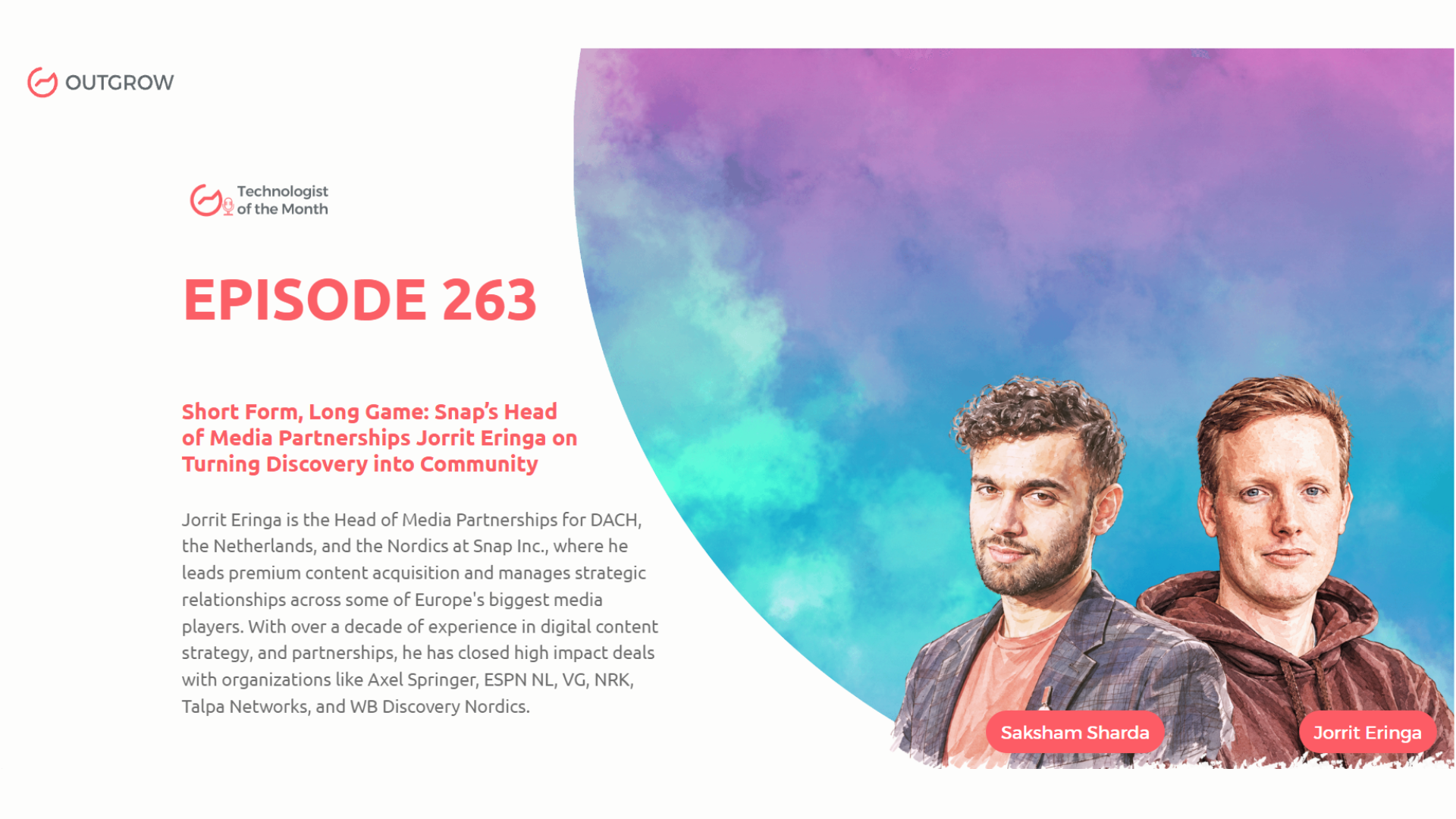
EPISODE 263: Marketer of the Month Podcast with Jorrit Eringa
Table of Contents
Hey there! Welcome to the Marketer Of The Month blog!
We recently interviewed Jorrit Eringa for our monthly podcast – ‘Marketer of the Month’! We had some amazing, insightful conversations with Jorrit, and here’s what we discussed about-
1. Why helping creators find audiences beats fighting for attention
2. What makes advertising feel natural instead of intrusive
3. Content that wins in one market and flops next door
4. Creators as a new layer, not a replacement for media
5. Why shrinking attention spans might be a myth
6. How short-form Spotlight videos lead audiences into longer Stories
7. What media partners and creators each bring to the table
About our host:
Dr. Saksham Sharda is the Chief Information Officer at Outgrow.co He specializes in data collection, analysis, filtering, and transfer by means of widgets and applets. Interactive, cultural, and trending widgets designed by him have been featured on TrendHunter, Alibaba, ProductHunt, New York Marketing Association, FactoryBerlin, Digimarcon Silicon Valley, and at The European Affiliate Summit.
About our guest:
Jorrit Eringa is the Head of Media Partnerships for DACH, the Netherlands, and the Nordics at Snap Inc., where he leads premium content acquisition and manages strategic relationships across some of Europe’s biggest media players. With over a decade of experience in digital content strategy, partnerships, and program management, he has closed high impact deals with organizations like Axel Springer, ESPN NL, VG, NRK, Talpa Networks, and WB Discovery Nordics.
Short Form, Long Game: Snap’s Head of Media Partnerships Jorrit Eringa on Turning Discovery into Community
The Intro!
Saksham Sharda: Hi, everyone. Welcome to another episode of Outgrow’s Marketer of the Month. I’m your host, Dr. Saksham Sharda, and I’m the creative director at Outgrow. co. And for this month, we are going to interview Jorrit Eringa, who is the Head of Media Partners for the Benelux and Nordics at Snapchat
Jorrit Eringa: Great to be here. Thank you.
Don’t have time to read? No problem, just watch the Podcast!
Challenge yourself with this trivia about the exciting topics Jorrit Eringa covered in the podcast.
Or you can just listen to it on Spotify!
The Rapid Fire Round!

Saksham Sharda: Let’s start with the rapid-fire round to break the ice. The first question is, at what age do you want to retire?
Jorrit Eringa: Seventy.
Saksham Sharda: How long does it take you to get ready in the mornings?
Jorrit Eringa: Twenty minutes.
Saksham Sharda: Most embarrassing moment of your life?
Jorrit Eringa: I don’t know.
Saksham Sharda: Favorite color?
Jorrit Eringa: Blue.
Saksham Sharda: What time of day are you most inspired?
Jorrit Eringa: Early afternoon.
Saksham Sharda: How many hours of sleep can you survive on?
Jorrit Eringa: Four.
Saksham Sharda: How do you relax?
Jorrit Eringa: Workout.
Saksham Sharda: How many cups of coffee do you drink per day?
Jorrit Eringa: Three.
Saksham Sharda: A habit of yours that you dislike?
Jorrit Eringa: Overthinking stuff.
Saksham Sharda: The most valuable skill you’ve learned in life?
Jorrit Eringa: Understanding someone’s perspective. Sorry, it’s a bit long.
Saksham Sharda: Early riser or night owl?
Jorrit Eringa: Early riser.
Saksham Sharda: One-word description of your leadership style?
Jorrit Eringa: Collaborative.
Saksham Sharda: Coffee or tea to kickstart your day?
Jorrit Eringa: Coffee.
Saksham Sharda: Top priority in your daily schedule?
Jorrit Eringa: Checking in with my media partners, creators, and my colleagues.
Saksham Sharda: Ideal vacation spot for relaxation?
Jorrit Eringa: A beach city.
Saksham Sharda: Key factor for maintaining a work-life balance?
Jorrit Eringa: Trying to maintain boundaries.
Saksham Sharda: A memorable career milestone?
Jorrit Eringa: Launching a creator bootcamp.
The Big Questions!

Saksham Sharda: Everybody’s fighting for attention these days. What’s that actually like as your job?
Jorrit Eringa: When I work with creators and media partners, I don’t think it’s fighting for attention that much. It’s much more about helping them and equipping them to really understand how to find an audience, generally speaking. So when I, for instance, work with a content creator locally, my job really revolves around basically helping them out to understand, like, “Hey, how can you find a meaningful audience on the platform? What are some of the things that you need to pay attention to when it comes to your content? How can you optimize it in the best possible way?” And then I think if we would flip the question also to me, like how they work with me, it’s like a lot of the content creators and media partners that I work with, I’ve been working with them for many years now, and so they know their audience really well. They know the platform really well. So, from time to time, they just need to check in with me like, “Hey, how can I utilize this new product?” Or, “What is this new update?” And like, “How should I think about this?” So, I don’t think creators and media partners are also on a day-to-day level, not really fighting for my attention. It’s more a collaborative experience, basically, that I have with them.
Saksham Sharda: And has your own taste in content changed since you started doing all of this?
Jorrit Eringa: Well, there’s certain things I still enjoy watching. I still enjoy watching challenges videos. I enjoy watching things that revolve maybe around my interests, like music or that type of stuff. But one of the things that I think is very fun, and when starting to work with Snap, is that the unpolished, more raw kind of type of content. I think I wasn’t maybe so attuned to that before. So, that is something I really enjoy, just seeing what content creators and media partners basically make very much the type of behind-the-scenes content. And that is something that I really value from the type of content that they create.
Saksham Sharda: You’ve sat in the room for deals with giants like Axel Springer and ESPN. Ever had a moment where you thought, “Nobody here actually knows what they’re doing”?
Jorrit Eringa: No. I mean, when you work with media partners, I think a lot of the time, it’s more like they know their kind of fields really well, and what I then come into is basically to explain them how our platform works and how basically they can create content for our platform or how they can adapt basically our content to our platform. So, it’s in that kind of nature, it’s quite collaborative. It’s in basically exchanging of ideas. It’s really educating them on how you can succeed, so what are content best practices to pay attention to, what are features that they can leverage to enhance their content. And there are some media partners that you’ve been working longer with or that are maybe more leaned into digital stuff, where this is almost really second nature and they take off immediately. And there’s some others that are maybe a little bit less digital savvy, and you basically then work a lot more with them just to really help them basically how to find success on the platform.
Saksham Sharda: And then talking about the other side then, are people rejecting advertising or just bad advertising?
Jorrit Eringa: So, I think the most successful advertising is basically if it kind of makes sense in the context that you’re watching it for, and so if it feels really natural to the platform. I think, so if it doesn’t feel intrusive, if they think there is some value to be gained from that. So, for example, a couple of examples that come to mind is, I work with a lot of content creators, and because they’re already creating content for the platform, it sometimes feels very natural for them to basically create content that their audience would really appreciate and still really value. And so it doesn’t really feel like an ad as much, and people might find value through it because they do a product review and they unbox basically the whole product and go through all the steps. Or it could be that they can take them behind the scenes of an activity or that type of stuff that their audience really finds value in. So, I think if it is placed in the right context and if people derive value from it, I don’t think advertising needs to be tuned out. It’s just more like how it relates back to the audience watching the content.
Saksham Sharda: So speaking of context then, you work across Germany, the Netherlands, and the Nordics. Is there such a thing as European culture?
Jorrit Eringa: Well, all of these markets are very different, so there might be sometimes trends in comedy or something that would translate. But there are really significant differences country by country. So there’s cultural taste, cultural norms that are completely different, and as a result, the content looks very different. So one of the markets that I work on is, for instance, Norway, and in Norway, what we see is that there’s a lot of We have a position there in the market where everybody’s on Snapchat and everybody’s consuming content there. So, what I see there is that we have news partners that want to inform their audience. We have content creators that do all kinds of stuff. This basically goes from lifestyle content to sports content to cooking, interior kind of stuff. But some of those things are sometimes really cultural, revolve around really cultural moments in the market, and that type of content doesn’t then necessarily translate to another country. So, I think all these countries that I work for are very distinctive, and so I wouldn’t say that there is one European culture that can translate across all of these countries.
Saksham Sharda: Is there any story that comes to mind regarding what’s huge in one country but flops right next door in another country?
Jorrit Eringa: Well, I wouldn’t say it’s necessarily one thing, but like, let’s say, but this is kind of logical, I think. It’s like, if you talk about, for instance, something happening with a famous person or a news story about a certain creator, and predominantly, people that care about this content creator is based in one country, that news is not going to necessarily translate in the same way to another country. So, because they don’t have the same level of popularity, people might not care so much about that type of content in another country. But it might also be very simple things like a recipe, for instance, that is very popular in one country. People maybe don’t eat that recipe in another country, and so that will not be popular in another.
Saksham Sharda: So speaking of these creators then, they’re kind of the new celebrities. Are they replacing TV and news, or is that overblown?
Jorrit Eringa: No, I don’t think… I think it’s just creators are just a new layer to the mix, so it’s not that they replace anything. And I think also creators provide something different, for instance, for media partners. So where media partners come in the mix is basically maybe really providing value in terms of their editorial, maybe their production, their vetting, their rights management, for instance, on all of that type of stuff. Creators might maybe come more into the areas of understanding their audience, really finding an authentic voice, so those kind of things. So, I don’t think it’s necessarily that they will replace that type of stuff. Maybe the one thing that you obviously are going to see is that some of the creators now also build out full production houses and really have an understanding of how to create content. So that is one trend that you see, but I don’t think it’s necessarily the case that they replace other… It’s basically just a new layer to it.
Saksham Sharda: And meanwhile, videos keep getting shorter, 15 seconds, 30 seconds. Are our attention spans actually shrinking, or are we just adapting?
Jorrit Eringa: So no, I don’t think that’s really the case. So, what we see obviously is that short-form video is a very, content format that is really popular and that people really enjoy, and it’s also a discovery mechanism for a lot of people on the platform. And then in addition to that, what I kind of see is the opposite side as well, is like people basically are also watching content in podcast format, for instance, that is two hours long. So I don’t necessarily agree with the premise that attention spans are getting shorter. What I actually see on Snapchat actually is that people, for instance, watch Spotlight videos. These are short-form content. And it’s kind of a discovery mechanism for the creator, and that will basically lead often for their audience basically to go into their stories, and really where the creator can then cultivate a relationship with their audience and really do much more longer type of content and really go into much more detail and establish that much more meaningful relationship with their audience. So, that’s a way how content creators leverage short-form content as well.
Saksham Sharda: And speaking of these relationships then, what does a meaningful relationship with an audience look like, or building a community actually look like?
Jorrit Eringa: So, it will depend obviously a little bit from creator to creator. But I think, so when I work with creators at Snapchat, what they find really meaningful is basically to also hear from their audience. So, we have quite a lot of tools available for that. So what they enjoy is basically getting direct feedback or getting questions or saying like how great a certain content was. Or they might question like, “Hey, how did you create that?” Or, “How did you make that?” for instance. So I think those are some of the areas which is where you can build a meaningful community. And I think also meaningful communities is really try to be authentic. So, try to come across as basically genuine in the things that you do. I think that also goes a long way in establishing trust with your community.
Saksham Sharda: And can a brand ever really be a part of a community, or would it always feel like an outsider?
Jorrit Eringa: No, I think brands can do this in a similar fashion than to creators. It’s just really more about understanding like, why is your audience coming to you? What are they there for? Like, what is the type of relationship that you want to have basically with that audience? And one of the things that you could look at is like indicators in your analytics, but also basically get the feedback loops that, for instance, we offer through story replies and all that type of stuff to really understand why people are enjoying the type of content that you’ve created.
Saksham Sharda: We’re coming from a world where newspapers and TV used to own their audiences. Is it a good thing or a bad thing that platforms now also just sit in the middle?
Jorrit Eringa: Yeah, I don’t think it’s… I still think newspapers and broadcasters and those type of stuff, they still have a direct relationship with their audiences. So I think what platforms just enable is sometimes for them to reach out to a new audience they’re trying to connect to. So, an audience that they might not initially or having more difficulties to reach, for instance. So I think that is more where platforms can play a role. So I think it’s more an extra layer that they can utilize. I still see that a lot of broadcasters and media partners that I work with still have a direct way basically going to their audience, and they basically use platforms maybe to tap into new audience or basically cultivate already the relationship that they have with their audience.
Saksham Sharda: Going back to the AI disruption then, AI is now writing scripts and making videos. Does that freak you out or are you optimistic?
Jorrit Eringa: I’m generally pretty optimistic about that. I think AI can be really helpful in terms of like maybe enhancing your videos. So, it can maybe be your sparring partner for creative ideas. It can maybe help you maybe to fine-tune your script or improve the production quality. The one thing that I would note that I think is important here is that, where I think there’s, where for instance what we in Snap don’t find that so much value in is that fully generated AI videos that don’t feel authentic, that are fully made by AI. I don’t think that is something where people will find a lot of value in. But if you are using AI strategically for your content, I think that’s perfectly fine, and I’m pretty optimistic about that front.
Saksham Sharda: So in such a world, is the future of media platform first, creator first, or audience first?
Jorrit Eringa: My point of view is that it’s audience first. I think it really is all about really understanding like who your audience is, what they like, what their tastes are like. And then I think what platforms can help with is more basically enabling that basically. And then I think for what creators can do is basically speak in a certain voice, be authentic in the way that they enable that. But yeah, I think it’s really important for any creator or media partner or anyone that is producing content is really to understand your audience. What do they like? Who are they? And like, how does my content basically resonate with them?
Saksham Sharda: Okay. All right, so keeping all this in mind, if you had one sentence to explain your job to a total stranger, what would you say?
Jorrit Eringa: So my job is to work with media partners, creators, athletes, musicians to understand like how they can best leverage their platform for their content in a creative way, and how to succeed basically on the platform.
Saksham Sharda: All right, so the last question for you is of a personal kind. What would you be doing in your life if not this?
Jorrit Eringa: I would love to do maybe something like educate or teach. I think that would be really interesting to explore. So maybe something along the lines like that. And the other thing that I would like to spend more time on is basically doing something in photography. So I’ve done a lot of courses like that and really hone my skills in that area. So those are the two things that I would probably do.
Let’s Conclude!
Saksham Sharda: Thanks, everyone for joining us for this month’s episode of Outgrow’s Marketer of the Month. That was Jorrit Eringa, who is the Head of Media Partners for the Benelux and Nordics at Snapchat
Jorrit Eringa: Great to be here. Thank you.
Saksham Sharda: Check out the website for more details and we’ll see you once again next month with another marketer of the month.
I am a Digital Marketing Enthusiast with a passion for optimizing content and paid marketing strategies. Continuously seeking innovative approaches to boost ROI and engagement at Outgrow.