

Body Fat Percentage Calculator: The Ultimate Guide to Understanding and Tracking Your Body Composition
Let’s be honest most people are obsessed with the number on the scale. But here’s the thing: that number doesn’t tell the full story. Two people can weigh exactly the same and look completely different. Why? Because body composition specifically, your body fat percentage matters far more than your total weight ever will.
Whether you’re a fitness enthusiast working toward your ideal physique, a healthcare provider helping patients understand their metabolic risk, or a marketer looking to build interactive tools that drive real engagement, a body fat percentage calculator is one of the most powerful tools you can put in front of your audience.
In this guide, we’ll break down everything: what body fat percentage actually means, how to calculate it accurately, what healthy ranges look like for both men and women, and how you can build your own interactive body fat percentage calculator using Outgrow just like the big players do.
What Is Body Fat Percentage And Why Does It Matter?
Table of Contents
Body fat percentage refers to the proportion of your total body weight that is composed of fat tissue. Unlike body weight alone, this metric distinguishes between fat mass and lean body mass which includes muscle, bone, organs, and water.
So when people ask, “Am I fat?” or “What is my body fat percentage?” they’re really asking a much smarter question than they realize. They want to know how their body is composed, not just how much it weighs.
Why Body Fat Percentage Beats BMI Every Time
BMI (Body Mass Index) has been the go-to metric for decades, but it’s increasingly criticized by health professionals for one major reason: it doesn’t account for body composition. A muscular athlete can register as “obese” on a BMI scale while carrying very little actual fat.
Body fat percentage solves that problem. By calculating how much fat is in your body relative to everything else, it gives you a far more accurate picture of your health risk and physical fitness level.
- A person with 30% body fat at 160 lbs carries very different health risks than someone with 15% body fat at the same weight
- Athletes often have low BMI AND low body fat BMI can’t tell the difference
- Older adults may have “normal” BMI but dangerously high body fat due to muscle loss (sarcopenia)
The Body Fat Percentage Chart: Where Do You Fall?
Before we get into how to measure body fat, let’s look at what the numbers actually mean. The American Council on Exercise (ACE) uses the following body fat percentage chart as a general guideline:
Body Fat Percentage Chart for Men:
| Category | Body Fat % Range |
| Essential Fat | 2% – 5% |
| Athletes | 6% – 13% |
| Fitness | 14% – 17% |
| Average | 18% – 24% |
| Obese | 25% and above |
Body Fat Percentage Chart for Women:
| Category | Body Fat % Range |
| Essential Fat | 10% – 13% |
| Athletes | 14% – 20% |
| Fitness | 21% – 24% |
| Average | 25% – 31% |
| Obese | 32% and above |
Ideal body fat percentage varies by age and gender. Women naturally carry more fat than men due to hormonal and reproductive factors, which is why healthy ranges are higher across every category.
Quick Tip: The ideal body fat percentage for men in their 20s falls between 8% and 19%, while women in the same age group typically aim for 21% to 32% for general good health.
How to Measure Body Fat: 6 Methods Explained
There’s more than one way to measure body fat percentage, and they vary significantly in accuracy, cost, and accessibility. Here’s a breakdown of the most common methods:
1. U.S. Navy Method (Circumference-Based)
This is the method used by most online body fat percentage calculators, including the popular one at calculator.net. It uses simple body measurements neck, waist, and hips (for women) along with height, to estimate body fat percentage.
- Accuracy: Moderate (within 3–4% of actual body fat)
- Equipment: Measuring tape only
- Best for: Quick estimates without equipment or professional help
2. BMI-Based Estimation
The body fat percentage calculator using height and weight is essentially a BMI-to-fat-percentage conversion. While convenient, it’s the least accurate method since it doesn’t account for muscle mass or body composition.
3. Skinfold Calipers
A trained professional pinches the skin at specific sites on the body and uses calipers to measure skinfold thickness. Reasonably accurate (within 3–4%) when done properly, this is a common method in gym and clinical settings.
4. DEXA Scan (Dual-Energy X-Ray Absorptiometry)
The gold standard for body composition analysis. A DEXA scan uses X-ray beams to measure bone density, lean mass, and fat mass with exceptional precision. However, it requires a medical facility and can cost $50–$150 or more.
5. Hydrostatic Weighing (Underwater Weighing)
Considered highly accurate, this method measures body density by comparing your weight on land vs. submerged in water. It’s available at some university labs and fitness research centers.
6. Bioelectrical Impedance Analysis (BIA) The Body Fat Percentage Calculator Machine
This is what most body fat percentage calculator machines (like smart scales and InBody devices) use. A low-level electrical current passes through the body, and resistance is measured to estimate fat vs. lean mass. It’s convenient but can be affected by hydration levels.
How to Calculate Body Fat Percentage: The Navy Method Formula
Want to know how to calculate body fat percentage manually? Here’s the formula used by the U.S. Navy method, which is also how most online calculators work:
For Men:
Body Fat % = 86.010 × log10(abdomen − neck) − 70.041 × log10(height) + 36.76
For Women:
Body Fat % = 163.205 × log10(waist + hip − neck) − 97.684 × log10(height) − 78.387
All measurements are in inches for the standard version. The metric version uses centimeters with slightly adjusted constants.
How to calculate body fat percentage step-by-step:
- Measure your neck circumference at the narrowest point
- Measure your waist at the navel (for men) or the narrowest point (for women)
- Women: also measure hips at the widest point
- Measure your height
- Plug those numbers into the formula above or use a body fat percentage calculator to do the math instantly
Case Study: How Calculator.net Built a Traffic Powerhouse with Its Body Fat Calculator
If you want proof that a well-built body fat calculator can drive massive organic traffic, look no further than calculator.net, one of the internet’s most visited utility websites.
The Traffic Numbers
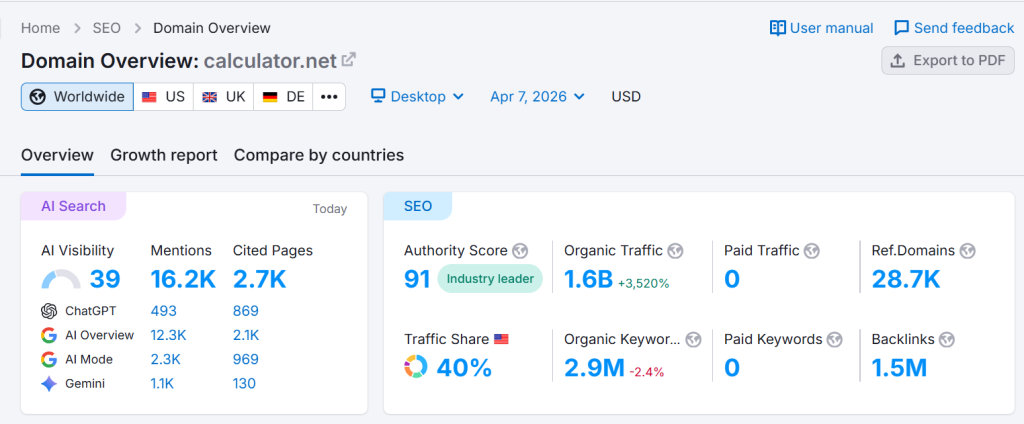
According to Semrush data, calculator.net received approximately 53.76 million total visits in February 2026 alone, with an average session duration of over 4 minutes and 49 seconds well above industry averages for utility websites. The site holds a global ranking around #900 and is the #1 ranked site in the Math category in the United States.
How They Built It
Calculator.net’s body fat calculator is a masterclass in functional, user-friendly design. Here’s what they did right:
- Dual-method calculation: They provide results using both the U.S. Navy Method and the BMI-based method, giving users two data points and reinforcing credibility
- Unit flexibility: Users can switch between US Units, Metric Units, and Other Units serving a truly global audience
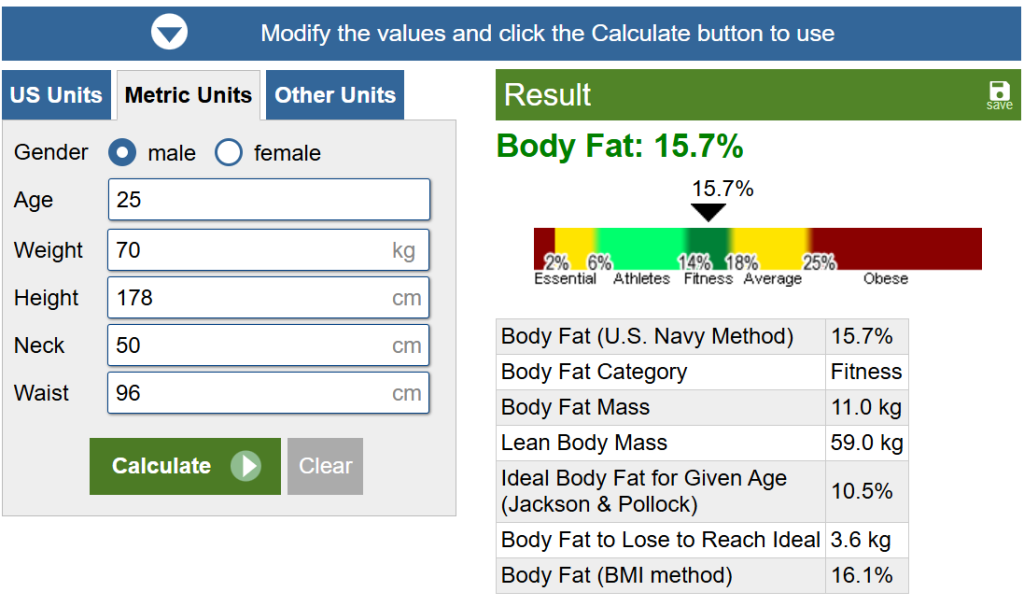
- Rich output: Rather than just showing a percentage, the tool outputs body fat category, body fat mass, lean body mass, ideal body fat (using Jackson & Pollock), and body fat to lose to reach ideal a full body composition weight calculator in one tool
- Visual result bar: A color-coded spectrum bar shows where the user falls from Essential to Obese making results instantly readable
- In-depth educational content: The calculator is accompanied by detailed explanations of methodology, body fat percentage charts, and health information which drives organic search traffic and improves dwell time
Body Fat Calculator
Calculator.net’s Body Fat Percentage Calculator interface shows dual-method results including Body Fat Mass, Lean Body Mass, Ideal Body Fat percentage (Jackson & Pollock), and Body Fat to Lose to reach an ideal all calculated instantly using the U.S. Navy Method.
The lesson here is clear: a simple, accurate, and information-rich body fat percentage calculator can become a long-term organic traffic engine. And the best part? You don’t need to be a developer to build one like this anymore.
How to Build a Body Fat Percentage Calculator with Outgrow
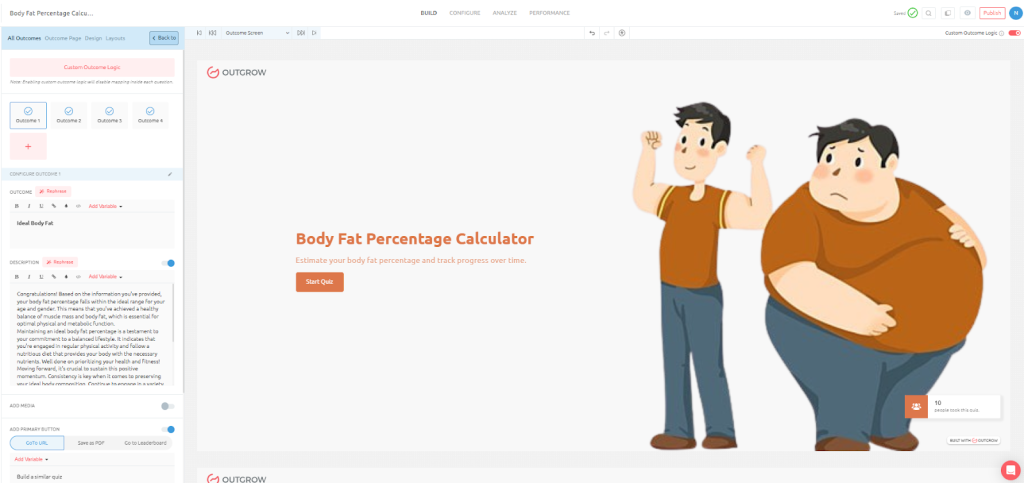
Outgrow is a no-code interactive content platform that lets you build calculators, quizzes, assessments, and more without writing a single line of code. Businesses across healthcare, fitness, finance, and marketing use Outgrow to create tools that generate leads, drive engagement, and deliver real value to their users.
Here’s how you can build your own body fat percentage calculator step by step:
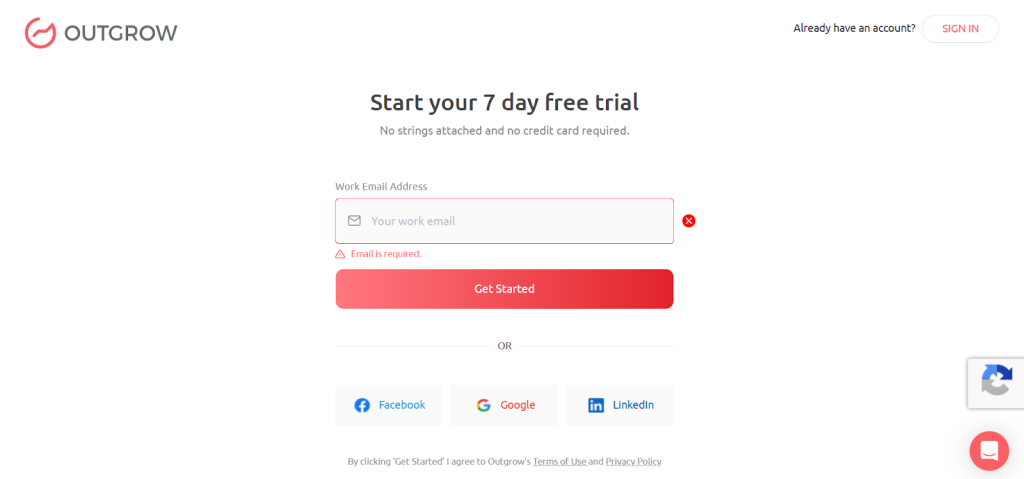
Step 1: Sign Up for Outgrow
Head to Outgrow and start a free trial with no credit card required. Once inside, navigate to the calculator builder and select “Calculator” as your content type.
Step 2: Set Up Your Question Flow
The Outgrow calculator uses a step-by-step question format, which improves completion rates compared to a single long form. Here are the questions you’ll want to include based on the same logic that powers the Navy method:
Question 1: What is your age?
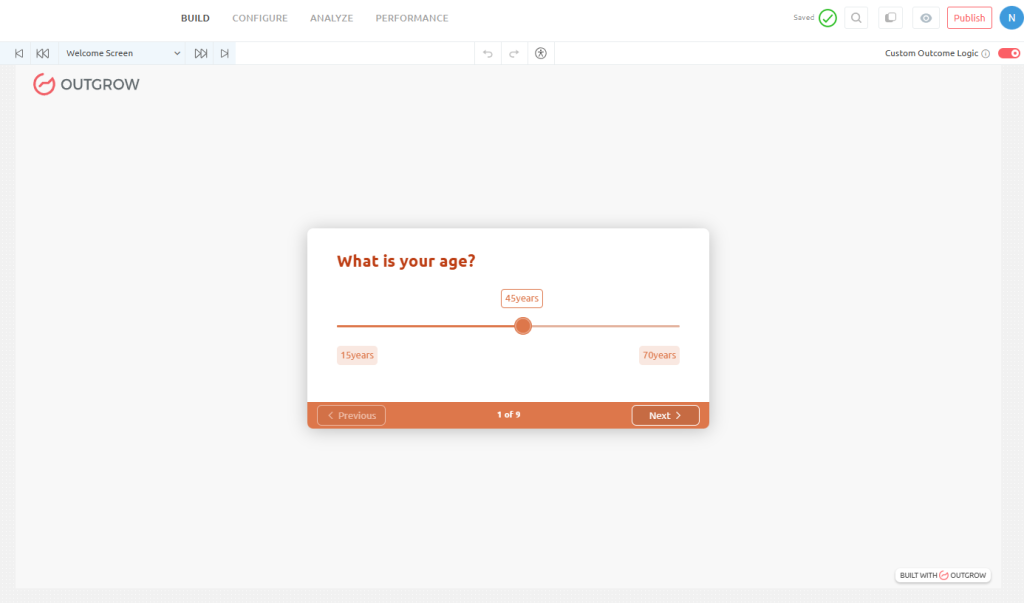
Use a slider input ranging from 15 to 100 years. Age matters for determining your ideal body fat range. Healthy body fat percentage for men and women shifts as we get older. The Jackson & Pollock formula, for example, factors in age directly.
Question 2: What is your gender?
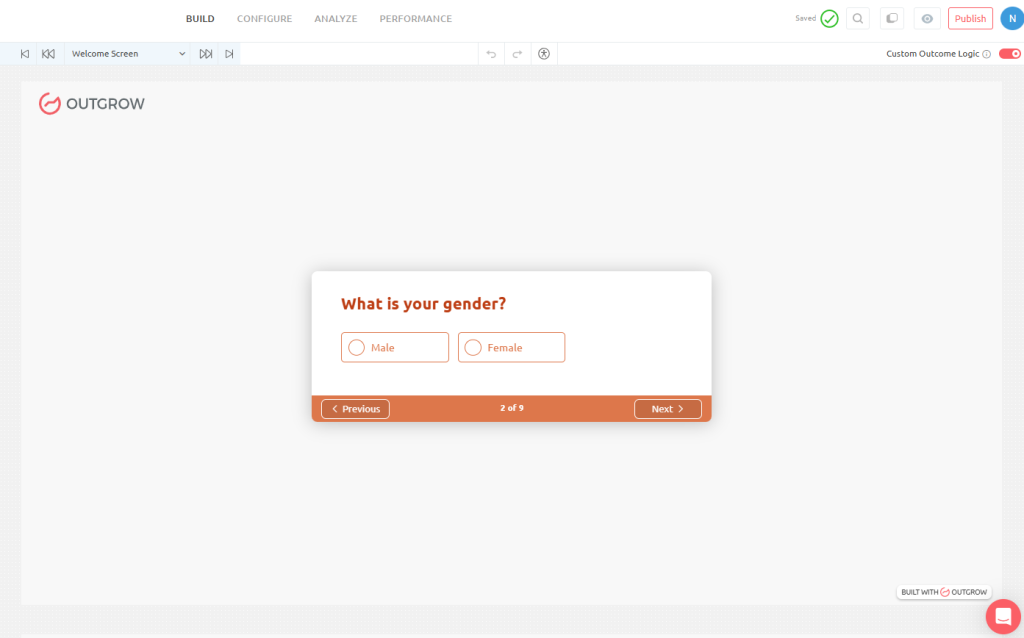
Provide a simple radio button with Male and Female options. Gender determines which formula to use; the body fat percentage men calculator uses the two-measurement Navy formula (neck and waist), while the body fat percentage women calculator requires three measurements (neck, waist, and hips).
Question 3: What is your height?
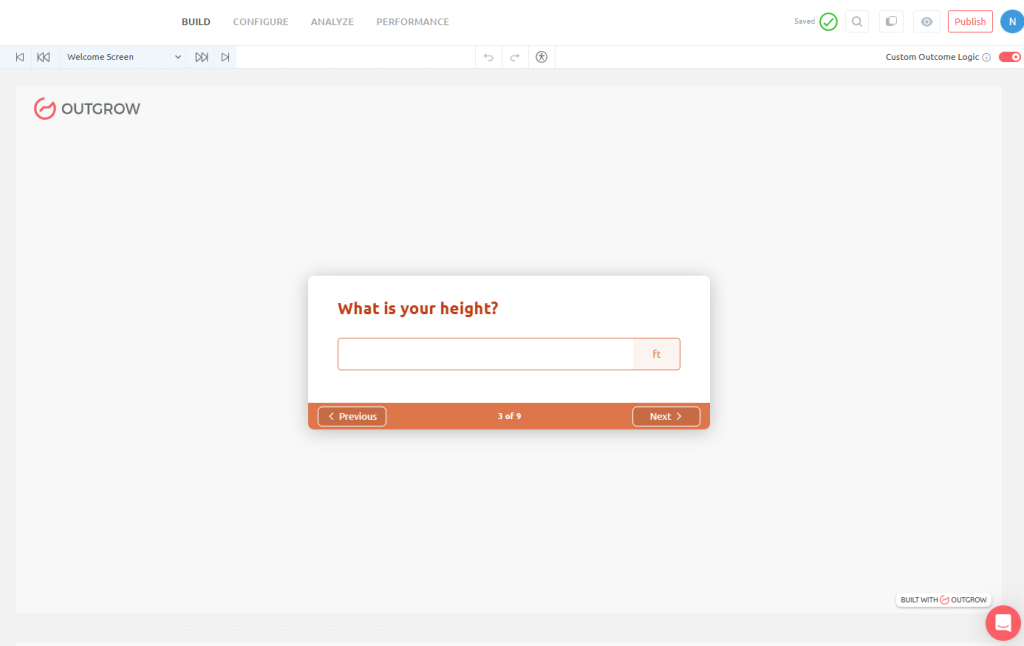
A numeric text input with a unit selector (ft/in or cm). This feeds into the body fat percentage calculator using height and weight logic. Make it flexible. American users think in feet and inches, while most of the world uses centimeters.
Question 4: What is your weight?
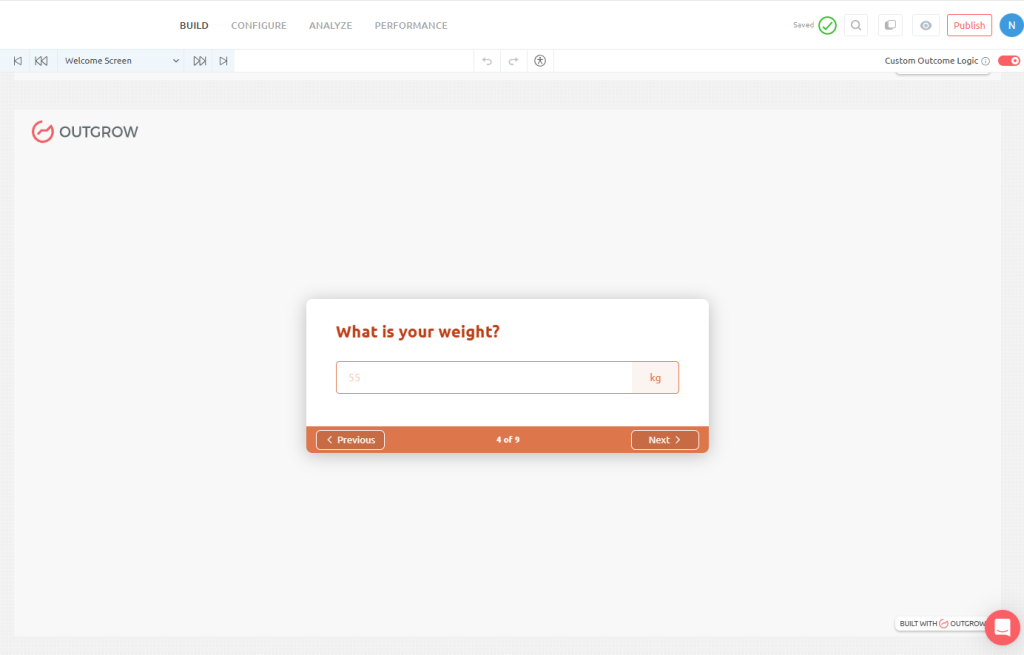
Numeric input in lbs or kg. Even though weight alone doesn’t determine body fat, it’s needed to calculate lean body mass and body fat mass in actual weight units which users find far more actionable than a percentage alone.
Question 5: What is your waist measurement?
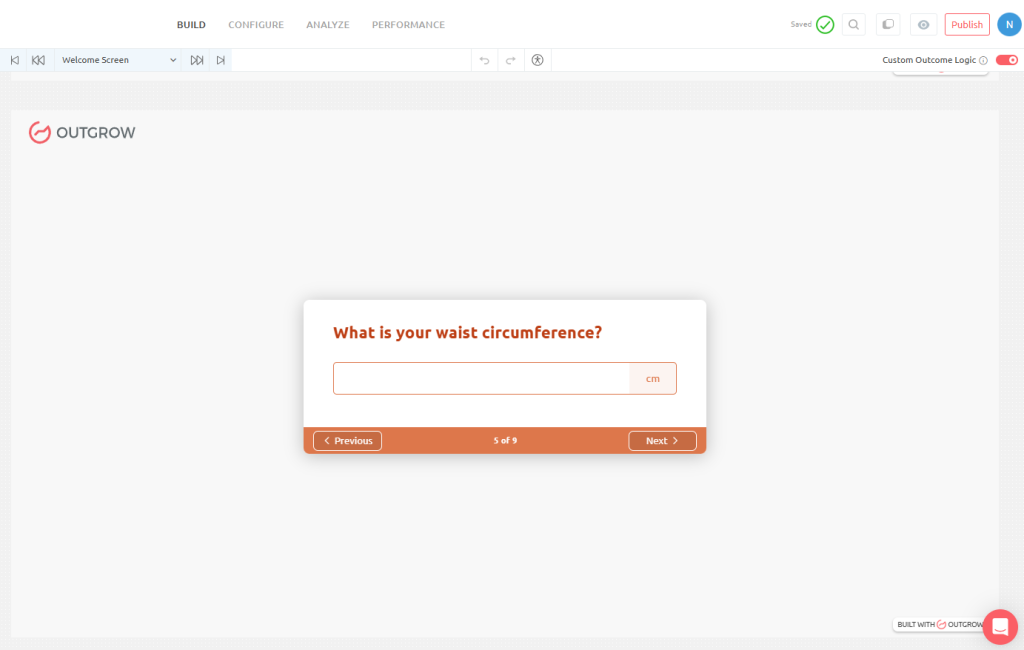
For men, instruct users to measure at the navel. For women, measure at the narrowest point. You can use conditional logic in Outgrow to show different instructions depending on the gender selected in Question 2.
Step 3: Configure the Body Fat Formula
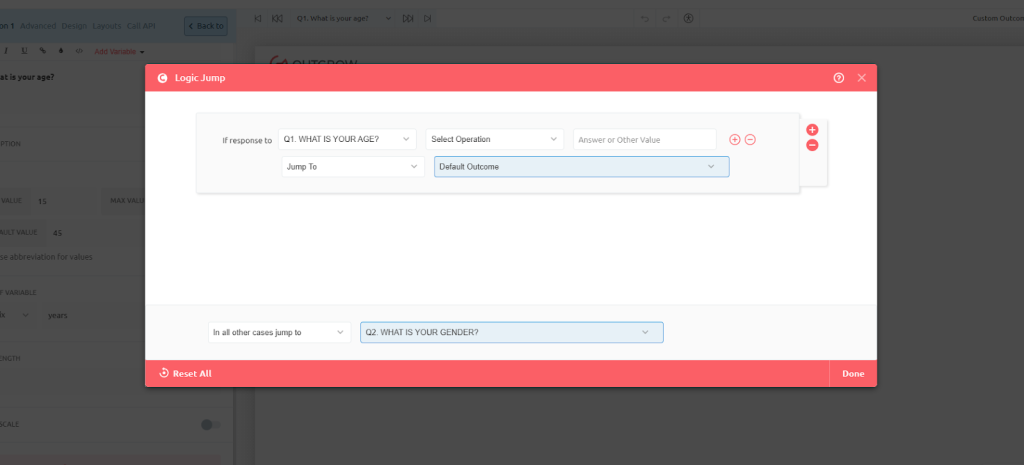
In Outgrow’s formula editor, you’ll enter the Navy method calculation. You can use conditional formulas to apply different equations based on gender. The output should include:
- Body fat percentage (primary result)
- Body fat category (Essential / Athletic / Fitness / Average / Obese)
- Body fat mass in lbs or kg
- Lean body mass the lean body mass calculator with body fat percentage integrated right into the results
- Body fat to lose to reach the ideal body fat percentage for their age and gender
Step 4: Design Your Results Page
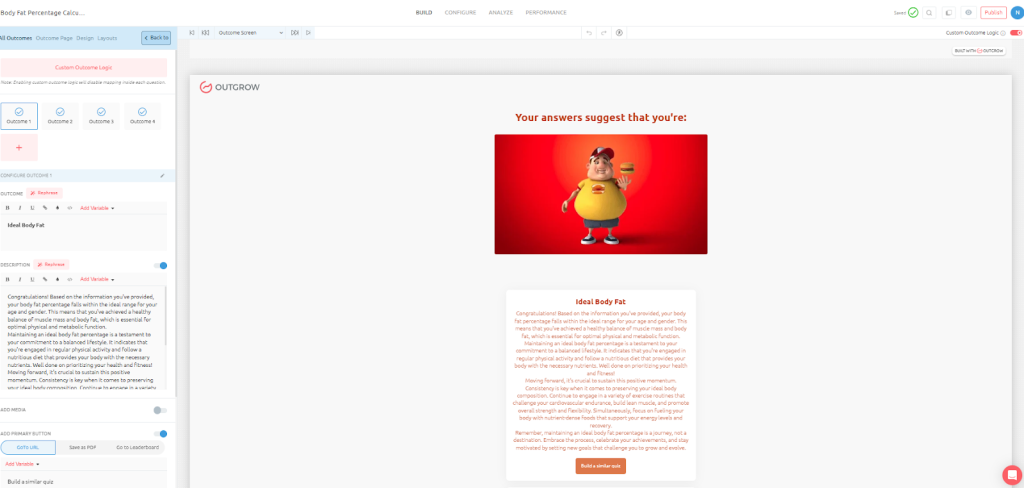
This is where Outgrow really shines. The results page can include personalized messaging based on where someone falls on the body fat chart. Someone in the “Fitness” category gets a different response than someone flagged as “Obese” and that personalization drives engagement and trust.
Consider adding a body fat percentage loss calculator feature on the results page, showing how many pounds of fat someone needs to lose to reach their ideal range. This gives users a concrete goal, not just a number.
Step 5: Embed, Share, and Grow
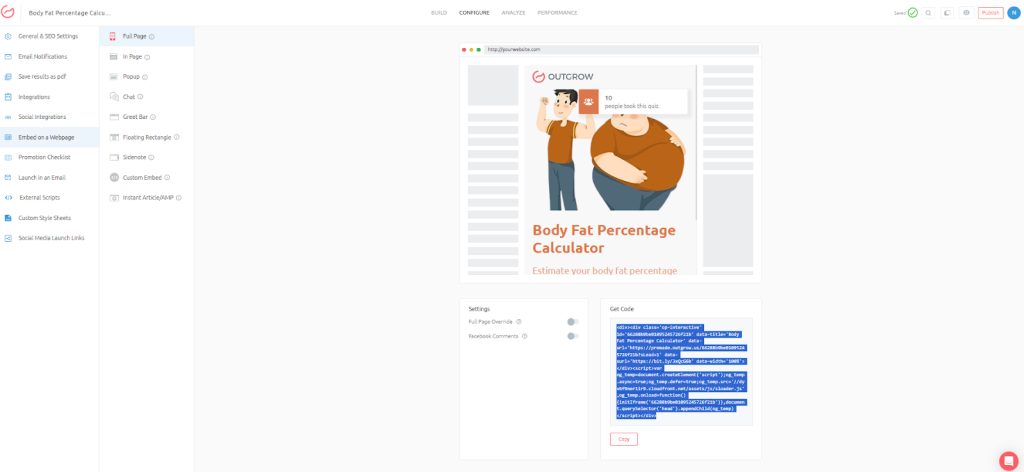
Once built, embed your body fat percentage calculator on your website, share it via email campaigns, or add it to landing pages. Outgrow integrates natively with tools like Salesforce, Mailchimp, HubSpot, and more so every calculator completion can automatically generate a lead.
Body Fat Percentage by Gender: Key Differences to Know
Body Fat Percentage Women: What’s Healthy?
Women naturally carry 6–11% more body fat than men because of sex-specific fat deposits associated with reproductive health around the breasts, pelvis, and thighs. This is why healthy body fat percentage for women starts higher:
- Essential fat: 10–13% (minimum required for survival and hormonal function)
- Athletic: 14–20% (competitive athletes, highly active women)
- Fitness: 21–24% (above average activity level, lean physique)
- Average: 25–31% (typical for healthy, moderately active adult women)
Body fat percentage women who fall below 13–14% may experience hormonal disruption, irregular periods, or bone density loss even if they feel fit. For women, going too low can be just as harmful as being too high.
Body Fat Percentage Men: What’s Healthy?
Men typically have lower essential fat requirements and higher metabolic rates, which is why their healthy ranges are lower across the board:
- Essential fat: 2–5% (absolute minimum; seen in elite endurance athletes during competition)
- Athletic: 6–13% (competitive athletes, bodybuilders in off-season)
- Fitness: 14–17% (active individuals with visible muscle definition)
- Average: 18–24% (healthy, lightly active adult men)
Body fat percentage men in the athletic to fitness range (6–17%) tend to have the best cardiometabolic health markers. Men above 25% are typically classified as obese and face elevated risks for heart disease, type 2 diabetes, and metabolic syndrome.
Using a Body Fat Percentage Weight Loss Calculator: Setting Real Goals
One of the most powerful features of a sophisticated body fat percentage weight loss calculator is that it reframes your fitness goals in terms of fat loss not just total weight loss.
Here’s why that matters: if you’re 180 lbs with 28% body fat, your body carries about 50.4 lbs of fat. Your goal isn’t just to “lose weight” it’s to lose fat while preserving lean mass.
Example: A 180 lb man at 28% body fat wants to reach 18% body fat. Current fat mass: 180 × 0.28 = 50.4 lbs Current lean mass: 180 − 50.4 = 129.6 lbs To reach 18% BF while keeping lean mass constant: Target weight = 129.6 ÷ 0.82 = 158 lbs Fat to lose = 180 − 158 = 22 lbs This is far more specific and motivating than just saying “lose 20 pounds.”
A good body fat percentage loss calculator does this math automatically, giving users both their current state and a concrete, science-based target to work toward.
20 Body Fat: What Does It Really Look Like?
One of the most Googled questions in fitness is: “What does 20 body fat look like?” The answer depends heavily on gender and how muscle mass is distributed, but here’s a general guide:
Men at 20% Body Fat:
- Classified as “Average” above fitness range but not obese
- Some muscle definition visible, but abs are not typically visible
- Slight softness around the midsection; no sharp muscle separation
- Often described as the “dad bod” range normal looking but room for improvement
Women at 20% Body Fat:
- Classified as “Fitness” range above average fitness level
- Visible muscle tone, slim figure, some ab definition possible
- Often considered an attractive, athletic physique
- Requires consistent training and a reasonably clean diet to maintain
Why Interactive Body Fat Calculators Drive More Traffic (And Leads)
There’s a reason tools like calculator.net’s body fat calculator generate tens of millions of visits per month: interactive calculators deliver personalized value. People don’t just want to read about body fat percentages, they want to know their number.
From a marketing standpoint, interactive tools like a body fat percentage calculator:
- Generate 2x more conversions than passive content (like blog posts or static pages)
- Are shared significantly more on social media because results feel personal and worth sharing
- Collect first-party data, name, email, health goals that standard content never captures
- Keep users on your page longer, improving dwell time and reducing bounce rate
- Build brand credibility, offering a tool that helps people adds real value to your brand
Businesses using Outgrow to deploy calculators report substantial improvements in both engagement and lead quality. Whether you’re in fitness, nutrition, healthcare, insurance, or wellness, a body composition weight calculator or lean body mass calculator with body fat percentage can become your most trafficked page within months.
Body Fat Percentage Navy Method: Why It’s the Most Popular Online Formula
The body fat percentage navy method has become the default formula for most online calculators for a handful of compelling reasons:
- It requires only a measuring tape, no expensive equipment or trained professional
- It’s reasonably accurate for most people (within 3–4% of DXA scans in studies)
- The measurements are easy to take alone at home
- It’s been validated on large populations and is considered trustworthy for general health screening
The body fat percentage calculator navy formula was originally developed by Hodgdon and Beckett at the Naval Health Research Center in 1984 and has been used by the U.S. military ever since. Any service member above the body fat threshold cannot re-enlist, which speaks to the formula’s practical real-world use.
Ready to Build Your Own Body Fat Percentage Calculator?
The fitness and wellness industry is booming, and users are actively searching for tools that help them understand their bodies. A well-built, accurate body fat percentage calculator can become a cornerstone of your content strategy, driving organic traffic, capturing leads, and positioning your brand as a trusted health resource.
With Outgrow, you can build that tool today, no developers needed, no complex formulas to code yourself. Choose from pre-built templates, customize the question flow, plug in the Navy method formula, and launch an interactive experience that rivals what the biggest players in the space have built.
Start your free 7-day Outgrow trial at outgrow, no credit card required. Build your first body fat percentage calculator in under an hour and watch the leads roll in.
Frequently Asked Questions
For men, 14–17% (fitness range) is ideal. For women, 21–24%. These vary by age and activity level.
It uses the U.S. Navy Method, measuring neck, waist, and height, to estimate your body fat percentage instantly.
Yes. BMI ignores muscle mass. Body fat percentage directly measures fat vs. lean mass, giving a far more accurate health picture.
Men typically see abs below 14%; women below 20%. Muscle development and genetics also influence visibility significantly.
Every 4–6 weeks is ideal. Daily fluctuations from hydration and food make more frequent tracking unreliable and misleading.

Ankit Upadhyay is a Digital Marketing and SEO Specialist at Outgrow. With a passion for driving growth through strategic content and technical SEO expertise, Ankit Upadhyay helps brands enhance their online visibility and connect with the right audience. When not optimizing websites or crafting marketing strategies, Ankit Upadhyay loves visiting new places and exploring nature.