Carbon Footprint Calculator: Know Your Numbers, Change What Matters
Table of Contents
How many tons of CO2 did your household put out last year? Go on, guess. Most people stall right there. You know you drove a lot. That flight to Cancun probably didn’t help. But a real number, one you could write down and defend? Almost nobody has one.
That’s kind of the whole problem with how we talk about climate stuff. Everyone’s got an opinion. Almost nobody has data on their own footprint. A carbon footprint calculator closes that gap in about two minutes. Punch in your commute, energy bill, diet, and flights, and out pops a figure you can actually work with.
Think of it like checking your bank balance instead of guessing. You might be close. You might be off by 40%. A decent calculator skips the polar-bear guilt trip and hands you a number, broken down by category, so you can see where the biggest wins are hiding. Sometimes it’s your car, or the flights. Sometimes, weirdly, the burgers.
Businesses caught on to this a long time ago, too. Utilities, EV brands, sustainability nonprofits- they’ve all started dropping a carbon footprint calculator onto their sites. Makes sense, really: the visitor gets a real answer, the company gets someone engaged enough to hand over an email address.
What is a carbon footprint?
Before jumping into the calculator, there should be a clear understanding of what the footprint entails. A carbon footprint refers to the total emissions of greenhouse gases such as CO2 and others like methane and nitrous oxide that are produced during the course of your activities over the period of one year.
It goes beyond vehicle exhaust emissions. Each time you flip the light switch, the energy used might have come from the plant that uses some fuel to produce it. Each meal you buy comes at a cost – production, cattle raising, transportation, and storage of each product contribute to the emissions in some way. Your flights, shopping done online, clothes you wear, and even your waste all have their footprint, which is rarely calculated by anyone.
The scientists make all the measurements in one standard unit – CO2 equivalent.
What Is a Carbon Footprint Calculator?
It is simply a means of calculating the emissions of greenhouse gases related to an individual, family, or firm in terms of metric tons of CO2 equivalent per annum. You simply provide answers to several questions relating to your lifestyle, and the answers are converted to one uniform figure.
Here’s roughly what feeds into the math, in no particular order:
- Home energy use: electricity, gas, sometimes heating oil
- Transportation: car type, mileage, transit, flights
- Diet (meat shows up as a bigger factor than most people expect)
- Shopping and general consumption
- Waste and recycling habits
- Household size
The average US household, according to EPA figures, produces around 16 tons of waste per year. Your result might come in well under that or well over it, and honestly, the number alone isn’t the interesting part. What matters is the breakdown next to it. A single figure with no context doesn’t tell you what to fix. A carbon footprint calculator that shows 40% of your total coming from flights? Now you’ve got a lever to pull.
Why You Need a Carbon Footprint Calculator
Emissions feel abstract right up until they’re yours. That’s the real argument for a carbon footprint calculator, more than another article about melting ice caps ever will be.
Vague guilt rarely moves anyone. “Your last two flights equal four months of driving” tends to land harder than “fly less” ever could. No two households look alike, either. A long rural commute and an old furnace add up to a completely different footprint than an apartment dweller who bikes to work, which is exactly why national averages don’t tell you much about your own situation. A carbon footprint calculator adjusts for your actual setup instead of flattening everyone into one number.
Small swaps add up faster than people assume, too. Trade two beef dinners a week for chicken, and a calculator shows you the real annual savings in hard numbers, not vague reassurance. That’s what keeps someone engaged past week one.
There’s a credibility angle for businesses, too. No receipt for your sustainable claims will go unnoticed, and an online carbon footprint calculator allows visitors to verify their numbers themselves. Wondering whether it’s worth investing in solar panels, an electric vehicle, or conducting an energy audit of your home? You have to know where you stand in the first place.
Companies in energy, insurance, travel, and retail have quietly made this table stakes for their sustainability pages now, right next to their interactive quiz tools.
How Outgrow’s Interactive Content Helps Your Decision

Most calculators floating around online feel like tax forms. Thirty fields, zero explanation, a flat result page that reads like a lab report nobody asked for. That’s not how people take in information, and it’s definitely not how they take action on it.
Outgrow’s calculator maker takes that dry estimate and turns it into something people actually finish, and often share.
Conditional logic does most of the heavy lifting here. Someone without a car skips the mileage questions. A vegetarian never sees the meat-consumption fields. Fewer irrelevant questions mean fewer people bailing halfway through, and a final number built from data that actually applies to them.
Visual results matter more than people give them credit for. Swap a plain number for a chart splitting emissions into transportation, home energy, diet, and shopping, and the result sticks. Nobody remembers a sentence claiming “your flights make up over a third of your total.” They remember the pie chart.
Branding and the underlying formulas stay in your hands. A utility, an EV brand, a nonprofit, whoever, can build a carbon footprint calculator with its own logo, tone, and scoring logic, without touching a line of code.
Lead capture happens quietly in the background. Visitors trade an email for personalized results and a few reduction tips. For a business, that’s a list of people who cared enough about their own emissions to spend two minutes measuring them, about as warm as a lead gets.
Try Outgrow’s Carbon Footprint Calculator
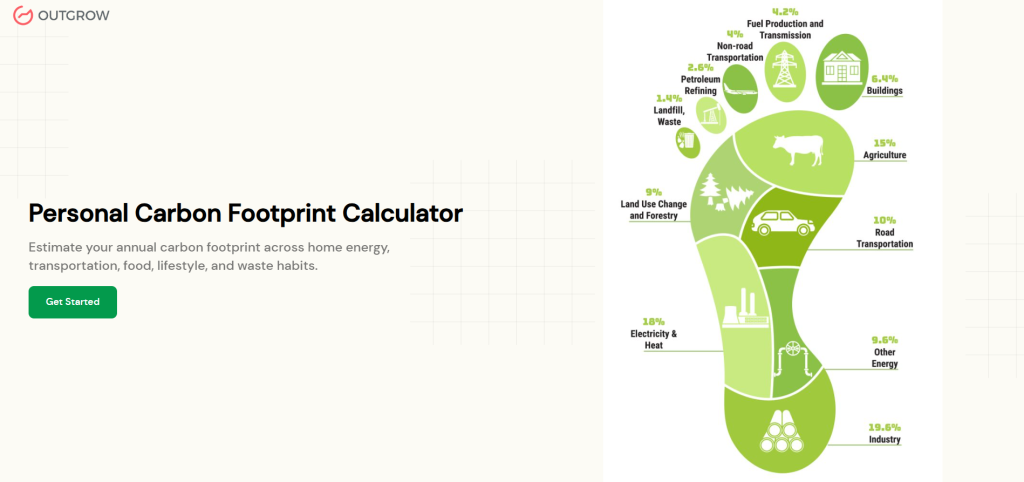
Rather than keep describing it, just go try it. Outgrow’s carbon footprint calculator is live right now, ready for a test run before you commit to building your own.
It asks for a handful of things: household size, home energy source, primary commute method, weekly driving mileage if you own a car, flights per year, diet type, and how often you buy new clothes.
Two minutes, give or take, and that’s it. Submit, and the carbon footprint calculator hands back a personalized annual emissions estimate, stacks it against national and global averages, and breaks it down by category.
Run it once with your actual numbers. Then run it again and change one thing: cut a long flight, swap in a hybrid, drop meat two nights a week. Watching the total move in real time teaches more than any general statistic ever will.
Sustainability brands, EV makers, and green energy providers lean on this exact setup to turn casual visitors into genuinely interested leads. Someone who just measured their own footprint and saw “switching to solar cuts this by 60%” is a far warmer prospect than someone who skimmed a blog post and moved on.
Building Your Own Calculator with Outgrow
A custom carbon footprint calculator, built through Outgrow’s survey builder, usually takes 30 to 45 minutes from a template or blank canvas.
Worth including in your question set: household or company size, home energy type and monthly spend, commute method and distance, flights per year split by short and long-haul, diet type, shopping frequency, waste and recycling habits, and any green initiatives already in place, solar, EV, composting.
The formula builder is where the real work happens. It lets you assign emission factors to each answer and sum them automatically, functioning like a spreadsheet dressed up as a quiz.
For format, multi-step tends to win. Guiding people through one question at a time keeps completion rates higher than dumping everything on a single page. Add a short explanation next to anything ambiguous, like what counts as a “short-haul” flight.
The results page deserves more than a single number sitting there. Show the category breakdown, compare it against an average, and add a specific next step: “switching your commute to transit three days a week cuts 0.8 tons annually” does more work than “consider public transit.”
Hook the whole thing up to your CRM or email platform so results land right in your workflow. Someone who just measured their carbon footprint calculator score and got curious about solar panels or offsets is exactly who your sales team wants next.
Common Mistakes to Avoid
A few things trip people up when they try to build one of these themselves.
Treating every mile or every flight as equal is a big one. A short domestic hop and a long international flight differ wildly in impact, and lumping them together gives you a distorted number. Skipping diet entirely is another; red meat carries more weight than most builders expect, and cutting that question skews the estimate low. Stale emission factors are a quieter mistake: grid electricity has gotten cleaner in a lot of regions, and old numbers overstate someone’s real footprint.
There’s the results page problem, too. A bare number with nothing to compare it against doesn’t mean much, so show an average alongside it, plus one concrete next step. And don’t skip household size. A family of five sharing one utility bill has a very different per-person footprint than someone living alone with the same bill.
Reading Your Results
Total annual emissions are the headline number, in tons of CO2 equivalent, the figure most people remember or share. The category breakdown underneath is where the real insight sits, splitting that total into transportation, home energy, diet, and shopping. Comparison to the average tells you where you land relative to your country or region. Reduction potential shows what a specific change, such as cutting one flight or switching providers, would actually do to that total.
A three-ton swing between two scenarios might not change your life much. A twelve-ton swing from switching commute and energy provider is worth acting on.
Wrapping Up
A carbon footprint calculator takes something that usually stays fuzzy, “I should probably do something about my emissions,” and turns it into a number with a plan attached. That shift from guilt to data is what actually gets people to change behavior, rather than feeling bad after reading a headline.
Build one with Outgrow. The calculator can’t make lifestyle decisions for you. What it does is strip out the guesswork.
For energy providers, EV brands, sustainability nonprofits, and ESG teams, a carbon footprint calculator pulls double duty: it educates your audience and hands you a list of people already engaged with the exact thing you sell.
So punch in your numbers, run a few scenarios, and make your next green decision off a real figure instead of a hunch. Sign up for a free 7-day trial today and start building your own carbon footprint calculator.
Frequently Asked Questions
It is a calculator that calculates the amount of greenhouse gases you generate annually based on factors such as energy consumption at home, modes of transport, diet, and shopping practices.
For most households, it’s a toss-up between transportation, flights especially, and home energy use. Diet usually lands third, though it surprises people how much red meat weighs on the total once you run the numbers.
Plenty already do. Energy companies, electric car manufacturers, and environmentally conscious businesses can include the tool to attract people interested in reducing emissions.
Not with Outgrow. The builder runs on drag-and-drop questions and a formula system that behaves like a spreadsheet, so a fully branded carbon footprint calculator comes together without a developer anywhere near it.
Once a year is a reasonable rhythm, or any time something big changes, a new car, a move, a switch in energy providers. Rerunning the carbon footprint calculator after a change is the quickest way to see whether it made the dent you expected.

Sakshi is a digital marketing enthusiast passionate about connecting brands with audiences. With a background in content strategy and social media, she loves turning trends into actionable strategies. Outside of work, you’ll find her reading a book or hunting for the perfect cup of coffee.