Summarize with :
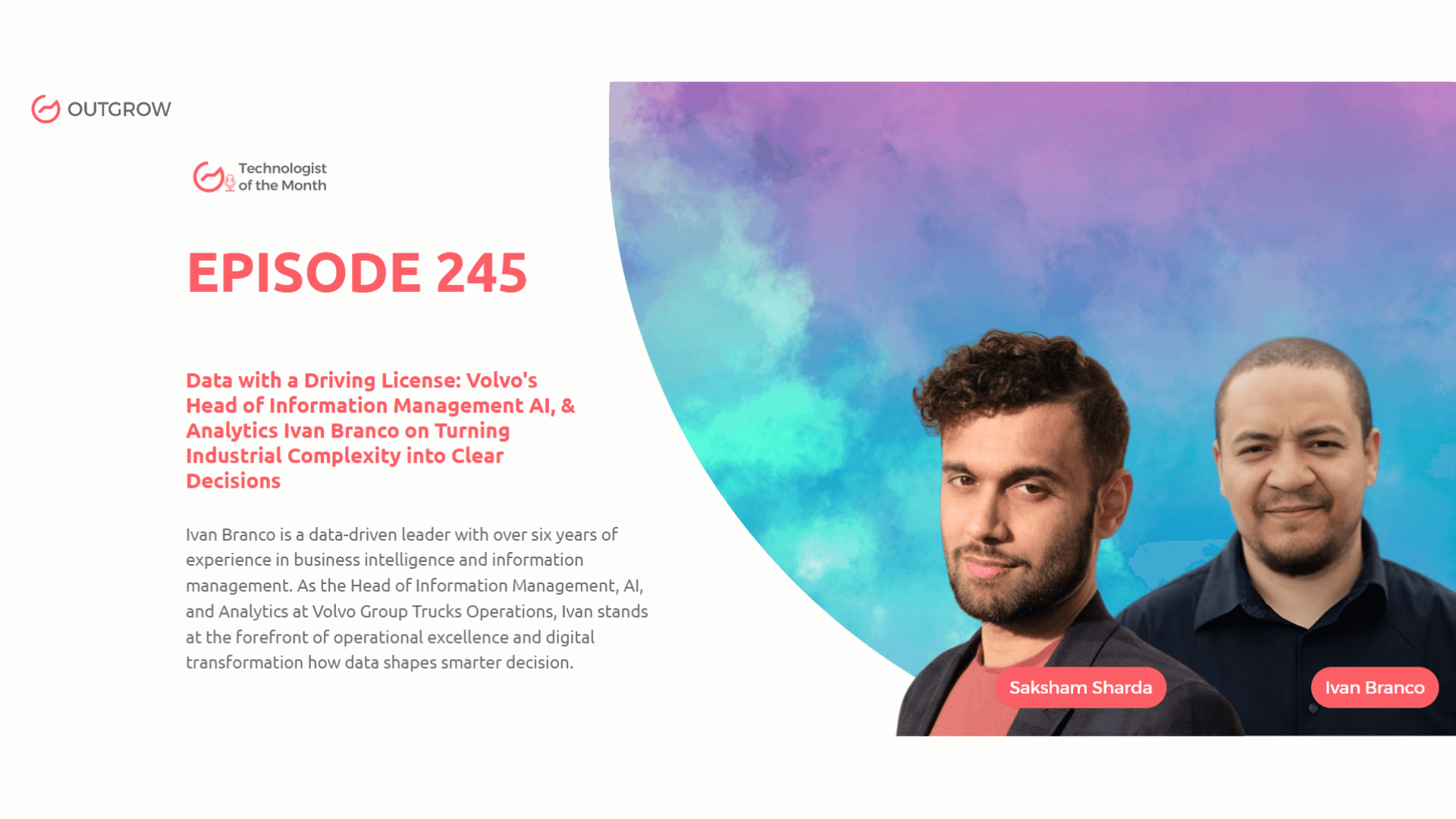
EPISODE 245: Marketer of the Month Podcast with Ivan Branco
Table of Contents
Hey there! Welcome to the Marketer Of The Month blog!
We recently interviewed Ivan Branco for our monthly podcast – ‘Marketer of the Month’! We had some amazing, insightful conversations with Ivan, and here’s what we discussed about-
1. Data’s role in Volvo’s service-oriented business transformation
2. Why is governance structure foundational to data strategy
3. Customer satisfaction as the ultimate business compass
4. Fraud detection through data insights at Volvo Group
5. Technology should solve problems, not drive strategy choices
6. Human factors remain essential despite AI advancement
7. Trust-based leadership in technology and data teams
About our host:
Dr. Saksham Sharda is the Chief Information Officer at Outgrow.co He specializes in data collection, analysis, filtering, and transfer by means of widgets and applets. Interactive, cultural, and trending widgets designed by him have been featured on TrendHunter, Alibaba, ProductHunt, New York Marketing Association, FactoryBerlin, Digimarcon Silicon Valley, and at The European Affiliate Summit.
About our guest:
Ivan Branco is a data-driven leader with over six years of experience in business intelligence, analytics, and information management. As the Head of Information Management, AI, and Analytics at Volvo Group Trucks Operations, Ivan stands at the forefront of operational excellence and digital transformation, redefining how data shapes smarter decisions and resilient systems.
Data with a Driving License: Volvo’s Head of Information Management AI, & Analytics Ivan Branco on Turning Industrial Complexity into Clear Decisions
The Intro!
Saksham Sharda: Hi, everyone. Welcome to another episode of Outgrow’s Marketer of the Month. I’m your host, Dr. Saksham Sharda, and I’m the creative director at Outgrow. co. And for this month, we are going to interview Ivan Branco, who is the Head of Information Management, AI, and Analytics at Volvo Group
Ivan Branco: Great to be here. Thank you.
Don’t have time to read? No problem, just watch the Podcast!
Challenge yourself with this trivia about the exciting topics Ivan Branco covered in the podcast.
Or you can just listen to it on Spotify!
The Rapid Fire Round!

Saksham Sharda: Let’s start with the rapid-fire round. The first question is, at what age do you want to retire?
Ivan Branco: 50
Saksham Sharda: How long does it take you to get ready in the mornings?
Ivan Branco: Ten minutes
Saksham Sharda: Favorite color?
Ivan Branco: Blue.
Saksham Sharda: What time of day are you most inspired?
Ivan Branco: Two o’clock,
Saksham Sharda: How many hours of sleep can you survive on?
Ivan Branco: Four.
Saksham Sharda: The city in which the best kiss of your life happened?
Ivan Branco: Brussels.
Saksham Sharda: Pick one, Mark Zuckerberg or Elon Musk?
Ivan Branco: Mark Zuckerberg.
Saksham Sharda: How do you relax?
Ivan Branco: Video games.
Saksham Sharda: How many cups of coffee do you drink per day?
Ivan Branco: Zero.
Saksham Sharda: A habit of yours that you hate?
Ivan Branco: Procrastinating sometimes.
Saksham Sharda: The most valuable skill you’ve learned in life.
Ivan Branco: Never give up.
Saksham Sharda: Your favorite Netflix show.
Ivan Branco: Right now, Vikings.
Saksham Sharda: Are you an early riser or a night owl?
Ivan Branco: Night owl.
Saksham Sharda: One-word description of your leadership style
Ivan Branco: Trust.
Saksham Sharda Coffee or tea to kickstart your day?
Ivan Branco: Tea.
Saksham Sharda: Top priority in your daily schedule.
Ivan Branco: My children.
Saksham Sharda: Ideal vacation spot for relaxation.
Ivan Branco: Portugal
Saksham Sharda: Key factor for maintaining a work-life balance.
Ivan Branco: Knowing when to stop.
The Big Questions!

Saksham Sharda: Now we’re going to go on to the longer questions. For the longer questions, the first one is Volvo is a globally trusted brand. How are you leveraging data and analytics to enhance customer trust, operational transparency, and marketing precision at scale?
Ivan Branco: First of all, I have to say when we talk about Volvo, I work for the Volvo Group.
That’s everything, excluding Volvo cars. We are very much a business-to-business type of company. Volvo trucks, Volvo construction equipment, buses, etc. Data is very important because we want to become a more service-oriented company. The only way to create services is to have insights on how your equipment or your products are being used. For us, it’s a no-brainer that it’s the only way to get the answers to the questions we have and to secure that we can do that transition into a service-minded operation. The role that I play, together with my team is about collecting that data for our logistics division and then creating data products that can be consumed by the people within the business who are truly the ones that know every single step of our operations. I cannot be the one bringing all of the answers. We’re more of a platform facilitating data and then you have people empowered in the business to use that data either for analytics, either for automation, either for process optimisation, or to create new business capabilities that we do not have today.
Saksham Sharda: Can you share an instance or story where data storytelling helps bridge the gap between operations and brand communications?
Ivan Branco: That’s a tough one. In our reality, we have multiple brands within the Volvo Group, and we try to facilitate the data connected to each one of those brands to create awareness. It’s impressive how sometimes people think that they know, if we put it like that, in the sense that they do an interpretation of what they see and they’re not being based on facts. So using or leveraging our platform, we could see a lot of aha moments where people were finally faced with the reality of things. Also, we’re using that information for fraud detection, making sure that our parts are being distributed as they’re supposed to be. So we also had a lot of investigations into that area and it was interesting to see, once the figures were out, fluctuations in different markets that we were not expecting to see. So without sharing too much, those were the two main moments, I would say, where we had these aha reactions, and we could see the true value of having those data insights.
Saksham Sharda: In your current role, how do you balance innovation in AI with Volvo’s legacy infrastructure and robust governance frameworks?
Ivan Branco: That’s a good question. Because in automotive, we don’t have a tendency to be very technologically advanced when it comes to our internal processes. It’s more about the products, it’s more about the trucks, it’s more about the construction equipment, the buses. But that is slowly shifting because we have to follow the trends in the industry. What we do is we are leveraging or we’re completing the picture by using new technologies. And it shouldn’t be just use technology for the sake of using technology, it has to correspond to a problem. And most people would be surprised to understand or to see that we have legacy solutions that are offering us stability a lot more than new technology. So we don’t change just for the sake of changing; it has to be for a purpose. So identifying use cases, identifying challenges, identifying opportunities, that should be the focus. Then, once you have done that, you can start thinking about which technology is the best to solve that problem. Because again, like I said, you might be surprised that in some cases, the best technology is an old technology and not a new technology. Now we have this hype of the generative AI, agentic AI, and so on. And our explorations have shown us that many of our use cases, actually, it would be very expensive to solve them with generative AI. And it wouldn’t be the best solution either. So it has to be a case-by-case reflection, where you consider all of the different technological advances and all of the potential solutions. So don’t focus on technology, focus on challenges, problems, and opportunities.
Saksham Sharda: What frameworks or principles help you ensure safety, compliance, and business value in AI implementation?
Ivan Branco: I know a lot of people have a hard time with the word governance, but it’s there for a reason. I mean, we have this natural tendency as human beings to kind of reject everything that has to do with government and politics and all of this. But at the same time, if we’re truly honest with ourselves, we recognise the need for it. Then we can argue on models and so on. So when it comes to data, it’s the same thing. What you need is to have a very strong governance structure with clear information or data ownership, with clear roles who are responsible for securing the data quality. Because if you don’t have that, then your data is, for lack of a better expression, it will be just crap. So how do you secure that you can work on improving it so that the outcomes, so that the way in which you use that data can be really fruitful for your company. That should be the number one. That is the foundation of any data strategy or any data framework is to have first a governance structure. That is the base, the foundation, on which you can then build the rest. Without that, it doesn’t work. Even if people don’t like the term governance, give it another name, but you will need to have some type of structure that is there to make sure that we are focusing on the right things.
Saksham Sharda: Collaboration across marketing, supply chain, and tech teams can be complex. How do you unify such diverse stakeholders around shared data goals?
Ivan Branco: If you look, for example, at my team, we’re called Information Management, AI, and Analytics. The reason why we selected information management instead of data is because data is nothing if not applied to a context. When applied to a context, it becomes information. And it’s rare that a context is unique to an organisation. Most of the time, it’s transversal. It’s corresponding to a process from beginning to end. So you should never, let’s say, encapsulate data into a silo where it only belongs to an organisation. I come from a logistics organisation, like I said before, and most of the data that we work with does not belong to us. It’s either from the material supplier, from the transport supplier, from our purchasing organisation, from our technology organisation. So even though you set those ownership layers, like I said, you have a data governance structure; it is about sharing more than anything. Within our data strategy, we talk a lot about democratising data. And that’s truly what it is about. It’s about breaking those silos, breaking those layers, and sharing as much as you can to create insights. So we have really this approach of available by default instead of restricted by default. We want to share as much as possible in respect, of course, of rules and legislation and guidelines that we’re having today. But it is about being transversal. So we share with our marketing companies, with our sales organisations, with our technology organisations. We’re sharing data all the time because that’s the only way in which you can really create value. And you need to think about the whole and not just about your own little department. If you think about things like that, then it’s the wrong approach, you’re in the wrong job. You belong to an organisation, you belong to a sector. It’s also about sharing with others in many cases, not keeping all of the things that we’re finding just for ourselves because we also have a due to when it comes to working towards a better environment, reducing CO emissions and all of that. So it’s about sharing data as well with other parties within the same industry. That’s the approach we try to have. That’s the mindset that we have within the company.
Saksham Sharda: So with supply chain agility becoming a key competitive edge, how can data and analytics go beyond optimisation to help Volvo anticipate disruptions and build resilience?
Ivan Branco: Data for me is about speed. Or if you connect, let’s say, data with artificial intelligence, it’s about speed. It allows you to see things that you would normally not see in your daily operations. We can accelerate insights. And by that, you accelerate the agility because your reaction time is much, much quicker. And we have seen that simply with some dashboards, control towers. You can easily see, you have more access to the information, you have a better understanding of what is happening. Also, if you apply those models to a digital twin type of setup, because you can have digital twins on different levels. You can have it on a part level, for example, component level or product level. You can have it for your infrastructure, like a warehouse, a factory, etc. Or you can have it also for your processes, where you can actually see digitally a copy of how your processes are being executed. If you then apply, let’s say, an AI layer on top of that, then you can run simulations in minutes that allow you to see, okay, this is how quickly I can optimise my setup. In the past, you couldn’t do that. Well, you could do it, but you would have to do it manually. You would have to do it through the knowledge of people. And by trial and failure. And that takes a lot of time. And the investment needed to do that, because in many cases, it’s also about, if you look at a warehouse, if you look at a factory, it’s about moving parts around. It’s about moving stations around. That involves money. Now you can do a simulation, and the simulation can give you a degree of predictability that you wouldn’t have otherwise. That is really the key in how you can use data to gain agility and to speed up the growth of your business.
Saksham Sharda: So what indicators should marketing or sales teams monitor to stay in sync with operational shifts?
Ivan Branco: The number one will always be customer satisfaction. You start with customer satisfaction, and then you break it down to really understand what are the challenges or opportunities that you have. That is also visible through data. But it requires, although I speak about data, I speak about artificial intelligence, the human factor will always be present. The dialogue, being close to the customer and really understand what they want, is not something that data can give you so clearly. It can indicate trends, but they sometimes cannot explain why those trends are happening. So that dialogue, that continuous dialogue, is essential to really see which opportunities we have, and those opportunities can be translated then into new services, into new products, where data does play a significant role because it will help you define how those can be distributed. That’s where I see the leveraging point of how you can use data to then collaborate with your sales or marketing organisations.
Saksham Sharda: AI is transforming both backend systems and customer-facing initiatives. What excites you most about its role in enhancing marketing effectiveness at Volvo?
Ivan Branco: Like I said, it’s a question of speed. It’s a question also of having new ways of doing things, on how you offer certain services, on how you offer certain products, on how you organise yourself. Looking at some, let’s say, figures from studies that have been ongoing, you can see how the speed has increased. We have never used as much data as we use today. We have never used as much digital twin as we use today or will use in the future. So there’s this rapid acceleration of the industry that makes it even unpredictable when you’re making predictions, let’s say, of how the technology will go, or when you’re preparing your long-term strategy. Long-term strategies don’t work any longer. You have to have a maximum of two to three years because the technology changes very quickly. Also, if you look at the profile of a customer, if you look at the profile of an employee, all of that is changing dramatically. The new generations work in a completely different way from the generations of the past, and it’s exciting to be part of that journey, of that, yeah, of that future that is still to be set. So that’s what gives me energy, seeing that everything is changing. I’m not afraid of change. I’m embracing that change, and I want to be part of that change.
Saksham Sharda: Are there overhyped AI trends you think the marketing industry should steer clear of?
Ivan Branco: Well, I don’t think there’s anything overhyped. What there is is a correlation between ability and opportunity, and sometimes we have this AI or generative AI as a whole. You can consider it to be overhyped because people want to use it to solve all of the problems. That’s not what you do. Again, you need to go from what are the best mechanisms to solve this problem, and then AI, generative AI, and classical AI, they offer you plenty of tools that you can use for those specific scenarios. So I don’t think it’s overhyped. It’s more about being sure of the correlation or the possibilities that you have in between problem and solution, and for many problems, generative AI can be the solution. So for me, it’s not overhyped. It’s just a question about how you use it.
Saksham Sharda: So what does your typical day at Volvo look like? You wake up in the morning and
Ivan Branco: Every day is different. I’m lucky enough that I’m not in a function where things are repetitive, so every day we have a different challenge. We’ve gone through the motions of, let’s say, collecting, ingesting, replicating data into now creating the data products, exposing those data products, making sure that there’s usage, but there’s always something new coming every day, a request from the operations, a request from our development teams, a request from my teams that make every day have a different flavour, and that’s what I like. So when I start my days, it’s about cleaning your mailbox, of course. That’s everyone’s office environment. It’s the start of their day, but then it’s reflecting. It’s also about learning. Like I said, technology is changing all the time, so you need to keep pace. So there’s a lot of research that goes into my days as well, learning from my colleagues, learning from we have our internal whole group university, so from the programmes we have there, and then talking to my teams, making sure that they have all the support that they need, that we’re reaching our targets. So it’s quite diverse. One day is never like the previous, nor like the next one.
Saksham Sharda: Let’s talk a bit about information democratisation, which is often seen as a tech challenge, but it’s also a cultural one. How do you empower marketing and sales teams with the right data without overwhelming them?
Ivan Branco: You mentioned something quite important. It’s actually mainly a cultural problem, because we still have that tendency of saying, my data, this is my property. And like you talked about the term of democratising the data, for us that is what is critical and crucial. Make everything available. It’s a little bit of an open source type of approach, but open source on data, of course, with the caveat that you should always be respective of rules legislations that we have, very strong in the European Union, to secure that you’re compliant. But if you are compliant, then all of the rest of the data, is a little bit open source. Use it, share it, because you can find opportunities that you wouldn’t otherwise. So for me, that’s the mindset that we need to show, to choose. It’s not at all about technology. I think technology is there to execute processes that we design as humans. So for me, it is absolutely about culture. Having this openness to share, and to be open to others to share with you as well.
Saksham Sharda: And is there any role for data visualisation in helping non-technical teams act on insights?
Ivan Branco: Yes, absolutely. I think that’s the first usage that we have, is on analytics and advanced analytics. It’s about creating insights that can be done automatically, can be done with the support of AI, or can be done simply by having experts looking at the data and creating that type of interpretation. Data visualisation is, I would say, still the number one usage that we have for data within a business.
Saksham Sharda: So, from strategy to system design, your work connects multiple business layers. What’s your approach to building data products that are both scalable and human-centric, especially for marketing use?
Ivan Branco: That’s a tough one. Because you described different layers, and it’s, again, going back to the purpose. Why do you build them? You can build them, let’s say, to support different systems. You can build them to be a description of a domain or of a process. You can build them to service a specific business use case. So that discussion, that dialogue in between, let’s say, my organisation and a marketing organisation, sales organisation, a logistics organisation, that is going to help us in making sure that we’re building the data product to fulfil your needs. And in some cases, you can have, let’s say, your core data products, and then you can do customised data products that are, let’s say, collecting data from multiple data products to serve that specific use case. And that’s kind of the approach that we have. We’re combining these more core data products that are, let’s say, a definition or replication of our domains. And then we are creating these customised data products that are really an interpretation of what is needed for that specific use case. That’s the dialogue we need to have with marketing organisations, sales organisations, whichever organisation requires our data.
Saksham Sharda: So we can agree, then, that high-quality data is essential for effective campaigns. In practical terms, though, what does good data look like for a marketing team, and how do you ensure they have access to it?
Ivan Branco: It means having data that is understandable, that is true, that has the proper levels of quality, which will be defined for that specific data element. But for me, it’s mainly about being understandable. So you look at the data, you know what you’re seeing. Data modelling becomes an extremely important task when it comes to creating that understanding because it is a transformation of the data from the technical tables into something that an end user, a business user, can actually use and can understand. So again, going back to my previous statements, there is a very close relationship between IT and the business users because it will be the business users that will assist us in that final phase of the data modelling, so that it is a pure translation of what is happening in the business, so that it’s not just a technical term. So that’s how we embrace the full community, and that’s how we work together. Creating data, having proper data quality, is not an IT task. It is a common task from everyone within an organisation.
Saksham Sharda: Are there any mechanisms you use to detect and fix bad or outdated customer data?
Ivan Branco: Well, we try to use data catalogues to set, let’s say, the standards for data quality, to set the definitions as well, and then that is connected to visualisations and triggers that can indicate to us whenever we see deviation in data quality. I think it’s an area we still need to improve in, but that would be the tool that could be used to highlight or bring to light that type of problems.
Saksham Sharda: So as marketing becomes more tech-driven, what emerging trends in information management, analytics, or martech do you believe will define the next 5 years?
Ivan Branco: You know, yesterday I saw a very cool solution that has been developed for marketing purposes, which was like this combined reality type of ads where you can actually, from a picture, it kind of creates an altered dimension where you can engage the customer in just looking at something that is amazing, but at the same time connecting it to the product. So I think marketing needs to go more and more in that direction of how do we connect or marry ourselves better with technology. We know today that all of this data, you talked about Mark Zuckerberg and Elon Musk, we know how our data is used today for all of these marketing purposes, but I think there’s still an opportunity to make it more engaging by using technology. Instead of just showing the ads that you think people want because of how you followed their profile, try to go beyond that. Try to engage them. Try to make games about it where people can really truly feel like a connection with a product. That’s the opportunity I see for marketing, to use data not only to give them input on the customers, but also to create visual opportunities that really stimulate and that allow you to have a better touch and feel of the products that you’re trying to sell or the services that you’re trying to sell. Not a lot of companies are very successful in doing that.
Saksham Sharda: The last question for you is of a personal kind. What would you be doing in your life if not this?
Ivan Branco: When I was a kid, I thought I would be an anthropologist. I had always this interest about discovering different societies, different cultures, living amongst them, learning their language, understanding why we are so different in this world. But then I think sometimes life decides for you. So that’s how I ended up in IT, even though I studied law in college. So you can see that life kind of orients you where it thinks you should be. But otherwise, that would have been my dream to do some exploration of the different facets of our world.
Let’s Conclude!
Saksham Sharda: Thanks, everyone for joining us for this month’s episode of Outgrow’s Marketer of the Month. That was Ivan Branco, who is the Head of Information Management, AI, and Analytics at Volvo Group
Ivan Branco: Great to be here. Thank you.
Saksham Sharda: Check out the website for more details, and we’ll see you once again next month with another marketer of the month.

I am a Digital Marketing Enthusiast with a passion for optimizing content and paid marketing strategies. Continuously seeking innovative approaches to boost ROI and engagement at Outgrow.