Your Customer Acquisition Cost Calculator Is Either Making You Money or Lying to You!
Table of Contents
Let me paint a picture you might recognize.
Q3 ends. You pull the numbers. Revenue looks decent. Then someone in the room asks, “So what did it actually cost us to get those customers?” and the silence gets awkward fast.
Most teams have a vague answer. A ballpark. Something pulled from the ad platform dashboard, only measuring paid spend and ignoring the three-person team, the tools they utilized, or the two months of content to warm up the audience.
This isn’t a calculation of CAC. That’s a guess wearing a spreadsheet.
A proper cost per customer acquisition calculator fixes this. Not because the math is complicated- it genuinely isn’t, but because it forces you to put every relevant cost in one place and look at the real number. That number changes decisions. Budgets. Channel mix. Sometimes it changes whether you keep running a campaign at all.
What is the customer acquisition cost?
Customer acquisition cost, commonly known as CAC, is the total amount a business spends to acquire new customers divided by the number of new customers acquired during a specific period. For example, if you spend $80,000 across sales and marketing last month and bring in 400 new customers, your CAC is $200.
The basic customer acquisition cost formula is: CAC = Total Sales and Marketing Costs ÷ Number of New Customers Acquired
The calculation is straightforward, but determining which costs to include is where things get complicated.
Where people go wrong is in the numerator. They put in ad spend. Maybe agency fees. And they stop there. Meanwhile, the account manager who ran 60 hours of campaign work, the designer who made the creatives, and the SaaS tools renewing quietly every month- none of that makes it into the calculation.
So the number looks great. And the business is actually bleeding. A good customer acquisition cost calculator doesn’t just do the math. It prompts you to include the costs you’d otherwise skip. That’s the feature that actually matters.
How To Calculate Customer Acquisition Cost?
To calculate CAC, add up the sales and marketing costs associated with acquiring customers during a specific period, then divide that total by the number of new customers acquired during the same period.
For example:
Total sales and marketing costs = $80,000
New customers acquired = 400
CAC = $80,000 ÷ 400 = $200
This simple customer acquisition cost example shows how the calculation works. The customer acquisition cost formula is straightforward, but for an accurate business-wide number, you need to make sure you include all relevant acquisition costs.
A second customer acquisition cost example is comparing different acquisition channels. If one marketing channel costs $20,000 and generates 100 new customers, the CAC is $200 per customer. Comparing this figure with other channels can help you identify which campaigns are acquiring customers most efficiently.
These can include advertising, employee salaries, sales commissions, content production, software subscriptions, agency fees, events, and other expenses directly connected to acquiring new customers. The key is consistency. Use the same calculation method and time period when tracking CAC so you can identify changes and compare performance over time.
What CAC Actually Measures (and What Most People Get Wrong)
Customer acquisition cost is the total amount you spent divided by the number of new customers you got. Simple division.
Spent $80,000 across sales and marketing last month, and brought in 400 new customers. Your CAC is $200.
Where people go wrong is in the numerator. They put in ad spend. Maybe agency fees. And they stop there. Meanwhile, the account manager who ran 60 hours of campaign work, the designer who made the creatives, and the SaaS tools renewing quietly every month, none of that makes it into the calculation.
So the number looks great. And the business is actually bleeding.
A good customer acquisition cost calculator doesn’t just do the math. It prompts you to include the costs you’d otherwise skip. That’s the feature that actually matters.
The Inputs That Belong in Your Customer Acquisition Cost Calculator
Think of this in three buckets. Marketing spend, sales spend, and overhead. Most calculators stop at the first bucket. Don’t. A good cost per customer acquisition calculator should make it easy to separate marketing costs, sales costs, and overhead, so you can see the true cost behind every new customer.
Marketing spend
Paid ads across every platform. Content production. SEO tools. Email software. Social scheduling tools. Any freelancers or agencies you paid. Also: the time your internal marketing team spent. That last one is the one that messes up most CAC calculations when it’s excluded.
Sales spend
Base salaries and commissions for anyone in a closing or business development role. Your CRM subscription. Any outbound tools, like sales engagement platforms or data providers. Demo software. If there’s travel involved in your sales process, that too.
Overhead allocation
This one feels like a stretch until you actually run the numbers. A portion of your rent, your utilities, your management time, if those things support the people doing sales and marketing work, some of that cost belongs in your CAC. A reasonable estimate beats leaving it out entirely.
How Outgrow’s Interactive Content Helps Your Decision
Most CAC calculators online are static forms. Type some numbers in, get a number out, close tab. That’s all well and good for a one-time calculation, but it doesn’t really get you anywhere in terms of building something for your audience.
Outgrow approaches this differently. The platform is built for creating interactive calculators that adapt to whoever’s using them.
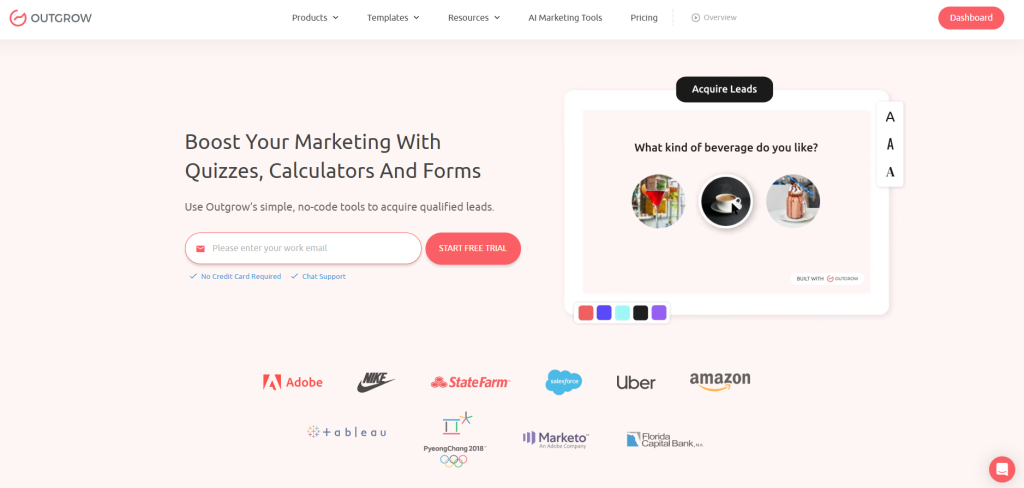
The results aren’t just a number, either. You can build a results page with charts, benchmarks, and personal recommendations based on the results of the calculator. Users walk away with something that actually helps them think, rather than a single figure they don’t know what to do with.
For businesses publishing the calculator, there’s a lead generation layer built right in. You gate the full results behind an email capture. The people filling out your customer acquisition cost calculator are thinking hard about their growth costs; they’re not casual browsers. That makes them some of the most qualified leads you can collect through content.
The other practical win: Outgrow calculators embed anywhere. Your website, a landing page, a LinkedIn post, an email campaign. You build it once, and it runs.
Try Outgrow’s Ready-to-Use Customer Acquisition Cost (CAC) Calculator
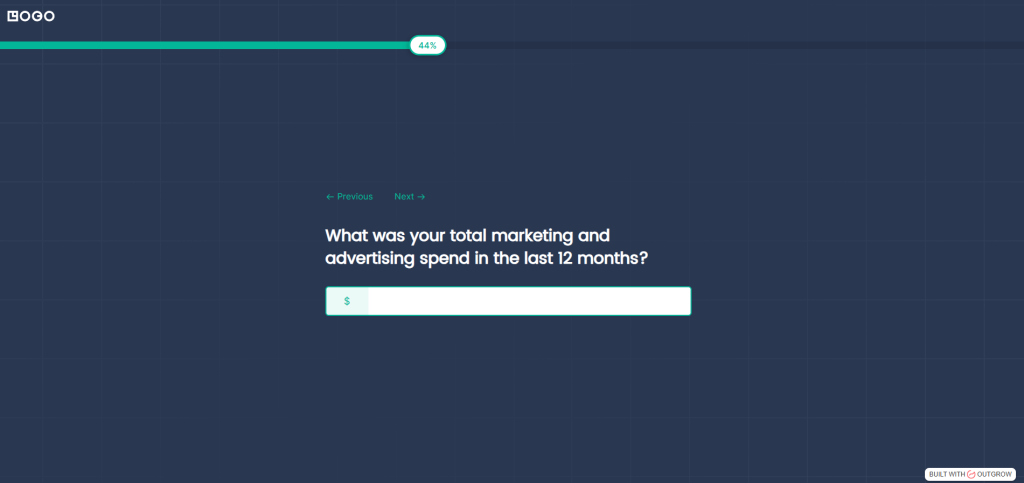
If you want to see what a well-built CAC calculator looks like before creating your own, Outgrow already has a ready-made version. The interactive customer acquisition cost calculator template from Outgrow lets you explore how it works and how it feels for users before you start building your own.
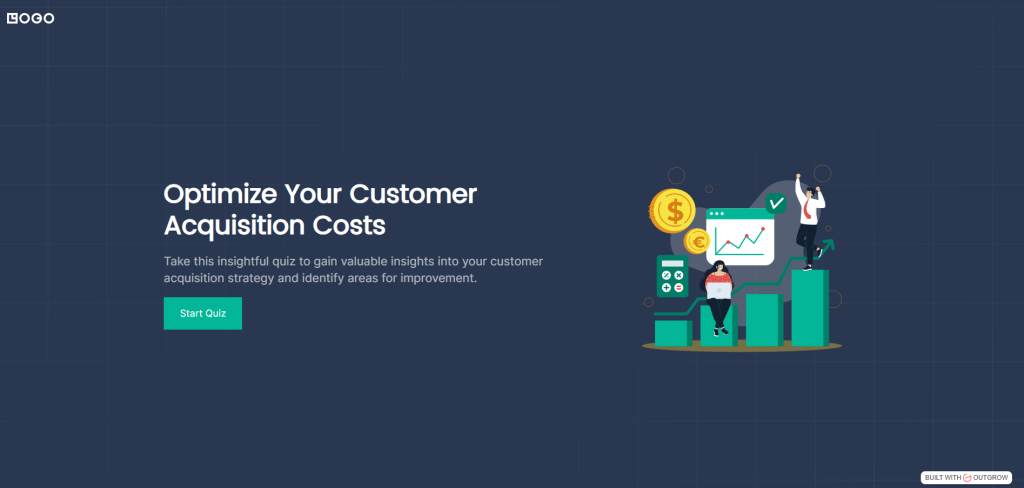
It’s worth trying for a few reasons. First, it gives you the experience of using an interactive calculator versus a static one; the difference is obvious once you’ve done both. Second, it’s a fast way to get a real CAC number for your own business without building anything yet.
Use it as a starting point, a reference point, or just a way to pressure-test your own numbers before your next planning meeting.
Building Your Own Calculator with Outgrow
Once you’ve seen how the premade version works, building a custom one for your specific audience takes a few hours at most. Here’s the general flow:
- Pick a template. Outgrow has calculator templates across industries. Start with whichever one is closest to what you need and modify from there.
- Set up your input fields. Add the cost categories your audience actually uses. Sliders work well for spend ranges. Dropdowns are cleaner for categorical inputs like industry or business model.
- Map your formulas. The formula builder is visual. Connect your inputs to the CAC formula, then layer in the LTV ratio or payback period if you want the output to be more complete.
- Build a results page that actually means something. Add a chart, a benchmark comparison, or a short recommendation based on what the output shows. A raw number on a white page doesn’t help anyone.
- Put a lead gate in. Ask for an email before delivering the full results. People who’ve spent five minutes entering their real business data will give you their email to see the output.
- Brand it and publish. Add your logo, colors, and fonts. Grab the embed code and drop it wherever your audience spends time: website, blog post, LinkedIn, email sequence.
The whole build is realistically done in an afternoon. After that, it just runs.
Who Actually Gets Value From a Customer Acquisition Cost Calculator?
Anyone spending money to grow a customer base has a use for this. But the people who get the most out of a customer acquisition cost calculator tend to fall into a few specific buckets:
- SaaS teams tracking CAC across tiers. A $400 CAC on a $99/month plan looks very different than the same number on a $2,000/month enterprise contract.
- Ecommerce brands where paid acquisition costs are rising, and you need a clear read on paid vs. organic CAC before you can make smart budget calls.
- Marketing agencies that can publish a branded customer acquisition cost calculator as a free tool for prospects. It’s a credibility signal and a lead magnet in one.
- B2B companies with long sales cycles, where deals take six to twelve months to close, and you need cohort-level CAC data to know which campaigns from last year are actually paying off now.
- Founders talking to investors who need clean CAC and payback period numbers before a fundraise. Investors ask. You want a confident answer ready.
Five CAC Mistakes Worth Avoiding
These come up constantly. Most of them are fixable once you’re using a customer acquisition cost calculator consistently:
- Counting only ad spend. The creative team, the strategist, the tools, if they contributed to acquisition, they belong in the number. Leaving them out flatters your CAC and misleads your planning.
- Mixing new and returning customers. CAC measures acquisition. If repeat buyers end up in your denominator, your CAC looks better than it is. Keep them separate.
- Running the calculation once a year. Ad costs shift. Campaigns age. Conversion rates change. A customer acquisition cost calculator you run monthly catches problems in weeks instead of quarters.
- Skipping payback period. If your CAC is $300 but it takes 14 months to recover that cost, your cash flow has a real problem, even if the lifetime math looks good.
- Treating CAC as a single static number. The trend matters as much as the figure. A customer acquisition cost calculator you use regularly shows you the direction, not just the destination.
The Number You’ve Been Avoiding Is the One You Need Most
Plenty of teams know their revenue. Fewer know their real customer acquisition cost. Fewer still track it consistently enough to act on the trend.
That gap is where bad budget decisions live. It’s where you keep funding channels that stopped working six months ago. It’s where you underfund the ones that are quietly generating your best customers at a fraction of the cost.
A customer acquisition cost calculator doesn’t solve all of that on its own. But it makes the numbers impossible to ignore, which is usually the thing that needs to happen first. A cost per customer acquisition calculator doesn’t solve all of that on its own. But it makes the numbers impossible to ignore, which is usually the thing that needs to happen first.
The customer acquisition cost formula is simple, but getting the inputs right is what makes the result useful. Track your costs consistently, separate new customers from returning customers, and monitor the trend over time.
Another useful customer acquisition cost example is comparing CAC across different acquisition channels. If one channel generates customers at $150 each while another costs $300, the lower-cost channel may initially look like the obvious winner. But you should also consider customer quality, retention, and lifetime value before shifting your entire budget.
Try Outgrow’s Customer Acquisition Cost Calculator template to get your number today, or build a custom version for your audience and start generating leads from people who are actively working through their own growth math. Either way, sign up for Outgrow’s 7-day free trial today and get your calculator live before your next campaign.
Frequently Asked Questions
It determines how much money you’re spending to acquire each new customer, with the calculation of total sales and marketing expenses divided by the number of new customers acquired. Most businesses don’t know the real cost because they don’t factor in the cost of staff time and tools, so the structure helps ensure you plug in the real numbers.
Total marketing spend, total sales spend, and a portion of overhead related to those expenses. Most people only know their ad spend, which can be 30-50% lower than the real cost of acquiring each customer.
Yes. Outgrow’s drag-and-drop builder and visual formula editor mean no coding required. Most people have a branded, embedded Customer Acquisition Cost Calculator live within a few hours using one of the existing templates.
You gate the full results behind an email capture. Since users have already invested time entering their real data, they’re motivated to hand over their email to see the output, and they arrive as genuinely high-intent leads, not passive content browsers.

Sakshi is a digital marketing enthusiast passionate about connecting brands with audiences. With a background in content strategy and social media, she loves turning trends into actionable strategies. Outside of work, you’ll find her reading a book or hunting for the perfect cup of coffee.