Summarize with :
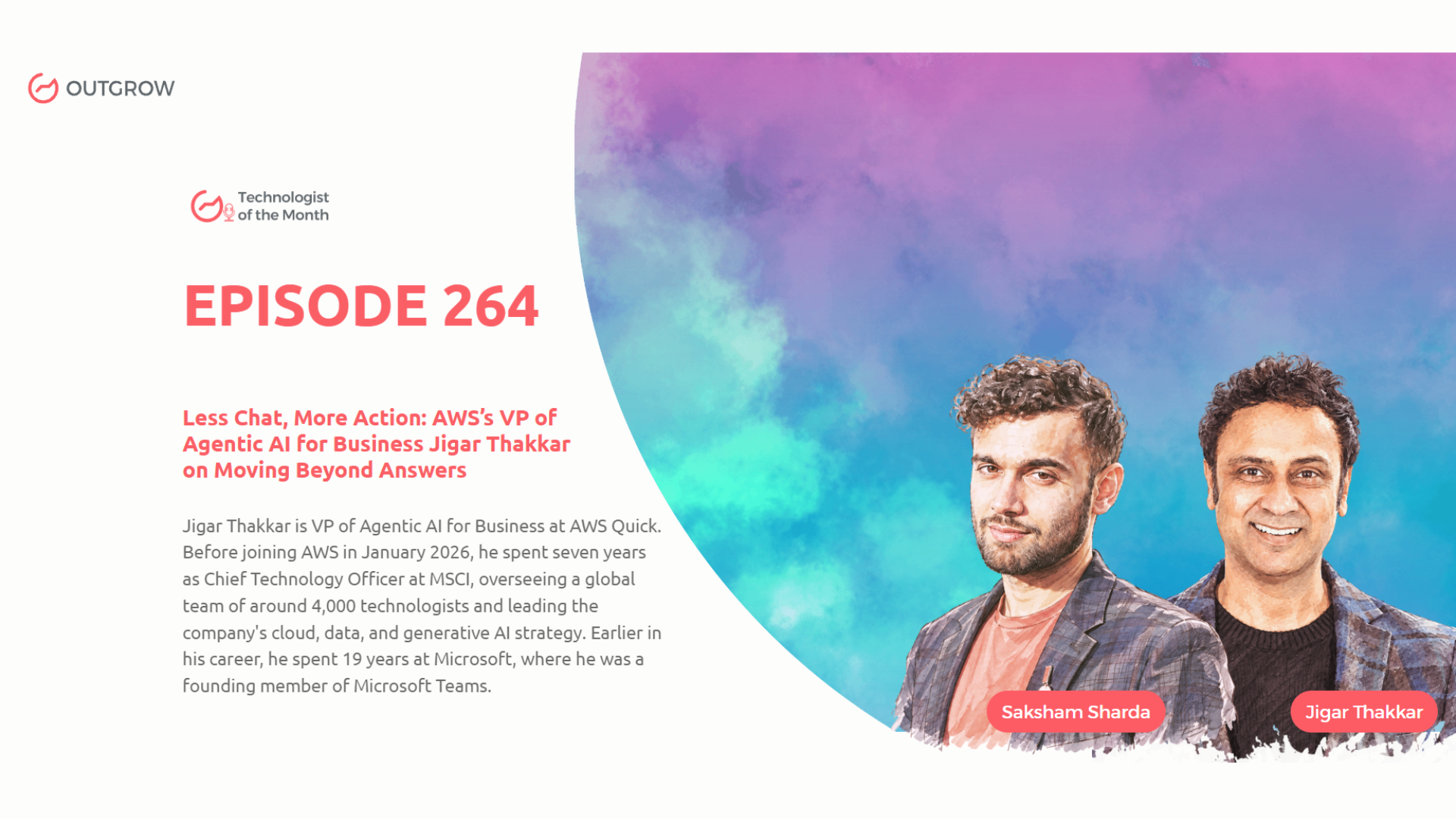
EPISODE 264: Marketer of the Month Podcast with Jigar Thakkar
Table of Contents
Hey there! Welcome to the Marketer Of The Month blog!
We recently interviewed Jigar Thakkar for our monthly podcast – ‘Marketer of the Month’! We had some amazing, insightful conversations with Jigar, and here’s what we discussed about-
1. Why Jigar swapped a CTO title for agentic AI at AWS
2. Why agentic AI is the most powerful tech of his career
3. How Quick connects Salesforce, Jira, Asana, and SAP into one knowledge graph
4. Why regulated industries need guardrails and zero margin for hallucination
5. Why the best software disappears into the background of your work
6. Trust and privacy: staying in control of what Quick remembers
7. AWS Quick explained for beginners, an AI assistant that knows your context
About our host:
Dr. Saksham Sharda is the Chief Information Officer at Outgrow.co He specializes in data collection, analysis, filtering, and transfer by means of widgets and applets. Interactive, cultural, and trending widgets designed by him have been featured on TrendHunter, Alibaba, ProductHunt, New York Marketing Association, FactoryBerlin, Digimarcon Silicon Valley, and at The European Affiliate Summit.
About our guest:
Jigar Thakkar is VP of Agentic AI for Business at AWS Quick. Before joining AWS in January 2026, he spent seven years as Chief Technology Officer at MSCI, overseeing a global team of around 4,000 technologists and leading the company’s cloud, data, and generative AI strategy. Earlier in his career, he spent 19 years at Microsoft, where he was a founding member of Microsoft Teams and served as Corporate Vice President for Teams and Skype for Business Engineering, building the product from scratch to global scale.
Less Chat, More Action: AWS’s VP of Agentic AI for Business Jigar Thakkar on Moving Beyond Answers
The Intro!
Saksham Sharda: Hi, everyone. Welcome to another episode of Outgrow’s Marketer of the Month. I’m your host, Dr. Saksham Sharda, and I’m the creative director at Outgrow. co. And for this month, we are going to interview Jigar Thakkar, who is the VP of Agentic AI for Business at AWS Quick
Jigar Thakkar: Great to be here. Thank you.
Don’t have time to read? No problem, just watch the Podcast!
Challenge yourself with this trivia about the exciting topics Jigar Thakkar covered in the podcast.
Or you can just listen to it on Spotify!
The Rapid Fire Round!

Saksham Sharda: All right. Let’s start with a rapid-fire round just to break the ice. The first question is, at what age do you want to retire?
Jigar Thakkar: The day I die, possibly.
Saksham Sharda: How long does it take you to get ready in the mornings?
Jigar Thakkar: Usually just a few minutes.
Saksham Sharda: Favorite color?
Jigar Thakkar: Yellow.
Saksham Sharda: What time of day are you most inspired?
Jigar Thakkar: I think the early mornings when it’s kind of quiet at home and at work.
Saksham Sharda: Most embarrassing moment of your life?
Jigar Thakkar: I’d rather not talk about that one.
Saksham Sharda: How many hours of sleep can you survive on?
Jigar Thakkar: I’ve survived on nights without sleep completely, so I would say zero.
Saksham Sharda: The city in which the best kiss of your life happened?
Jigar Thakkar: Oh, that would be in Gujarat, in India.
Saksham Sharda: How do you relax?
Jigar Thakkar: Play chess.
Saksham Sharda: How many cups of coffee do you drink per day?
Jigar Thakkar: Usually one, sometimes two.
Saksham Sharda: A habit of yours that you dislike?
Jigar Thakkar: Playing chess.
Saksham Sharda: The most valuable skill you’ve learned in life?
Jigar Thakkar: Keep on learning, because you’re going to keep running into new things all the time.
Saksham Sharda: Your favorite TV show?
Jigar Thakkar: There’s quite a few. “Friends,” “Billions,” “Suits.” Pick one.
Saksham Sharda: Are you an early riser or a night owl?
Jigar Thakkar: I’m an early riser and a night owl.
Saksham Sharda: One-word description of your leadership style?
Jigar Thakkar: I’m not sure. One word? Empowering.
Saksham Sharda: Okay. It’s good that you didn’t say “not sure,” which would be two words, but anyway. Coffee or tea to kickstart your day?
Jigar Thakkar: Coffee.
Saksham Sharda: Ideal vacation spot for relaxation?
Jigar Thakkar: A bit of sightseeing and mountaineering, and then by the sea.
Saksham Sharda: Key factor for maintaining a work-life balance?
Jigar Thakkar: Work hard, play hard, have a lot of fun.
Saksham Sharda: Top priority in your daily schedule?
Jigar Thakkar: My thinking time.
Saksham Sharda: A memorable caeer milestone?
Jigar Thakkar: Right now.
Saksham Sharda: A recent business innovation that caught your attention?
Jigar Thakkar: The completely autonomous agents we built, which just get a bunch of stuff just done for me.
The Big Questions!

Saksham Sharda: All right, that was the end of the rapid-fire round. Now we’re just going to go on to the bigger questions, which you can answer with as much time and ease as you like. The first one is, you spent almost 20 years at Microsoft building products like Teams and Bing, then seven years running technology for one of the biggest names in global finance. What made you walk away from a CTO title to go build an AI assistant instead?
Jigar Thakkar: We’re at an inflection point, and with agentic AI, how a billion business users get their work done is getting reimagined. And I’ve built systems like the CRM systems or Teams, and this is that pivotal moment where you can build something where all the work gets done in one place for you. And agentic AI is the most powerful technology we have seen since I started working in software. And I felt I don’t want to be left out of this big moment in life. I can always go back into those CTO roles in the future if I want to, but this was the time I had to get back, shift left, and get back into core tech.
Saksham Sharda: So looking in your past then, you were there on day one of Microsoft Teams, which was another big thing before anyone knew it would actually work. What was that period like, building something that ended up becoming how half the world talks to each other at work?
Jigar Thakkar: That period was very exciting, and it’s reminiscent of the last 25 years. There’s very few moments you feel like that. And I feel like that today with AWS Quick, which I felt back then in Teams, which is moving extremely fast, reimagining how work gets done, and not looking at the last 25 years of apps and services and how things were done, but make a bet on what the future will look like. And it is very uncertain. It is high amount of ambiguity. It is fast-moving, making mistakes fast and correcting them fast. It’s not everybody’s cup of tea, but when you go through it, incredible things can happen after that.
Saksham Sharda: So what’s something interesting you learned building Teams that you’re now applying to AWS Quick?
Jigar Thakkar: I think the most important thing that I’m applying to AWS Quick is the fast iteration. When you have a goal which says, “In three months, we’re going to do this,” I simply ask for a demo in a week, the same Friday. What that does is 80% of the big questions we had to answer over the three-month period, they get accelerated, and you have to face those things immediately. And when you start building out code and start doing those demos, you actually start making the right trade-offs as opposed to having a long-term master plan. So I don’t believe in making very, very long-term plans. You want to move really fast and give yourself ability to take the customer input and market realities and the new innovations going on with AI and start changing your plans as you need. So speed is one of the most important things there. But that has to be coupled with a very thoughtful… vision of what we are trying to accomplish with keeping the customer in mind to know what problem we are trying to solve for them.
Saksham Sharda: And for listeners who don’t know, what is AWS Quick? If you could explain it to a complete noob out there.
Jigar Thakkar: So AWS Quick is your AI assistant that knows you, knows the people you work with, your full context. It connects with everything, whether it’s Salesforce, Asana, Jira, Google Docs, Microsoft Office, SAP systems, and it creates a knowledge graph of you and your work and your teams. And it becomes a proactive assistant who can understand what’s coming and start guiding you on how to get those things done.
Saksham Sharda: You’ve also called AWS Quick your digital soulmate. That’s a strong thing to say about software. What does that actually mean day-to-day, and what does it do for you that nothing else has?
Jigar Thakkar: Yeah, I think I said that impulsively at a pretty large audience. The reason I said that was I’ve gone through many changes in my career in multiple roles at Microsoft, then MSCI, and Wall Street, and back to Seattle. And adapting to a new culture, a new technology stack, a new problem domain, and adapting your leadership to the team you’re working with is not a trivial challenge. So when I started building AWS Quick and using it, I found out creative ways of using it. So not only what needs to get done is something that AWS Quick helps you with, when it needs to get done. If you ask the right questions, it can consult with you on how to do things. So, for example, I would ask AWS Quick, I asked a very high-level question, “How is my leadership style? How am I working with my direct reports? How does my team see me? How can I do a better job in leading this organization?” And it was mind-blowing what kind of insights AWS Quick came up with after a few minutes of research in my communication style, looking at my Slack, my Teams, the number of meetings I have, the number of follow-ups I do, what time of the day and the weekends I send messages. It created a complete profile of how do I lead, and some suggested some changes. So that felt like this is something that a coach would do with you, or a guide, or a colleague would give you those kinds of tips. And that’s, if you use it the right way, it can actually be a digital soulmate and help you reflect how do you work in any environment.
Saksham Sharda: And do you worry about people not getting too dependent on something like this?
Jigar Thakkar: I’m not. I think it helps you get better. All the information is already out there. Your information that you worry about software finding out is already sitting there. Software already knows your emails, your Slack, your mood. It just doesn’t do anything with it. For the last 25 years of thousands of SaaS products, productivity products, line of business apps, they take data, process it, save it, and give it back to you when you ask for it. So building something that is proactive is only utilizing all of that context that you have already given the permission to. It’s just that it hasn’t served us enough, so we do a lot of grunt work that we don’t have to.
Saksham Sharda: Speaking of thousands of SaaS tools out there, everyone now has shifted and claims they’re doing AI. In your view, what’s the real difference between a tool that just answers questions and one that actually goes and does the work for you?
Jigar Thakkar: Yeah, when you add AI to a SaaS tool or a productivity tool, it can answer your questions. It also has context of that app. But your life is not to go into those silos, right? So there are dozens of apps in a large enterprise somebody uses in a week. All of those apps and services have their own siloed context. What we see with AWS Quick is actually it connects the dots across all of these apps, so you don’t need to go into each and every one of them. So answering your question is kindergarten-level AI, in my opinion. But proactively telling you what needs to get done and comes up with options of how to solve those things and getting a lot of things off the plate so that you can focus on the right things, that is what AI needs to be doing for us, and that’s what AWS Quick does.
Saksham Sharda: And how far away are we from that being completely normal instead of new and exciting?
Jigar Thakkar: I think our customers who have started using it, let’s say, three, six months ago, for them, this is the normal way of doing things, right? They wake up in the morning, the autonomous agent has prepared all the customer briefings for them. It is highlighting a conflict that is coming up. There’s a board meeting and you have to travel that time, and it’s suggesting some options of how to deal with it. It is looking at all your chatter and suggesting the document changes you need to be making. So all of that is happening. Of course, there’s a lot more innovation and enhancements that’ll keep on coming for weeks and months and years to come. But customers have started realizing it, and one of the things customers tell us is that they find it magical. The other thing you hear right after that is, “We have forgotten how we used to work without it.” And that’s when you know that at some point they start forgetting that this is a new piece of software. They realize this is the new way to work, and they start living in it and start recouping hours and hours back for what they really want to focus on.
Saksham Sharda: So if we were to weave all this into your own background and career, you’ve spent years running technology for a company that sits right at the center of how the world’s investors make decisions. What did that experience teach you about how careful you have to be now when AI touches something people generally cannot afford to get wrong?
Jigar Thakkar: Yes, there’s a big difference between having AI for the consumer and AI for the enterprise. And the difference is, for an individual, you give a question and answer, they can decide for themselves what to do with it. But when it comes to enterprise, say your example of the financial industry, there are fiduciary requirements for having exact data. There are regulations around it, governance around it. And in these regulated industries, you make a mistake, the CEO or the CFO is answerable to these kinds of issues, right? So, with Agentic AI, with AWS Quick, we understand this, and natively from day one, the guardrails were put in. So security, governance, compliance, the guardrails, the controls at the admin level, at the user level, at the agent level, those things are not features we add. That is the foundation of the platform to be had from day one. That is very critical when you think about energy, healthcare, finance, and many such highly regulated industries, that there is no margin of error, hallucination, or speculation.
Saksham Sharda: And if AI really does end up handling most of the repetitive work for people, what do you think we end up doing with all the time instead?
Jigar Thakkar: Go back to the first principles of what we are trying to accomplish in your day, right? If you’re working in a company, typically you want to focus on your customers, your investors, your employees. What can you innovate for your customers? How can you serve them better? How can you make your employees and your work go more smoothly? And how do you drive those inefficiencies out of the system and bring out your creativity? When was the last time you felt productive in a productivity app? When I go to the productivity apps, I’m just drowning in the task and the to-do list. So, what I would like to do is to have a lot more focus time where I can think. And if you remember the first question you asked me around what is the highest priorities, it’s my thinking time. Because if you don’t have that, you’re going to be swept away with tactical responses, questions, and answers all day long. So, with something like AWS Quick, it brings you back to what is the real work you’re trying to accomplish, is to focus on building something for your customers, doing something for your shareholders, and for your employees, all the stakeholders that are around you. How do you make things better for them?
Saksham Sharda: And then, well, when it comes to your own work life, you moved your whole life back to Seattle for this role, and that’s a big call at this stage in your career. What made this the one worth the failing doing that for?
Jigar Thakkar: So, when I saw AWS Quick in doing the interview process and played with it, it gave me this thought that this is my second opportunity to really build something that can touch the lives of hundreds of millions of people. This will change the way we fundamentally work in the workplace. And for that to happen, I really wanted to be at the heart of where the innovation is happening, where the cloud started, come back to where my roots are, it’s from Seattle, and build with the engineers, the designers, the scientists, all the builders, the product leaders, and all the customers, be close to where the action is. This is the exact reason why I had moved to New York City, to be in… If you want to work in finance, you want to be where the epicenter of that world is. This is why I wanted to move back to the West Coast.
Saksham Sharda: So you have led engineering teams of hundreds and thousands of people across very different companies. Is there one thing about leading people that never changed, no matter what you were building?
Jigar Thakkar: I think it’s about the people you work with, keeping them in mind, providing the full context and support, and then letting them do their work. That never changes, whether you use AI or any tools you use or how much gets automated. The fundamental point in your leadership skills that you need to bring the best out of everybody who works with you doesn’t change. And for that to happen in this world, you have to give them the full context of what are we trying to accomplish with the customers, what are our constraints, what is our strategy, what is the long-term vision, and keep them very close to all of that, and then listen. There are a lot of signals you’ll get from your team if you listen to them, ask questions, hang out with them. And if you do that, things will go much better, much faster for yourself, for your team, and for the customers. And that never changes.
Saksham Sharda: So when you talk about strategy, vision, and building, you’ve built and shipped products that reached hundreds of millions of people, from Bing to MSN to Teams. What do you think actually separates a good idea from something people end up saying they can’t live without?
Jigar Thakkar: So, the software that just disappears but you cannot live without is really key. Something that keeps pulling you in and makes you busy, I would not say that is your measure of success. The measure of success is when you realize that a vast body of work that you used to do is now taken care of for you in the background, and it’s always there for you. That is a measure of success, in my opinion.
Saksham Sharda: So then the be-all and end-all of all software would just be this AI that can do everything, a single chat interface, but that will just be in the background.
Jigar Thakkar: I wouldn’t even say it’s a single chat interface. It is more than that, because sometimes it is not a chat interface. Sometimes it is a dashboard that shows up in front of you when you need it. Sometimes there is no UI, and it has done all the background processing to get a presentation ready for you. And sometimes there is a chat box that you can ask questions to. Sometimes you’re driving from your home to work, and you ask for, “Prepare me for the day.” You just have a voice command, and the voice is coming through your car system telling you the top three priorities for the day, the three hurdles you’re going to run into, the briefings of a document you’re supposed to be presenting in a couple of hours. All of that information can be coming in multiple different modalities, and that is going to be the future of what AWS Quick is looking like right now, and more and more so in the future.
Saksham Sharda: At the same time, though, all your rivals are flooding the market with AI assistant claims right now. How do you get someone to actually believe AWS Quick is different rather than just more noise in an already crowded space?
Jigar Thakkar: For the last several months, meeting lots and lots of customers, and the simplest thing I tell them is, “Install it, connect it to the things you care about, and use it for a few minutes.” It instantly adds value, and the customers get surprised. So, that is the best way to differentiate. Instead of a marketing pitch or a sales pitch, you simply tell them the product speaks for itself.
Saksham Sharda: And again, I guess you’ve talked about this a little, but if it learns from you personally, the way you work and communicate, isn’t there something a little unsettling about software knowing you that well? How do you get people comfortable with that currently, instead of being creeped out by it?
Jigar Thakkar: So there’s three things to think about. One is that you are in full control. You can delete the memories, you can delete the knowledge graph, you can ask it to stop tracking something. The second is, is it adding more value to the work it does, and are you getting comfortable with that? When you realize that you’re getting hours back in your life, in your work, you start realizing that you need to be able to trust the system and allow it to know all of these things. And thirdly, most important in some ways, like I said before, the software out there already knows all this information. Your emails, your Teams messages, your Slack messages, your documents, your presentations, your calendar. It’s already sitting somewhere in dozens of different applications, right? Your Jira tickets, Asana, PagerDuty information. All of that is already out there. You’re already trusting software to know all this information. All you’re doing here with AWS Quick is connecting the dots, providing the context, and really removing that cognitive load from your brain to go through a dozen different applications and services and copy-pasting things and remembering where this information lies, in which Slack thread, or was it an email you sent me, or was it a document you sent me on a Zoom chat? It eliminates all of that work from your brain and just lets you focus on what is your objective today, and it helps you get it done. So this is the way I believe our customers are finding it easy to trust it.
Saksham Sharda: All right, so the last question for you is of a personal kind. What would you be doing in your life if not this?
Jigar Thakkar: Hiking, running, playing chess. Playing poker, maybe. Enjoying life.
Let’s Conclude!
Saksham Sharda: Thanks, everyone for joining us for this month’s episode of Outgrow’s Marketer of the Month. That was Jigar Thakkar, who is the VP of Agentic AI for Business at AWS Quick
Jigar Thakkar: Great to be here. Thank you.
Saksham Sharda: Check out the website for more details and we’ll see you once again next month with another marketer of the month.

I am a Digital Marketing Enthusiast with a passion for optimizing content and paid marketing strategies. Continuously seeking innovative approaches to boost ROI and engagement at Outgrow.