Summarize with :
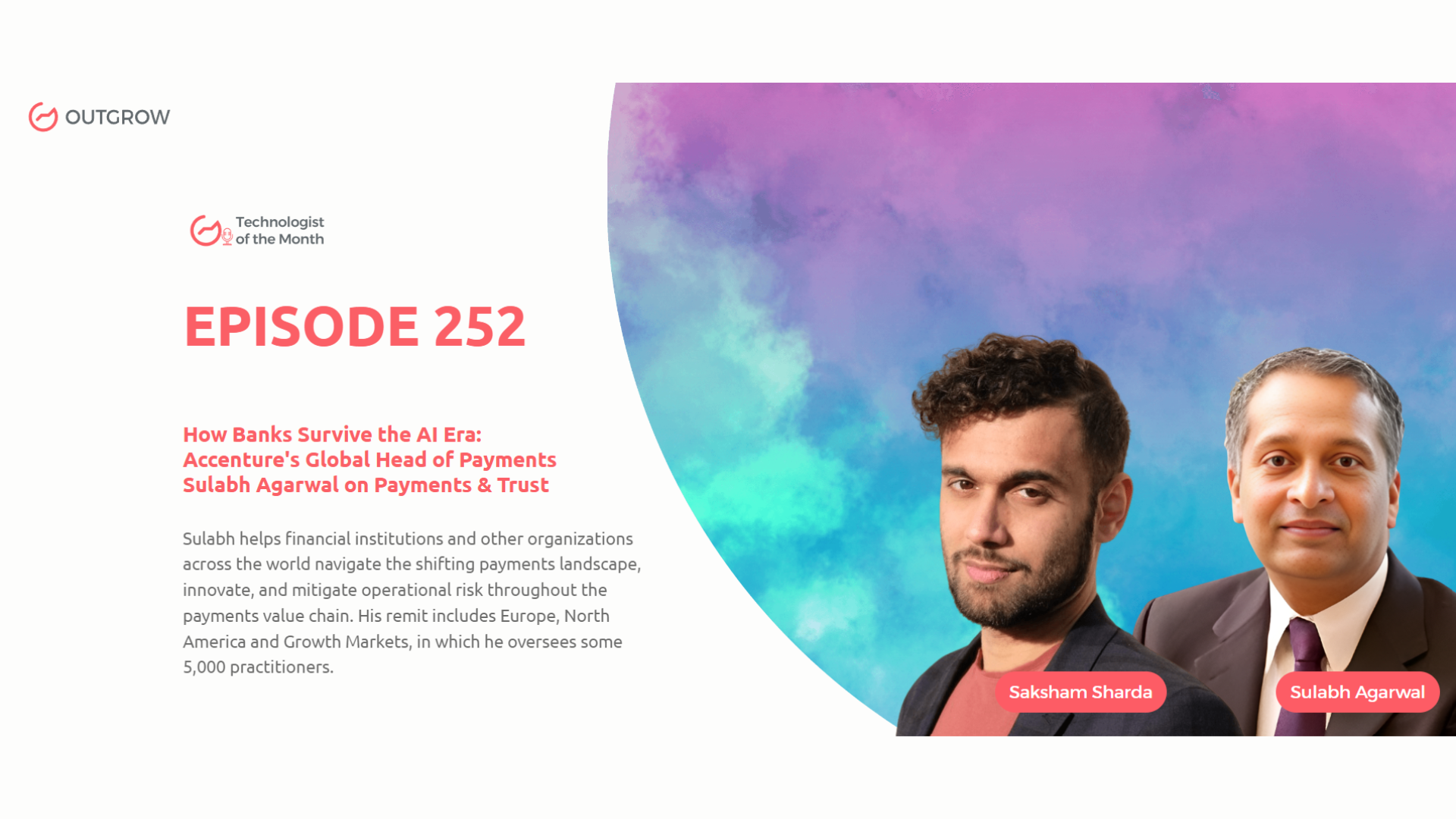
EPISODE 252: Marketer of the Month Podcast with Sulabh Agarwal
Table of Contents
Hey there! Welcome to the Marketer Of The Month blog!
We recently interviewed Sulabh Agarwal for our monthly podcast – ‘Marketer of the Month’! We had some amazing, insightful conversations with Sulabh, and here’s what we discussed about-
1. Why hy reinventing yourself every two years keeps you sharp
2. Digital euro vs digital dollar: Europe’s CBDC edge
3. Real-time payments and the shrinking fraud detection window
4. What India’s UPI got right that others haven’t
5. Separating genuine fintech innovation from industry noise
6. Why loyalty and rewards are becoming payment differentiators
7. How AI agents will soon pick your payment method
About our host:
Dr. Saksham Sharda is the Chief Information Officer at Outgrow.co He specializes in data collection, analysis, filtering, and transfer by means of widgets and applets. Interactive, cultural, and trending widgets designed by him have been featured on TrendHunter, Alibaba, ProductHunt, New York Marketing Association, FactoryBerlin, Digimarcon Silicon Valley, and at The European Affiliate Summit.
About our guest:
Sulabh helps financial institutions and other organizations across the world navigate the shifting payments landscape, innovate, and mitigate operational risk throughout the payments value chain. His remit includes Europe, North America and Growth Markets, in which he oversees some 5,000 practitioners.
How Banks Survive the AI Era: Accenture’s Global Head of Payments Sulabh Agarwal on Payments & Trust
The Intro!
Saksham Sharda: Hi, everyone. Welcome to another episode of Outgrow’s Marketer of the Month. I’m your host, Dr. Saksham Sharda, and I’m the creative director at Outgrow. co. And for this month, we are going to interview Sulabh Agarwal, who is the Global Head of Payments at Accenture.
Sulabh Agarwal: Great to be here. Thank you.
Don’t have time to read? No problem, just watch the Podcast!
Challenge yourself with this trivia about the exciting topics Sulabh Agarwal Top Explores covered in the podcast.
Or you can just listen to it on Spotify!
The Rapid Fire Round!

Saksham Sharda: At what age do you want to retire?
Sulabh Agarwal: Sixty.
Saksham Sharda: How long does it take you to get ready in the mornings?
Sulabh Agarwal: Half an hour.
Saksham Sharda: Favorite color?
Sulabh Agarwal: Blue.
Saksham Sharda: What time of day are you most inspired?
Sulabh Agarwal: 5:00 AM.
Saksham Sharda: How many hours of sleep can you survive on?
Sulabh Agarwal: Six.
Saksham Sharda: Pick one, Mark Zuckerberg or Elon Musk?
Sulabh Agarwal: Elon Musk.
Saksham Sharda: How do you relax?
Sulabh Agarwal: Meditate.
Saksham Sharda: How many cups of coffee do you drink per day?
Sulabh Agarwal: None.
Saksham Sharda: A habit of yours that you hate?
Sulabh Agarwal: Comment on the kids’ activities.
Saksham Sharda: The most valuable skill you’ve learned in life?
Sulabh Agarwal: To be curious all the time.
Saksham Sharda: Your favorite Netflix show?
Sulabh Agarwal: Not a Netflix watcher.
Saksham Sharda: Are you an early riser or a night owl?
Sulabh Agarwal: Early riser.
Saksham Sharda: One-word description of your leadership style.
Sulabh Agarwal: Collaborative.
Saksham Sharda: Coffee or tea to kickstart your day?
Sulabh Agarwal: Milk.
Saksham Sharda: Top priority in your daily schedule?
Sulabh Agarwal: My meditation.
Saksham Sharda: Ideal vacation spot for relaxation?
Sulabh Agarwal: Mauritius.
Saksham Sharda: Key factor for maintaining a work-life balance?
Sulabh Agarwal: Prioritization.
Saksham Sharda: Memorable career milestone?
Sulabh Agarwal: Making MD in Accenture.
Saksham Sharda: A recent business innovation that caught your attention?
Sulabh Agarwal: Agent e-commerce.
The Big Questions!

Saksham Sharda: All right, that’s the end of the rapid fire.
Sulabh Agarwal: Oh, my God.
Saksham Sharda: Now, now we’re going to move on to the longer questions, which you can answer with as much time and ease as you like. The first one is you went from an IIT engineering degree to an INSEAD MBA to Capital One and then built a global payments practice in Accenture. What was the thread connecting these moves, and when did payments specifically become your passion?
Sulabh Agarwal: Yeah, the common thread connecting all these moves is that I have a passion to continuously, you know, reinvent myself every few years. And, uh, whether it was, um, IIT, which was learning from, engineering perspective; going to the US with Capital One, where I was actually running a P&L from a credit card perspective; then moving with Capital One to, um, Asia for new business development. Again, a change, um, to my MBA to joining Accenture and doing strategy. Then somehow payments came in because of one assignment. I did lots of payment strategies. Then I’ve moved on to continue to learn in data. I used to lead data and analytics. Then I moved on to lead risk and finance, came back in, into payments. But then payments is there, there’s never a dull day, right? Every day is new. And I think I thrive on learning and continuously, um, you know, enriching myself to do something new and learn, learn from whatever is happening. And I think someone gave me good career advice early on in my career. He said, sort of, “If every two years you’re not reinventing yourself, you’re probably getting stale.” So I’ve just kept it to my heart.
Saksham Sharda: And you now oversee five thousand practitioners across Europe, North America, and growth markets. How do you keep a team that size intellectually coherent around a strategy?
Sulabh Agarwal: Yeah, I mean, it is about clear communication. So we’ve got regular calls, sessions, visits, town halls, um, and clear cascade of what the vision is, what we are looking to achieve, what the clients are, are worried about, and what is it that we can bring to the table to solve their problems.
Saksham Sharda: You’ve described financial institutions as standing at a defining moment, either becoming a banking utility or an everyday bank. Where do most banks actually sit on that spectrum today, and is the middle ground sustainable?
Sulabh Agarwal: Yeah. They’re all things to all people at this point in time. and it is hard. I mean, just to keep the infrastructure up and running and secure, being able to fight things like mythos, which is coming from the right view, and different fraud threat actors, from a security perspective, coming from the other side. You’ve got agents coming and attacking you from the other side, which means you have to do real-time scalable solutions, and infrastructure is not that easy, especially if you’re running high volume and you’ve built your infrastructure long back. So I think that’s more or less a hygiene need, and organizations are a way to go to just keep that going. While they’re doing that, there’s a whole set of market movements in terms of the change in customer needs, new propositions, and new forms of money like stablecoins and tokenized money, like tokenized deposits and others. Agent e-commerce is picking up. You’ve got embedded finance and various things happening on the other side. And I think it’s about balance between the two, but then also making the choices around what is going to be the key thing that the organization will stand for in times to come.
Saksham Sharda: And what are the specific revenue lines that banks are losing, and who is capturing them?
Sulabh Agarwal: I think there’s a famous phrase called “Your margin or your revenue is my opportunity,” right? And essentially all the big revenue lines have been at threat for some time. If you look at cross-border payments and FX, you’ve had so much innovation and so many new players that have come in. You look at merchant acquiring, and again, a lot of new competition has come in, and now it’ll be the core account-to-account payments as well, which is kind of disrupted, and finally, where it’ll start to get into the B2B side of payments as well. So I think wherever there’s money to be made, you can see that there’s more and more competition. And, um, you can see like organizations facing stiffer competition not to say that clearly the way to win includes a big factor, which is like trust and also you know, long-term relationships, which is what is in the incumbent’s favor. But, but needless to say, like if the gap between the proposition out there, um, is significant to what the new organizations or fintechs are offering, you can see clear disruption.
Saksham Sharda: You’re considered an influential voice on the future of money, digital currencies, real-time rails, and embedded finance. Which of those forces do you think is most underestimated by the industry right now?
Sulabh Agarwal: Well, I think some of these things are kind of seen as given, right? So you look at, you mentioned embedded finance and others; I think that’s a given, and everyone feels, both on the retail side as well as the B2B side, that there’s more which needs to be done. I think where there’s more uncertainty and organizations are looking at various options and being very cautious is the whole area of digital currencies as well as the agentic commerce side, where the more traditional organizations are still waiting and watching and looking at where there will be traction. I personally believe that agentic commerce has got a clear customer value proposition. I mean, I as a customer have already… I’m already switching my searches from the traditional search engines to LLM searches. And US is clearly demonstrating as a market that, you know, customer discovery has already moved. And discovery to actually purchase and the transaction to follow is only that far away in terms of what’s likely to happen. So I do believe both on the consumer side as well as the business side, which is where you’re seeing agents being defined by the big, you know, procurement systems and the finance systems like SAP and Coupa and others. Both of those will mean that I’ll see more activity happening there quite quickly, and I do believe that organizations will need to start investing in there quite soon.
Saksham Sharda: What about central bank digital currencies? They have been debated for years. Do you think we’ll see mass adoption in your lifetime, and what’s the real blocker?
Sulabh Agarwal: Oh my God, this is a politically charged question. I think it is more geographical. So if you look at Europe, we can see more traction in terms of a digital euro, and at least if I was looking at a crystal ball, it’s likely to happen that the digital euro will see the light at the end of the tunnel. Whereas in some of the other markets, like US, we don’t see central bank digital currency really having traction. Then there are markets like the UK, where there are experiments happening along all lines, and it’ll become more clear in the coming months as to which direction it goes. I mean, if you look at digital central bank digital currency as a replacement of cash, of course it is, right? it’s a form of money which is backed by the central bank, which gives guarantee that the bearer will get the money, which is worth the amount. But if you look at mass adoption, I mean, not everyone uses cash today, so it is only a replacement of part of the overall flow of money. As well as if you look at then trying to have a functioning economy where you know, significant leverage possibilities, commercial bank gives you significant advantages, as well as stable coins and others have proven that you can get the programmability advantages without needing central bank digital currency. So I think the jury is out in terms of what will really, you know, gain traction, but I think it’ll be geographical as well as use case dependent.
Saksham Sharda: Payment failures, outages, fraud, and misdirected transactions make headlines regularly. From your vantage point, are institutions getting better at operational risk or just better at managing the PR around it?
Sulabh Agarwal: I think the risk is increasing day by day, right? So what used to be operational risk of a service which was batch-based when we moved to real-time to now what we are talking about is threat actors and threat vectors also moving real-time as well as the real-time expectation from a agent perspective from the core infrastructure and others, and full scalability due to micropayments and the scaling of transactional infrastructure. I think this is not something you can, you know. Even if you’ve invested a lot of money and improved your infrastructure, you cannot rest on your laurels here. You have to constantly work on it, and I think that the activity and the amount of, you know, focus needed for resilience and security is only going to increase even though the industry has moved significantly and will continue to invest in this area.
Saksham Sharda: Real-time payments shrink the window for fraud detection to milliseconds. How are the best institutions handling that pressure?
Sulabh Agarwal: I mean, what real-time payments have also added is the the way the whole liability framework works, right? Because, like credit cards have been a mature set of instruments, and they had a liability framework around chargebacks and whether it’s customer liability, merchant liability, payment service provider liability, etc., very well defined and very mature over a period of time. Real-time payments has been organically developing those liability frameworks in terms of who is liable and where fraud is originated. I’ll give you example of the UK, for example. Like the fraud may be originating in social media platforms, but essentially the sending bank and the receiving bank have got 50/50 liability for real-time payments. So it’s very hard to then control fraud outside of the liability framework. Whereas certain geographies are starting to bring different actors together and, you know, also to be held responsible and accountable and liable for the money that is losing from those network. I mean, the other thing which is happening as organizations are becoming more mature in tackling the impersonation fraud and the scams which we are seeing, including the romance scams, the investment scams, and others. We’re seeing a lot of these threat actors, or the fraudsters, shifting to the card network, and there is an increase in the fraudulent activity. In fact client was mentioning to me very recently that they’re finding that there are synthetic profiles being created in terms of the card actors who sit dormant for like 18 months, two years with perfectly, you know, acceptable and creditworthy behavior. And then suddenly you see across multiple banks activity where, you know, they would defraud the whole set of actors there. So, like, I think they’re getting more sophisticated. So are the financial institutions getting more sophisticated in identifying as well as collaborating to to figure out what’s the best way to handle these fraudsters, and both preventative as well as recovery actions are being put in place.
Saksham Sharda: Your remit spans mature markets like Europe and high-growth emerging ones. Do you see payments innovation happening faster at the edges in markets that skipped legacy infrastructure, or is the frontier still in the developed world?
Sulabh Agarwal: I think both have their advantages. I mean, emerging markets, like I would say Brazil, China, India, have had clearly the advantage of skipping a generation of infrastructural change where they’ve gone with central infrastructures. But then also the support from the particular organizations have meant that the pace of change and innovation has really accelerated significantly. And I had one senior exec move from the UK to India, saying that, “I can hardly just keep pace with the market change in terms of innovation.” whereas I think mature markets have had more structural changes, like adoption of ISO 2022 open banking, open finance being very widely available, and the structural changes actually creating the foundations for innovation for fintechs to come in. So I think there are innovations on both sides of the fence. It’s just that some are different… one set of innovations are different to the others.
Saksham Sharda: India’s UPI now that you mention it, is often held up as a model. What did they get right that other countries have struggled to replicate?
Sulabh Agarwal: I am genuinely impressed with the pace of innovation and central innovations. So payments by nature is quite networked, so what you have is you need the whole ecosystem to work in most use cases for the adoption to happen and, you know, to really get over the adoption chasm in any new innovative proposition that you’re trying to bring in the market. And what I believe India has got right is this whole pace of every quarter or every few months, there is a new overlay service, as you call it in the West they would come up with, whether it is UPI Circle, whether it is UPI 123, or whatever the new innovative, you know, scheme or overlay service that they will come up with. And everyone kind of just adopts it, just like, you know, like Visa, MasterCard, or Swift will have regular releases. Everyone adopts it, and then the chasm of adoption just goes away, and the whole market is transformed to the next set of service. And I think their real passion focus on what are the real, you know, issues both for consumers as well as businesses, that they need to work on. The central organization, NPCI, is really focused on it and really driving it hard, as well as the regulator.
Saksham Sharda: So you’ve presented at Sibos, Mobile World Congress, and other major stages, and you’ve built a thought leadership platform at Accenture. How do you distinguish genuine insight from noise in a space where everyone has a hot take on fintech?
Sulabh Agarwal: So I’ll probably say that there are two or three qualifying questions I would ask before saying whether it is noise or a real change happening. I think the first will be, is there value in the whole, you know, proposition, which means genuine cost reduction, genuine customer value, and business value in whatever the change we are seeing. And it could be theoretical, but at least the value needs to be real. I think the second thing I look at is, are the hurdles in adoption surmountable? So you go through whether it is a liability framework, whether it is the security fraud risk that you’ve been talking about, and others. Are these issues genuinely surmountable? and are there industry actors working towards, you know, solving it, and there… Is there a commonplace where they can be solved? And I think the third question I would ask myself is, is the capital flowing enough in that space that the chasm will get, you know, passed very quickly? And if there’s enough capital flowing in, you can be rest assured that even if there are issues and problems, they can be solved for.
Saksham Sharda: What’s a prediction you made publicly that turned out to be wrong, and what did you learn from it?
Sulabh Agarwal: Oh my God, lots of things haven’t been that right. I mean, open banking adoption, for example. It made sense, yeah, like open banking as a concept. I mean, we’ve been talking about data as the new oil, it being exposed to not just the individual institution but to the market. There was enough; there were enough fintechs in the market who were looking to exploit it, and there was enough money also flowing in, and there was quite a lot of hype in terms of open banking. It just took a lot of time to come up. And like, I think we as an industry, sometimes you know, the trend may be right, but we underestimate the time it’ll take for adoption to happen. I think that was the one which I feel I definitely didn’t get as right as I would have liked to in terms of how quickly the industry will pick it up.
Saksham Sharda: So retailers and non-bank players are increasingly building their own payments infrastructure. How should traditional banks think about that shift, and is it a threat or an opportunity?
Sulabh Agarwal: Yeah, I mean, there will always be institutions who are looking to get in the payments space. The only thing I would say is what a quick realization is that there are different levels of regulations and capital requirements with respect to how far you go in the value chain. As well as then there is the expertise and the knowledge and the data you have to be able to do a good job at whatever you’re looking to do. So there will always be institutions who feel they have deep pockets they believe that their business model still benefits from the return on equity or return on investment that you get from a financial services or a payments business versus whatever their core business is, and they will look to go in. But then it also comes down to expertise as well as data that they have. And we’ve seen so many examples of retailers trying to do that and then, you know, reverting back to their core business, finding it not so easy. But we’ve had other platforms trying to get into it, making it big in certain geographies, but then struggling in the others. So it’s… I don’t think it’s a you know, easy answer that, you know, a straightforward answer that that’s a good idea. Having said that, it is proving that the demand is there. And you were mentioning embedded services, embedded financial services. There is a demand, and banks and financial institutions and payment institutions have a opportunity to embed the offering, the platform, into their clients. I mean, most banks Large banks would have been dealing with the treasury department of a large corporate. They have an opportunity to go work with the front end, the marketing the customer departments of large corporates and merchants, and helping solve their problems. And I think that’s what, um, the need is of embedding an end-to-end proposition. And you can already see movement in the market where organizations are looking to do it.
Saksham Sharda: And where does the loyalty and rewards economy fit into all this? Is it still a payment differentiator or a race to the bottom?
Sulabh Agarwal: Well, Adyen have just announced buying a big loyalty company, so you can see that there’s still scope. You’ve had various other examples of, I mean, card loyalty is still a big factor as to how organizations or how individuals are looking to buy financial instruments. Um, I think what it will probably become more integrated in all forms of payments, and I would say because of the adoption of agent changes. Because when you look at individuals trying to figure out what’s the best proposition in the market you may miss out on the various features, loyalty, and other benefits that a proposition provides. When you replace the individual being assisted by an agent, you can be rest assured that the agent will look at it more holistically as long as you have given it the right prompt, or even to optimize. And this is where I think loyalty associated with the transaction itself is going to become a huge factor in selecting. I mean, we were talking about how in future the… it is not the individual that will choose your payment type; it will be the agent choosing your payment type. And whether it is cost or whether it is the overall value proposition or the benefit that you provide into the agent, these factors will become even more important.
Saksham Sharda: So let’s change track a bit here. Tell us a bit about your day. You wake up in the morning, how much time do you spend on emails? How much time do you spend in meetings? What is your day like?
Sulabh Agarwal: Yeah, I mean, morning is personal time and getting the kids out. But then yeah, my day starts in the office around 8:00 AM. Yeah, it’s pretty much back to back. I try and do my meetings or calls in 15 minutes, sometimes 25 minutes, just to squeeze that some you know extra five minutes or 15 minutes to walk around, to see people, to meet them, as well as, you know, catch up on emails. And it typically finishes with an evening event with teams or with clients. But, but I find it really energizing to be with people to solve real-world genuine problems as we work through with different clients on the various problems they have, and there’s never a dull day in payments.
Saksham Sharda: And what kind of talent is Accenture looking for in the market today?
Sulabh Agarwal: Curious, analytical, really driven individuals. Like, I mean, for me, that’s priority one. Of course, capability and problem-solving and analytic ability is important. And the last thing is teamwork, right? Can you fit in the culture in the team? Do you know your stuff? Still can be humble about it and work jointly to actually create the right outcome for our clients.
Saksham Sharda: Okay, so back to the big questions. Regulation across payments, from open banking to instant payment mandates, is accelerating in many markets. Are regulators ahead of the industry, behind it, or just in a different conversation entirely?
Sulabh Agarwal: You know, the tech industry is like sprinting at the moment. Yeah. The rest of the industry is trying to keep pace. And with the agenda being defined by the AI and the tech players, the rest of the industry is trying to keep pace, and then the regulator are also trying to keep pace. And it’s hard, right? Because every day is a new day. You don’t know what new AI release is gonna come out, what new disruption is gonna come out, what new possibilities will be there, as well as what new threats will be posed by the change. Yeah, it’s hard work. It’s hard work, but it is exciting as well. I think regulators are in the same mix where they need the right talent and capability to be able to understand what is changing. I mean, you were talking about noise versus real change and what is the likely impact is as a result of that change, and they are trying to keep pace as well.
Saksham Sharda: AI is moving from pilot projects to core infrastructure in financial services. Where in the payment stack are you seeing it create the most tangible impact today, and where is it still mostly hype?
Sulabh Agarwal: You know, I genuinely believe that AI value is real, front to back, top to bottom. Where it is starting is in the core ops and tech space ops, tech, and risk, I would say. I mean, risk, whether it is fraud, financial crime, and others, we have always used AI to, you know, identify the trends, to be able to work through the various possibilities and the probabilities of you know, either default or financial crime or whatever the case may be. Operations there is big use case. You can see how a lot of repetitive work can be automated as well as enriched, where, you know, humans are capable of doing more and faster. And tech as well, in terms of, you know, as we have gone through the whole tech revolution, and I mean, you know, whether it’s coding or, um, implementation of tech, we are seeing rapid, you know, growth in adoption. So I don’t think any of this is hype. I mean, they are all real. On the front end as well, I would say, whether it’s marketing or customer personalization of offerings, I mean, we are seeing lots of use cases where you know, AI is very real, and the clients are getting immediate benefits. I think what needs to happen now is, instead of individual pockets of improvements, a full end-to-end orchestration of AI to actually help redesign the end-to-end processes is kind of the next wave as we see better adoption and, you know, real business cases come out. And the big unknown in this is the cost of tokens themselves and at what point is the break-even point of the cost of tokens versus, you know, doing it in the more traditional way itself. So I think all of those questions are still open questions and need to be answered.
Saksham Sharda: So looking out 10 years, what does the payments landscape look like, and what role do today’s banks actually play in it?
Sulabh Agarwal: If I had a crystal ball for 10 years out, I mean, we would have progressed so much on the various dimensions of payments. I would have seen the payments propositions being completely instant and invisible from a customer perspective, very rich from a proposition perspective. There’ll be smart contracts all over, value-added services completely linked in, fully embedded into the end-to-end life cycle so that they will be completely seamless and not very visible. And I think a lot of focus will still be on the core infrastructure because I do believe that, um, the threat actors from a security resilience perspective will continue to demand lot of focus even in 10 years from now because, you know, it’s not gonna become easy. but having said that, that’s what makes our jobs exciting and all those who are working in payments this to be a great place to continue to be involved in.
Saksham Sharda: So the last question for you is of a personal kind. What would you be doing in your life if not this?
Sulabh Agarwal: I would be owning a sports franchise. And yeah, cricket or football, soccer as they call it in the US, one of those things, because I think when everyone will be bored of technology and AI, I think sports, media, and entertainment will probably still be very high on people’s radar, and everyone will move towards that. So I think that’s what I would be doing if it is not this.
Let’s Conclude!
Saksham Sharda: Thanks, everyone for joining us for this month’s episode of Outgrow’s Marketer of the Month. That was Sulabh Agarwal, who is the Global Head of Payments at Accenture.
Sulabh Agarwal: Great to be here. Thank you.
Saksham Sharda: Check out the website for more details, and we’ll see you once again next month with another marketer of the month.
I am a Digital Marketing Enthusiast with a passion for optimizing content and paid marketing strategies. Continuously seeking innovative approaches to boost ROI and engagement at Outgrow.