Brand Awareness Survey: The Ultimate Guide to Assessing Market Impact
A Brand Awareness Survey helps you understand whether your marketing efforts are actually making an impact. You’ve invested time and money into advertising on social platforms, started a newsletter series, and shared content daily. This question keeps you up at night: Are people aware that your brand exists?
Here’s an interesting truth: 46% of your customers will be more likely to purchase from you if they recognize your brand. Almost half of your business depends on creating brand recognition.
The best part? You won’t have to play a guessing game anymore. This is where a brand awareness survey comes in. It gives you the facts you need to figure out where your brand sits in a customer’s mind. And now, you can do this with Outgrow, as you can create a survey that your customers want to take part in using an Outgrow Survey Builder.
Many brands today also design their surveys in a way that feels engaging, almost like surveys to do when bored, so users actually enjoy answering the questions.
What Is a Brand Awareness Survey and Why You Cannot Ignore It
Table of Contents
A brand awareness survey is a questionnaire-based tool for determining how well your brand is known to your target market, and what people think and feel about your brand.
This often raises the discussion of survey vs questionnaire. While a questionnaire is simply a set of questions, a survey refers to the full process of collecting and analyzing responses.
Think of it as taking the temperature of your brand. You’re seeing if people can name you, if they recognize you, and then the ultimate goal: if they think of you first when they need something that you offer.
The real value lies in identifying where awareness is strong and where potential customers still don’t recognize your brand. It’s much more involved than determining recognition of a brand.
Example: Let’s say you own a café. The coffee business in your café is going well. However, your killer breakfast sandwiches are not being bought. The information you collect from your brand awareness survey could potentially include the following: 45 percent of your loyal clientele enjoy the lattes; however, they did not know you served hot foods.

Types of Brand Awareness You Need to Track
When measuring how well-informed consumers are regarding your brand, you are evaluating two different categories:
Unaided Brand Awareness (The Hard Truth)
Unaided brand awareness questions aim to determine if your brand is at the top of customers, and they measure brand recall. These questions ask for the names of the brands that come to consumers without being aided or pushed by anything.
Ask someone, “What are the coffee shops that you know?” If they include your brand without any prodding on your part, then you are getting mindshare. This is the highest level of brand awareness.
Example questions:
- When you think about {[product category]}, what brands pop up in your mind?
- What is the first company that comes into your head as far as the type of service they provide?
- Name three brands that market [product].
Aided Brand Awareness (The Reality Check)
Aided brand awareness questions aim to see how well brands are recognized. In this type of research, the respondent is shown a number of brands or logos and then asked which ones they know.
This is still good data. You may not be the first person that someone thinks of, but if you can make them recognize you when they see you, then you’ve made your presence known. That is half the battle.
Example questions:
- Which of these brands do you know?
- Is there any advertising that these companies may have placed?
- Pick all the logos you recognize.
How to Build a Brand Awareness Survey That Works
Nearly all surveys tend to fall flat because they either linger too long or bore people with questions. Here’s how to avoid that.
Step 1: Define Your Goals (Get Specific)
Whatever brand awareness survey you choose to conduct, there should be clear objectives for conducting it. Some companies even experiment with fun formats similar to surveys to do when bored, which increases participation and completion rates.
Goals provide a rationale for every objective that follows. When assessing the effectiveness of advertising efforts, you’d set up your query differently from when you’re trying to gauge overall market positioning.
List your own personal objectives:
- What would you like to learn?
- Whom do you need to hear from?
- What impact does this have on decision-making?
Step 2: Target the Right Audience
The brand awareness survey must be conducted among your target audience who are very likely to use your brand.
When creating an Outgrow survey, you can easily target specific audience segments and collect responses from the most relevant users.
You can also conduct surveys among individuals who are not part of your current consumer base to help identify areas for expansion. Just make sure to conduct your research among those who can potentially buy from you, not randomly selected individuals. For the food and drink industry, understanding what customers want is critical. Surveys and feedback help brands uncover emerging food and drink trends, showing which flavors, products, or experiences are resonating in the market.
Step 3: Design Questions That Eliminate Bias
This is where most surveys go wrong. Poorly designed survey questions can lead to underestimating or overestimating awareness.
Understanding the difference between survey vs questionnaire also helps marketers structure better research methods and avoid biased questions.
Research has indicated that if the brands being surveyed increase from 5 to 20, it might result in a decrease in the average awareness levels of the brands by up to 15%. The way alternatives are presented matters.
Best practices for question design:
- Ask unaided questions before aided questions
- Limit the number of brands to between 5 to 10
- Mix the order of brands to eliminate position bias
- Incorporate brand logos into questions for more accurate results
- Wherever possible, keep your language simple.
- Keep surveys short (5-10 minutes maximum)
Step 4: Select the Format of Your Survey Tool
There are several ways to distribute your survey to disseminate the survey to individuals, and you can choose:
Email Surveys: Best for existing customers. They are already interested in your company. You have their emails.
Social Media: Share survey links on your social sites. Give people a reason to respond.
Website Pop-ups: Catch users once they are already engaged with your brand.
Interactive Content: With the drag-and-drop survey creator in Outgrow, surveys can be designed in a quiz format. These are achieve higher completion rates compared to other survey types since they are interactive and mobile-responsive.
These interactive formats often feel similar to surveys to do when bored, which increases engagement.
A best practice is to split your fieldwork into two steps: survey a small sample first, review your findings to make sure your survey is effective, then send it out to your full sample.
25 Brand Awareness Survey Questions You Can Use Today
Unaided Awareness Questions
Unaided awareness questions measure spontaneous brand recall without providing prompts or options.
Top Unaided Awareness Questions:
- What brands come to mind when you think of [product category]?
- What company do you think of for [service type]?
- When did you last purchase a [product category] product?
- What are three companies that offer [service]?
- Which brands would you consider top performers in this category?
Aided Awareness Questions
Aided awareness questions help measure brand recognition when respondents are given specific prompts or lists.
Essential Aided Awareness Questions:
- Which of these brands are you familiar with? (Provide list)
- Have you personally made any purchases with any of these companies before?
- Where have you seen advertisements for these brands?
- Which logos do you recognize? (Display brand logos)
- Are you familiar with the brand [Your Brand Name]?
Brand Recognition Questions
Brand recognition questions assess how well consumers identify and remember your brand.
Key Brand Recognition Questions:
- What do you associate with the brand name [Brand Name]?
- What products and services do you connect with our brand?
- How would you describe our brand to a friend?
- What words would you use to describe our brand?
- Which of these values do you associate with our brand? (Provide value options)
Brand Perception Questions
Brand perception questions evaluate how customers view your brand’s quality, trustworthiness, and market position.
Critical Brand Perception Questions:
- On a scale of 1-10, how would you rate your trust in our brand?
- How likely are you to recommend our brand to others? (Net Promoter Score)
- How does our brand compare to competitors?
- What makes our brand different from competitors?
- On a scale of 1-10, how would you rate the quality of our products/services?
Purchase Intent Questions
Purchase intent questions help predict future customer behavior and buying decisions.
Important Purchase Intent Questions:
- How likely are you to purchase from us in the next six months?
- What factors would make you choose our brand over competitors?
- Have you ever recommended our brand to others?
- What sources do you use when researching brands like ours?
- What are your preferred methods for discovering new brands?
Best Practices for Brand Awareness Surveys
Survey Design Tips:
- Start with unaided questions before aided questions to avoid bias
- Use rating scales consistently (1-10 or 1-5 scale)
- Keep questions clear and concise for better response rates
- Mix question types for comprehensive insights
- Test surveys with small groups before full deployment
When to Use Each Question Type:
- Unaided awareness: Measure true brand recall and top-of-mind awareness
- Aided awareness: Assess brand recognition within competitive landscape
- Brand recognition: Understand brand associations and identity strength
- Brand perception: Gauge brand reputation and positioning
- Purchase intent: Predict customer behavior and conversion likelihood
Measuring Brand Awareness Results
Key Metrics to Track:
- Unaided awareness percentage: % of respondents who mention your brand spontaneously
- Aided awareness percentage: % of respondents who recognize your brand from a list
- Top-of-mind awareness: % of respondents who mention your brand first
- Brand consideration: % who would consider purchasing from your brand
- Net Promoter Score (NPS): Likelihood to recommend your brand
Making Sense of Your Survey Results
Collecting responses is only the first step. Next is using data to develop insights that will benefit your brand strategy.
With the help of the analytics tool from Outgrow, you can segment your leads based on their responses. When running an Outgrow survey, you can easily track conversion rate, completion rate, and where respondents drop off.
Calculate Your Awareness Score
To arrive at the total brand awareness, you need to calculate the sum of unaided brand awareness and the aided brand awareness. If you are working with a sample group, you get the total brand awareness by adding the percentage of unaided brand awareness to the percentage of the aided brand awareness. If 22% of your sample group recognizes your brand name without assistance, and 51% of your sample group recognizes your brand name after being shown your brand name, your total aided awareness is 51%. This number should be tracked over time. It is your north star metric.
Look for Patterns in the Data
Break out your feedback by demographic groups. Age? Geography? Job title? You might see that awareness levels are high in one demographic and low in another.
Strong awareness in the healthcare sector could mean going deeper into messaging for the finance audience.
You get to find out your conversion rate, completion rate, and at which point respondents are quitting in your survey. You get to adjust your survey questions accordingly.
Turn Insights Into Action
When you are unknown to consumers through your brand and product names, you face a visibility problem. When you are known by your brand, but consumers won’t buy, you face a perception problem. Each requires a different solution.
Low awareness = Need more reach through advertising, PR, and content. Good awareness but poor perception = Need better messaging, product improvements, customer experience work. High awareness but low purchase intent = Price issues, unclear value proposition, or strong competitor presence
Campaign vs. Long-Term Brand Awareness Surveys
You have two approaches here, and both serve different purposes.
Campaign-Specific Surveys
These surveys are done around a particular marketing campaign or product launch. These help determine short-term changes in awareness and perception. These provide quick feedback on the success of your marketing efforts.
Send them immediately after a campaign finishes to capture immediate impact. Ask about message recall, where respondents saw your ads, and whether the campaign changed their perception.
Continuous Brand Tracking
Long-term studies are conducted regularly and used to track changes in awareness and attitudes. They give trends to aid decision-making.
Perform these quarterly or annually. You are essentially building a historical account of the health of your brand. Consider these as doctor visits. You would like to identify health concerns early.
Common Mistakes that Kill Response Rates
Now, see how things went wrong:
Too Long: Keep surveys short. Respondents will drop off if they exceed 10 minutes.
Wrong Audience: Conducting surveys among random audiences rather than your target audience provides you with irrelevant information.
No Incentive: Users are too busy. Give them a good reason to contribute by offering a discount, a chance to win a prize, or early access.
Bad Design: With surveys that are mobile incompatible, you’ll immediately lose 50% of your potential respondents. With Outgrow Templates, you will never have that problem since all of our templates are mobile responsive.
Leading Questions: “Don’t you think our amazing brand is the best?” will not yield you an honest response.
Why Interactive Surveys Beat Static Forms Every Time
Static forms are fine, but interactive experiences get dramatically better results. This is where Outgrow truly makes a difference.
Instead of the usual list of questions, you can create:
- Interactive quizzes that reveal brand awareness insights
- Calculators that provide value while collecting data
- Polls that offer real-time results and are fun to complete
- Recommendation engines that engage while measuring recognition
Outgrow lets you build all of these with no coding at all. Their drag-and-drop builder features more than 1,000 templates, which are optimized for conversion. Choose a template based on your industry, add your own questions with your personal brand, and launch in under an hour.
Why does this matter? Interactive surveys get completed at much higher rates since to users they are not surveys. People actually enjoy the experience. Outgrow users report completion rates 40-60% higher than regular forms.
You can embed these tools directly on your website, share them on social media, send them via email, or even set them up as chat widgets. The data flows seamlessly into Outgrow’s analytics dashboard, where you will be able to find the trends, segment the leads, and export reports with just one click.
Outgrow integrates with all of your existing tools: Salesforce, HubSpot, Mailchimp, Marketo, and dozens more. When anyone finishes your brand awareness survey, their responses will automatically sync into your CRM, where follow-up campaigns are triggered based on their answers.
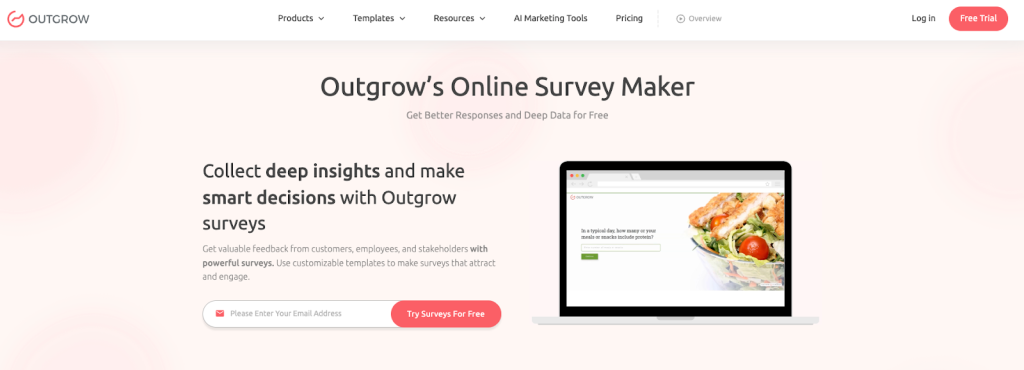
These interactive formats feel less like traditional research and more like surveys to do when bored, which is one reason users are more willing to complete them.
Turning Survey Data Into Revenue Growth
Here’s where theory meets reality. What do you actually do with all this data?
Scenario 1: High Awareness, Low Purchase Intent
People know you exist but aren’t buying. You need to work on:
- Value communication (they don’t understand why you’re worth it)
- Trust building (testimonials, case studies, social proof)
- Competitive differentiation (why choose you over alternatives?)
Scenario 2: Low Awareness Overall
Nobody knows you exist. Your focus:
- Increase ad spend in the right channels
- Build content marketing programs
- Get PR coverage and backlinks
- Run partnership or influencer campaigns
Scenario 3: Strong Awareness in One Segment, Weak in Others
You’ve found product-market fit somewhere but haven’t expanded. Time to:
- Study what worked in your strong segment
- Adapt messaging for new audiences
- Test campaigns in underperforming segments
- Consider whether the product needs adjustment for different markets
The Role of Brand Awareness in Your Marketing Funnel
Brand awareness is the foundation all marketing efforts rely on, from social media to SEO.
Without awareness, nothing else works. You can’t convert someone who’s never heard of you. You can’t build loyalty with strangers.
Here’s how it flows:
- Awareness: People know you exist
- Consideration: They’re thinking about trying you
- Conversion: They become customers
- Loyalty: They keep coming back
- Advocacy: They tell others about you
Most marketing focuses on conversion. Smart marketing invests heavily in awareness because it makes everything downstream easier and cheaper.
When you run brand awareness surveys through Outgrow, you’re not just collecting data. You’re actively engaging potential customers. Each survey interaction is a chance to educate people about what you do, show your personality, and start building a relationship. That’s the difference between passive measurement and active marketing.
Measuring Beyond the Survey: Complementary Metrics
Surveys give you direct feedback, but combine them with other data for a complete picture:
Branded Search Volume: How many people search for your brand name on Google? Branded search volume is a strong indicator of brand awareness because it shows how many people are actively looking for you online.
Social Listening: What are people saying about you online? Brand mentions, sentiment analysis, and conversation volume all signal awareness. Using the top social media listening tools can help businesses monitor these conversations in real time, identify emerging trends, and respond more effectively to customer feedback
Direct Traffic: People typing your URL directly into browsers already know who you are.
Share of Voice: This measures your brand’s visibility and presence within the market compared to competitors.
Outgrow helps here, too. When people share your interactive surveys on social media (which they do, because the content is actually interesting), you’re getting organic reach and building backlinks. The platform tracks shares, completion rates, and time spent, giving you engagement metrics that correlate directly with awareness. The data collected through an Outgrow survey also provides valuable engagement metrics.
Building Your Brand Awareness Strategy for 2026
The market moves fast. What worked last year might not work now. Here’s what’s working today:
Authenticity Over Polish: Audiences quickly recognize inauthentic marketing from a mile away. Real stories and genuine personality build stronger awareness than perfect ad copy.
Community Building: Brands that create spaces for customers to connect with each other build awareness through word of mouth.
Value-First Content: Don’t just promote. Teach, entertain, or solve problems. The awareness follows naturally. This is why interactive calculators and quizzes work so well. You give value (results, insights, recommendations) in exchange for attention and data.
Consistency Across Channels: Your brand should feel the same whether someone finds you on Instagram, reads your blog, or sees your ad. Consistency builds recognition. Outgrow lets you maintain brand consistency with customizable templates that match your colors, fonts, and voice.
Test, Measure, Repeat: Run your survey quarterly. Track your metrics monthly. Adjust your strategy based on what the data tells you, not what you hope is true. Outgrow’s A/B testing feature lets you run multiple survey versions simultaneously to see what resonates best.
Real Results: How Interactive Surveys Drive Business Growth
Let’s talk numbers. Companies using Outgrow for brand awareness surveys typically see:
- 40-60% higher completion rates compared to static forms
- 2-3x more qualified leads per survey
- 25-35% reduction in cost per lead
- Better data quality (people engage more, so they give better answers)
One Outgrow customer, a fitness coaching business, created an interactive “What’s Your Fitness Personality?” quiz to measure brand awareness. They embedded it on their homepage and shared it across social media. Within three months:
- 12,000 people completed the quiz
- Conversion rate jumped from 2.1% to 4.8%
- They identified three distinct customer segments that they hadn’t known existed
- Email list grew by 8,500 qualified leads
The quiz did double duty: it measured how people perceived their brand AND it actively educated people about their services. That’s the power of interactive content.
Getting Started: Your First Brand Awareness Survey
Ready to stop guessing and start measuring? Here’s your action plan:
Week 1: Define your goals and target audience. What do you need to learn? Who should you survey?
Week 2: Choose 10-15 questions from the list above. Start with unaided awareness, then aided, then perception questions.
Week 3: Build your survey in Outgrow. Pick a template, customize it with your brand colors and logo, set up your logic flows. (This takes 2-3 hours, not weeks.)
Week 4: Launch to a small test group (100-200 people). Review the data. Adjust questions if needed.
Week 5: Full launch. Share via email, social media, and website pop-ups. Track responses daily.
Week 6: Analyze results. Calculate your awareness score. Look for patterns. Build your action plan.
Week 7+: Implement changes based on insights. Schedule your next survey for three months out.
Ready to Measure Your Brand Awareness?
You can’t improve what you don’t measure. And you can’t measure what you don’t define clearly.
The brands winning in their markets right now aren’t guessing about their position. They’re measuring, adjusting, and measuring again.
With Outgrow, you can build a professional brand awareness survey in under an hour. No coding required. No design skills needed. Just pick a template, customize your questions, and launch.
Start with something simple. Survey your current customers this week. See what you learn. Then expand to people who’ve never bought from you. Compare the results. The gaps you find? Those are your opportunities.
Your competitors are either already doing this, or they’re flying blind. Which one do you want to be?
Try Outgrow free for 7 days and create your first brand awareness survey today. Your future customers are waiting to tell you what they think. You just have to ask.
Frequently Asked Questions
Approximately 385 respondents need to be invited to take part in giving representative results.
Conduct targeted surveys right after major marketing efforts. In terms of long-term tracking, surveying on a quarterly basis is appropriate for fast-moving markets, and annual surveying is enough for markets with lower dynamics.
Unaided awareness measures if an individual can remember your brand without any reminders. Aided awareness measures if an individual recognizes your brand from options shown to them.
Both. Current customers tell you about brand depth and loyalty. Potential customers in your target market tell you about awareness gaps and growth opportunities.
The surveys should not take more than 10 minutes, include rewards such as a discount or a prize for a chance to win, be mobile-friendly, be dispatched at times that are most suitable for survey participation, and be made in a way that is of high interest, such as a quiz format. Interactive surveys experience 40-60% more completions.
Yes, through branded search volume, direct website traffic, social mentions, and share of voice metrics.The best approach combines both methods for complete visibility.
Outgrow specializes in interactive content that people actually want to complete. This drives 40-60% higher completion rates. Plus, you get advanced analytics, automatic CRM integration, and over 1,000 templates optimized for conversion. No coding required.

Deeksha Malik is a Marketing Professional at Outgrow, working at the crossroads of people, brand, and growth. She helps scale teams, strengthen employer branding, and drive B2B marketing campaigns that actually move the needle. Known for balancing strategy with execution, Deeksha enjoys building meaningful campaigns and smarter growth stories. When she’s not working, you’ll likely find her with a good cup of coffee, staying curious about marketing trends, people dynamics, and what makes a brand memorable.