
Introduction
Table of Contents
You have vacation days sitting there and absolutely no clue where to spend them. You scroll Instagram for forty minutes. Read a couple of blog posts about Bali. Watch a YouTube video on Iceland. And somehow, an hour later, you are still staring at a blank Google search bar with nothing to show for it.
That is the exact problem a travel destination quiz was built to solve.
A well-designed travel destination quiz moves a traveler from overwhelmed and stuck to genuinely excited and ready to book, usually in under five minutes. It asks the questions that actually matter, weighs the answers, and delivers a destination that fits the specific person sitting on the other side of the screen. Not a recycled top-ten list. Not one-size-fits-all travel advice. Something that actually feels like it was meant for them.
For travel brands, the value goes well beyond helping someone pick a country. A travel destination quiz is one of the strongest pieces of interactive content in the entire marketing toolkit. Better engagement numbers, higher quality leads, stronger conversion rates, and actual behavioral data you can use. That combination is rare.
This guide walks through everything: what separates a quiz that actually performs from one that just sits there, how to build one using Outgrow, why interactive content consistently outperforms static blogs, and how travel brands are already putting these quizzes to work.
What a Travel Destination Quiz Actually Does (and Why People Enjoy Taking Them)
At its core, a travel destination quiz gathers user preferences through a focused set of questions and uses those answers to recommend a destination that genuinely matches the person. Think of it less like a survey and more like a well-informed travel friend who asks the right things before making a suggestion.

A quiz that is worth taking covers the factors that shape a real trip decision:
- Ideal travel pace, whether someone wants every hour planned or prefers to drift
- Activity preferences like adventure, food scenes, cultural landmarks, beaches, or nature
- Accommodation style from luxury resorts to hostels to camping
- How they like to explore, whether through guided tours or figuring it out themselves
- Who they are traveling with, solo, partner, group of friends, or family
- Budget range
- Trip length
- Preferred climate
Eight inputs. That is genuinely enough to produce a recommendation that does not feel random. Someone who gravitates toward slow travel, stays in boutique hotels, loves cultural experiences, works with a modest budget, and wants warmth is not heading to Patagonia in July. But Oaxaca, Chiang Mai, or central Portugal could be a near-perfect match. The quiz figures that out in seconds. Likewise, travelers who consistently choose military history, museums, and battlefield experiences could be matched with a specialized Italian Campaign Tour instead of a traditional sightseeing itinerary. The quiz figures that out in seconds.
People keep coming back to travel quizzes because the experience feels personal in a way that reading a blog post never does. You are not consuming someone else’s opinion. You are answering questions about yourself, and the result is shaped by your answers. The shareability factor matters too. Telling someone “I got Lisbon” is a far more interesting conversation starter than “I read an article about Europe.”
Outgrow’s content marketing research puts it plainly: Interactive content generates twice the conversions of passive formats. Quiz completion rates sit between 80 and 85%, which puts them well above almost every other content type. That stat alone deserves attention from anyone in travel marketing.
What Makes a Travel Destination Quiz Actually Convert
Plenty of quizzes get built and quietly ignored. The ones that drive real results share a recognizable structure: a clear entry point, questions that feel natural, and a result page designed to do something more than deliver a destination name.
A First Screen That Makes People Want to Start
The welcome screen does one job: convince someone that the next few minutes are worth their time. Keep it direct. Something like “Answer 8 questions. Find out exactly where you should travel next.” No paragraphs of explanation. Just a clear trade that earns the click.
Questions That Feel Like a Conversation, Not a Form
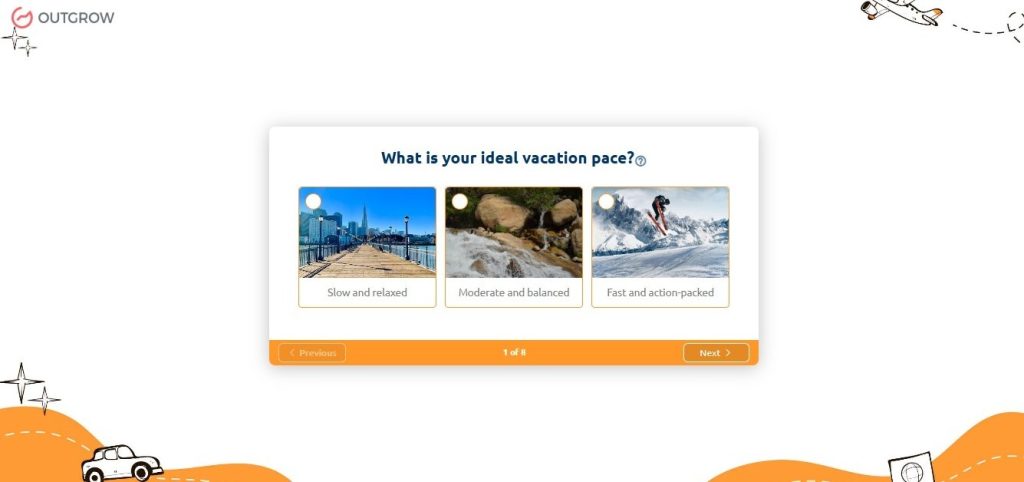
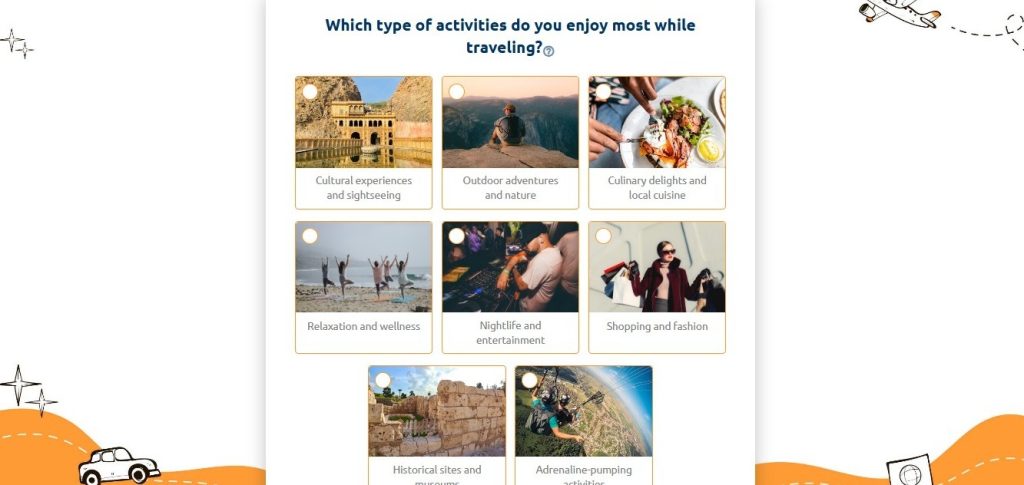
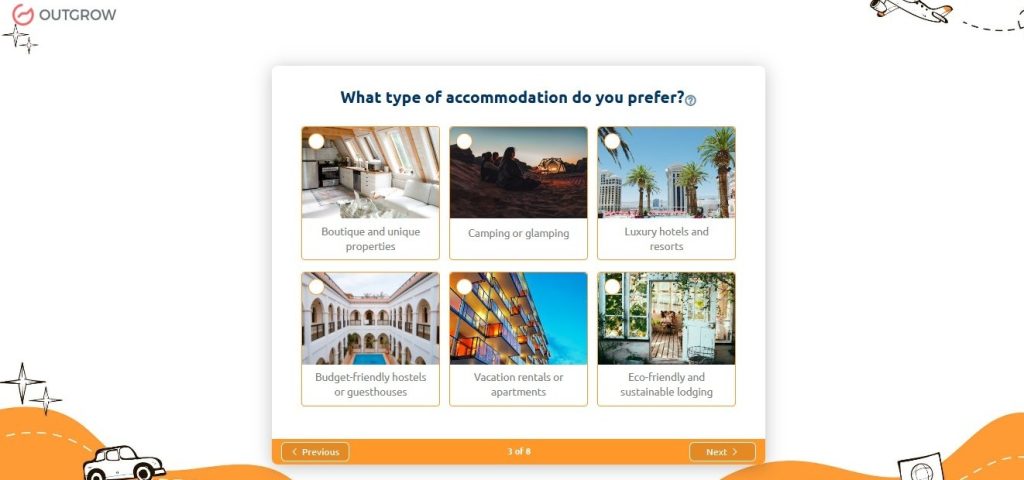
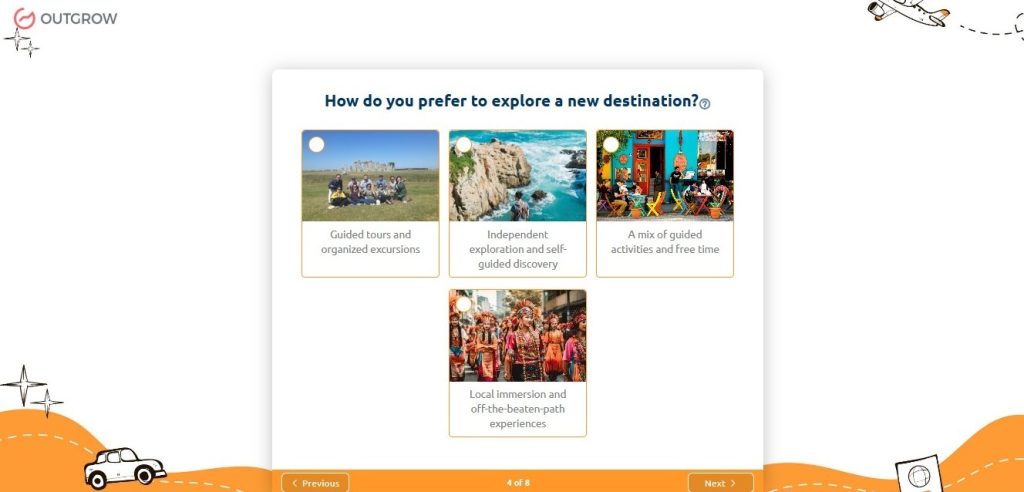
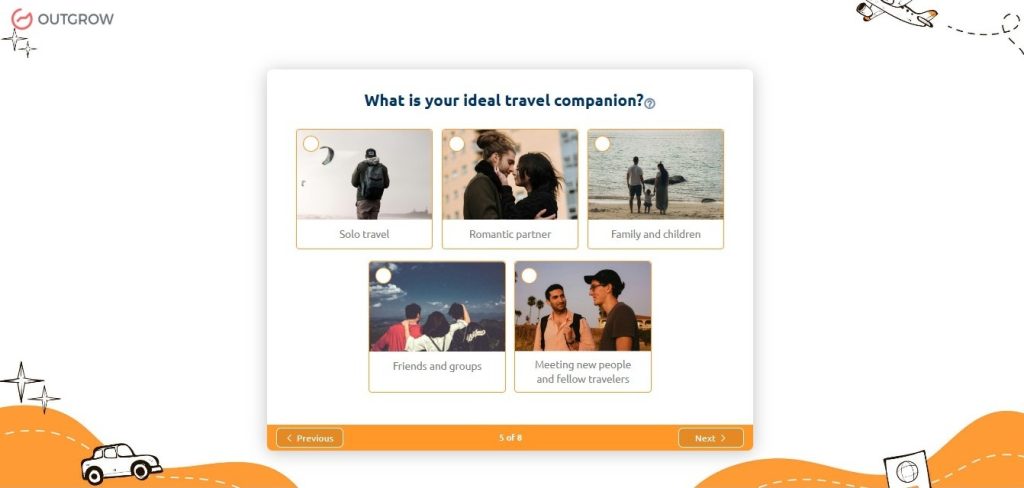
The best quiz questions feel like a knowledgeable person is asking them, not a data collection tool. The Outgrow premade travel destination quiz template handles this well. Eight questions, each one purposeful:
- What is your ideal vacation pace?
- Which activities do you enjoy most while traveling?
- What type of accommodation do you prefer?
- How do you prefer to explore somewhere new?
- Who are you traveling with?
- What is your travel budget?
- How long is your ideal trip?
- What climate do you prefer?
Eight is close to the right number. Drop below six, and the recommendation starts to feel like a guess. Push past twelve, and people start dropping off before they finish. This set gets the data without wearing anyone out.
Result Pages Built to Convert, Not Just Inform
The result page is where the quiz either pays off or falls flat. “You got Kyoto” is mildly entertaining. “You got Kyoto, and here is exactly why it fits the way you travel,l” paired with a compelling photo and a button that says “Plan My Perfect Trip,” is something people act on.
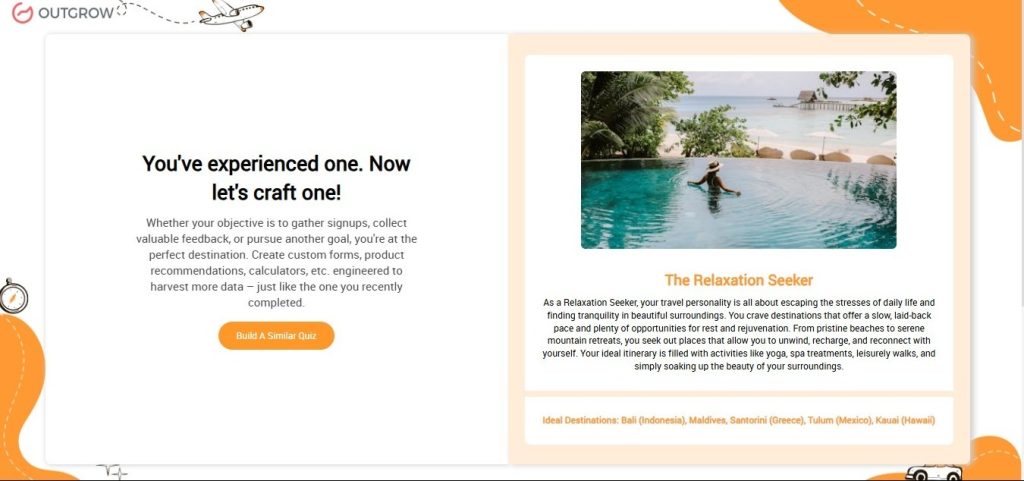
A result page that works includes a destination name anda strong image, a short description that ties back to the person’s actual answers, a clear CTA, and, optionally, a lead capture form placed right before the result is shown.
A Lead Capture That Feels Worth It
Placing a simple email form between the last question and the result is one of the most reliable list-building moves in travel marketing. Outgrow data shows quizzes with a lead form convert at around 40.9%. Standard landing pages sit at 2 to 5%. The reason it works is timing. The person just answered eight questions. They are curious about their result. That is exactly the moment they are willing to hand over an email address.

Building a Travel Destination Quiz in Outgrow: A Practical Walkthrough
Outgrow’s online quiz maker sits in a different category from basic free quiz makers. It is a proper interactive content platform where travel brands can build quizzes, assessments, calculators, and recommendation tools without touching a line of code.
Step 1: Open the Premade Template
The Outgrow travel destination quiz template gives you a working structure right out of the box. Eight questions already written, outcome logic already mapped, result pages already framed. Starting here instead of from scratch cuts the build time significantly.
Step 2: Adjust Questions and Set Your Logic
Inside the Configure tab, you can rewrite any question, swap out answer choices, add photos to response options, and set the logic that routes different answer combinations to different destinations. All of this is handled visually. No coding required.
Step 3: Build Out Your Result Pages
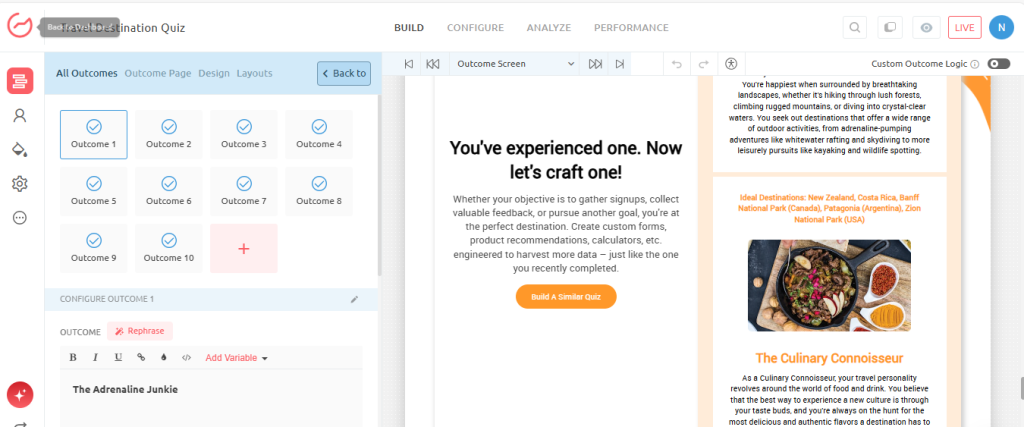
Each destination outcome gets its own page. Drop in a strong header image, write a description that references why this destination fits this particular traveler, add your CTA, and include the email form if you want leads. The result page is your conversion moment. Treat it accordingly.
Step 4: Review Where People Drop Off
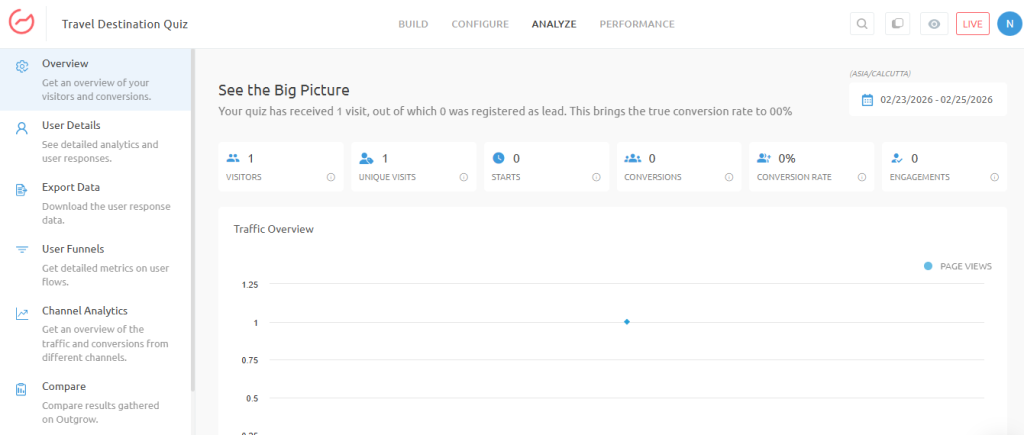
The Analyze tab breaks down completion rates question by question and shows you exactly where people stop. If one question consistently kills momentum, you have a clear place to improve. This feedback loop is what keeps a quiz performing better over time rather than just going stale.
Step 5: Track Overall Performance
The Performance tab shows traffic, engagement, and conversions in one place. Connect Outgrow to your CRM or email platform, and every lead captured through the quiz feeds directly into your follow-up workflows.
Step 6: Get It in Front of People
Outgrow gives you a standalone URL, an embeddable code block, and popup options that trigger on exit intent or a time delay. Put the quiz in a high-traffic blog post, make it your homepage CTA, share the link on social media, or run it as a paid ad. You can try out the fully functional travel destination quiz here.
Why a Travel Destination Quiz Outperforms Static Content
A blog post delivers information. A quiz creates a two-way experience. That distinction drives measurable differences across every performance metric that matters.
| Content Type | Avg. Time on Page | Conversion Rate | Personalization | Shareability |
| Static Blog Post | 1 to 3 minutes | 1 to 3% | None | Low |
| Travel Destination Quiz | 3 to 5 minutes | 30 to 40% | High | Very High |
| Landing Page | 1 to 2 minutes | 2 to 5% | Low | Very Low |
| Video Content | 2 to 4 minutes | 3 to 8% | Low | Medium |
Research found that 91% of buyers actively prefer interactive and visual content over traditional formats. In travel, where the whole category runs on aspiration and imagination, that preference is even more pronounced.
Outgrow’s own data across thousands of published quizzes shows travel quizzes generate 3 to 4x more leads than comparable static landing pages. The SEO side is real, too. Longer time on page and lower bounce rates send positive engagement signals. Interactive tools also attract backlinks organically because publishers and bloggers link to things that are genuinely useful.
Other Interactive Tools Travel Brands Can Build in Outgrow
The travel destination quiz is the most obvious starting point, but Outgrow supports a broader range of interactive formats that fit the travel category well. One can also use an AI Assistant to instantly build the quizzes that fit their needs and preferences.
1. Trip Budget Calculator
A user enters their destination, travel dates, group size, and preferred accommodation type, and the tool outputs a ballpark trip cost. Budget tools are genuinely useful for people in the early planning stage, and they keep visitors on your site far longer than a static article would.
2. Travel Style Assessment
Rather than recommending a destination, this kind of tool identifies a traveler’s overall persona. The Solo Explorer. The Luxury Collector. The Budget Adventurer. Each persona gets tailored content and product recommendations, which is personalization at scale without requiring a development team to build it.
3. Travel Readiness Survey
Asks about passport status, scheduling flexibility, budget, and travel goals, then tells the user whether they should book something now, start planning for six months out, or look at domestic options first. Practical, useful, and a strong trust-builder with an audience that is still in the research phase.
4. Packing List Generator
User inputs their destination type and trip length. The tool outputs a relevant packing checklist. Simple to build, high engagement, and the kind of utility that brings people back.
Five Ways Travel Brands Are Using Destination Quizzes Right Now
1. Travel Agency Lead Generation
A boutique agency places a travel destination quiz on its homepage. Users get a destination recommendation and a prompt to book a free planning consultation. Within 60 days, the agency sees a 45% jump in consultation bookings. The quiz pre-qualifies each lead, so consultants already know budget, pace preferences, and destination interest before the first conversation starts.
2. Travel Blog Email List Growth
A solo travel blogger running 50,000 monthly readers adds the quiz to their most-visited post. Results are gated behind an email opt-in. Three months later, the list has grown by 8,000 subscribers, all tagged by destination interest. Southeast Asia content goes to the right people instead of the whole list.
3. Tourism Board Social Campaign
A regional tourism board builds a quiz recommending one of five areas within its territory. They seed it across their social channels. Because results feel specific and shareable, users post them without being asked. Social referral traffic rises 200% over the campaign window. No extra ad spend is involved.
4. OTA New User Onboarding
An online travel agency swaps its generic post-signup homepage for a destination quiz flow. New users land on curated packages that actually match their interests. Bounce rate drops 35%, and average session length goes up by four minutes.
5. Hotel Brand Paid Social
A hotel group with 15 international properties runs the quiz as a paid ad on Instagram and Facebook. It matches users to their best-fit property based on travel style and group type. Cost per lead drops from $18.70 to $2.40 compared to their previous display campaigns.
CTAs That Actually Work on Result Pages
The CTA is what turns a quiz someone enjoyed into a lead or booking.
“Plan My Perfect Trip” is the strongest default. It is personal, action-oriented, and follows naturally from the result. The traveler just identified where they want to go, so helping them plan the trip is a logical and welcome next step.
Other CTAs worth testing:
- Show Me Trips to [Destination], which dynamically inserts the result and tends to outperform generic alternatives
- Send Me My Full Itinerary, which pairs well with an email capture and promises additional value
- Talk to a Travel Expert, which works well for agencies and tour operators
- Book My Trip, which fits users who are further along in the decision process
Put your main CTA high on the result page, before anyone has to scroll. Add a secondary option at the bottom for people who read through everything before making a move.
Getting the Quiz in Front of the Right People
Publishing is step one. Distribution is what makes it work.
Drop it into your highest-traffic posts. Articles covering how to choose a travel destination or where to travel next already attract people in the right mindset. Adding the quiz inside those posts gives the visitor something to do with that energy.
Use it as a paid social creative. Quiz-based ads require active participation from viewers, which tends to produce better cost-per-lead numbers than static image or video formats.
Include it in email newsletters. A single line like “Still figuring out where to go this year? This 60-second quiz might help” regularly pulls 15 to 25% click-through rates in travel-focused newsletters.
Swap out your homepage CTA. “Find My Destination” as an entry point tends to outperform “Browse Our Packages” because it frames the brand as a helper rather than a seller.
Send it to travel creators. When an influencer shares their own result authentically, the content performs well on Stories, TikTok, and YouTube Shorts without feeling like an ad.
Building From Scratch: What Makes Quiz Questions Work
If you are starting from a blank slate instead of a template, these are the principles that separate quizzes that hold attention from ones that lose people halfway through.
Every question needs to pull its weight. If cutting a question would not change a single recommendation outcome, it should not be in the quiz. Padding the question count with filler questions raises drop-off rates without improving the quality of results.
Use images in answer choices wherever the subject matter supports it. Choosing between a photo of a beach and a photo of a mountain range is faster and more intuitive than choosing between text descriptions. Outgrow supports image-based answers natively.
Test every logic path before publishing. Walk through every possible answer combination and confirm the routing works correctly. A quiz that returns the same destination regardless of what someone answers will get called out, and trust is hard to rebuild once that happens.
Keep result descriptions focused. Two or three paragraphs are the right length. Open with the destination and a reason tied to their specific answers. Add two or three supporting details that connect back to what they selected. Close with the CTA.
Mistakes That Quietly Kill Quiz Performance
1. Stacking Too Many Questions
Completion rates fall noticeably above twelve questions. Eight to ten is where most travel destination quizzes perform best. If your data needs go beyond that, split the experience into two shorter quizzes rather than making one long one.
2. Copy-Paste Result Pages
Users notice when every result page is the same template with a different city name plugged in. Reference their actual choices in the description. “Since you prioritized slow travel, warm weather, and cultural depth, Oaxaca fits your travel style particularly well,” reads completely differently from a generic destination paragraph.
3. No Email Follow-Up
Most people who take a quiz are not ready to book the same day. If you capture their email and never send anything, the lead goes cold. A three-email sequence works well here: their result on day one, relevant content for that destination on day three, and a soft booking prompt toward the end of the week.
4. Not Optimizing for Mobile
More than 60% of quiz completions happen on a phone. If tap targets are too small, images load slowly, or text is hard to read on a small screen, a large share of potential completions will not finish.
Final Thoughts
A travel destination quiz works because the problem it solves is real. Choosing where to travel has gotten harder as the amount of available information has multiplied. A quiz that takes someone’s specific preferences and turns them into a clear, confident recommendation is genuinely useful in a way that most travel content is not.
For brands, that usefulness is also a commercial opportunity. Someone who finishes a quiz knowing where they want to go and how to take the next step is considerably more likely to convert than someone who reads a blog post announcement.
Outgrow lowers the barrier to building a quality quiz significantly. The premade travel destination quiz template gives you a working structure to start from. Customize the logic, build result pages that are worth acting on, and connect everything to your CRM so no lead disappears after the quiz ends.
The travel industry has always been built on inspiration and trust. A quiz that delivers a personal, well-matched recommendation builds both of those things, with every single person who takes it.
Start your free 7-day Outgrow trial and have your travel destination quiz live before the week is out.
Frequently Asked Questions
A travel destination quiz is an interactive tool that collects responses to a focused question set and uses those answers to recommend a destination that fits the person taking it. Questions typically cover travel pace, preferred activities, accommodation style, budget, trip length, climate preference, and who they are traveling with. The result is a specific recommendation rather than a broad list.
The quickest path is an online quiz maker like Outgrow. Start from their premade travel destination quiz template, adjust the questions and result logic for your specific audience, build out result pages with strong CTAs, and publish. Most teams get a working quiz live within a few hours using quiz software that requires no coding background.
Yes, consistently. Quizzes with a lead capture form before the results page convert at around 40%, well above the 2 to 5% typical of standard landing pages. The leads are also self-qualified since respondents have already shared their preferences, which makes follow-up far more targeted and productive.
Yes. Outgrow provides embed code that drops into any webpage, a standalone URL you can share directly, and pop-up options that trigger on exit intent or after a time delay. It works inside blog posts, landing pages, and product pages.
The eight areas that produce the most useful results are vacation pace, preferred activities, accommodation type, exploration style, travel companions, budget, trip length, and climate preference. That combination gives enough data to differentiate meaningfully across destinations without making the quiz feel tedious.

Muskan is a Marketing Analyst at Outgrow. She is working on multiple areas of marketing. On her days off though, she loves exploring new cafes, drinking coffee, and catching up with friends.