Summarize with :
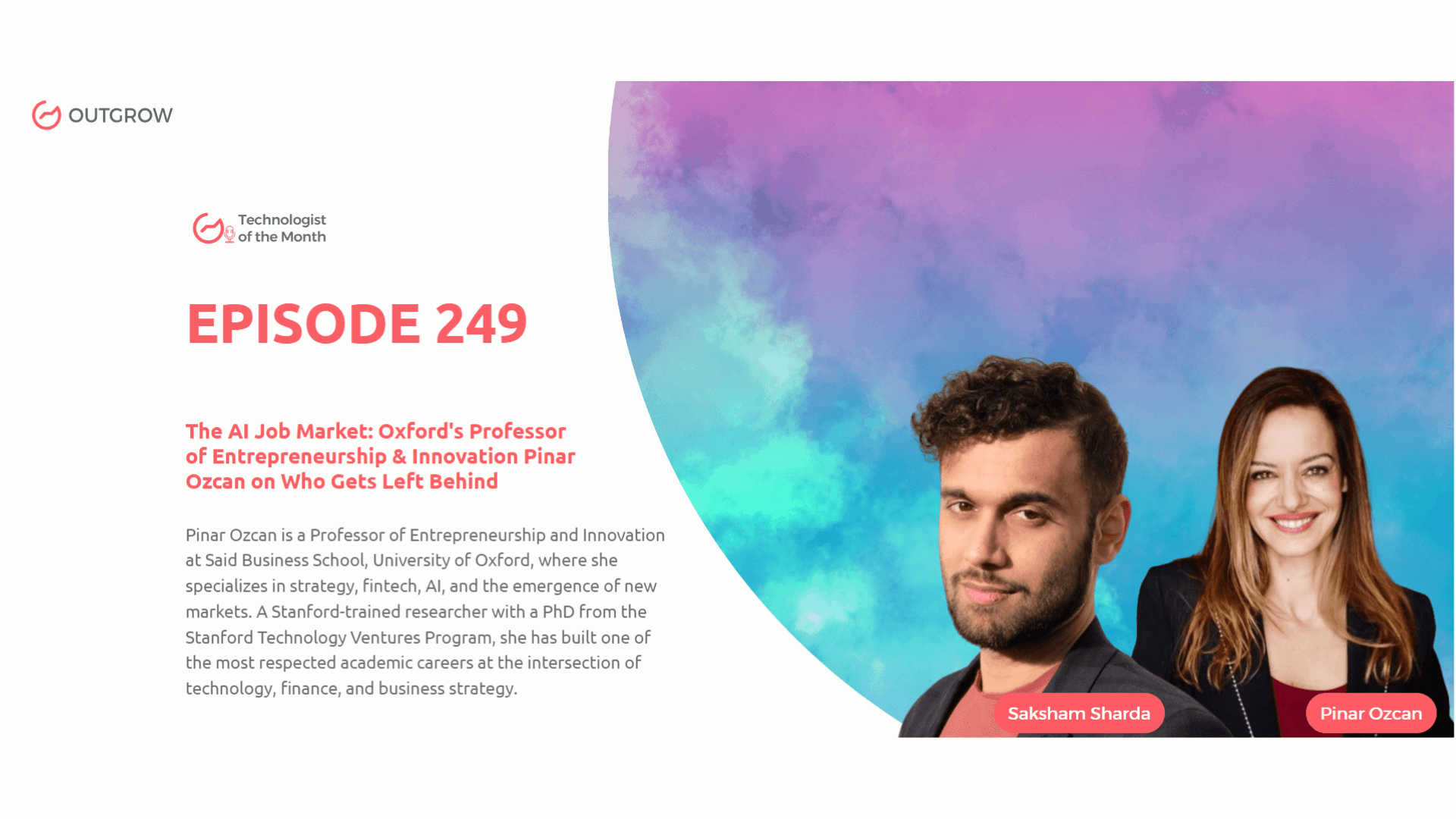
EPISODE 249: Marketer of the Month Podcast with Pinar Ozcan
Table of Contents
Hey there! Welcome to the Marketer Of The Month blog!
We recently interviewed Pinar Ozcan for our monthly podcast – ‘Marketer of the Month’! We had some amazing, insightful conversations with Pinar, and here’s what we discussed about-
1. What the job market really needs from graduates now
2. Where AI genuinely changes lives vs hype
3. Is AI humanity’s savior or its downfall?
4. The one money concept that would change everything
5. Why 2% of VC funding goes to women founders
6. What makes a community last vs burn out fast
7. The ugly truth about corporate short-sightedness
About our host:
Dr. Saksham Sharda is the Chief Information Officer at Outgrow.co He specializes in data collection, analysis, filtering, and transfer by means of widgets and applets. Interactive, cultural, and trending widgets designed by him have been featured on TrendHunter, Alibaba, ProductHunt, New York Marketing Association, FactoryBerlin, Digimarcon Silicon Valley, and at The European Affiliate Summit.
About our guest:
Pinar Ozcan is a Professor of Entrepreneurship and Innovation at Said Business School, University of Oxford, where she specializes in strategy, fintech, AI, and the emergence of new markets. A Stanford-trained researcher with a PhD from the Stanford Technology Ventures Program, she has built one of the most respected academic careers at the intersection of technology, finance, and business strategy. Pinar is the founder of Inspiring Female Founders, an Oxford-led global series championing women entrepreneurs, and serves on the World Economic Forum Council for Financial Education, working with world leaders to improve financial literacy for people of all ages.
The AI Job Market: Oxford’s Professor of Entrepreneurship & Innovation Pinar Ozcan on Who Gets Left Behind
The Intro!
Saksham Sharda: Hi, everyone. Welcome to another episode of Outgrow’s Marketer of the Month. I’m your host, Dr. Saksham Sharda, and I’m the creative director at Outgrow. co. And for this month, we are going to interview Pinar Ozcan, who is the Professor of Entrepreneurship & Innovation at Oxford University.
Pinar Ozcan: Great to be here. Thank you.
Don’t have time to read? No problem, just watch the Podcast!
Challenge yourself with this trivia about the exciting topics Pinar Ozcan Top Explores covered in the podcast.
Or you can just listen to it on Spotify!>
The Rapid Fire Round!

Saksham Sharda: At what age do you want to retire?
Pinar Ozcan: Never.
Saksham Sharda: How long does it take you to get ready in the mornings?
Pinar Ozcan: Half an hour.
Saksham Sharda: Favorite color?
Pinar Ozcan: Turquoise.
Saksham Sharda: What time of day are you most inspired?
Pinar Ozcan: mornings.
Saksham Sharda: How many hours of sleep can you survive on?
Pinar Ozcan: Five.
Saksham Sharda: The city in which the best kiss of your life happened?
Pinar Ozcan: San Francisco.
Saksham Sharda: Pick one: Mark Zuckerberg or Elon Musk?
Pinar Ozcan: Neither.
Saksham Sharda: How do you relax?
Pinar Ozcan: Yoga.
Saksham Sharda: How many cups of coffee do you drink per day?
Pinar Ozcan: Two or three.
Saksham Sharda: A habit of yours that you hate?
Pinar Ozcan: Overthinking.
Saksham Sharda: The most valuable skill you’ve learned in life?
Pinar Ozcan: To figure out your most important lessons and concentrate on them.
Saksham Sharda: Are you an early riser or a night owl?
Pinar Ozcan: Early riser.
Saksham Sharda: One-word description of your leadership style.
Pinar Ozcan: Collaborative.
Saksham Sharda: Top priority in your daily schedule.
Pinar Ozcan: Focus on the big picture.
Saksham Sharda: Ideal vacation spot for relaxation.
Pinar Ozcan: Beach, turquoise waters.
Saksham Sharda: Key factor for maintaining a work/life balance.
Pinar Ozcan: Turn everything off the moment you come home.
Saksham Sharda: Memorable career milestone.
Pinar Ozcan: Moving to Oxford.
Saksham Sharda: A recent business innovation that caught your attention.
Pinar Ozcan: Anything AI.
The Big Questions!

Saksham Sharda: All right. That was the end of the rapid fire. Now we’re gonna move on to the bigger questions.
Pinar Ozcan: Okay.
Saksham Sharda: The first one is a Stanford engineer, strategy consultant, now Oxford professor. That’s a wild ride. Did you actually plan that, or were you just figuring it out as you went?
Pinar Ozcan: I planned it, and believe it or not, from a very young age, if you had asked my five- or six-year-old, I would have told you, “I wanna be an international speaker.” And that’s because my parents were entrepreneurs, giving leadership training to managers back in Turkey, and I grew up next to them, so I ended up really catching the teaching bug, and I planned my entire career to be a well-known teacher and speaker at a top institution.
Saksham Sharda: And what was the moment you realized the corporate world wasn’t it for you?
Pinar Ozcan: I actually, um, never thought the corporate world wasn’t for me; I just liked it much better to be able to get in and out of it whenever I wanted to. So I wanted the freedom that didn’t come with the corporate world, so therefore I chose a profession that deals with the corporate world but isn’t in it.
Saksham Sharda: You literally study how industries are born, like before Uber existed, before anyone could pay with their phone. What is actually going on behind the scenes before something like that just becomes normal life?
Pinar Ozcan: Well, there’s lots of trial and error, and sometimes the technology might be there, but the political situation around it might be that the technology never meets the consumers. So it’s not just about whether the technology is ripe enough to go to market, but also whether the right people are promoting it, whether the ecosystem around it is being built, and of course, whether the giants of industries pay attention to it or not.
Saksham Sharda: So what’s the messiest, ugliest part of that process that nobody ever sees?
Pinar Ozcan: Well, the ugliest part of that process is when corporations become so shortsighted that they don’t invest into these long-term, um, opportunities, and when entrepreneurs don’t get the support that they need in order to make them happen.
Saksham Sharda: You’re researching a company in Ghana that waited almost 10 years just to get permission to operate as a bank. 10 years. How does a company not just completely fall apart waiting that long?
Pinar Ozcan: Well, one of the most important skills for an entrepreneur is resilience, and especially in a volatile environment, that is extremely critical. So how do you survive so many years when regulation is up and down, and you don’t know whether tomorrow you might get the license or you might have to wait another five years? You build, and you invest into things that you can do in the meantime. You build the right connections. You test your product until the moment that you get your license. And when that license comes, you enter the market with a bang.
Saksham Sharda: And what does that kind of uncertainty do to the people actually inside that company every day?
Pinar Ozcan: Well, they go crazy. But they also really learn resilience. They have to think not from day to day, because that, that will drive you crazy, but they have to think long term, “What is it that we’re building, and where are we getting, even if we have to wait another, a few days or another few months?”
Saksham Sharda: Speaking of going crazy, everyone’s losing their mind about AI right now. Half the people think it’s going to save humanity, the other half think it’s going to end it. You actually study this stuff. What’s the real answer?
Pinar Ozcan: The real answer is both, in the sense that AI is going to be a huge aid to humanity. it will bring inclusivity. It will make it possible for us to educate people, to give people financial services, healthcare. But at the same time, if it falls into the wrong hands, and right now it is partially in the wrong hands, it can also be the end of humanity. So we need to develop AI in support of humans rather than in replacement of humans, and we need strong regulation to regulate AI.
Saksham Sharda: And so from your experience, where is AI genuinely changing lives right now, and where is it just a really expensive magic trick?
Pinar Ozcan: Where it changes life is where products and services have been either too expensive or too impossible due to the processing power needed. So imagine someone who’s in the rural part of a country speaking a rare dialect that you know, companies usually don’t pay attention to because they don’t have the resources to give that person services, whether that’s education or healthcare, or financial services. That’s the… That’s really where it’s changing life. But, where is it a magic trick? you know, there are already organizations that have been doing data analytics for decades, and for those organizations, it’s just you know, doing data analytics a little bit faster, so no big deal. But there’s really other parts of life, human life, where it can change everything.
Saksham Sharda: You sit on a World Economic Forum Council trying to teach people about money, and honestly, most people have no idea how any of this works. How bad is it really out there?
Pinar Ozcan: It really is bad. Even in developed countries, more than half the population doesn’t have a good understanding of basic financial terms and fina- don’t have the financial skills. And it’s not necessarily that we’re lacking the educational system for it, it’s also that the educational system that we have about finance is ineffective. And so what I’m passionate about is to understand what makes people tick, what are their worries about money, bringing emotion back into the picture, and teach people in ways that that will stay with the money.
Saksham Sharda: What’s the one money concept that if every person on earth just understood it, everything would get better?
Pinar Ozcan: Well, I don’t know if there’s such a magic one, but I think if people understood credit and the way that you need to pay that back, in many countries, including the one I’m from, Turkey, would be a different place where people… Right now people are losing their mental health because of their credit card debt.
Saksham Sharda: You built Inspiring Female Founders from scratch, and now it’s selling out events globally. In a world where everyone’s attention lasts about three seconds, how did you actually build something people keep showing up for?
Pinar Ozcan: By bringing really inspirational and interesting speakers and building a community around it. It’s not so much the events are about the way that you feel as a female founder, the support that you get, and I’m very careful about who I put on stage and who I invite to the meetings, and it’s, it’s just been amazing.
Saksham Sharda: And what’s the real difference between a community that lasts and one that just burns out fast?
Pinar Ozcan: A community that lasts, um, is one that collaborates and integrates into other communities. So my goal isn’t to create a distinct community around Inspiring Female Founders Oxford, but to infiltrate all the knowledge that we’re building through these founders, through the stories that we’re writing, which we’re doing quite a bit with AI, into the rest of the world through educational systems, universities, secondary schools, newspapers, YouTube, TikTok. We want to infiltrate this knowledge into everything else that’s happening in the world. That’s how you make it last.
Saksham Sharda: All right, so let’s change track a bit. What does your typical day look like? You wake up in the morning. How much of it is meetings? How much of it is email? What is it like?
Pinar Ozcan: So the first hour or so is breakfast with my family, and once the kids are out to school, then I start my day. I’m really lucky that I can cycle to work, so it takes me 10 minutes to cycle to work. And then I have quite a few meetings whether that’s research or for Inspiring Female Founders or Entrepreneurship Center of Oxford. so I would say that half of my day is, uh, dedicated to meetings, but then I also carve out entire days in which I do research and get together with my co-authors in order to complete projects.
Saksham Sharda: In your experience, what’s the job market like for people today?
Pinar Ozcan: The job market is in flux right now. On the one hand, there’s a big need for recent graduates who have AI skills, yet many universities, including Oxford yet have to build programs that are supported by AI and that teach students a certain profession with AI. And so right now, you know, many banks and financial institutions in general, consulting firms, are hiring less. But if they want to hire, they want to hire an AI-enabled graduates. And so that’s really what we’re hoping to build in the future.
Saksham Sharda: So you’re an Oxford professor, but you’ve also built a serious personal brand online with thousands of followers, and you’re on stages next to founders and investors. How do you think about putting yourself out there in a space that’s already so noisy?
Pinar Ozcan: Well, maybe the trick is to not think about putting myself out there. I do research and speak about things that excite me, and I think it’s that passion that comes through. And if that means that I get to be put out there on stage, that’s great, but that’s not what I’m looking for.
Saksham Sharda: Does being an academic ever hold you back from just saying what you actually think in public, or does it clash sometimes with industry perspectives?
Pinar Ozcan: It clashes with industry perspectives, but being independent and, you know, as academics, we are independent researchers, really helps me being able to say what, you know, what I want and what’s the truth, and that is probably one of the reasons why I’m put on stage so much
Saksham Sharda: You posted recently about Global Money Week and making sure kids grow up understanding money. But why does this feel personal to you and not just like another research topic?
Pinar Ozcan: It feels personal to me because I see through my own kids how little financial education they get in their environment, and I was the same. I didn’t understand really you know, any money issues until I had to go to university in a different country and had to figure out everything all alone and, you know, overnight. And so we need to give people the skills to understand money, to understand the value of money, how it’s earned, how it’s invested, and how it’s saved in order for societies to really become financially better and therefore physically and mentally better.
Saksham Sharda: So if you could rip out one thing from how schools teach money and replace it tomorrow, what would it be?
Pinar Ozcan: Well, the schools don’t really teach so much about money yet, so it would be, you know, ripping out something from the future of education. But I would say that being able to earn and spend money within the school setting would be really valuable. If students could start businesses, if they could earn money, and if they could spend that money, then they would have a very different understanding of the world as they grow up.
Saksham Sharda: You founded a whole movement around female founders, and you keep showing up for it. But let’s be real. How broken is the system still for women who actually want to build something?
Pinar Ozcan: The system is still very broken. For every five male founders, there’s one female founder in the world, and of the entire venture capital money globally, only 2% goes to female-founded businesses. So the system is very much broken, and within the last two, three years, it hasn’t changed. And this, this will require long-term investments, which is what I’m doing. But at the same time, in order for the system to change, we can’t just support female founders, we need to change the people who are giving out the money. In other words, we need more female investors, and we need less gender bias and gender gaps in those venture capital loops.
Saksham Sharda: Is there an interesting story about something honest and raw that a female founder has ever said to you on stage or off stage?
Pinar Ozcan: Well, in our first-ever Inspiring Female Founders events on stage, one of my speakers said that an investor had told her that she should paint her nails when she is going to ask for money.
Saksham Sharda: Wow. All right. Well, the last question for you is of a personal kind. What would you be doing in your life if not all this?
Pinar Ozcan: Wow. Right now, I am fascinated with the ethics of AI, for instance. If I had a second life right now, I would be asking and trying to figure out questions around what is it you, you know, that we need to put in terms of guardrails around AI? How does it work? Is it safe as a life companion? Is it safe in a board meeting? Is it safe as a co-founder in an entrepreneurial setting? I would love to understand AI better, both from a legal and from an ethics perspective.
Let’s Conclude!
Saksham Sharda: Thanks, everyone for joining us for this month’s episode of Outgrow’s Marketer of the Month. That was Pinar Ozcan, who is the Professor of Entrepreneurship & Innovation at Oxford University.
Pinar Ozcan: Great to be here. Thank you.
Saksham Sharda: Check out the website for more details, and we’ll see you once again next month with another marketer of the month.
I am a Digital Marketing Enthusiast with a passion for optimizing content and paid marketing strategies. Continuously seeking innovative approaches to boost ROI and engagement at Outgrow.