Summarize with :
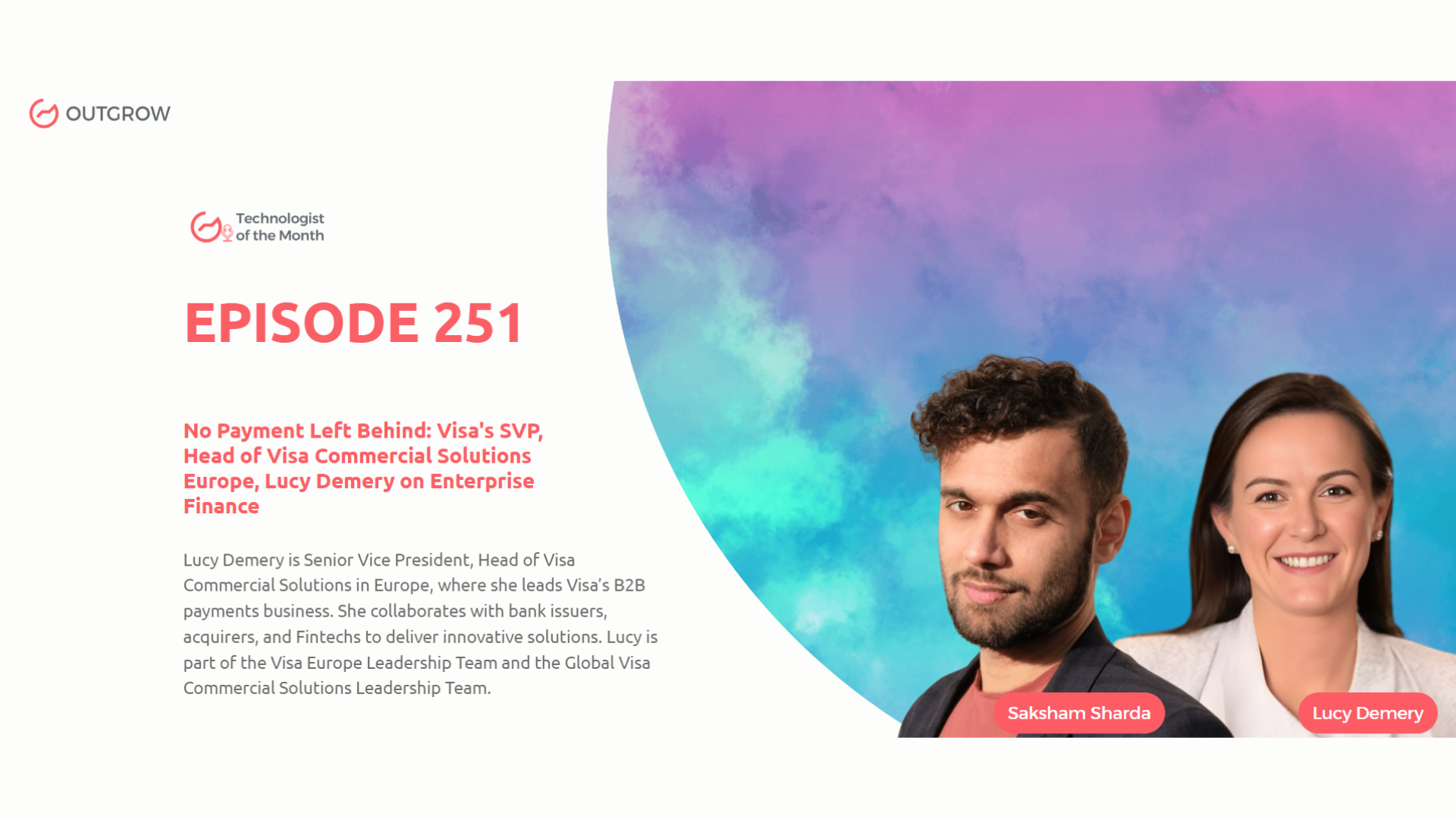
EPISODE 251: Marketer of the Month Podcast with Lucy Demery
Table of Contents
Hey there! Welcome to the Marketer Of The Month blog!
We recently interviewed Lucy Demery for our monthly podcast – ‘Marketer of the Month’! We had some amazing, insightful conversations with Lucy, and here’s what we discussed about-
1. Why agentic commerce is her biggest bet for B2B payments
2. How Visa is scaling AI adoption across sales teams
3. The truth about stablecoins as a threat or an opportunity for Visa
4. What fintechs still misunderstand about enterprise buying behavior
5. What businesses using Visa’s tools can do differently in 2026
6. The one broken thing Lucy would fix in global payments
7. Why does human behavior change matter as much as better tech
About our host:
Dr. Saksham Sharda is the Chief Information Officer at Outgrow.co He specializes in data collection, analysis, filtering, and transfer by means of widgets and applets. Interactive, cultural, and trending widgets designed by him have been featured on TrendHunter, Alibaba, ProductHunt, New York Marketing Association, FactoryBerlin, Digimarcon Silicon Valley, and at The European Affiliate Summit.
About our guest:
Lucy Demery is Senior Vice President, Head of Visa Commercial Solutions in Europe, where she leads Visa’s B2B payments business. She collaborates with bank issuers, acquirers, technology platforms, and Fintechs to deliver innovative solutions and drive go-to-market strategies. Lucy is part of the Visa Europe Leadership Team and the Global Visa Commercial Solutions Leadership Team.
No Payment Left Behind: Visa’s SVP, Head of Visa Commercial Solutions Europe, Lucy Demery on Enterprise Finance
The Intro!
Saksham Sharda: Hi, everyone. Welcome to another episode of Outgrow’s Marketer of the Month. I’m your host, Dr. Saksham Sharda, and I’m the creative director at Outgrow. co. And for this month, we are going to interview Lucy Demery, who is the SVP, Head of Visa Commercial Solutions Europe at Visa.
Lucy Demery: Great to be here. Thank you.
Don’t have time to read? No problem, just watch the Podcast!
Challenge yourself with this trivia about the exciting topics Lucy Demery Top Explores covered in the podcast.
Or you can just listen to it on Spotify!
The Rapid Fire Round!

Saksham Sharda: What time of day are you most inspired?
Lucy Demery: First thing in the morning.
Saksham Sharda: How do you relax?
Lucy Demery: With my kids, rolling around on the floor. They’re boys, so you have to be rough and tumble a bit.
Saksham Sharda: How many cups of coffee do you drink per day?
Lucy Demery: Three.
Saksham Sharda: The most valuable skill you learned in life.
Lucy Demery: Stamina, I think. Work ethic.
Saksham Sharda: Your favorite Netflix show.
Lucy Demery: I mean, it’s outrageous, but at the moment I’m watching Your Friends and Neighbors with John Hamm.
Saksham Sharda: Are you an early riser or a night owl?
Lucy Demery: Bit of both.
Saksham Sharda: One word description of your leadership style.
Lucy Demery: Motivated.
Saksham Sharda: Top priority in your daily schedule.
Lucy Demery: What’s gonna move the needle.
Saksham Sharda: Ideal vacation spot for relaxation.
Lucy Demery: Amalfi Coast.
Saksham Sharda: Key factor for maintaining a work-life balance.
Lucy Demery: pushups in the morning, looking outside the window on the commute, and fun with kids, I guess.
Saksham Sharda: Memorable career milestone.
Lucy Demery: Probably making managing director before hitting 30.
The Big Questions!

Saksham Sharda: Well, that was the end of the rapid fire. Now we’re gonna move on to the longer questions, which you can answer with as much ease and time as you like. The first one is, you’ve identified AI-driven commerce, stablecoins, embedded payments, and verticalized solutions as the four forces reshaping business payments. If you had to bet your career on the order in which those actually change the world, what’s your ranking and what keeps you up at night about getting it wrong?
Lucy Demery: Well, the beautiful thing about those forces is that they thrive off each other, right? They’re mutually reinforcing. If I had to choose one that’s really gonna change the world most rather than first, it would be agentic commerce and its application to B2B because there’s just so much need and demand from, uh, businesses, entrepreneurs, and the communities they serve to automate some really painful processes that get in the way of focusing on growing their business. And I think that automation just takes on a whole new, um, uh, pace with agentics. But you know, embedded payments really sit so nicely alongside that because if we’re focused on embedding our, uh, virtual credentials in the software platforms that businesses use every day to manage their business, their workflow, uh, you get that infrastructure right, agentic, then just takes it to the next level.
Saksham Sharda: So we are potentially heading towards a world where AI just handles business transactions on its own, no human in the loop. How close are we really, and what’s the thing that still scares people enough to keep a human finger on the button?
Lucy Demery: Yeah. I think the great thing is that over the past year, Visa and our partners has really got the infrastructure in place now to make payments work for agentic. Everything we’ve done with Visa Intelligent Commerce and opening up our stack, our agentic stack, for others to build on top. I think maybe it’s been slower to move… the ecosystem has been slower to move than we initially hoped, in part because I think the big AI companies have had to prioritize just the race to advance their models and compute capacity and raise capital around that. Um, but I think ultimately that will be a good thing in the medium-long term for agentic adoption ’cause it just means the underlying foundations are that much more powerful, so that when they eventually turn to refocus on commerce and monetization, what, you know, the whole thing will just work so much more powerfully. And I think then, um, in terms of underlying adoption, like for the end user, um, you know, there’s still a lot of conservatism, I guess, in the business community around the thought of agents, but I think if we make it invisible on the front end and focus more on just making, uh, their processes more automated, I think that’s where adoption really takes off.
Saksham Sharda: Not everyone on your team is a coder or an engineer, but you still need them all to genuinely understand where technology is going. How do you build that kind of literacy without it feeling like a mandatory training nobody wants to sit through?
Lucy Demery: Yeah, I mean, AI adoption entirely at Visa has been immense over the past year. We were now, you know, ingesting trillions of tokens a month, and that’s doubled just in the past couple of months. A lot of that has, of course, started with our engineering teams and then product, and now we’re looking at how we can make sure that drags across to our sales team so that we can keep pace with the incredible acceleration of product development. I mean, for instance, in our business area, commercial and money movement solutions, we’re developing products like fifty percent faster now than last year, and so can we sell it that much faster? And, you know, I think it starts with evangelism from the top. Ryan and our leadership team and all of us are really pushing, uh, the value of this new productivity gain and also making all of the tools available across our entire org and really encouraging everyone to get their hands dirty and doing like joint discovery sessions on the tools together where we can. And you know, in my sales team, for instance, we now have over ninety percent of our salespeople say they’re confident using GenAI, which is awesome, and we’ve seen sort of high usage rates, which we you know, folks using it more than every other day. Um, that cohort of people has increased from, like, thirty percent at the end of last year to sixty percent in our sales team this year, and those folks are like doing ten prompts a day now, maybe less than, obviously less than our engineering teams, but we’ll get there. and you know, it’s bridging that productivity between tech and sales. It’s really gonna make a difference.
Saksham Sharda: Let’s talk a bit about stablecoins next. They are either gonna be the future of money movement or a spectacular experiment that fades out. Where does Visa actually land on that? Is it a threat? Is it an opportunity? Is it something you have to prepare for regardless of which way it breaks?
Lucy Demery: Yeah, I mean, we’re super bullish on the opportunity for Visa and our whole ecosystem, actually. so the thing about Visa is that our infrastructure is kind of front-end infrastructure around, you know, messaging on money movement, and we’ve innovated over the course of many years to make that a super slick front-end infrastructure for everyone, but it still relies on a back end of, of settlement infrastructure that is still quite traditional, and, and we rely on that traditional settlement infrastructure as does everyone else in the financial services ecosystem. So if we think about stablecoin unlocking new efficiency in, in particular around settlement infrastructure, that’s only gonna enable Visa and our rails to operate at like new levels of efficiency and speed, particularly, you know, when you also when you think about a twenty-four-hour settlement, when you think about relieving liquidity collateral requirements in our ecosystem, that’s a big that’s a big boost. And then on top of that, adding to what we’re doing on stablecoin around our front-end solutions and how we’re helping not just consumers, but financial institutions and fintechs who handle or hold stablecoin actually be able to use it at all of our endpoints with stablecoin net cards, for instance. I mean, that’s a massive opportunity. And then in my part of the business, B2B, there’s so much opportunity to unlock cross-border B2B flows, higher-ticket flows, so we’re investing a lot.
Saksham Sharda: So speaking of this kind of efficiency and speed, then you’ve operated inside some of the biggest traditional banks and worked closely with fintechs. What do the scrappy, fast-moving fintech guys still fundamentally not get about how a large enterprise actually buys integrates something?
Lucy Demery: Yeah. Do you know what? We’ve seen actually some really positive moves here recently, I think, particularly in business banking and corporate banking. Banks realized they had to innovate more on the retail side a long time ago because that’s where the fintechs started. Now they’re starting to see a lot of the fintechs that we work with, Revolut, Capron, Tap, and others, really take market share from their business banking, corporate banking portfolios. So they’re starting to invest in transforming their platforms and their front-end solutions around that and increasingly opening up their risk appetite a bit to partnering with third-party fintechs who are focused on building, uh, in-house for the banks to help them reach that next level of innovation and growth. And so we partner, for instance, with the likes of Client or Mint and Cardlay on digital spend management solutions for fintechs, and there’s just so much more willingness from even tier one large banks across Europe, and I think globally now we’re seeing it too, to adopt their cards as a service and spend management software solutions for their clients. Although I would say still there’s much… there’s still a lingering preference to work with Visa as sort of the front-end layer that connects all of those fintech partner capabilities and so that the bank can deal with Visa, and then we can integrate on the back end.
Saksham Sharda: So Visa is, as you’re saying, the infrastructure that the whole payments world runs on. But every few years, someone comes along and says they’re going to make Visa irrelevant. How do you stay essential rather than getting quietly routed around?
Lucy Demery: Yeah, I think just the enduring value, the really differentiated value of Visa’s network, never ceases to amaze me. In payments, you need three things to be successful. You need trust, ease of use, and scale. Our CEO, Ryan, said that a year ago, and it’s, it’s so true if you think about any emergence of fintech, stablecoin, agentic commerce. You know, nobody does that better than Visa. And so increasingly we position, or I think the market understands, that Visa is the hyperscaler for payments. We are the infrastructure, the leverage on which others build and successfully scale more rapidly, right? Because we’ve got that scale, that trust, that ease of use that nobody else has. And I think, you know, that manifests in our results. I think you may have seen that last quarter was one of our best ever quarters, right? And then for all of Visa, and then if you look at my part of the business in B2B for Europe, for instance, you know, we’ve… over the past couple of years, we’ve more or less doubled our sales velocity, in part because the underlying market opportunity is still immense, particularly in these new growth areas that we’re pursuing, but also ’cause we’ve got really clear, really deep on our strategy, our plan, and our execution to, like, go and unlock that opportunity for our entire ecosystem. And then it’s also just hustle, right? It’s, you know, we… from our engineering teams to our sales teams, like, we’re hustling hard. We take nothing for granted. Like, the competitive pressure in this really dynamic market is real, and so it keeps us on our toes. We’re here at Money20/20 Europe. I’ve got, I think, 14 meetings with our clients, partners, and prospects, and in every conversation I’m thinking, “How can I accelerate the sales motion for our team? How can we, uh, create meaningful new value for our clients and their business customers? “And it, you know, it’s that hustle and new dynamism I think at Visa that never never ceases. I mean, you guys focus on spotlighting technologists, but our technology’s only as good as the sell and vice versa. And at Visa, we’re proud to bridge the two to create enduring value in the market.
Saksham Sharda: And everyone now says cash flow visibility is going to transform how businesses operate. But is the real problem the data, the technology, or just getting humans to actually change how they do things? Because those are very different fights.
Lucy Demery: Yeah. I think obviously great tech and real data insight at the point that decisions are being made by businesses, uh, for instance, by embedding it, you know, in a meaningful way in the workflow that they’re using, that’s what allows for easier human behavior change, right? So we’re focused on solving for those two things because it unlocks the other. But still, like, when you’re trying to totally transform an industry… Like for instance, we have integrations in Visa’s virtual card engine with the big ERPs like SAP and Oracle, as well as the small business accounting software platforms like Xero and QuickBooks. You know, that tech and product integration is really important, but we’re equally investing in how do we activate that? How do we support that human behavior change among the accountants, the treasurers, the procurement officers at the corporates? And you know, it’s on the enterprise side, on the small business side, the founder who’s having to do all of the above and also get their business to thrive. I mean, we’re now investing in, okay, how can we handhold a little bit along that journey for the first few proof points so that we can demonstrate the value and unlock more in a more automated way?
Saksham Sharda: All right. So let’s change track a bit tell us a bit about your regular workday. You wake up in the morning. How much of it is meetings? How much of it is emails?
Lucy Demery: my workday is mostly meetings, and then I handle my emails at night. My
Saksham Sharda: So, if a business is using Visa’s commercial tools really well in 2026, what does their day-to-day actually look like compared to three years ago? What’s the thing they can do now that would’ve felt like science fiction back then?
Lucy Demery: I think it’s end-to-end or excellent UX that’s actually designed for the business’s need. So we’ve got, like, digital onboarding, digital spend management, creative new credit solutions embedded virtual payment credentials into those software platforms that I mentioned they’re using every day, so that the whole journey of paying your day-to-day spend, paying your suppliers, and the software solutions around it that make it a more enriched proposition looks much different than it used to, and so what does that mean for their day-to-day? Well, they can focus more on growing their business. They don’t need to worry about the backend software, payments, infrastructure, et cetera. They can just get on with doing their job.
Saksham Sharda: All right, if you could snap your fingers and fix one broken thing in global business payments overnight, not the easiest thing, the most important thing, what is it?
Lucy Demery: I think it’s truly that integrated journey on procurement spend and supply chain payments, not just on the buyer side but also on the supplier side, and make it a really seamless straight-through process for suppliers to accept what we think is the best payment rail around virtual credit cards because it’s instant working capital. We just need to make the plumbing super smooth so it’s an easy lift for folks.
Saksham Sharda: All right. So the last question for you is of a personal kind. What would you be doing in your life if not all this?
Lucy Demery: Probably something in government because what motivates me is sort of positive impact at scale. That’s what brought me into fintech, that opportunity for outsized impact. I think you can also achieve that in the public sector if you get it right, and it’s really more of that systems change to unlock new innovation and growth that, you know, ultimately families day-to-day can feel the impact of.
Let’s Conclude!
Saksham Sharda: Thanks, everyone for joining us for this month’s episode of Outgrow’s Marketer of the Month. That was Lucy Demery, who is the SVP, Head of Visa Commercial Solutions Europe at Visa.
Lucy Demery: Great to be here. Thank you.
Saksham Sharda: Check out the website for more details, and we’ll see you once again next month with another marketer of the month.

I am a Digital Marketing Enthusiast with a passion for optimizing content and paid marketing strategies. Continuously seeking innovative approaches to boost ROI and engagement at Outgrow.