


Auto Loan Calculator: Know Your Monthly Payment Before You Sign
Introduction
Table of Contents
Here’s how most car purchases go sideways: someone walks into a dealership with a rough budget in mind, falls for a car that’s a little more than planned, and only really understands the monthly cost once the finance paperwork is already in front of them.
That’s backwards. The math should happen before the test drive, not after.
The number that actually matters is your monthly payment: what you’ll owe each month once the loan amount, interest rate, term, down payment, and every extra fee get factored in together. Skip that number, and you’re negotiating blind, no matter how good a deal sounds on the showroom floor. Whether you’re financing a new car, a used one, or just comparing offers from different lenders, an auto loan calculator cuts through the sales pitch and gets you to the real figure.
Below is how the auto loan calculator works, how the result shifts depending on what you enter, and how you can get your own number in about two minutes using a free tool from Outgrow.
What Is an Auto Loan Calculator?
An auto loan calculator works out your estimated monthly car payment by combining the loan amount, term, interest rate, and a handful of other details that most people forget to account for until it’s too late. Once that number exists, comparing offers, negotiating price, and deciding what’s actually affordable stop being guesswork and start being arithmetic.
It begins with the loan amount, the actual amount being borrowed after any down payment or trade-in value is deducted from the vehicle price. From there, the auto loan calculator applies the interest rate and loan term to spread that amount into a monthly figure, then layers on sales tax and any additional fees that get rolled into the financing.

A few things shape it:
- Loan amount sets the base. A bigger loan means a bigger monthly payment, all else equal.
- Interest rate matters more than most buyers expect, since even a couple of percentage points can significantly change the monthly payment over a multi-year term.
- Loan term changes the shape of the payment. Longer terms mean smaller monthly payments but more paid in interest overall.
- Down payment reduces what’s actually financed, which is why the auto loan calculator asks for it upfront.
- Trade-in value or rebates work similarly to a down payment, cutting down the amount that needs financing.
- Sales tax and additional fees get added into the total financed amount in a lot of states, so leaving them out understates the real payment.
Put all of that through the auto loan calculator and out comes one number: your estimated monthly payment.
Why Your Auto Loan Calculator Number Matters More Than You Think
“I can afford around $400 a month” is where most people start, without ever checking whether that number actually holds up once tax, fees, and the real interest rate get added in. That gap catches people off guard more often than it should.
Here’s what actually having that number gets you:
- A reality check before you shop. Walking into a dealership already knowing your monthly number means a $35,000 car doesn’t get a second look if the math doesn’t work.
- A way to compare offers on an apples-to-apples basis. Two loans with different terms and rates look similar on paper until the auto loan calculator shows what each one actually costs per month.
- Clarity on what a down payment actually buys you. Seeing the monthly payment shift as the down payment goes up makes it obvious whether saving a bit more first is worth the wait.
- Fewer surprises at the finance desk. Sales tax and add-on fees can push a payment higher than expected, and running the numbers ahead of time means nothing catches you off guard.
- Honesty about the term length. A 72-month loan might look affordable month to month, but the auto loan calculator makes the total interest paid over that stretch a lot harder to ignore.
Know your number, and the whole negotiation happens on your terms. Skip it, and you’re relying on whatever number gets handed to you.
How to Use the Auto Loan Calculator
Loan details ready? The auto loan calculator takes barely a minute.
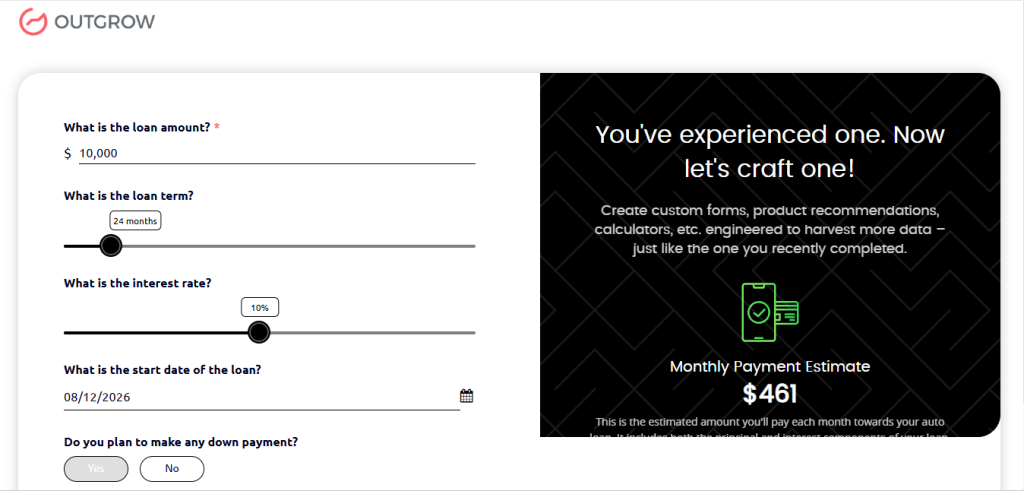
Step 1: Enter the loan amount
Enter the price of the vehicle you’re financing before subtracting any down payment or trade-in value.
Step 2: Choose your loan term
How many months you’ll be paying it off. This is one of the biggest levers on your monthly number.
Step 3: Enter the interest rate
The rate your lender is offering. Even a small difference here moves the result more than people expect.
Step 4: Add the loan start date
This sets the payment schedule and helps the auto loan calculator work out when the loan actually gets paid off.
Step 5: Add your down payment, if any
Any amount paid upfront reduces what actually needs to be financed.
Step 6: Include trade-in value or rebates
If you’re trading in a vehicle or getting a manufacturer rebate, this brings the financed amount down further.
Step 7: Factor in sales tax
Whether tax gets rolled into the loan depends on where you live, so the auto loan calculator lets you account for it either way.
Step 8: Add any additional fees
Add Documentation fees, registration, and other extras that dealers tend to fold into the total.
Step 9: Run the numbers
Enter everything and see what comes back. That figure is your estimated monthly payment, built around the actual terms you’re being offered rather than a rough guess.
Try the Interactive Auto Loan Calculator
No need to work through amortization math by hand. The auto loan calculator below takes your details and gives you a monthly number on the spot.

Try the Auto Loan Calculator here.
How Outgrow Builds Auto Loan Calculators (And Why That’s Useful)
Building something like this on your own, especially one that handles conditional fields for down payments, trade-ins, tax, and fees, takes more work than it might seem. Getting the amortization logic right, designing something that doesn’t feel like a spreadsheet, making sure it works on mobile, and embedding it properly can take several days.

Outgrow’s website calculator exists to close that gap. It’s a platform for building website calculators, quizzes, assessments, surveys, and recommendation tools, with no coding involved.
What you can build:
- Finance calculators like this one
- Mortgage and loan payment estimators
- Budget planning quizzes
- Lead qualification tools for finance and auto dealerships
- Recommendation tools for loan products or financing options
Why Businesses Actually Bother With It
An auto loan calculator on a dealership or lender’s site isn’t just answering a question; it’s collecting contact details from people who are actively shopping for financing, sorting them by loan size and readiness to buy, and setting off automated follow-up through tools like HubSpot or Mailchimp.
It also works as a quiz maker, free survey maker, and free form builder, all in one spot, but is designed around conversion specifically. You’re not just giving someone a monthly number. You’re setting up a piece of your funnel that keeps working on its own.
Worth knowing:
- Drag-and-drop, no code needed
- Conditional logic so fields like down payment or trade-in only show up when relevant
- Analytics and lead tracking, live
- Full control over branding and design
- Works embedded on any site or landing page
- Native integrations, plus 1,000+ more through Zapier
- Mobile-ready from the start
How the Actual Outgrow Auto Loan Calculator Works
Up to five things go in: loan amount, loan term, interest rate, start date, down payment. These get run through standard amortization math, and the answer shows up on a results screen as an estimated monthly payment, with a lead capture form built in right before the results appear. That means the tool collects a name and email from someone who’s already shown real buying intent before they even see their number.
For any dealership, lender, or finance site trying to generate qualified leads while handing over something genuinely useful, an interactive auto loan calculator earns its spot on the page.
Auto Loan Calculator Use Cases Across 5 Scenarios
The auto loan calculator looks different depending on who’s punching in the numbers.
1. Buying a New Car
Take a buyer financing $32,000 over 60 months at 6.5% interest, with a $3,000 down payment. Running it through the auto loan calculator gives a clear monthly figure before they ever sit down at the finance desk, along with a sense of whether stretching the term further would actually help.
Before that number existed, the buyer was relying on whatever the dealership quoted, with no independent way to check it.
2. Buying a Used or Pre-Owned Car
A buyer looking at a $15,000 used vehicle with no trade-in and a modest down payment runs the auto loan calculator to see how a shorter term compares to a longer one. Used car loans often carry higher rates, so seeing the real monthly cost side by side matters more here than it does for new financing.
3. Trading In a Vehicle
Someone trading in a car worth $6,000 against a new purchase runs the auto loan calculator with and without the trade-in value entered, to see exactly how much that trade is actually saving them each month. Without running both versions, it’s easy to underestimate what a trade-in is really worth.
4. Comparing Loan Offers
A buyer with two competing offers, one at 5.9% over 48 months and another at 4.5% over 72 months, runs both through the auto loan calculator. The lower rate looks better on paper, but the longer term changes the total interest paid enough that the comparison isn’t as obvious as it first seems.
5. Budgeting Before Shopping
Someone who hasn’t picked a car yet uses the auto loan calculator backwards, testing different loan amounts against a monthly payment they know they can afford. Homeowners might also compare auto loan offers with other financing options, such as a home equity line of credit, before deciding how to fund a larger purchase. That sets a real price ceiling before they ever start browsing listings, instead of falling for a car first and doing the math after.
Mistakes People Make With the Auto Loan Calculator
The math behind the auto loan calculator holds up. It’s the inputs where people trip up.
- Leaving out sales tax and fees. In plenty of states, these get financed along with the vehicle, and skipping them understates the real payment.
- Ignoring the trade-in value. Ballparking it instead of using an actual appraised figure throws the whole result off.
- Focusing only on the monthly number. A lower payment from a longer term often means paying a lot more in total interest, and that trade-off is easy to miss.
- Guessing at the interest rate. Lenders quote different rates based on credit, so plugging in a rate that’s better than what you’ll actually qualify for gives a misleadingly low result.
- Not rerunning it after negotiating. Price, trade-in value, and rebates can all shift during the actual purchase, and the number from before negotiations often stops matching what you’re signing.
Building Your Own Auto Loan Calculator with Outgrow
Want an auto loan calculator built for your own site and your own audience? Outgrow’s builder gets you there fast, without much of a learning curve.
Basic setup looks like this:
Inputs:
- Loan amount
- Loan term
- Interest rate
- Loan start date
- Down payment
- Trade-in value or rebates
- Sales tax
- Additional fees
Formula:
Standard amortization math, adjusted for down payment, trade-in value, tax, and fees rolled into the financed amount
Output:
Estimated monthly payment, a short explanation, and a lead capture form placed before the results are revealed.
Add conditional logic on top (skipping the down payment or trade-in fields entirely if the buyer answers “no,” for example), hook the tool up to your CRM, and track every interaction as a lead. Outgrow also doubles as an online survey tool, free questionnaire maker, and form builder with analytics included, so a follow-up qualification survey can sit right on top of the calculator without needing separate platforms stitched together.
Conclusion: Know Your Auto Loan Calculator Number, Then Negotiate the Deal
The auto loan calculator isn’t complicated math. But knowing your number is what separates a negotiation you’re in control of from one where you’re just hoping the numbers work out.
Figure out your monthly payment before you shop. Before you fall for a car that’s out of range. Before the finance desk hands you a number you have no way to check. The auto loan calculator gives you the ground truth every financing decision should rest on.
Want a tool like this working for your own audience? Build a branded auto loan calculator with Outgrow and start turning site visitors into leads.
Sign up for the 7-day free Outgrow trial today and build your own auto loan calculator.
Frequently Asked Questions
An estimate of your monthly car payment based on the loan amount, term, interest rate, and extras like tax, fees, down payment, and trade-in value. It’s the single number that makes comparing financing offers much easier.
It’s a solid estimate built on standard amortization formulas, not an exact quote from a lender. The final rate and fees a lender offers can shift slightly based on credit and other factors, so use the number as a strong starting point going into negotiations.
It does, yes. Stretching a loan from 48 to 72 months can lower the monthly number noticeably, but it also raises the total interest paid over the life of the loan, so it’s worth weighing both sides.
The result comes back lower than what you’ll actually owe, since a lot of states finance tax and fees along with the vehicle itself. Leaving them out is one of the more common reasons people are surprised by their real payment.
Any time the loan amount, rate, term, trade-in value, or down payment changes during negotiation. Doing it again right before signing is a good habit, since dealership numbers can shift more than once during the process.

Muskan is a Marketing Analyst at Outgrow. She is working on multiple areas of marketing. On her days off though, she loves exploring new cafes, drinking coffee, and catching up with friends.

![What Is Growth Marketing? [Strategies and Examples]](https://outgrow.co/blog/wp-content/uploads/2023/05/Blogs-min-1536x768-1-1-1.png)
