Summarize with :
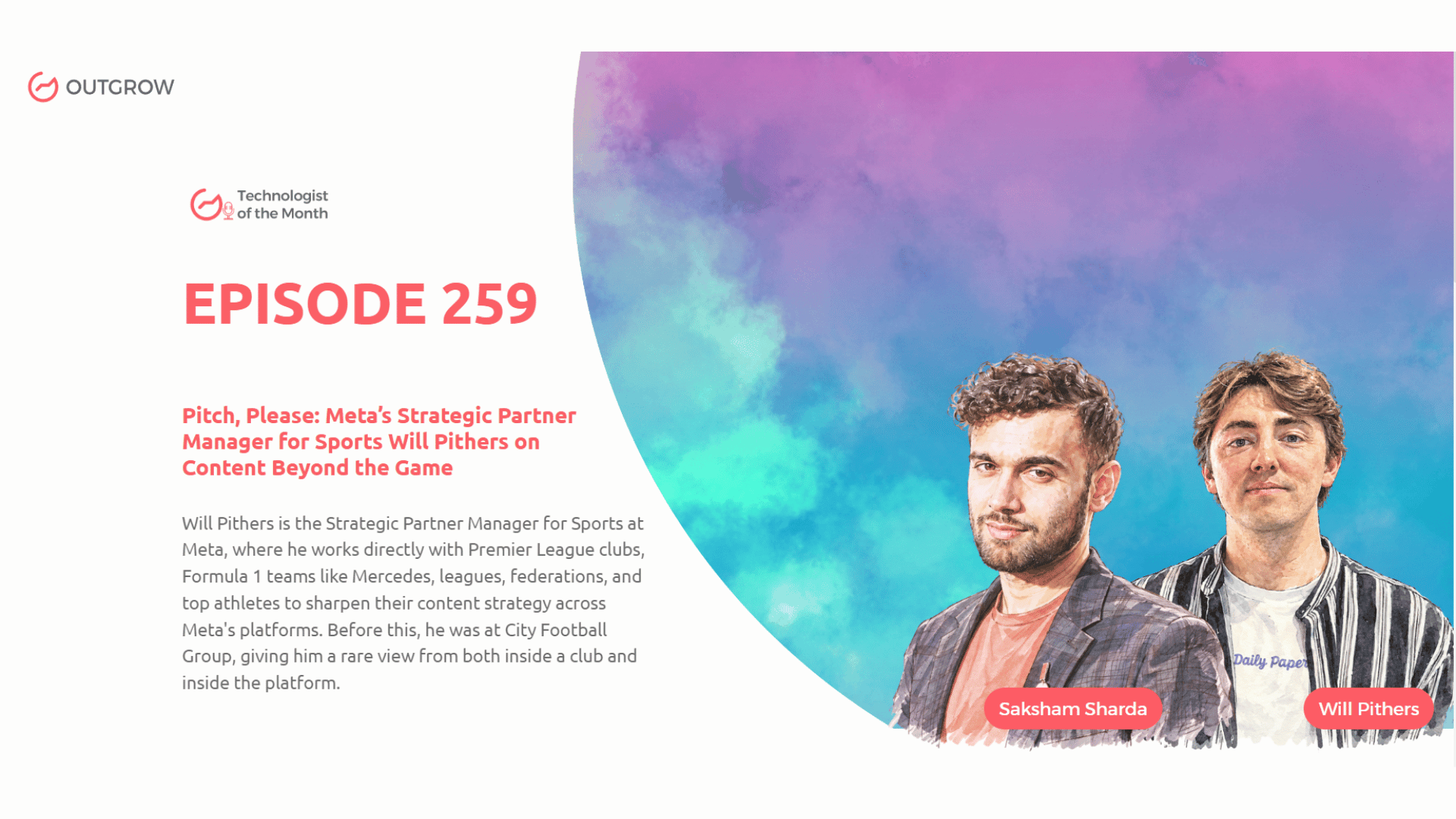
EPISODE 259: Marketer of the Month Podcast with Will Pithers
Table of Contents
Hey there! Welcome to the Marketer Of The Month blog!
We recently interviewed Will Pithers for our monthly podcast – ‘Marketer of the Month’! We had some amazing, insightful conversations with Will, and here’s what we discussed about-
1. Why polished content often loses to shareable, viral moments
2. Why lazy long-form is dying, not long-form itself
3. Measuring success through shares per reach, not just like
4. What watching sports could look like ten years from now
5. What top clubs, leagues, and F1 teams have in common
6. Will’s path from football dreams to Meta’s sports partnerships
7. Why more athlete storytellers make Meta’s job easier
About our host:
Dr. Saksham Sharda is the Chief Information Officer at Outgrow.co He specializes in data collection, analysis, filtering, and transfer by means of widgets and applets. Interactive, cultural, and trending widgets designed by him have been featured on TrendHunter, Alibaba, ProductHunt, New York Marketing Association, FactoryBerlin, Digimarcon Silicon Valley, and at The European Affiliate Summit.
About our guest:
Will Pithers is the Strategic Partner Manager for Sports at Meta, where he works directly with Premier League clubs, Formula 1 teams like Mercedes, leagues, federations, and top athletes to sharpen their content strategy across Meta’s platforms. Before this, he was at City Football Group, giving him a rare view from both inside a club and inside the platform.
Pitch, Please: Meta’s Strategic Partner Manager for Sports Will Pithers on Content Beyond the Game
The Intro!
Saksham Sharda: Hi, everyone. Welcome to another episode of Outgrow’s Marketer of the Month. I’m your host, Dr. Saksham Sharda, and I’m the creative director at Outgrow. co. And for this month, we are going to interview Will Pithers, who is the Strategic Partner Manager for Sports at Meta.
Will Pithers: Great to be here. Thank you.
Don’t have time to read? No problem, just watch the Podcast!
Challenge yourself with this trivia about the exciting topics Will Pithers covered in the podcast.
Or you can just listen to it on Spotify!
The Rapid Fire Round!

Saksham Sharda: All right, let’s start with a rapid-fire round just to break the ice. The first one is, at what age do you want to retire?
Will Pithers: Early 50s.
Saksham Sharda: How long does it take you to get ready in the mornings?
Will Pithers: I am very up and out, like 25 minutes.
Saksham Sharda: Favorite color?
Will Pithers: Orange.
Saksham Sharda: Most embarrassing moment of your life?
Will Pithers: Too many to count.
Saksham Sharda: What time of day are you most inspired?
Will Pithers: Late, midnight, something like that.
Saksham Sharda: How many hours of sleep can you survive on?
Will Pithers: I optimize for seven, seven and a half. I can probably survive on five.
Saksham Sharda: The city in which the best kiss of your life happened?
Will Pithers: Amsterdam.
Saksham Sharda: Pick one, Mark Zuckerberg or Elon Musk?
Will Pithers: Mark Zuckerberg.
Saksham Sharda: How do you relax?
Will Pithers: Reading, video gaming, watching movies.
Saksham Sharda: How many cups of coffee do you drink per day?
Will Pithers: Zero. Not a coffee drinker.
Saksham Sharda: A habit of yours that you hate?
Will Pithers: My incessant cleanliness.
Saksham Sharda: The most valuable skill you’ve learned in life?
Will Pithers: Speak Arabic.
Saksham Sharda: Are you an early riser or a night owl?
Will Pithers: Night owl.
Saksham Sharda: One-word description of your leadership style?
Will Pithers: Assured.
Saksham Sharda: Coffee or tea to kickstart your day?
Will Pithers: Neither, but if I have to, it’s tea.
Saksham Sharda: Top priority in your daily schedule?
Will Pithers: Catching up with my team every morning.
Saksham Sharda: Ideal vacation spot for relaxation?
Will Pithers: Mountains, French Alps.
Saksham Sharda: Key factor for maintaining a work-life balance?
Will Pithers: Discipline and organization.
Saksham Sharda: A memorable career milestone?
Will Pithers: Working on the Paris 2024 Olympic Games.
Saksham Sharda: And a recent business innovation that caught your attention?
Will Pithers: AI auto-translations on Instagram. We’re proud of it. It’s cool.
The Big Questions!

Saksham Sharda: All right, that was the end of the rapid-fire. So what’s the one mistake almost every club or athlete still makes online?
Will Pithers: I think the biggest mistake I see is people optimizing for output rather than what gets shared. You can spend a long time creating a really polished, hi-fi piece of content that looks visually beautiful, but if it doesn’t meet best practice criteria, then it’s not something that’s going to be seen by a lot of people or be shared with friends. And sometimes that means sacrificing kind of quality for kind of viral moments, and I think people still over-index on one over the other.
Saksham Sharda: What separates a team that gets social media from one just posting to check a box?
Will Pithers: I think it’s about appreciating that content is an end in itself rather than a driver to somewhere else. So those that treat social content as a promotion for a broadcast or another product often fall down, whereas those that recognize social as a destination in and of itself and create content for those people, to meet those users where they are in that moment, they’re the ones that really succeed.
Saksham Sharda: And speaking of content, then, short clips are eating everything right now. Is long-form sports content dying or just changing shape?
Will Pithers: Changing shape, for sure. I think lazy long-form content is dying. I think people, there’s a lot said about shortening attention spans and things like that, but people will stick around for long-form content if it’s good and it’s engaging. And I think the thing that’s died is kind of 40 seconds of a video, the first 40 seconds of a video that goes nowhere. And the kind of taking a surgical approach to editing long-form content to ensure that you are providing some value right from the off is kind of critical to success. So, not dead. More challenging than it used to be, for sure, but I think the appetite is still there for it.
Saksham Sharda: And is there any example of teams that come to your mind that have really cracked short form better than everyone else?
Will Pithers: I think it’s something obvious to say, but I think football clubs do this very well on their very, very seasoned. They have content strands that are very regular and have been in place for a very long time, so they know how to optimize these content strands. And you know, for example, when you’re posting a match highlights video, exactly how you need to edit that video in such a way to retain people’s attention, and they will stick around. You just got to figure out the right formula for that video, and football clubs do that very well.
Saksham Sharda: And you yourself worked inside a club before moving to the platform side. What did that teach you that outsiders never guess?
Will Pithers: Yeah, I think one thing that would surprise people about football clubs is just how small the team is that creates the content. It’s really, really intense environment for social and video teams at football clubs, [lip smack] often working all week and then match days and weekends. And so having worked there, I have a real appreciation for the hard work that they do. And then I guess the second thing is just the layers of approvals. There are so many people at a football club who have a hand in what the final piece of content looks like, which again is kind of logistical challenge that you have to deal with on the backend.
Saksham Sharda: And is there any sort of a gap between what clubs think fans want and what they actually want?
Will Pithers: Not necessarily. I think it’s just important not to assume that you know. For example, one of the biggest learnings for me when I was at City Football Group was we assumed that the content that would pull people in, that would drive most of our distribution was stuff that involved the kind of green grass of the pitch, right? Highlights, goal clips, et cetera. And what we realized over time was that it was actually recognizable faces that really drew people in, whether or not they were on the pitch. So, for example, talking about highlights, like starting your highlights video with a closeup of a player’s face celebrating, rather than starting it with a kind of pitch-wide view makes a massive difference. And so, yeah, not assuming that you know what is going to pull your customer in, your fans in, I think is the correct approach.
Saksham Sharda: Fans are moving from public feeds to private group chats. Does that scare teams or excite them?
Will Pithers: Both, honestly. I think it’s scary because engagement in a private group chat feels less measurable than a public like count. But it’s also exciting because it’s where fandom really lives. It’s where the true honest conversations happen between people. And so if you can craft content that makes the group chat, you are really kind of getting to the nub of what culture is in driving fan. So it’s both of those things, and I guess a changing landscape to navigate.
Saksham Sharda: So how would a club then measure success if fans are talking privately instead of commenting?
Will Pithers: The unlock on our side is a kind of shift in the way that you measure your metrics. We talk a lot about shareability. One number that’s kind of come to the fore in the last year or so is shares per reach. So, for every person who saw your content, how many of them elected to share it with a friend? It doesn’t give you exactly what that engagement is once they share it. You don’t see inside these kind of private messaging spaces, but it gives you an indication of whether or not you’re tapping into something, and that’s really important.
Saksham Sharda: Nowadays, athletes are becoming their own media companies at the same time. Does that make your job easier or harder?
Will Pithers: Easier, for sure. More great storytellers in the ecosystem is good for everyone. I think we’re going through a really interesting shift in the way that athletes perceive themselves. Historically, they’ve considered themselves as professional sports men and women, for me. Now they understand that they are both professional athlete and entertainer, and that really opens up lots of possibilities for them to kind of interact with fans and kind of show their true personality in a different way.
Saksham Sharda: Will athletes eventually earn more from content than sponsorships?
Will Pithers: I think it’s true that in many sports they already are. I think you’ll probably struggle in the highest paid, most popular sports like F1 and soccer. But in many sports, they already are doing that. So it’s a reality of both.
Saksham Sharda: Fans now expect access and personality, not just a game. Is that pressure good or bad for athletes?
Will Pithers: Genuinely good and bad. And I think the part of the answer is a wellbeing one, which is always worth saying. On the good side, you have the opportunity to show more of your personality, to find people of different interest areas, not just those who are interested in the sport that you play. And the ability to express yourself. Let’s say you love anime, you can create… We have footballers who created secondary Instagram accounts detailing their anime interests. Let’s say you’re really into chess, or you want to show more of your family side or your faith, then you have the ability to do that. The potential negative is feeling like you always need to be always on, and the pressure to kind of show up in all different facets of your life and not just the kind of professional facet. And so, we really recommend people make use of our wellbeing tools, how to manage their time effectively. And I think where we’ll see success here is not kind of blanket access to your whole life, but considered for certain aspects of your life that you want to show online, so that you have that kind of flexibility.
Saksham Sharda: Speaking of success, then, you shared some wild World Cup numbers, like 29 million WhatsApp messages come second to one match. What stand actually made your jaw drop?
Will Pithers: Yeah, that WhatsApp number is big. I’m constantly impressed and amazed by just how much more interaction and engagement around major sporting moments happens in these private messaging scenarios versus just in the feed. The other one that really struck me, and it’s an athlete one, is the story of Erling Haaland, footballer who has had kind of massive- … exposure in Europe at Premier League and Champions League level, but really kind of entered the world stage at the World Cup and doubled his following, basically grew 34 million followers over the space of six weeks, 860 million Reels views on Instagram. And is a great example, a success story of an athlete who doesn’t just kind of show the sporting side of their life, but also shows their personality, their humor, their interest in internet culture, and it resonates with people, and it’s been great to see.
Saksham Sharda: So what does watching sports even look like in 10 years’ time?
Will Pithers: I think sports today is you gather around the TV or the screen to watch a moment. And I feel like 10 years from now, sports is going to be more of a moment that you move through together with people that you’re with. And I think that also means multiple camera angles, not just from the perspective of the broadcast cameras, but the referee, the players themselves, the fans in the stadium, kind of all stitched together to make a really, really compelling broadcast experience. And it’ll be obvious for me to say this, but I think it’ll be social first. And this thing, your mobile phone, won’t be your second screen. It’ll be kind of inseparable from the first screen. It kind of weaves its way into your experience of the match rather than being secondary to it.
Saksham Sharda: And what about sports that are huge elsewhere but still underrated where you are? Are there examples of that and how that’s changing?
Will Pithers: Yeah. I was lucky enough to spend some time in Milano Cortina for the Winter Olympics this year, and I got a real appreciation for the kind of massive and engaged fan bases around Nordic winter sports. I live in the UK. We don’t have too many skiing spots [chuckles] in the UK. And so where I live, it doesn’t really register, but traveling to the Olympics, working with organizations like FIS and the International Skating Union, you really get appreciation for how dedicated and engaged these fan bases are. So that’s a really exciting one I’m going to watch out.
Saksham Sharda: So working with clubs, leagues, F1 teams, what do all the biggest names have in common?
Will Pithers: The thing these guys have in common is a kind of razor-like clarity about who they’re for, who they’re trying to reach with their content, and also discipline about who they’re not for. Understanding that every time you post something, you make a choice. You make a choice about the people that you want to reach and the people that you aren’t necessarily trying to speak to with this video. And that’s fine. It kind of feels like a scary decision in the moment, but I think is absolutely necessary to create the content that is engaging and works. And I think the other thing I would say is that they move fast. They don’t think too much. And specifically with sports, with certain clips, with certain moments, you have to be there on the buzzer. And if you’re not, if you’re a couple of minutes late, then it doesn’t have the juice. And so it’s a combination of those things, the clarity on your audience, plus the ability to move fast when you need to and really nail those key moments.
Saksham Sharda: So what’s something about how sports content gets made that most fans have no idea about?
Will Pithers: I think one thing that people would be shocked is that how much content gets shot and then doesn’t get used for whatever reason. And like I said, you have to imagine that teams are very small. They work very, very hard. But part of the job is that sometimes you’ll catch something that can’t be used, and that might necessarily be a transfer that didn’t come off, or a moment that got canned by your comms team, or anything else that you might capture that for some reason didn’t make it, hit the cutting room floor. There is so much of that stuff, and I think people would be astonished to see it. And what we have seen, I suppose, in recent years is, particularly in football, but in other sports too, that B-roll being upcycled and reused and turned into long-form documentaries. I think people would be shocked at how much footage like that there is that’s sitting in an editing suite somewhere just ready to be seen, maybe one day.
Saksham Sharda: All right, so the last question for you is of a personal kind. What would you be doing in your life if not this?
Will Pithers: The first thing that came to my head, the typical answer is when I was a kid, I wanted to be a professional footballer, obviously. That didn’t come off. I studied languages at university. And I think if I hadn’t ended up stumbling into sport, I would’ve done something with that, maybe as a translator or something like that. But I feel I stumbled into a sports job 10 years ago, and I feel very lucky that I did.
Let’s Conclude!
Saksham Sharda: Thanks, everyone for joining us for this month’s episode of Outgrow’s Marketer of the Month. That was Will Pithers, who is the Strategic Partner Manager for Sports at Meta.
Will Pithers: Great to be here. Thank you.
Saksham Sharda: Check out the website for more details and we’ll see you once again next month with another marketer of the month.
I am a Digital Marketing Enthusiast with a passion for optimizing content and paid marketing strategies. Continuously seeking innovative approaches to boost ROI and engagement at Outgrow.