Summarize with :
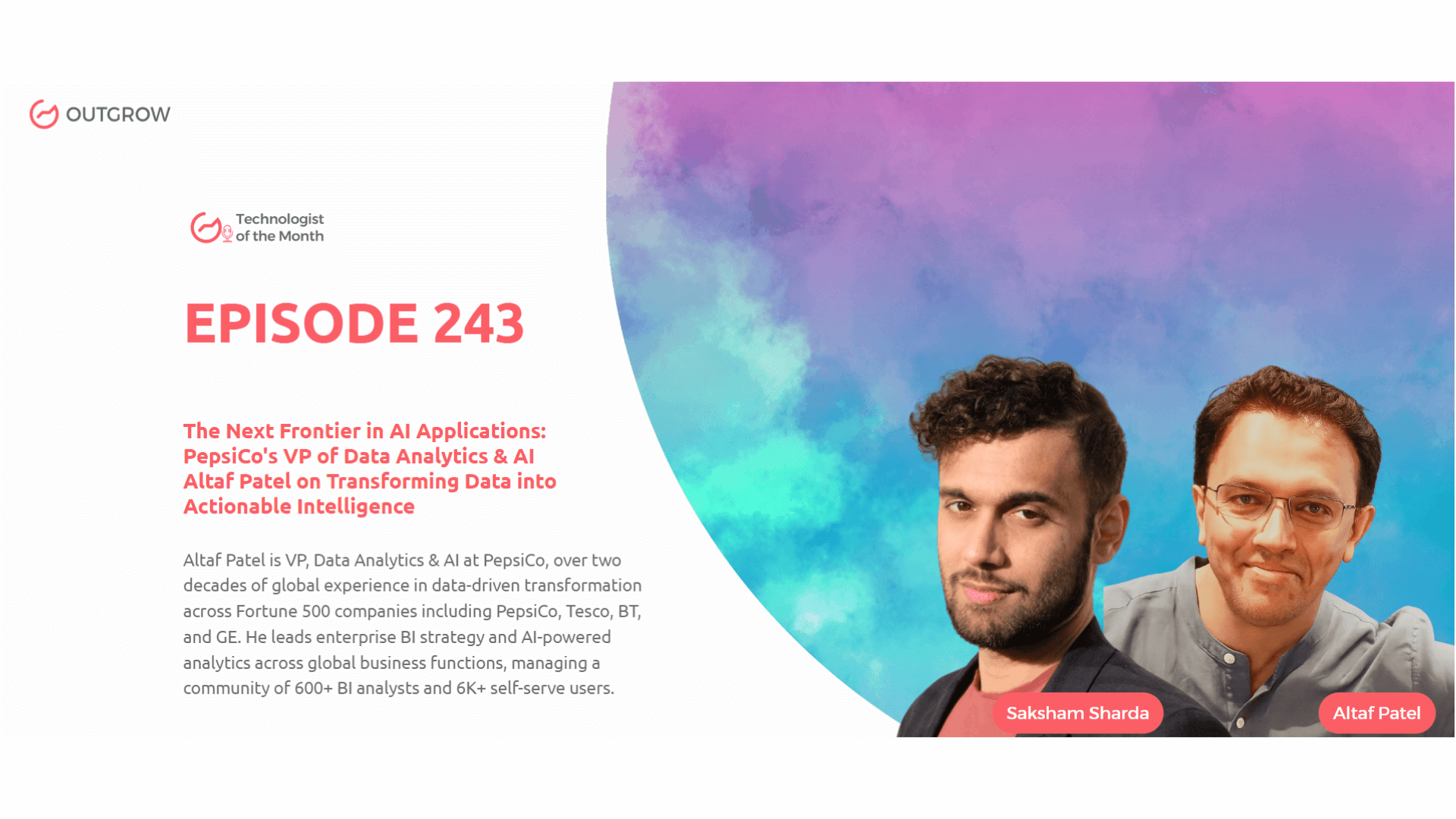
EPISODE 243: Marketer of the Month Podcast with Altaf Patel
Table of Contents
Hey there! Welcome to the Marketer Of The Month blog!
We recently interviewed Altaf Patel for our monthly podcast – ‘Marketer of the Month’! We had some amazing, insightful conversations with Altaf, and here’s what we discussed about-
1. Altaf Patel’s career journey in data analytics and AI leadership
2. Building unified data foundations for AI scalability
3. Embedding autonomous AI agents into business workflows
4. Forecasting the changing role of BI professionals in AI era
5. Practical examples of AI use case timelines and improvements
6. The power of rationalizing reports to enhance decision-making
About our host:
Dr. Saksham Sharda is the Chief Information Officer at Outgrow.co He specializes in data collection, analysis, filtering, and transfer by means of widgets and applets. Interactive, cultural, and trending widgets designed by him have been featured on TrendHunter, Alibaba, ProductHunt, New York Marketing Association, FactoryBerlin, Digimarcon Silicon Valley, and at The European Affiliate Summit.
About our guest:
Altaf Patel is VP, Data Analytics & AI at PepsiCo, over two decades of global experience in data-driven transformation across Fortune 500 companies including PepsiCo, Tesco, BT, and GE. He leads enterprise BI strategy and AI-powered analytics across global business functions, managing a community of 600+ BI analysts and 6K+ self-serve users.
The Next Frontier in AI Applications: PepsiCo’s VP of Data Analytics & AI Altaf Patel on Transforming Data into Actionable Intelligence
The Intro!
Saksham Sharda: Hi, everyone. Welcome to another episode of Outgrow’s Marketer of the Month. I’m your host, Dr. Saksham Sharda, and I’m the creative director at Outgrow. co. And for this month, we are going to interview Altaf Patel, who is VP, Data Analytics & AI at PepsiCo.
Altaf Patel: Great to be here. Thank you.
Don’t have time to read? No problem, just watch the Podcast!
Challenge yourself with this trivia about the exciting topics Altaf Patel covered in the podcast.
Or you can just listen to it on Spotify!
The Rapid Fire Round!

Saksham Sharda: Let’s start with the rapid-fire round. The first question is, at what age do you want to retire?
Altaf Patel: 55
Saksham Sharda: How long does it take you to get ready in the mornings?
Altaf Patel: I take a couple of hours.
Saksham Sharda: Most embarrassing moment of your life?
Altaf Patel: Your girlfriend walking away with someone else.
Saksham Sharda: Favorite color?
Altaf Patel: Blue.
Saksham Sharda: What time of day are you most inspired?
Altaf Patel: Morning, not straight after waking up, but probably an hour into seeing the sun rays.
Saksham Sharda: How many hours of sleep can you survive on?
Altaf Patel: Seven.
Saksham Sharda: The city in which the best kiss of your life happened?
Altaf Patel: Langkawi.
Saksham Sharda: Pick one, Mark Zuckerberg or Elon Musk?
Altaf Patel: Elon Musk.
Saksham Sharda: How do you relax?
Altaf Patel: Pranayama, meditation.
Saksham Sharda: How many cups of coffee do you drink per day?
Altaf Patel: One.
Saksham Sharda: A habit of yours that you hate?
Altaf Patel: I scratch my head when I’m confused about something..
Saksham Sharda: The most valuable skill you’ve learned in life.
Altaf Patel: Show gratitude for what you have.
Saksham Sharda: Your favorite Netflix show.
Altaf Patel: There are so many.
Saksham Sharda: Are you an early riser or a night owl?
Altaf Patel: Early riser.
Saksham Sharda: One-word description of your leadership style
Altaf Patel: Challenging.
aksham Sharda: Coffee or tea to kickstart your day?
Altaf Patel: Coffee.
Saksham Sharda: Top priority in your daily schedule.
Altaf Patel: Team, work, looking ahead.
Saksham Sharda: Ideal vacation spot for relaxation.
Altaf Patel: Something green, natural, mountainous, jungle.
Saksham Sharda: Key factor for maintaining a work-life balance.
Altaf Patel: Time. Discipline. And committed to family as well.
The Big Questions!

Saksham Sharda: So now we go on to the longer questions, which you can answer with as much time and ease as you like. The first one is that you are part of the Data, Analytics, and AI team driving the AI and Analytics agenda at a global scale for PepsiCo. What are the biggest challenges you’ve seen organizations face when trying to transform data into actionable intelligence with AI?
Altaf Patel: I think it just sort of becomes more reinforcing on some of those challenges when I talk to the other colleagues from Heineken to Philips to whatnot. The first one that I see is intelligence, typically in really big enterprises and global corporates such as PepsiCo, is really broken. The analytics are broken. You have tonnes of reports, tonnes of dashboards. It really confuses the decision-making. It confuses what a senior executive really has to go after. So much so that they stop looking at the insights for them to be able to then decide what they want to do. At PepsiCo, with the sponsorship of our executive vice president, we are very clear in seeing how we rationalise these reports, rationalise the business intelligence that we have, and figure out a way of consolidating it. That’s one. The second one that I would say, again, it’s very common, which sort of shows up is the data. Now, whether that’s pool, puddles, ponds, oceans of data, it’s floating around in the organisation, and there are analytics assets which are being built on top of it. But the fact that it’s all over the place, there’s nothing that brings it together, it does not allow the companies to scale the global to local capabilities in the same way that PepsiCo is doing. And at PepsiCo, we are very clear, we want to make sure that our backbone is really strong, be it on the cloud, be it on the data foundation. These are some of the really foundational investments that we’ve done to really ensure that it’s coming off really well on our products in the way we then drive the value out of these products. So those are the two I would really pick.
Saksham Sharda: And how do you differentiate between data that’s ready for AI consumption versus data that still needs significant preparation and governance?
Altaf Patel: So this is where I think the operating model is very important. How the various capabilities within the team are going to come together, what the various archetypes of products that we are going to see, and how the process is going to play out around these archetypes are also very important. So we’ve done that codification, right? From being in the data analytics and AI team, we have capabilities such as data engineering, data governance, AI platforms, data science, business intelligence, and we all wrap ourselves around a product proposition. So we have a data product management layer as well, which stitches these capabilities together. Now, whether the data is ready and hence how we’re going to operate, to how data is not ready, and that we’re going to figure out a way of getting that fed into the foundation, and then how we develop products on top of it. There are different approaches. It builds the clarity across the teams, and we know hence what it’s going to take to deliver those products, and it also lays out really nicely the expectations to our stakeholders, and that I would say becomes a very strong basis.
Saksham Sharda: We hear a lot about AI in analytics, but in your view, what makes AI for BI the real game-changer versus traditional business intelligence tools?
Altaf Patel: I kind of see it in three different lengths. The first one is it’s agentic. So essentially what that means is you’re allowing the agents, AI agents, to be able to now leverage the codified knowledge. That knowledge, typically in the traditional BI setup, would be either stored in reports, stored in the semantic layer of the BI reports, it would be stored in the data analyst, it would be stored in the insights leads who are packaging all of those insights together. Now you’re going to make it agentic. You’re going to codify that knowledge, you’re going to surface up the data that’s important, and you’re going to let agents now leverage it and make it hugely reputable in terms of producing the insights that you need. The second one that I feel is the pull versus push approach. When you look at the traditional BI, it’s a lot of a pull approach. You have to go into various dashboards, you have to go into looking at various reports, you have to traverse, you have to find out what’s really important, you have to draw inferences, you may spot something, you may miss out on spotting something as well. And so in a way, it’s static in nature. It’s tedious as well in nature. Whereas the agentic AI-enabled analytics or AI-powered analytics has a very strong push approach to it compared to the pull approach. What I mean by the push approach is that you will now be sent the triggers. You will be told what you’ve spotted in the data. You have the ability to ask the questions. You will have package insights for yourself. And so in a way, you don’t have to look for it or search for it. You’ll be provided with what you need to be looking at. And that brings us to the third aspect, because if you can leverage the power of agentic and couple that with the power of pull, sorry, the push, you can make it more personalised. So personalisation, I feel, is another real differentiator. I’m a persona. I’m interested in looking at certain tables, certain data sets, certain analysis, and I can package you the insights that are relevant for you. And to me, that power of personalisation is again what I feel the traditional BI does not offer. You can look at the reports and figure out what’s important to you versus the personalisation capability that the analytics powered by AI can really provide. So three things I would say, the agentic nature of analytics, the fact that it’s push, and the fact that it’s personalised for you.
Saksham Sharda: For senior leaders looking at ROI, what’s the clearest business value case you’ve seen from applying AI to business analytics and intelligence?
Altaf Patel: Interesting. And what’s interesting is that I attended another roundtable last week, exactly the same question, and we were debating about how do we justify the investment for doing some of the work? Because the reports exist, the dashboards exist. How do we kind of now turn those into AI-powered analytics, and who’s going to pay for those investments? First thing is productivity. We’ve seen huge gains within PepsiCo on rationalising both labour and the non-labour components associated with it. Now, whether you’re talking about report creators, whether you’re talking about people who are churning out these manual reports, whether you’re talking about visualisation developers, I think there’s a big scale of, I feel, productivity that you can drive on the labour part, which sort of typically is 20% to 30% of what we’ve essentially seen and achieved. But the other big component is all the infrastructure and all the non-labour assets. Now, whether those are licences. We were free-flowing. People could kind of get the Tableau licences as and when they want. A huge part of self-serve culture, but as a result of which massive proliferation, the awareness wasn’t there, people would go and get the licences, develop the reports, create the pipelines. Essentially, 60% to 70% of our reports had zero or low usage. So rationalising all those reports, freeing up all of your infrastructure and capacity can unlock huge productivity. And in a way, you can kind of repurpose that back into sort of making your analytics more AI-powered as well. The other three that I see, second is personalisation. I think that whole, you know, getting an executive excited about, hey, I can now see what I need to see for myself. I don’t need to kind of now go through different reports to find out what’s important. I can ask the question, and I will get an answer for what I have to carry out as part of my day job. Now, whether that’s a GM in a business unit, whether it’s a category manager in a procurement function, or whether that’s a commercial lead in a commercial function, I think that personalisation, and so you need to sell that story. You need to kind of get people excited about what that’s going to allow them to do, the agility, and the fact that they will now have the insight. The third piece I would say is performance. If you’ve got critical business KPIs, you would want to see, with the fact that now I can get what I need to get, when I want to get, you will be able to act quicker. Your time to insights is going to collapse. The fact that some of those KPIs, which were not necessarily performing well, will start performing well. And to me, I think there’s a clear performance indicator as well. And finally, prediction, right? You will be able to now leverage the AI in a way to help drive the prediction. You want to leverage the LLM capabilities and all of the ML capabilities that you have within the company to help sort of drive the prediction. Now, whether it’s in the form of forecasting, optimisation, predictions, I think those are the four I would say in terms of the clear value.
Saksham Sharda: And so how do you then structure ROI measurements for AI initiatives that might have long-term strategic benefits but unclear short-term returns?
Altaf Patel: I think this is where it’s important to kind of get a top-down sponsorship. So, for example, one of the things that we are very clear about in PepsiCo, and something that both my boss and the VP are very clear about is that we’ve got to invest in the data foundation. That data foundation is like the foundation of a massive, tall skyscraper as well. You need that foundational layer around which you can then build the products on top of it. If you were to kind of get the products and the use cases to pay for that data foundation, that’s never going to happen. But equally, investing in that data foundation is not going to give you tangible benefits on day one. There’s a long-term play to the data foundation. And with that data foundation and the knowledge foundation, you can then operate AI on top of it. And to me, I think that then sort of develops a very clear, accelerated ecosystem around which you start seeing the benefits, not necessarily in the short-term, but in the long-term. So I think having that top-down sponsorship, clarity of the vision around where we want to kind of head our company to, strategic programmes around where we want to deploy ourselves and invest in, helps you to kind of help justify the long-term ROI, but balancing it with some of the use cases that you can deliver in the short-term as well.
Saksham Sharda: The concept of agentic AI is emerging as a significant trend. How are you embedding autonomous AI agents directly into decision workflows rather than treating them as standalone tools?
Altaf Patel: Really good question. In fact, it’s part of the presentation that I was doing earlier today. So we come from a landscape where we had 20,000 reports. And we’re talking about, these are platform-based reports on Power BI on Tableau, where all of our insights and intelligences fragmented, federated across all of these reports. And I’m talking about this at an enterprise level. We’re not even including all the manual reports that sit on top of it. We’re not talking about all the PowerPoints and various other insights that we create as artefacts. We’ve come a long way where we’ve rationalised these 40,000 reports now into 10,000 reports. But now we want to move towards AI-powered consoles. We’re going to move from 10000 about to 50000 reports that we have now to AI-powered consoles. These 50000 AI-powered consoles will be agentic-powered. They will have the personalisation capability. They will be single one-stop shop for people to come. It will be rich with all the AI features that you can name. And it’s going to help drive the next wave of rationalisation that we want. Once you build the knowledge and the data that supports these consoles, you can essentially then drive the decision orchestration on the back of it as well. You can identify very quickly that you’re going to run out of stocks. And hence how you can then orchestrate an agent to go and figure out how we’re going to fill up the inventory. You’re going to have a transportation agent which is going to go and carry out activities that it needs to do across the various aspects of transportation. So something that normally used to take two, three months to bring people cross-functionally onto a business priority will now have an opportunity to bring those cross-functional agents together onto a common workflow and orchestrate it with far higher agility and speed. And to me, I think that’s the vision that we’ve got. We are on that journey. But what’s really good is that we’ve got that vision to really power us in how we move from fragmented, broken reporting landscape to AI-powered consoles which are going to turn into a decision intelligence.
Saksham Sharda: What safeguards and human oversight mechanisms do you implement when AI agents like these are making recommendations that could impact business operations?
Altaf Patel: Really good. I think our experience when we started off this journey on the first use case that we picked up was it took four months for us to do it. And our second use case took about two months. Our third use case took less than a month. As we sort of went through this journey, when you look at the accuracy, on our first use case, we had a huge struggle on the accuracy. A huge struggle in terms of our response time. And that was because we were leveraging the LLM and basically asking LLM to do a lot of the heavy lifting. In which case, it was hallucinating, it was going all over the place, and our agents were confused as well in their input-output in the multi-agent orchestration. As we sort of started picking up the knowledge, it was important and we learned a number of different things. Whether that’s developing metadata, that’s really important on top of the data, which really helps the agents and the LLM to become more accurate. Whether it’s leveraging and driving a platform approach to your use cases. So we have an abstraction layer, we call it PepGenX. It allows us to plug and play different models. It has the agentic framework on it. It offers a number of different components that we codify through the use cases so that they become far more reusable for us to use. And it has the observability on it so that ways we are governing the agents and their actions as well. We are able to explain, we are able to see the coherence, we are able to see the accuracy, we are able to kind of find out what’s exactly playing out in the interactions within these agents. In our first use case we didn’t have any of that. But in the last use case we have a number of those aspects available. Data was also really important. The more simpler data model that you have, when I say simpler I’m not necessarily referring to you can have a huge size of it, but it becomes a lot more easier for the LLMs to understand your schema and be able to find and give you the SQL query that you need to run on. So those are the things that I would suggest.
Saksham Sharda: So looking towards the future then, how will AI reshape the role of business intelligence professionals over the next three to five years?
Altaf Patel: Well, that’s interesting. I mean, I think typically in any corporate right now you’ll find visualisation engineers, you’ll find business analysts, you’ll find insights leads, you’ll find people who are spending their day job in preparing reports, in preparing visualisation, in preparing the various analytic artefacts and assets. I feel like they are gradually going to get transitioned into becoming agent builders, agent observers. Maybe they become the human in the loop around what the agents are doing. They become the way the orchestration needs to play out, so they become the designer of the orchestration as well. I see that as one part of it. The other part that I see is, right now a lot of these business professionals are working close to the business, they have the pulse of the business, but they are not necessarily providing the value add to the business. I think to me, with the automation of insights, I will see them shift towards becoming more closer to the business in adding value, in carrying on ad hoc analysis, in drawing inferences across various analytical assets to propose, to recommend the business users on the actions that they need to be taking. Right now they are autotakers, tomorrow I feel that they will be partners with the business. So yeah, we’ll see the shift because a lot of their activities are either going to get automated and AI will become a big enabler of it, but at the same time I feel human in the loop coupled with the fact that they’ll be adding a different level of value working with the business is where the opportunity is.
Saksham Sharda: Are there any particular new skills that you are actively developing in your 600 plus people business intelligence analyst community to prepare them for an AI augmented future?
Altaf Patel: Yeah, absolutely. One, I think within our own team, within the team that I’m part of, there’s a huge emphasis on how we drive the AI literacy. We’ve shaped an L&D programme across the different capabilities. We are going to now make sure that people can essentially certify themselves. We’re going to gamify it as well to kind of make sure we appreciate where the talent is and how they are. We’re going to also use that as a way to build the skills and incorporate them into the various use cases. We’re also getting them to become part of the journey. So, for example, if there are small scale use cases, how do we kind of get them to leverage something called Microsoft Power BI Copilot, right? Something that can very quickly give them an ability to draw out insights and a conversational capability limited to a dashboard, limited in its capabilities, but really helpful in the constraints of what they are operating on and how they can then use that with the business stakeholders to drive a different level of engagement and experience. We are also getting our teams to actively use PepGPT. This is their own personalised, you can think of it as a chatGPT version of PepsiCo, where they can plug and play, pick the models that they want, and within the confines of work, they can use the PepGPT to help them simplify their work and in doing so, how they can build a context, build their own context, but also build the context of the larger team, which over a period of time becomes really powerful for the company. So these are some of the things where, whether it’s literacy, whether we get them to use it in a small scale, or whether we get them actively involved in it in a way that helps them to augment their day-to-day jobs are some of the things that we are doing.
Saksham Sharda: Alright, so the last question for you is of a personal kind. What would you be doing in your life if not this?
Altaf Patel: Oh, that’s interesting. I love gardening. And one of the passions that I have is have my own farm behind my own farmhouse and growing everything in the world that I can so that I’m self-reliant and I can enjoy my life. So we’ll see whether I manage to do that after the age of retirement, which is 55.
Let’s Conclude!
Saksham Sharda: Thanks, everyone for joining us for this month’s episode of Outgrow’s Marketer of the Month. That was Altaf Patel, who is VP, Data Analytics & AI at PepsiCo.
Altaf Patel: Great to be here. Thank you.
Saksham Sharda: Check out the website for more details, and we’ll see you once again next month with another marketer of the month.

I am a Digital Marketing Enthusiast with a passion for optimizing content and paid marketing strategies. Continuously seeking innovative approaches to boost ROI and engagement at Outgrow.