SEO Quiz: Test Your Search Knowledge in Under 10 Minutes
Table of Contents
Quick test. Without Googling it, explain what a canonical tag does. Go ahead, we’ll wait.
If you froze, welcome to the club. We’d guess most people with SEO on their resume have a few holes like that, and the funny part is they rarely know where the holes are. You pick things up in pieces: a blog post here, a client call there, a coworker who swears title tags are dead. (They aren’t.)
Which is why an SEO quiz makes such a handy reality check. Ten minutes. You answer, you get a score, and you find out which parts of your knowledge are real and which are vibes.
What Is an SEO Quiz?
Plain version: an SEO quiz is a short test, usually multiple-choice, on how search engine optimization works. Ten questions, maybe forty.
Moz’s SEO Expert Quiz is a decent one to try first. Take it, then jot down any question that made you hesitate.
The weak ones just ask you to define terms. The good ones drop you into a scenario. A page won’t index. Traffic dipped after a site migration. Two link offers land in your inbox on the same day, and you can only say yes to one. Now what? That’s the actual job, and it’s what a decent quiz is poking at.
Difficulty swings wildly. Beginner versions ask about title tags and keywords. Expert ones get into canonicals, pagination, and how Google handles JavaScript, the stuff people argue about on conference panels. Plenty of quizzes score you and sort you into a level, like beginner, intermediate, or advanced.
One thing it isn’t: a credential. Nobody should hire (or skip) you over a quiz result. Think of it as a quick look in the mirror.
Topics tend to repeat. Keywords and intent, on-page stuff, technical health, links, analytics, content quality. Pretty much those six, in whatever proportions the author likes.
Why Testing Your Knowledge Matters
SEO knowledge spoils. Quickly. Advice that was gospel in 2019 can be pointless now, and some of it will actively hurt you, which is the nasty part, because you won’t notice.
A quiz turns up the spoiled stuff. It also shows you how lopsided you are. Say you’re a writer: you probably have a great feel for what searchers want, and then someone asks about crawl budget, and you go blank. Developers get the reverse problem. Neither is a crisis. But “I should really learn more technical stuff” never turns into a plan, while “I missed all three structured data questions” does.
That’s the time-saving part, by the way. You don’t need the whole 40-chapter guide. You need the structured data chapter.
And if you come back in three months and your score has jumped, you’ve got something to show your boss or a client, which beats saying “trust me, I’ve been studying.” Some hiring managers use short tests like this before interviews, too, so a little practice doesn’t hurt.
How to Get an Honest Score
Ground rules, because it’s easy to fool yourself.
- Don’t search for answers. If you do, you’re testing your Googling.
- As you go, keep a rough tally: knew it, guessed, got lucky. A lucky guess still counts as a gap, even if the score pretends otherwise.
- Do it in one go. Ten minutes with notifications off. Three attempts interrupted by Slack tell you nothing.
- When a quiz explains its answers, read the explanations, even for the ones you got right. Half the learning lives there.
Also, you won’t hit 100%, and you shouldn’t sweat it. SEO is full of “it depends,” so now and then a question will deserve an argument. Fine. Argue, then go look it up.
What the Questions Look Like
Every quiz writes its own, but scenario questions tend to feel like these.
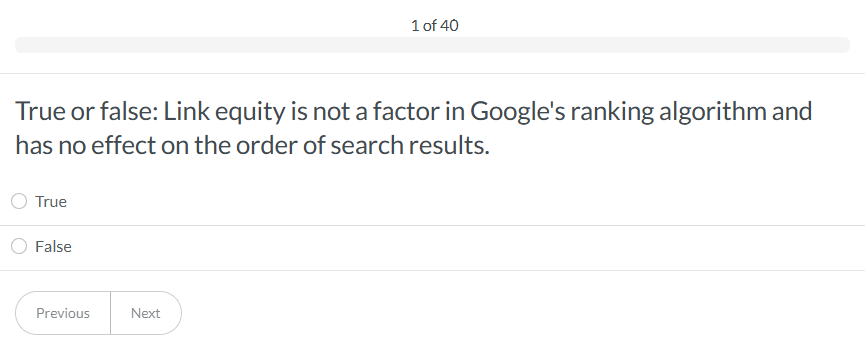
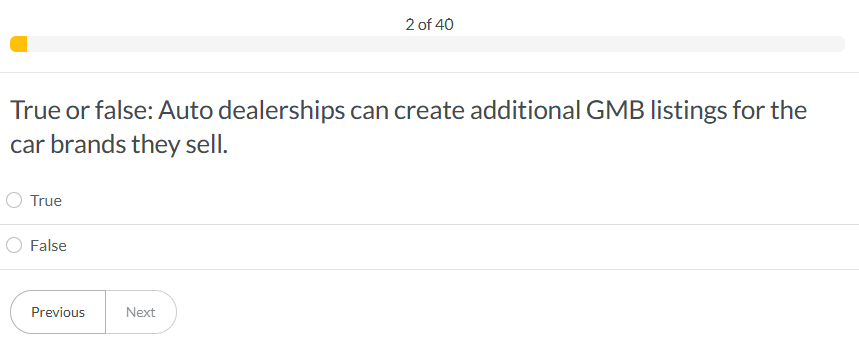
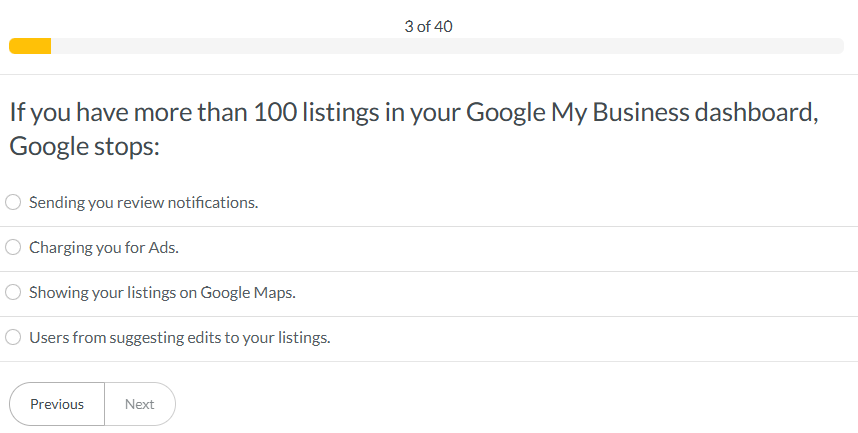
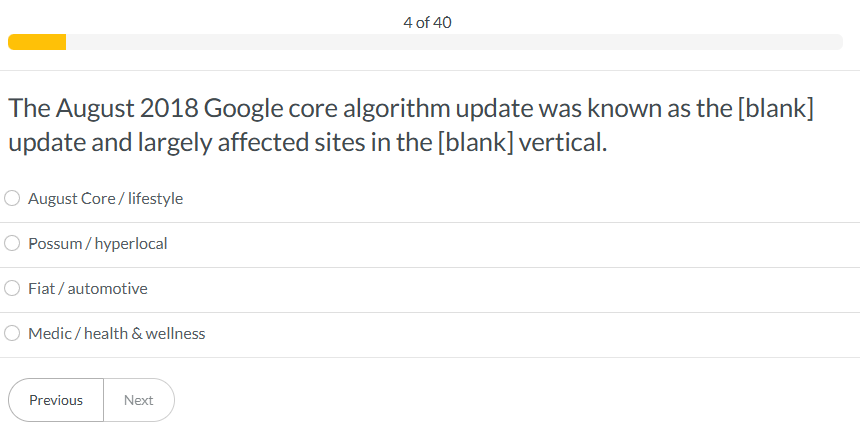
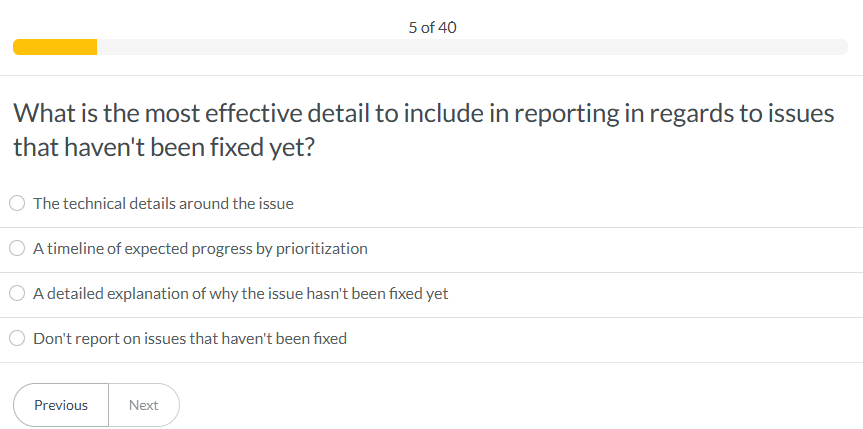
And more….
Reading Your Results
Don’t obsess over the number. The shape of your answers says more.
If you landed in beginner territory, you know the words but haven’t used them much. Get the crawl, index, rank loop firmly in your head, then practice on a real page. A throwaway site works. Watching your own page get indexed (or stubbornly refuse) teaches more than ten articles.
Intermediate means you get the big picture and trip on details. Find your weakest category and camp there for a week. Audit a site you actually care about, preferably your own, and learn your way around Google Search Console.
Advanced? Nice. Your enemy now is autopilot. Read Google’s Search Central docs, skim the update notes when they land, and try teaching something to a colleague. If you can’t explain it simply, you don’t know it as well as you think.
And then there’s the lopsided result, probably the most common one. Great at content, weak on technical. Or the reverse. Resist averaging yourself out. Fix the low spot first, retake the quiz in a month or two, and see what moved.
Free resources worth your time: Moz’s Beginner’s Guide to SEO and Google’s own documentation.
A Four-Week Plan, If You Want One
- Week one: take your weakest topic and read only the official docs on it.
- Week two: use what you learned on a real page. Rewrite a title tag. Fix an internal link that goes nowhere. Check whether your best pages are actually indexed (you might be surprised).
- Week three: pull up two or three sites that outrank you and look at how they handle the same topic.
- Week four: retake the quiz.
Not glamorous. But a little practice spread out beats a weekend cram session, mostly because you remember what you actually did.
Three Mistakes Quizzes Keep Catching
A few wrong answers show up again and again.
Meta descriptions and rankings, for one. Plenty of people still think they boost rankings. Google says they don’t, at least not directly. They do affect whether people click, so keep writing them, just stop expecting magic.
Then there’s the “more links, better rankings” idea. One link from a site that’s relevant and respected can be worth more than a whole pile of junk. Quality, context, relevance.
And the most important one: looking at SEO as an ongoing project. Rivals keep writing, algorithms continue to change, users keep changing their requirements. Companies that see SEO as an ongoing maintenance routine survive the ones that did one huge cleaning up and then disappeared.
Quiz Trends in 2026
Quizzes are everywhere in marketing now. Brands use them to teach visitors something, qualify leads, and personalize offers, all without a long form or a sales call.
The reason is simple. Visitors get a quick, personal answer, and you get data about them. A SEO quiz is one of the easiest ones to start with, because the results feed straight into your targeting and messaging.
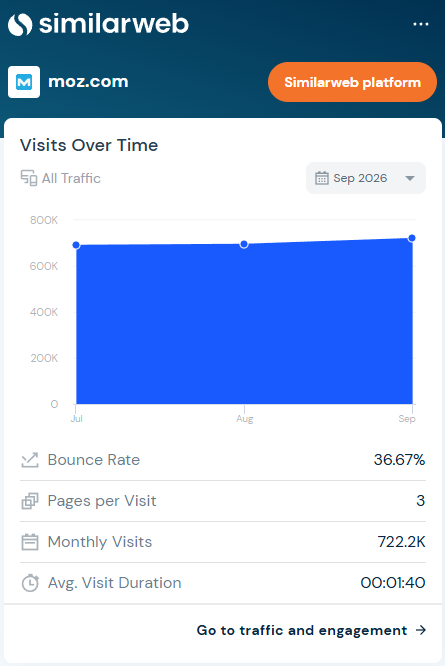
According to Similarweb, Moz, the home of the SEO Expert Quiz, drew 722,215 visits worldwide in September 2026, up 3.65% from the month before. US traffic climbed 15% month over month.
Visitors stick around, too: about 3 pages per visit, an average visit of 1 minute 40 seconds, and a bounce rate of just 36.67%. Desktop makes up 70.20% of visits, so most people are settling in for real study sessions.
How to Build Your Own SEO Quiz with Outgrow
Taking a quiz is one thing. Putting one on your own site is where it gets interesting. Run an agency? Teach marketing? Sell software or write a blog about search? Building your own SEO quiz does more than test people. It fills your pipeline.
A visitor spends five minutes answering questions about themselves, gets a result that feels personal, and happily hands over an email address to see it. Compare that with a newsletter pop-up. Not even close.
Outgrow is no-code, so you won’t be waiting on a developer.
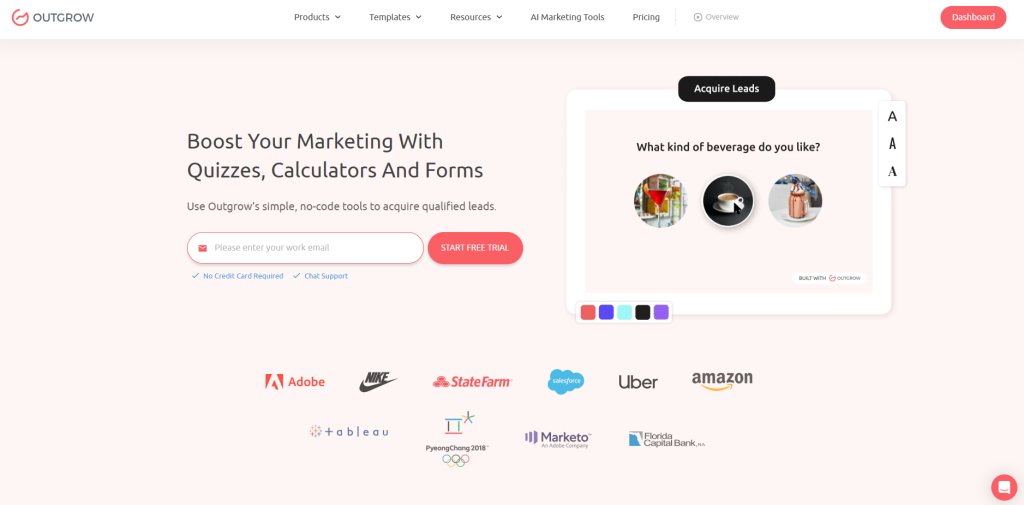
- Sign up or log in to Outgrow.
- Pick a format. A quiz or an assessment, starting from a template or a blank page- your call.
- Decide on result levels. Beginner, Intermediate, and Advanced work fine, or score by skill area: technical, content, links.
- Write 15 to 20 questions. Mix basics and scenarios, one idea per question. Make the wrong answers tempting, since obvious ones teach nobody anything. Add a one-line explanation for each answer if you can.
- Set up scoring. Map the outcomes. Every result should send people somewhere: a guide, a service page, a booking link.
- Plug in your tools: Mailchimp or Klaviyo for email, HubSpot or Salesforce for your CRM.
- Launch, then check the analytics. Where do people bail? Which result comes up most? Fix the weak questions based on what people actually do, not what you assumed they’d do.
Why This Format Works for Lead Generation
People like hearing about themselves. A quiz turns what would be a boring form into a small game. A good SEO quiz never feels like a pitch, yet you end up knowing exactly where each visitor stands. Beginners need a different follow-up than advanced folks, and you’ll know which is which before you’ve written a single email.
Bonus: the results double as market research. If most people tank the technical questions, that’s your next blog post, webinar, or paid service. You didn’t have to commission a survey.
Final Thoughts
An SEO quiz shouldn’t just stick a label on your audience. What you want is a clear picture of what your visitors know, what they’re missing, and how to talk to them without sounding like a script.
So stop guessing. Take the Moz test, or build your own with Outgrow, and turn audience insight into growth.
Ready to see the platform in action? Start your 7-day free Outgrow trial and build your first quiz today.
Frequently Asked Questions
Think snapshot, not verdict. How honest you are matters a lot, and SEO has plenty of gray areas, so use the score as a starting point.
Every two or three months works, plus after any big Google update. Much more often and you’re just memorizing the questions.
No. It tells you what to study. The studying is still on you.
Fifteen to twenty. Short ones get finished more often, and a progress bar helps people see the end.

Sakshi is a digital marketing enthusiast passionate about connecting brands with audiences. With a background in content strategy and social media, she loves turning trends into actionable strategies. Outside of work, you’ll find her reading a book or hunting for the perfect cup of coffee.