Summarize with :
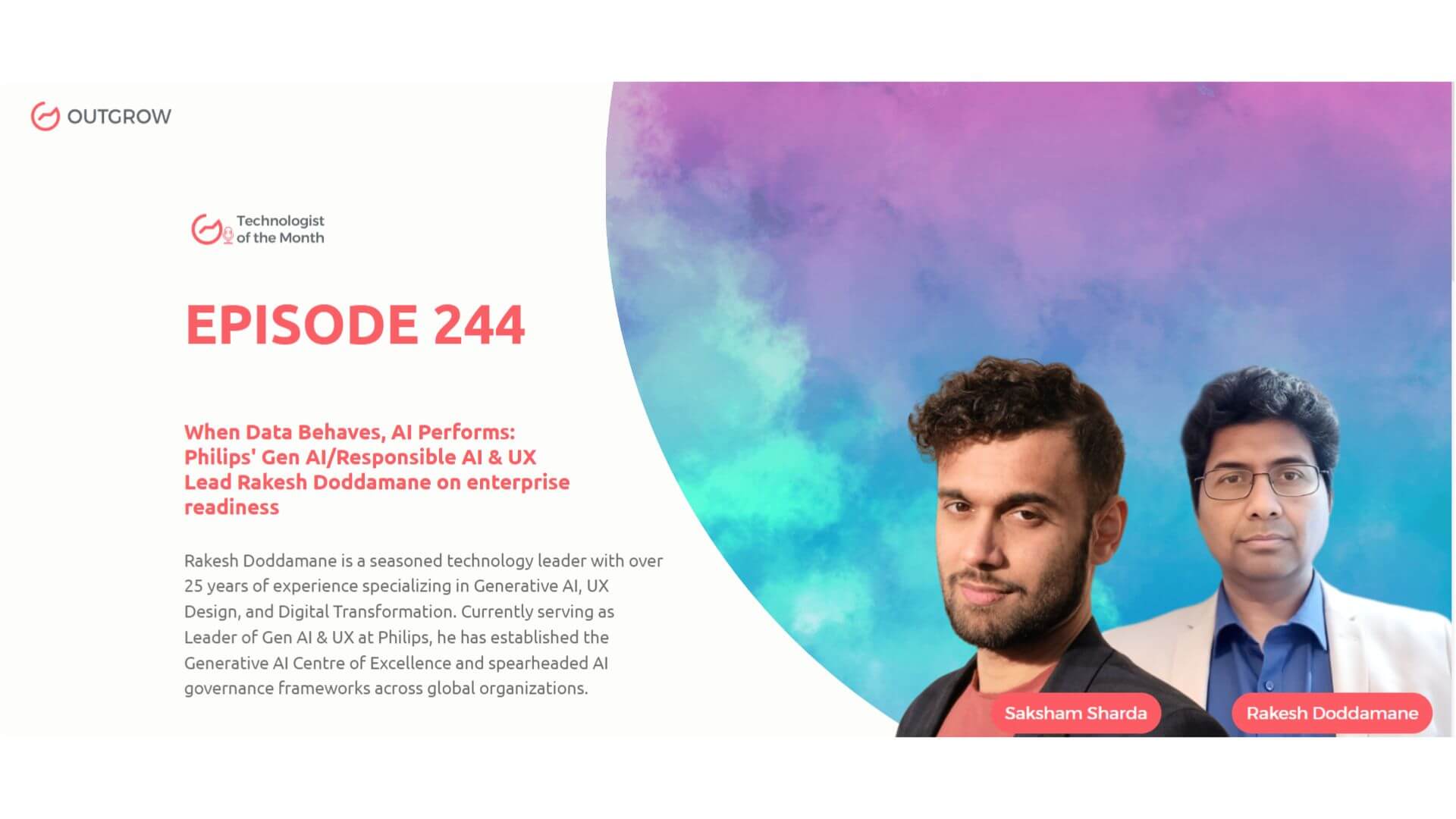
EPISODE 244: Marketer of the Month Podcast with Rakesh Doddamane
Table of Contents
Hey there! Welcome to the Marketer Of The Month blog!
We recently interviewed Rakesh Doddamane for our monthly podcast – ‘Marketer of the Month’! We had some amazing, insightful conversations with Rakesh, and here’s what we discussed about-
1. Value-driven approach to scaling generative AI solutions
2. Strategic AI investments across Philips’ business functions
3. Cloud infrastructure governance and cost optimization frameworks
4. Gen AI Ninja Certification: three-tier upskilling program
5. Customer insights leveraging AI for product innovation
6. Future of autonomous agents and orchestration governance
7. Navigating EU AI Act compliance in regulated industries
About our host:
Dr. Saksham Sharda is the Chief Information Officer at Outgrow.co He specializes in data collection, analysis, filtering, and transfer by means of widgets and applets. Interactive, cultural, and trending widgets designed by him have been featured on TrendHunter, Alibaba, ProductHunt, New York Marketing Association, FactoryBerlin, Digimarcon Silicon Valley, and at The European Affiliate Summit.
About our guest:
Rakesh Doddamane is a seasoned technology leader with over 25 years of experience specializing in Generative AI, UX Design, and Digital Transformation. Currently serving as Leader of Gen AI & UX at Philips, he has established the Generative AI Centre of Excellence and spearheaded AI governance frameworks across global organizations.
When Data Behaves, AI Performs: Philips’ Gen AI/Responsible AI & UX Lead Rakesh Doddamane on enterprise readiness
The Intro!
Saksham Sharda: Hi, everyone. Welcome to another episode of Outgrow’s Marketer of the Month. I’m your host, Dr. Saksham Sharda, and I’m the creative director at Outgrow. co. And for this month, we are going to interview Rakesh Doddamane, who is the Leader of Gen AI & UX at Philips
Rakesh Doddamane: Great to be here. Thank you.
Don’t have time to read? No problem, just watch the Podcast!
Challenge yourself with this trivia about the exciting topics Rakesh Doddamane covered in the podcast.
Or you can just listen to it on Spotify!
The Rapid Fire Round!

Saksham Sharda: Alright, let’s start with the rapid-fire round. The first question is, at what age do you want to retire?
Rakesh Doddamane: Well, technically, I don’t want to retire. Right? I keep doing something right. I don’t like to be idle. Maybe once I finish my corporate job, I will start something on my own where I can contribute to something. Not decided yet. There are multiple ideas, but yes.
Saksham Sharda: How long does it take you to get ready in the mornings?
Rakesh Doddamane: Very fast. I don’t spend too much time in front of the mirror.
Saksham Sharda: Favorite color?
Rakesh Doddamane: Red.
Saksham Sharda: What time of day are you most inspired?
Rakesh Doddamane: Mornings.
Saksham Sharda: How many hours of sleep can you survive on?
Rakesh Doddamane: Six hours.
Saksham Sharda: The city in which the best kiss of your life happened?
Rakesh Doddamane: Bangalore
Saksham Sharda: Pick one. Mark Zuckerberg or Elon Musk.
Rakesh Doddamane: Elon Musk.
Saksham Sharda: How do you relax?
Rakesh Doddamane: Three books.
Saksham Sharda: How many cups of coffee do you drink per day?
Rakesh Doddamane: Three to four.
Saksham Sharda: A habit of yours that you hate
Rakesh Doddamane: Less sleep. I would say
Saksham Sharda: The most valuable skill you’ve learned in life.
Rakesh Doddamane: Be open.
Saksham Sharda: Your favorite Netflix show.
Rakesh Doddamane: I’m not a Netflix guy.
Saksham Sharda: Are you an early riser or a night af?
Rakesh Doddamane: Early riser.
Saksham Sharda: One-word description of your leadership style.
Rakesh Doddamane: You understand the person, then you lead better.
Saksham Sharda: Coffee or tea to kickstart your day.
Rakesh Doddamane: Tea.
Saksham Sharda: Top priority in your daily schedule.
Rakesh Doddamane: Look at the most urgent parts of the day.
Saksham Sharda: Ideal vacation spot for relaxation
Rakesh Doddamane: Anything with nature.
Saksham Sharda: A key factor for maintaining a work-life balance.
Rakesh Doddamane: Take breaks.
The Big Questions!

Saksham Sharda: Let’s go on to the longer questions, which you can answer with as much time and ease as you like. Many organizations struggle with scaling AI initiatives beyond pilot projects, often due to fragmented data pipelines and insufficient governance structures. What systematic approach do you recommend for successfully transitioning AI projects from proof of concept to enterprise-wide production deployment?
Rakesh Doddamane: Yeah, very interesting question. See, when the charge GBD started, right? The way I started with charge GBD, there was a burst to start exploring things, and there was a time when a lot of POCs happened, right? But as things matured, they mature similarly with our own organization also, when we started maturing on things, we started the journey now with looking at value that where is the value now? Start with that process and then look at building or scaling the solutions beyond that part, right? So what is the first important part? Look at the value and then start scaling them, right? We have created an intake process where we start identifying the ROIs from the value perspective, what it delivers, and focus on those use cases.
Saksham Sharda: And what are the most common governance gaps you have observed that prevent AI pilots from scaling?
Rakesh Doddamane: The important gap, I would say, is not really understanding the technology, what value it can bring. It starts with that, right? Because this is a technology that is rapidly evolving, and having no good understanding of where it delivers value, how it delivers value is the starting point. I think the literacy levels of AI need to increase with that, then people can understand where the value comes from, and then use them to scale the solutions.
Saksham Sharda: With generative AI transforming multiple business functions, where do you see the biggest value creation opportunities for enterprises? And how has your experience at Philips shaped your perspective on prioritizing gen AI investments?
Rakesh Doddamane: The value comes pretty much in every area because obviously, if you look at wherever there is data, there is AI, right? You can leverage AI wherever there’s data. So the scaling starts from looking at the processes where you can involve AI, right? We kind of do a value mapping pro propositions. We look at the data of each of those processes and then start scaling those, leveraging AI there. That’s what we do at Philips, right? The main important element is to start looking at the data silos. Where earlier in the traditional way we were not engaging the data, but now with AI, the capabilities available to you start looking at the whole value chain, right? Where AI can infuse, there are some areas where probably AI is not the solution, but wherever there’s data, there’s always a possibility that AI can be involved either to streamline the process or improve the process.
Saksham Sharda: And what criteria do you use to determine which business processes are most suitable for gen AI transformation versus traditional automation?
Rakesh Doddamane: Again, as I said, gen AI is not the solution for everything, right? We need to really look at the process bottlenecks. What are the challenges that you have in the processes, right? Start from there. Wherever there is an initiative where you can automate by simple, you know, poor automate structures, right? Go for that. Don’t use AI because AI is expensive. And look at solutions where AI really makes sense from an RI standpoint, right? It is there. You need to make investments means
Saksham Sharda: The synergy between cloud infrastructure and AI capabilities is crucial, yet cloud costs can spiral quickly with AI workloads. How do you establish governance frameworks that optimize this synergy while maintaining cost control?
Rakesh Doddamane: Costs are crucial, right? AI, as I said, is expensive if you don’t do it right. What we have done within Philips is we have created what we call a foundation Gen I foundation, which is a framework to, you know, optimize the cloud cost. Right now, we use the shared model where when somebody wants to develop an AI solution, they come to the foundation and leverage the cross-functional capabilities that bring stability, which is also secure, thereby reducing the overlapping costs, right? That’s how we have started the journey. Again, we are looking at a lot more things now in the future, where we bring an agent setup and all of that to drive the cost factor.
Saksham Sharda: So there’s a fundamental principle. “AI is only as good as the data” is a fundamental principle. Based on your experience building AI infrastructure at Philips, what comprehensive approach do you recommend for preparing and maintaining enterprise data assets for AI readiness?
Rakesh Doddamane: When it comes to AI, data is a strategic asset, right? We need to start looking at data. Where are the silos in the whole value chain process where we can leverage AI and look at not only just using the existing data, but curating it to meet the AI needs, right? Because structured data, unstructured data, the semi-structured data, all of these are important elements to distinguish when you use AI. AI is strong with unstructured data when it comes to no sorry non-structured data. But when it comes to the unstructured data, right, there’s where I think we need to really look at, right? Which is a huge potential.
Saksham Sharda: And what data quality standards and validation processes are essential before feeding data into AI models, especially in regulated industries?
Rakesh Doddamane: Yeah. We at Philips are in a regulated industry in the health tech domain. So there are a lot of laws which govern the use of AI, especially if you look at the most recent one is the EUA act, which is already in place. So having a very kind of neat, responsible AI framework is crucial to that. We at Philips have established a setup where we have eight governing principles, which drive the responsible air framework, which includes looking at biases, looking at responsibilities, looking at observative, transparency, et cetera, all of that.
Saksham Sharda: And one of the biggest organizational challenges is addressing employee fears that AI will replace human workers. How are you fostering successful human AI collaboration models that demonstrate AI as an augmentation tool rather than a replacement threat?
Rakesh Doddamane: Yeah, that’s a very crucial part of the journey that we have started in Phillips. We have all the best tools that are in the market, whether it’s Copilot, whether it is Charge GD enterprise edition, or other tools. We also have a homegrown charge, GPD, as well. So we have empowered our employees with all of these tools. The primary intent there is to enable them to learn AI, use it for the, you know, their own personal productivity, also from other areas where it’ll benefit them, so that the fear of being left out or leaving out is not there to start with. But then, not only that, they also contribute towards the larger AI journey that the organization is moving towards.
Saksham Sharda: And so AI implementations require significant investment in infrastructure, talent, and technology. How do you establish meaningful ROI measurement frameworks for AI initiatives, and what metrics have proven most valuable in demonstrating business impact at Phillips?
Rakesh Doddamane: Very important question. As I mentioned earlier, if you don’t leverage AI, well, it is going to be very expensive. So the journey starts from the right, from the demand intake process, which we call looking at the value proposition from the beginning. Now, if you’re going to invest a certain amount into this process, what value are you gonna derive out of it? Whether it is the speed of implementation, or whether it is the data now, which is also a crucial part of the whole AI journey. You need to look at each element to see what it’ll return to you, and then scale those solutions, right? Do look at each and every element of the whole value chain process, right? Whether it is also on the literacy side, there is also RO out there, whether it is scaling a chatbot solution, then look at the ROI, what are you taking out to bring in this process, which is going to help you improve the ROI I think that’s where it starts. But in addition to all of this, I think the crucial part is looking at doing it in a very responsible way that also has an element of cost to that. So you bake all of this into your whole value chain process. That is how you approach it.
Saksham Sharda: And what approach do you take when AI projects show strong qualitative benefits, but struggle to demonstrate quantifiable financial returns?
Rakesh Doddamane: Yeah, as I said, you start with the value chain process, right? You look at the returns, what you are intending to get out of it right now, obviously, there are certain areas in the initial period of time where there might not be written. But from a long-term perspective, you still have a focus plan where you extend that, and you know, you’ll be able to get the returns. So if your plan is clean, your plan is robust, then I think you can easily make those, you know, ROI distinctions
Saksham Sharda: Looking towards the next frontier of AI innovation, from autonomous agents to multimodal AI systems, how is your organization preparing for these emerging capabilities while maintaining current operational excellence?
Rakesh Doddamane: Our journey started when it came into picture, when we started with initial POCs or small chatbots, and all of that. But if you look at what the industry is moving towards, there’s a rapid change. Rapid new things coming into the picture to catch them is very, very difficult. But then we started our journey in a small place. We have now started looking at agent frameworks. We are also locking into the data improvement initiatives, again, which is also crucial, right? We are taking baby steps there, but considering where the industry is moving, there’s an element of big governance steps that needs to be taken because while you’re catching up on the technology side, you also need to catch up on the regulation side, right? So that is the challenge that we are trying to address. How do we catch up with the technology, along with being responsible as well, right? So somewhere we need to balance that. But yeah, we are going step by step there so that we don’t end up in a situation where we are left behind from a technology standpoint, but also we are also governed well from a regulatory standpoint.
Saksham Sharda: From a user experience perspective, how can marketing teams leverage generative AI to create more personalized and engaging customer journeys without compromising privacy or appearing intrusive?
Rakesh Doddamane: Yeah. One of the important initiatives that we’ve taken is to leverage AI in the customer journey, right? We have built a tool for using the consumer insights journey of the innovation process of our product development, right? We get the feedback from customers, how we as a company are faring with our products, how they are faring, et cetera. That huge amount of feedback that is available in the public forums is leveraged. We feed that into our AI systems, which then drives the innovation process of what our products have to improve upon or what are the new products that we are supposed to, you know, build. I think that’s the crucial part that we’re leveraging AI for. Now, that’s one part of the journey. But then also when it comes to marketing, content marketing, no presentations or marketing drives, all of that. AI is also infused there.
Saksham Sharda: And what ethical boundaries should marketers establish when using AI to analyze customer behavior and preferences?
Rakesh Doddamane: Yeah, as I mentioned already, responsible AI is a very important element, whether it’s brand reputation in place, or whether it is your legal compliance requirements everywhere, it’s a crucial element. So we have established a responsibility framework, which not only drives the technology angle, what needs to be done to meet the compliance angle, but more from also looks at the reputation of the company as well. What needs to be done, how we release products that are not harmful to the end customers who use our products.
Saksham Sharda: You’ve established upskilling programs like the “Gen AI Ninja Certification.” What key competencies should professionals develop to remain relevant in an AI-driven workplace?
Rakesh Doddamane: Yeah, that’s very crucial. Employees, as you already touched upon, saying that the fear of not catching up or no AI replacing jobs, I think that’s a crucial element to address within our organization. And towards that goal, we started an issue called certification, which is basically nothing but empowering the employees to embrace AI so that they can be part of the journey and not be fearful of AI taking our jobs or no AI impacting them. This journey has been very, very successful because, you know, close to half of the population has been enabled on this certification program, and a lot more are in the journey. We have launched three levels, starting at the beginner level, which is the basic program, then at the mid-intermediate level, which we call as yellow belt. And then a green belt, which is the highest level, is pure technology-driven. So in this journey, we are bringing in the feedback, what is, you know, given by the employees and continuously feeding into the process to improve the latest and the greatest that is coming in the technologies.
Saksham Sharda: So what does your typical day at Phillips look like? You wake up in the morning and then
Rakesh Doddamane: Yep, wake up in the morning, look at my calendar. What are the important steps to be done today, and accomplished today? Get ready, go to the office. Work through those schedules that I have prioritized. Look at what is all done? Email responses. Obviously, that’s part of the whole day program. And in the end, see if I achieved what I did for the plan for the day,
Saksham Sharda: And how much of your time is taken up in meetings?
Rakesh Doddamane: A lot of time, I would say.
Saksham Sharda: How can marketing leaders use AI to better understand and predict customer behavior while maintaining ethical data user practices and building customer trust?
Rakesh Doddamane: Trust is an important factor. If you look at where the market is setting, there’s a lot of talk on AI happening, but there’s also a lot of talk of whether AI is reliable, right? While it brings in a lot of benefits, it is on our side to bring the element of trust into the solutions that we are building, and how do we achieve that? You know, we make the solutions very clean. When I say clean, it means that when somebody uses the solution, they should clearly understand how it works, what steps it takes to arrive at a decision, for example, or what are the, you know, important elements that it uses to come up with a solution, right? You give the sources of the solution, and what it gives you. These are some of the important steps when it comes to, you know, building that trust. Now, without that, obviously, it is always difficult to, you know, get the trust of the customers, right? So you need to bake in all of these elements, which builds the confidence of the customers or the consumers, right? Especially in the medical domain, there are regulations for that. But then there’s also a repetition at stake here, right? So these are very important steps when you’re building an AI solution.
Saksham Sharda: Looking towards the future, then, what emerging trends in AI governance and responsible AI do you believe will become critical for organizations to address in the next five years?
Rakesh Doddamane: Yeah, one, I think if you look at where the technology’s heading now, agents are going to play a very big role in how you work in an organization, right? So the important element now is how do you govern these agents, right? You have to build a framework where you allow the technology to be used, right? But we also need to build the governance around the agent setup, right? Agent frameworks, agent orchestration. Also, looking at the responsible element of the AI orchestration is important, right? Technology is going to change a lot, but then catching up from a governance stand also is going to be equally important because trust, as I mentioned already, is a crucial factor. If you are not trusted with using AI, then obviously, whatever solution you put in place is not going to work, right? So yes, this is one great area that I think everybody, not only Phillips as such, will have to be really focusing on.
Saksham Sharda: And what new ethical considerations might emerge as AI systems become more autonomous and capable?
Rakesh Doddamane: Yeah. Obviously, as I mentioned, right, more and more autonomous AI is going to bring those additional challenges. Do we really trust it right now? How do we give the transparency of how the AI is behaving is going to be crucial, right? How do you give out the usage when it comes, and no, you are going to use it? It should be clear and transparent to you, saying that no, this is what the AI is doing to you. And I think the most important part is upfront, being that no, it is an AI, right? That starts the journey of being, you know, trustful here, right? The journey starts when it starts using AI, then you build those solutions, you build those transparency elements so that the solution is clean when it comes to the customer user, and it’s easily usable for the user, right? So I would say that’s where the journey starts. Build the trust upfront, saying that I’m using AI to give you a solution, but then this is how I’m using AI so that the solution is clean for you.
Saksham Sharda: The last question for you is of a personal kind: what would you be doing in your life, if not this?
Rakesh Doddamane: I think I will be doing agriculture. I come from an agricultural background. My family comes from an agricultural background. That’s something that I still love in my free time. So probably I’ll go back to that.
Let’s Conclude!
Saksham Sharda: Thanks, everyone for joining us for this month’s episode of Outgrow’s Marketer of the Month. That was Rakesh Doddamane, who is the Leader of Gen AI & UX at Philips
Rakesh Doddamane: Great to be here. Thank you.
Saksham Sharda: Check out the website for more details, and we’ll see you once again next month with another marketer of the month.

I am a Digital Marketing Enthusiast with a passion for optimizing content and paid marketing strategies. Continuously seeking innovative approaches to boost ROI and engagement at Outgrow.