Basal Metabolic Rate (BMR) Calculator: Calculate Your BMR Instantly
Your body burns calories every second of every day, even while you sleep. Most people have no idea what that number actually is, which means most diet plans, calorie targets, and fitness goals are built on guesswork instead of data.
A BMR calculator fixes that. In under a minute, it tells you exactly how many calories your body needs just to keep your heart beating, your lungs breathing, and your cells repairing themselves, before you factor in a single workout or meal. Research shows this resting calorie burn accounts for roughly 60 to 75 percent of the total calories most adults use in a day, making it the single most important number in any nutrition or weight management plan.
This guide breaks down everything you need to know: what BMR actually means, the exact formulas used to calculate it, how it differs from your total daily calorie needs, what affects it, and how to raise it naturally. If you run a fitness, wellness, or health brand, we’ll also show you how to turn this into an interactive, lead-generating BMR calculator using Outgrow, no coding required.
What Is a BMR Calculator?
Table of Contents
What does BMR mean?
BMR stands for Basal Metabolic Rate, the number of calories your body needs to carry out its most basic functions while completely at rest: breathing, circulating blood, regulating temperature, and keeping your organs and brain running.
What does a BMR calculator do?
A BMR calculator takes a few simple inputs, typically your age, gender, height, and weight, and runs them through a validated scientific formula to instantly estimate your resting calorie burn. It replaces manual math with a personalized number in seconds.
Why your BMR matters
Your BMR is the foundation of every calorie target you’ll ever set. Whether the goal is fat loss, muscle gain, or maintenance, it all starts with knowing your baseline. Get this number wrong, and every calorie plan built on top of it will be wrong too.
Calculate Your Basal Metabolic Rate (Interactive BMR Calculator)
Enter your age, weight, height, and gender
To calculate your BMR, you only need four data points: your age, biological sex, height, and current weight. That’s it. No blood tests, no lab visits, no equipment.
Get your BMR instantly
Once entered, the calculator applies a formula such as Mifflin-St Jeor and returns your estimated resting calorie burn immediately, giving you a real number instead of a rough guess.
Understand your personalized results
A good BMR calculator doesn’t just show a number. It explains what that number means, how it compares to typical ranges for your age and gender, and what to do with it next, such as calculating your total daily calorie needs.
What Is Basal Metabolic Rate (BMR)?
Basal Metabolic Rate is the minimum amount of energy, measured in calories, your body needs to sustain life while at complete rest. It’s measured under strict conditions: after 12 to 14 hours without food, in a temperature-neutral room, and in a calm, awake state.
How your body burns calories at rest
Even lying still, your body is working. Your heart pumps roughly 2,000 gallons of blood a day, your brain consumes a significant share of your resting energy, and your cells are constantly repairing and regenerating tissue. All of that requires fuel, and BMR is the measure of exactly how much.
BMR vs resting metabolism
Basal Metabolic Rate (BMR) and Resting Metabolic Rate (RMR) are often used interchangeably, but they’re not identical. Unlike RMR, BMR is measured under strict laboratory conditions. Resting Metabolic Rate, on the other hand, is a slightly less rigid estimate of calories burned at rest that includes minimal digestion and movement. In everyday use, most calculators (including consumer BMR calculators) actually estimate something closer to RMR, since true lab-grade BMR testing isn’t practical for most people.
How to Calculate BMR
Mifflin-St Jeor Equation
Considered the most accurate formula for the general population and the current standard used by most dietitians and calculators:
- Men: BMR = (10 x weight in kg) + (6.25 x height in cm) – (5 x age in years) + 5
- Women: BMR = (10 x weight in kg) + (6.25 x height in cm) – (5 x age in years) – 161
Harris-Benedict Formula
An older equation, originally developed in 1919 and revised in 1984:
- Men: BMR = 88.362 + (13.397 x weight in kg) + (4.799 x height in cm) – (5.677 x age in years)
- Women: BMR = 447.593 + (9.247 x weight in kg) + (3.098 x height in cm) – (4.330 x age in years)
Katch-McArdle Formula
Best suited for people who know their body fat percentage, since it calculates BMR from lean body mass rather than total weight:
- BMR = 370 + (21.6 x lean body mass in kg)
Which BMR formula is most accurate?
Studies and clinical resources generally point to Mifflin-St Jeor as the more reliable formula for most adults, largely because it was developed using more modern population data than the century-old Harris-Benedict equation. Katch-McArdle can outperform both, but only when an accurate body fat percentage is available, which most calculator users don’t have on hand.
BMR Formula for Men and Women
BMR formula for males
Using Mifflin-St Jeor: BMR = (10 x weight in kg) + (6.25 x height in cm) – (5 x age) + 5
BMR formula for females
Using Mifflin-St Jeor: BMR = (10 x weight in kg) + (6.25 x height in cm) – (5 x age) – 161
Example calculations
Take a 30-year-old man who weighs 80 kg and is 178 cm tall: BMR = (10 x 80) + (6.25 x 178) – (5 x 30) + 5 = 800 + 1,112.5 – 150 + 5 = 1,767.5 calories/day
Now take a 30-year-old woman who weighs 65 kg and is 165 cm tall: BMR = (10 x 65) + (6.25 x 165) – (5 x 30) – 161 = 650 + 1,031.25 – 150 – 161 = 1,370.25 calories/day
These figures land close to national averages. Data shows the average man has a BMR of around 1,696 calories per day, while the average woman’s BMR sits closer to 1,410 calories per day.
BMR vs TDEE: What’s the Difference?
What is Total Daily Energy Expenditure?
TDEE (Total Daily Energy Expenditure) is your BMR plus all the additional calories you burn through movement, exercise, and digesting food. It’s calculated by multiplying your BMR by an activity multiplier, typically ranging from 1.2 (sedentary) to 1.9 (extremely active).
Why BMR isn’t your daily calorie requirement
BMR only reflects the calories your body burns at total rest. It does not include walking, working out, fidgeting, or even the energy required to digest your meals. Using BMR alone as a daily calorie target will almost always underestimate what your body actually needs.
When to use each metric
Use your BMR to understand your baseline metabolism. Use your TDEE to actually plan your daily calorie intake, whether the goal is fat loss, maintenance, or muscle gain. For weight loss, the general approach is eating fewer calories than your TDEE to create a deficit; for maintenance, eating close to your TDEE; and for weight gain, eating above it.
How Many Calories Should You Eat Based on Your BMR?
Weight loss calories
A moderate, sustainable deficit typically falls between 500 and 750 calories below TDEE per day, which generally supports a loss of about 0.5 to 1 kg (1 to 2 lbs) per week.
Weight maintenance calories
Eating at or near your calculated TDEE keeps your weight stable over time.
Muscle gain calories
A modest surplus of 250 to 500 calories above TDEE, paired with resistance training, supports lean muscle gain without excessive fat accumulation.
Activity multipliers explained
| Activity Level | Description | Multiplier |
| Sedentary | Little to no exercise | 1.2 |
| Lightly active | Light exercise 1 to 3 days/week | 1.375 |
| Moderately active | Moderate exercise 3 to 5 days/week | 1.55 |
| Very active | Hard exercise 6 to 7 days/week | 1.725 |
| Extremely active | Physical job or twice daily training | 1.9 |
Factors That Affect Your BMR
Age
BMR and age move in opposite directions. As people get older, they typically carry less muscle mass, which causes BMR to decline over time. In practical terms, resting calorie burn can drop by roughly 1 to 2 percent per decade after early adulthood.
Gender
Men generally have more muscle mass and greater height than women on average, which results in a higher BMR.
Muscle mass
Muscle tissue requires significantly more energy to maintain than fat tissue, so people with more muscle mass have a higher BMR. This is one of the few BMR factors you can actively influence.
Height
People with a larger body surface area, meaning taller and leaner frames, tend to have a higher BMR, while shorter individuals carrying more weight tend to have a lower one.
Weight
Heavier bodies generally require more energy to maintain basic function, though the relationship is more nuanced than weight alone since body composition matters more than the number on the scale.
Genetics
Some people are simply born with a faster or slower resting metabolism, independent of lifestyle, due to inherited variations in cellular efficiency and thyroid function.
Hormones
Thyroid function, insulin sensitivity, and hormonal shifts such as menopause can all influence BMR. Menopause in particular tends to reduce lean muscle mass, which typically lowers BMR.
How to Increase Your BMR Naturally
Strength training
Building muscle is the most direct, evidence-backed way to raise your resting calorie burn, since muscle tissue demands more energy around the clock than fat tissue does.
Protein intake
Protein has a higher thermic effect than fats or carbohydrates, meaning your body burns more calories digesting it. It also supports the muscle mass that drives BMR up in the first place.
Sleep
Poor sleep disrupts the hormones that regulate metabolism and appetite. Consistently getting 7 to 9 hours supports a healthier resting metabolic rate.
Hydration
Your body needs water for nearly every metabolic process. Even mild dehydration can slow down metabolic efficiency.
Daily movement
Beyond structured workouts, everyday activity like walking, standing, and household tasks (often called NEAT, or Non-Exercise Activity Thermogenesis) adds up and supports a more active metabolism over time.
Is Your BMR Healthy?
Average BMR ranges
Typical resting calorie burn for an average-sized adult ranges from around 1,450 to over 2,000 calories a day depending on age, with younger adults generally burning more at rest than older adults. On average, adult women fall between 1,400 and 1,500 calories a day, while adult men fall between 1,600 and 1,800 calories a day.
Low BMR
Research on BMR distribution suggests roughly 1 in 5 women fall below 1,200 calories a day and roughly 1 in 5 men fall above 2,200 calories a day, showing that the “normal” range is wider than most people assume. A BMR that seems unusually low could point to reduced muscle mass, an underactive thyroid, or a history of extreme dieting.
High BMR
A higher than average BMR is often linked to greater muscle mass, larger body size, or an overactive thyroid.
When to consult a healthcare professional
If your BMR seems significantly outside the typical range for your age and gender, or if you’re experiencing unexplained weight changes, fatigue, or appetite shifts, it’s worth speaking with a doctor or registered dietitian rather than relying on a calculator alone.
Common Mistakes When Using a BMR Calculator
Confusing BMR with calories burned
BMR is not the total number of calories you burn in a day. It excludes activity, exercise, and digestion entirely. Treating it as your full daily calorie budget almost always leads to under-eating.
Incorrect measurements
Small errors in height or weight input, especially when converting between units, can meaningfully skew results. Always double-check kg/lbs and cm/inches conversions.
Ignoring activity level
Using BMR alone to plan meals, without layering in an activity multiplier to get TDEE, is one of the most common and most consequential mistakes people make.
Using outdated formulas
The original 1919 Harris-Benedict equation tends to overestimate BMR compared to more modern formulas. Where possible, use Mifflin-St Jeor for a more accurate baseline.
Create Your Own BMR Calculator with Outgrow
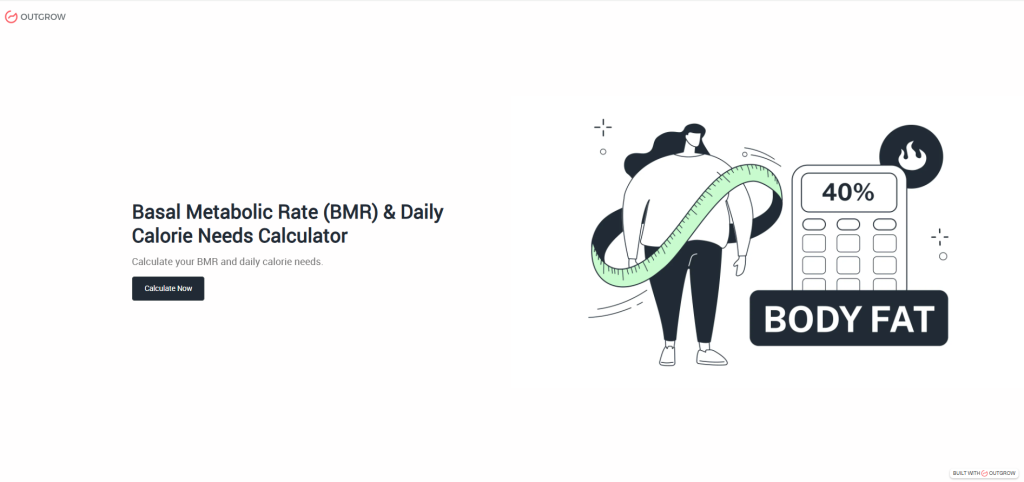
Reading about BMR is useful. Letting your audience calculate their own BMR on your website, under your brand, is what actually turns visitors into leads. Here’s how to build one on Outgrow in five simple steps, no coding required.
Step 1: Sign Up or Log In to Your Outgrow Account

Head to Outgrow and either create a free account or log in if you already have one. Once you’re in, select Calculator as your content type from the dashboard to get started.
Step 2: Select a Template
Outgrow has 1,000+ pre-built templates to make your content interactive, including several designed specifically for health, fitness, and calorie calculators. Pick one closest to a BMR calculator and use it as your starting point, or start from a blank canvas if you’d rather build the flow entirely from scratch.
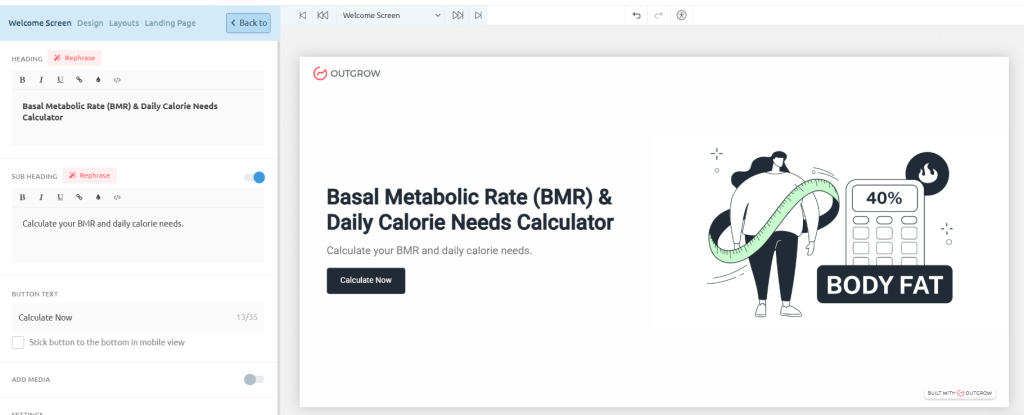
Step 3: Customize the Welcome Screen
First impressions decide whether a visitor clicks in or clicks away. Customize your welcome screen by updating the title, description, background image, and CTA button text. Something like “Find Out How Many Calories You Really Burn” paired with a “Calculate My BMR” button gives users a clear reason to start.
Step 4: Add Questions Related to Your BMR Calculator
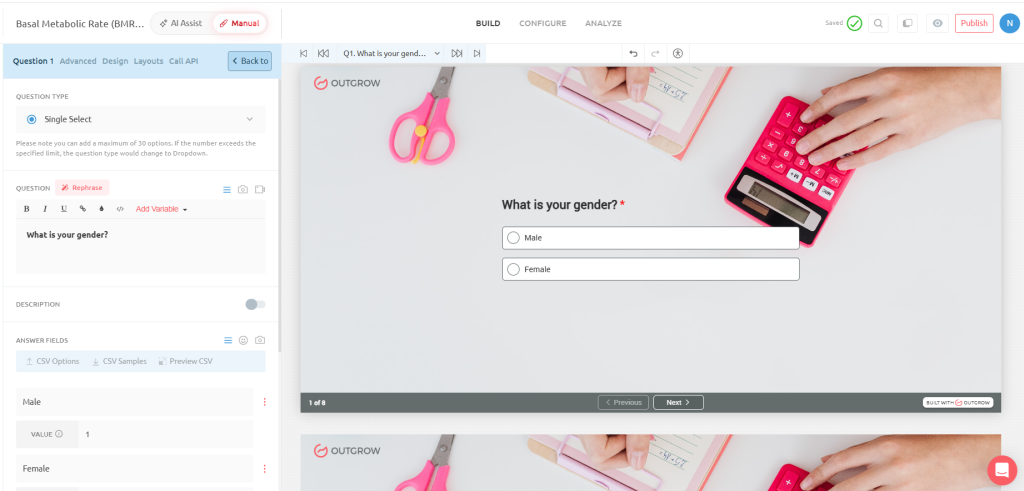
Build out your question flow using the left panel of the builder. For a BMR calculator, this typically means:
- Gender (single select)
- Age (numeric input)
- Height (numeric input, with a cm/inches toggle)
- Weight (numeric input, with a kg/lbs toggle)
- Activity level (single select, if you want to extend into TDEE)
Outgrow supports multiple input types, including sliders, single select, and numeric fields, so you can choose whichever format feels most intuitive for each question. You can also add conditional logic to personalize the flow based on how someone answers.
Step 5: Add Result Outcomes

Open the Formula Builder and map each question, age, weight, height, and gender, into the Mifflin-St Jeor equation (or your formula of choice). Once the formula is set, add the result variable so your BMR outcome displays clearly to users, along with a short explanation of what the number means. You can also layer in a second formula to calculate TDEE, add a lead capture form before or alongside the results, and customize the design to match your brand before publishing and embedding the calculator on your site.
Step 6: Embed your calculator on any website

Once published, Outgrow generates a simple embed snippet you can drop directly into any landing page, blog post, or product page. No developer is needed to get it live.
Step 7: Capture emails and integrate with your CRM

Place a lead capture form before or alongside your results to turn curious visitors into qualified leads. Outgrow connects natively with major CRM and email marketing platforms, so every completed calculator automatically syncs new leads into your existing workflow.
Start Building Your BMR Calculator Today
Understanding your Basal Metabolic Rate is the first real step toward setting calorie goals that actually work, whether that’s for you personally or for the audience your brand serves. A generic formula on a page tells people a number. An interactive calculator tells them what that number means for their life, and keeps them engaged while it does.
If you’re ready to turn this topic into a lead-generating tool for your website, you don’t need a developer or weeks of build time. Outgrow lets you go from idea to a fully branded, published BMR calculator in a single afternoon.
Start your 7-day free trial with Outgrow today. No credit card required.
Frequently Asked Questions
There’s no single “good” BMR. It depends entirely on your age, sex, height, weight, and muscle mass. A BMR is considered typical if it falls within the expected range for your demographic profile.
Not exactly. BMR is one component of your overall metabolism, specifically the resting portion. Your full metabolic rate also includes calories burned through digestion and physical activity.
Formula-based calculators are estimates, typically accurate within about 10 percent for most healthy adults. Lab-based indirect calorimetry is more precise but far less accessible.
Yes, indirectly. Your BMR helps you calculate your TDEE, and creating a calorie deficit relative to your TDEE is what drives weight loss.
BMR measures the calories your body burns at rest. BMI (Body Mass Index) measures body weight relative to height as a general screening tool. They serve completely different purposes and aren’t interchangeable.
Recalculating every few months, or after a significant change in weight, muscle mass, or age, keeps your estimate accurate.
Mifflin-St Jeor is widely regarded as the most accurate general-purpose formula. Katch-McArdle can be more precise if you know your body fat percentage.
On average, between roughly 1,400 and 1,500 calories per day, though this varies by age, height, weight, and muscle mass.
On average, between roughly 1,600 and 1,800 calories per day, with similar variation based on individual factors.

Ankit Upadhyay is a Digital Marketing and SEO Specialist at Outgrow. With a passion for driving growth through strategic content and technical SEO expertise, Ankit Upadhyay helps brands enhance their online visibility and connect with the right audience. When not optimizing websites or crafting marketing strategies, Ankit Upadhyay loves visiting new places and exploring nature.