Workplace Personality Test: How to Build One Using Outgrow
Everyone’s clicked through one of those forgettable “what’s your work style” quizzes at some point. Then, every so often, you land on one that actually sticks, where the result sounds like something a coworker would say about you rather than a vague horoscope line. That second kind is usually a well-built workplace personality test, and figuring out what it’s doing right is worth the time.
Here’s a look at why a workplace personality test is worth finishing in the first place, what a strong one actually contains once you break it down, and how to put your own together using Outgrow.
Why a Workplace Personality Test Actually Matters
Table of Contents
Most people don’t have a completely accurate read on how they show up at work. You might think of yourself as organized while your manager quietly files you under “rigid.” You might assume you communicate well, and a teammate might disagree without ever saying it out loud. A workplace personality test gives people something closer to an outside view, real patterns in how they think and act, instead of just their own self-image echoing back at them.
It works both ways too. People get clarity about their own strengths. Employers get a structured lens on fit and team dynamics. That combination is likely why this format keeps turning up across career and learning platforms.
What Is a Workplace Personality Test?
Stripped down, it’s a self-assessment built from statements about how someone thinks, works, and behaves. Rather than open-ended prompts, most run on a rating scale, agree-to-disagree, and the whole exercise only holds up if people answer honestly instead of aspirationally.

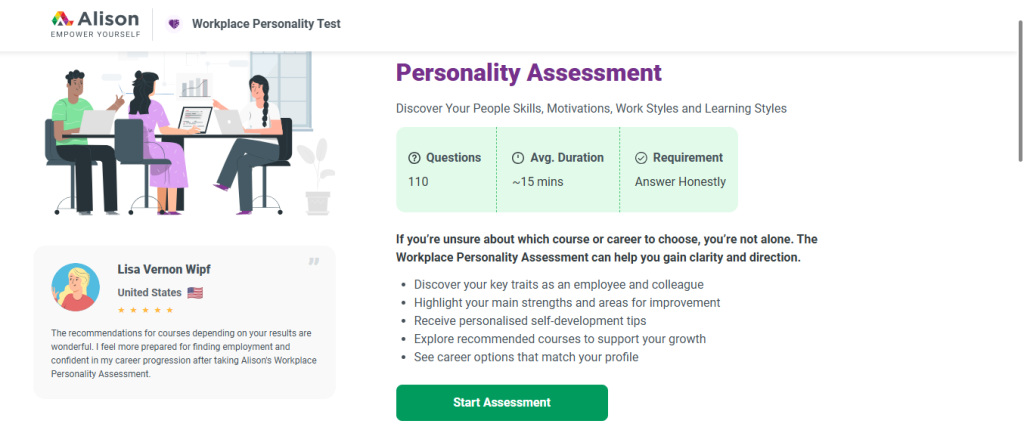
Alison’s version is a good example. Around 110 questions, taking roughly 15 minutes, one requirement stated right up front: answer honestly. That’s really the entire mechanism behind a workplace personality test worth taking. Feed it dishonest answers, get a useless result back.
Understand Yourself Better: How the Workplace Personality Test Works
There’s a fairly consistent shape to how these unfold. Here’s roughly what it looks like.
1. A Clear Welcome Screen Sets Expectations
Before questions even show up, a decent workplace personality test tells you exactly what you’re getting into: question count, time needed, and what you’ll get out of it. Something like “discover your people skills, motivations, work styles, and learning styles” sets the tone before you’ve touched a single button.
2. It Lists the Payoff Upfront
Instead of just “take this quiz,” it spells out what’s actually in it for you: key traits, strengths, areas worth improving, personalized tips, sometimes career paths that fit your results.
3. A Testimonial Builds Trust Before You Start
One genuine quote, complete with a name, location, and star rating, and suddenly people are far more willing to spend fifteen minutes instead of closing the tab.
4. One Statement at a Time, on a Simple Scale
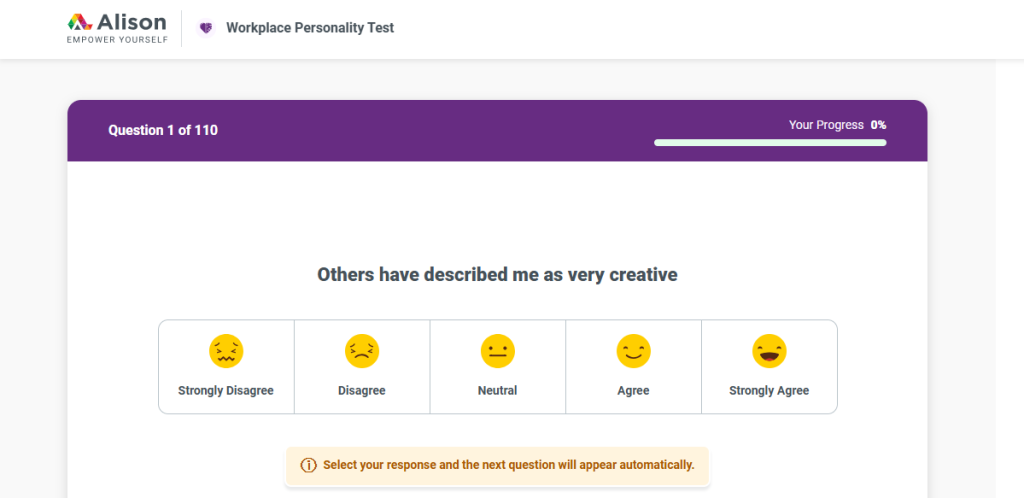
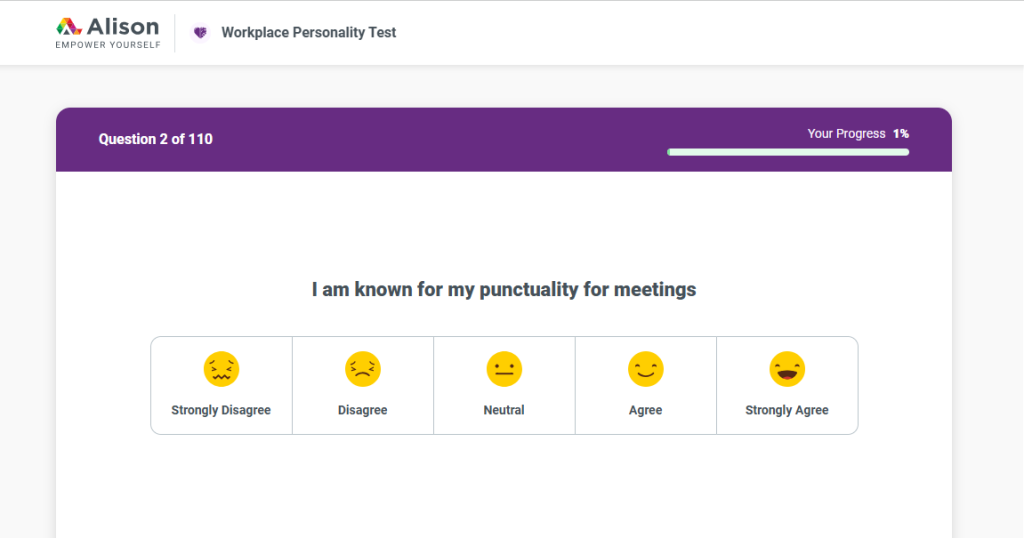
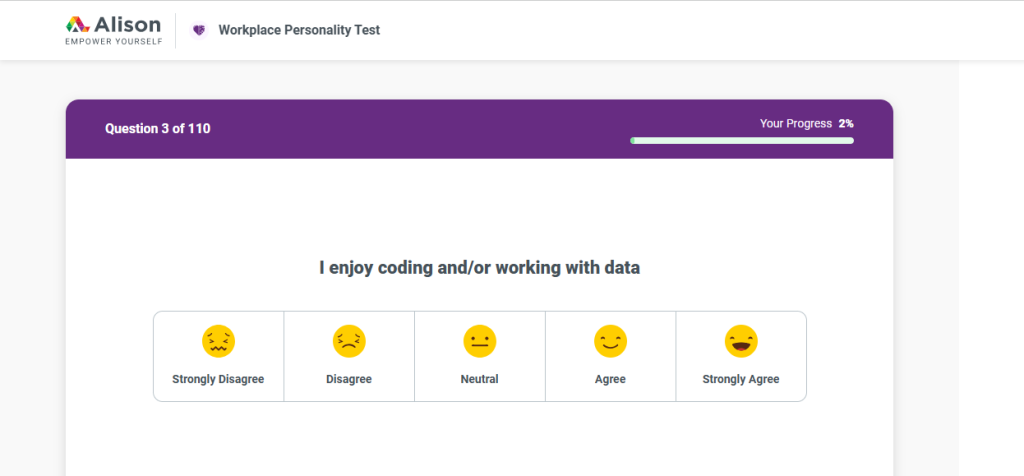
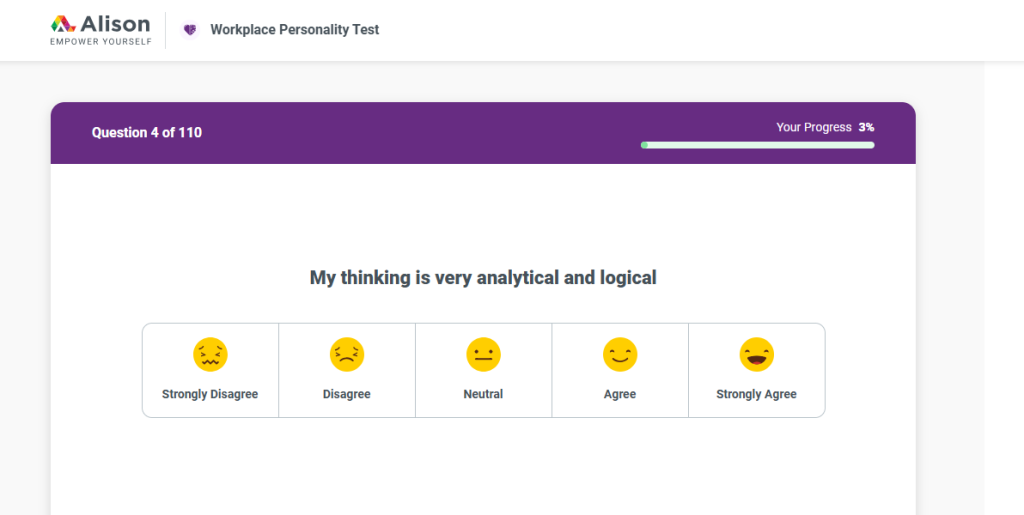
Once it begins, each screen carries a single first-person statement next to a five-point scale, ranging from Strongly Disagree to Strongly Agree. One statement per screen keeps the overall length from feeling like a wall.
5. Progress Stays Visible the Whole Way
A running counter, something like “Question 12 of 110,” paired with a progress bar, keeps people oriented and gives them a real reason to push through instead of quitting halfway.
6. It Moves On Automatically
No clicking “next” over and over. A well-built version advances the instant you pick an answer, keeping the whole experience quick rather than tedious.
A handful of examples of what these statements typically sound like:
- Others have described me as very creative
- I am known for my punctuality for meetings
- I enjoy coding and/or working with data
- My thinking is very analytical and logical
- I like to consider how to improve myself
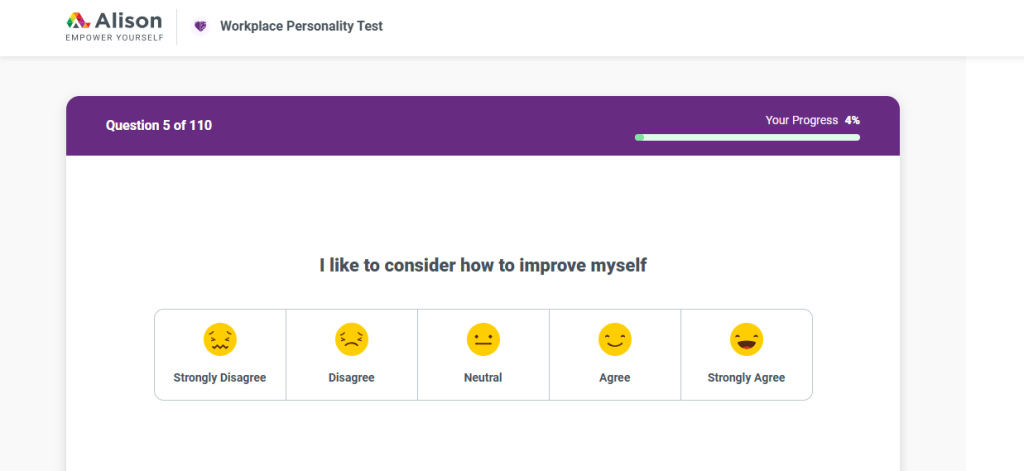
Each targets something different: creativity, reliability, a technical leaning, logic, self-awareness, and stacked together, they build an actual picture of how someone operates.
Who Actually Benefits From a Workplace Personality Test
Easy to assume this is only for job seekers dressing up a resume. The real audience is broader than that.
Someone early in their career takes it to figure out what roles might genuinely suit them, rather than guessing off job titles alone. Someone further along uses it to check whether their self-image still lines up with how they actually work. HR teams and coaches lean on the same format to open conversations about team dynamics without singling anyone out directly.
Plenty of people just take one out of curiosity too, the same pull that gets any well-built quiz passed around in the first place.
Common Mistakes That Weaken a Workplace Personality Test
Not every version pulls this off cleanly. A few things tend to drag it down.
- Length without real pacing. A hundred-plus questions work fine, but only if the format- one statement, one scale, auto-advance- keeps the pace moving. Without that, people drop off fast.
- Statements too vague to mean anything. “I am a good person” tells you nothing useful. The strongest ones are specific enough that someone can actually picture themselves agreeing or not.
- Results with no follow-through. Labeling someone “the analytical type” and leaving it there wastes the whole exercise. The real value comes when traits connect to something actionable, a course, a role, a next step.
- No sense of how much is left. Without a visible marker, even a well-paced test starts feeling like it’ll never end.
Why Interactive Tools Like This Work So Well
People genuinely want to understand themselves, and that curiosity, more than any entertainment value, is what keeps completion rates high.
The results feel personal instead of generic, largely because the statements are specific and written in first person, so nothing about the output reads like a template.
It spreads on its own, too. People compare results with coworkers or friends the same way they’d compare any personality quiz, and that naturally extends its reach.
It leads somewhere useful as well. Career platforms tie results back to relevant courses or roles, turning the quiz into an actual next step rather than a dead end.
And it produces data worth having. Trait patterns across enough users feed directly into sharper course recommendations and content down the line.
How Popular Is a Workplace Personality Test? (Traffic Insights)
Not a niche curiosity by any stretch. This format brings in real, steady traffic on career and learning platforms. On average:
- The website attracts 5.9M monthly visits
- A large share of users finish the entire thing instead of bailing partway, largely thanks to that auto-advancing, one-question setup
- Traffic tends to climb during career transitions, around graduation season, and at the start of a new year, whenever people are naturally reflecting on their work life more than usual
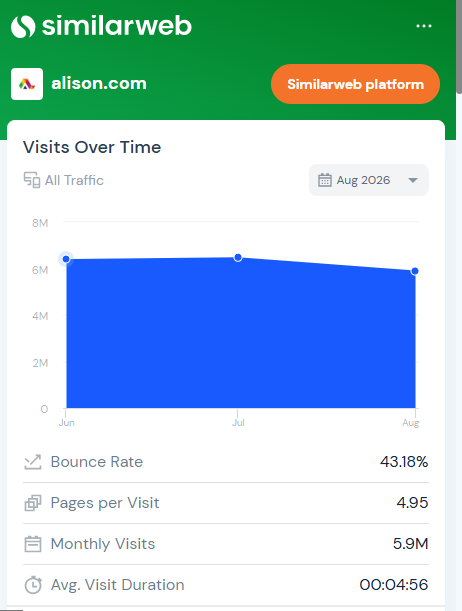
Source: Similarweb
That pattern is worth noting. A well-built workplace personality test doesn’t just catch curious clicks. It holds attention long enough to actually deliver something.
How to Build a Workplace Personality Test Using Outgrow
If this format has you thinking about your own version, here’s how to actually put it together with Outgrow.
1. Sign Up on Outgrow
Create a free account, head into the assessment builder. Already using Outgrow? Straight to your dashboard.
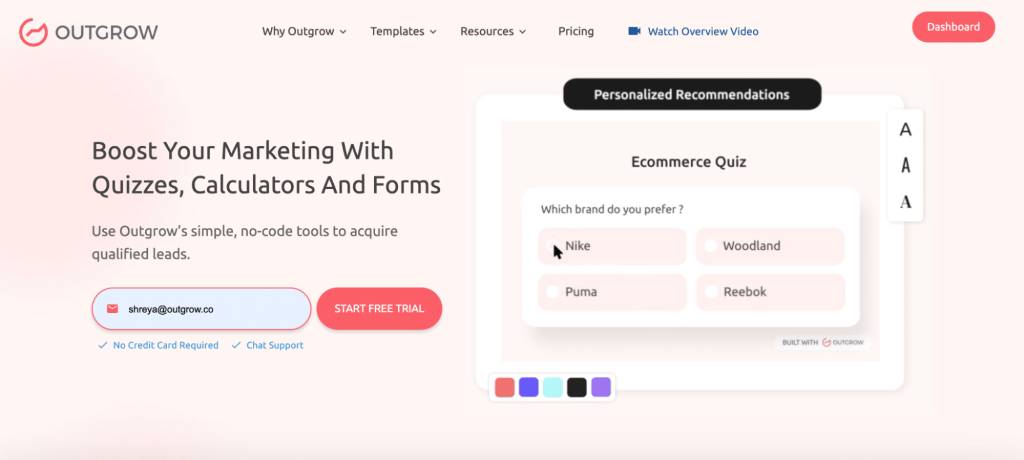
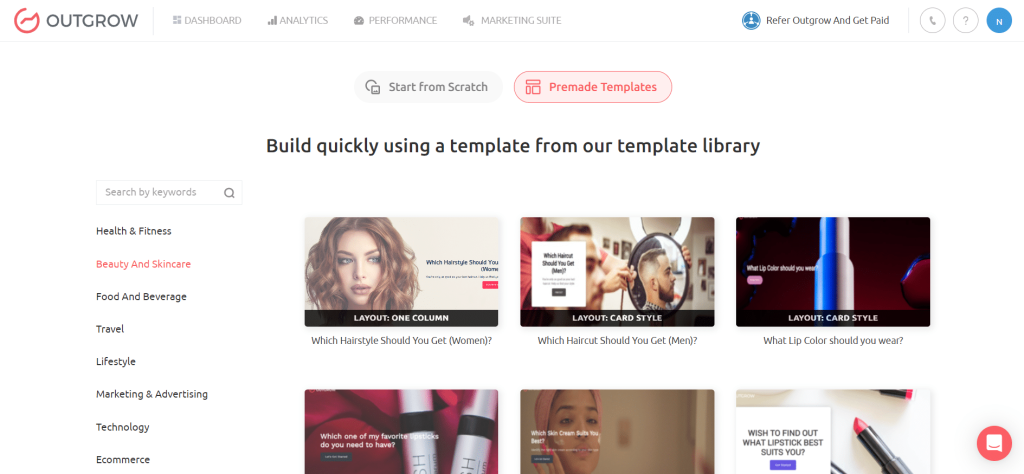
2. Choose Your Format
Pick “Personality Test” or “Assessment” from your dashboard. Start from a template, or build from scratch if that suits you better.
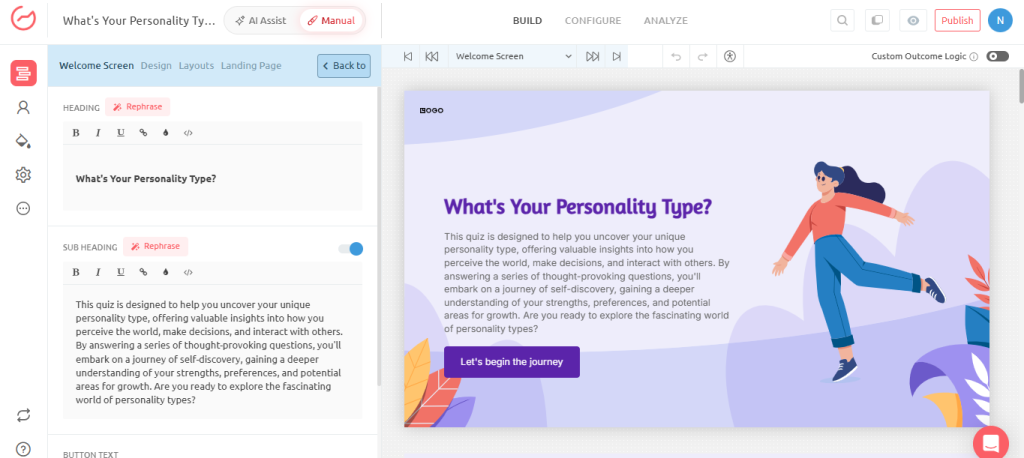
3. Design a Strong Welcome Screen
Set expectations early: the question count, time needed, what someone walks away with. Add a testimonial if you’ve got one; it genuinely bumps up start rates.
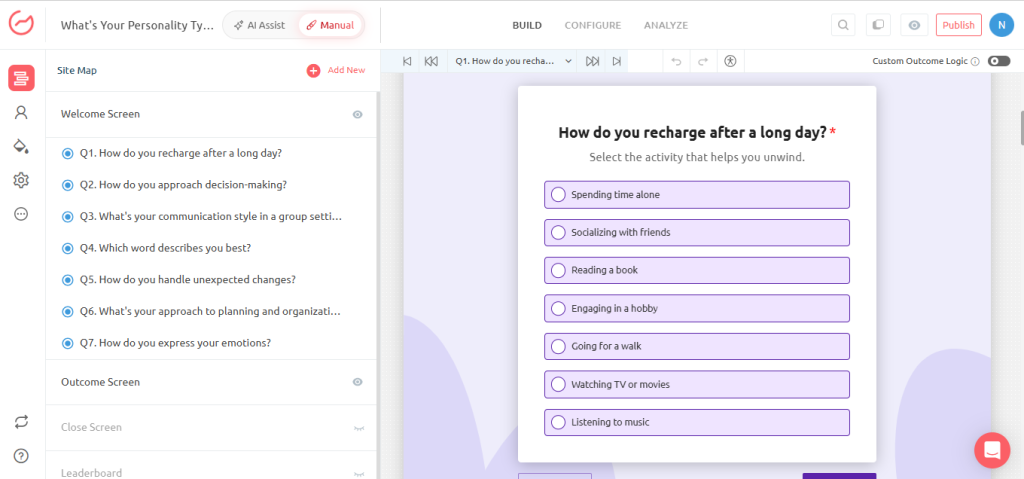
4. Write Statements, Not Questions
Keep everything first person, specific enough that someone can actually place themselves on the scale. Spread it across different traits: creativity, reliability, communication, logic, self-awareness, rather than piling up on just one or two.
5. Use a Simple, Consistent Scale
A five-point Strongly Disagree to Strongly Agree scale does the job well. One statement per screen, auto-advance the moment someone answers, keep the pace moving.
6. Keep Progress Visible
Add a counter plus a progress bar so people always know how much is left. This alone noticeably cuts drop-off on longer assessments.
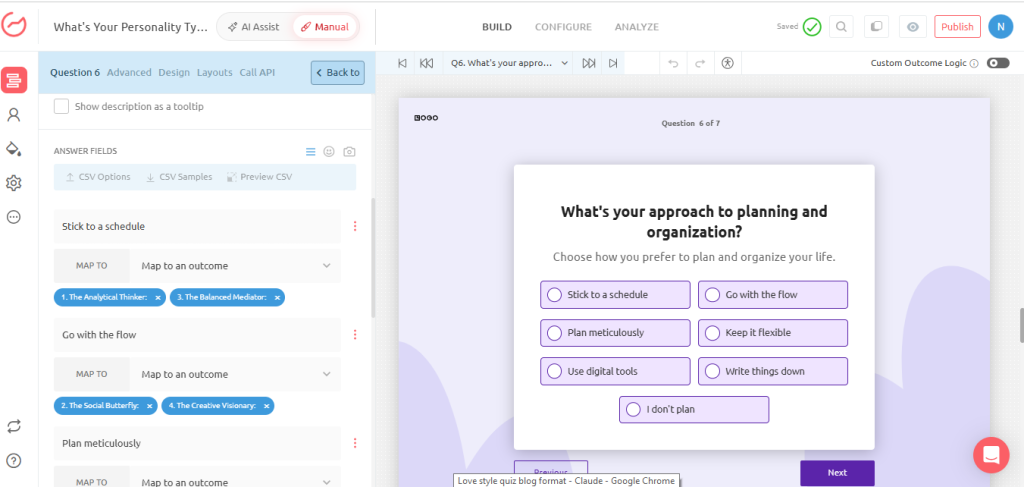
7. Map Results to Something Real
Connect trait patterns to actual outcomes, career suggestions, course recommendations, and development tips using Outgrow’s mapping tools. No coding required.
8. Embed and Share
Once it’s live:
- Embed it on your site or careers page
- Work it into onboarding or L&D content
- Push it through social and email
- Use it as a lead magnet for coaching or course offers
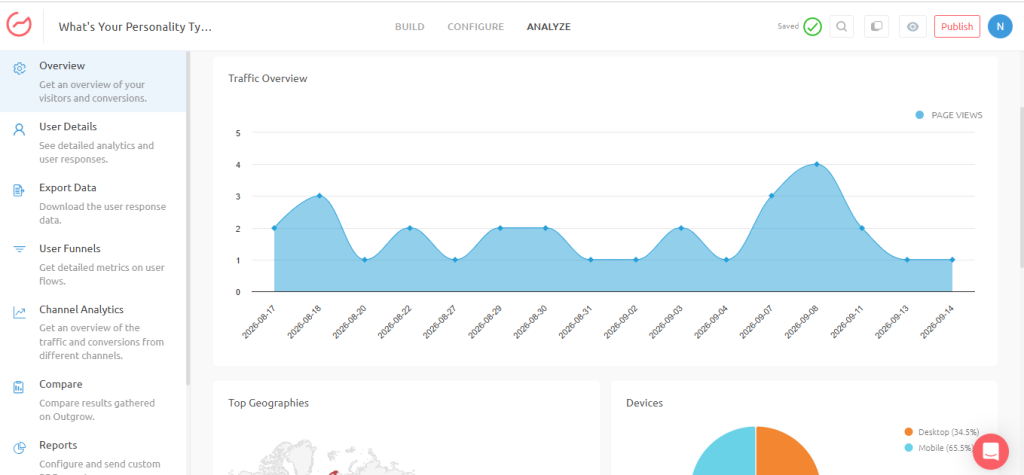
9. Analyze and Improve
Track how your quiz performs, where people finish, where they drop off, and which traits come up most often. Feed that straight back into refining the next version.
Final Thoughts
A workplace personality test earns its keep when it does more than slap a label on someone. It should help them put words to something they’d already half-noticed about themselves, and ideally point them toward a useful next step. Get the format right: clear statements, a simple scale, visible progress, and it becomes something people actually finish and trust.
With Outgrow, you can build a workplace personality test that fits your brand and gives people real insight into how they work, not just another quiz forgotten by tomorrow.
Ready to build your own?
Start exploring Outgrow, no code required, and put together a workplace personality test people will actually complete.
Frequently Asked Questions About the Workplace Personality Test
A structured self-assessment using rating-scale statements to reveal how someone thinks, works, and interacts on the job.
Most run around 15 minutes for somewhere near 100 to 110 statements, though shorter versions work fine too.
The results are only as good as what goes in. Answering how you wish you behaved instead of how you actually do skews everything.
Yes. Plenty of platforms pair results with course or role suggestions, turning the test into a real next step instead of just a fun distraction.
Not quite. This usually zeroes in on specific traits and behaviors tied to work, rather than sorting people into broad personality buckets.

Muskan is a Marketing Analyst at Outgrow. She is working on multiple areas of marketing. On her days off though, she loves exploring new cafes, drinking coffee, and catching up with friends.