Business Assessment Quiz: How to Tell If Your Idea Has Real Traction
Introduction
Table of Contents
Ask a company’s founder to present the elevator pitch, and you’ll hear a well-oiled two-minute presentation. Ask who the actual client is, and why that client wouldn’t simply continue with the spreadsheet. Crickets. Perhaps a cough.
Such silence is precisely what a business assessment test seeks to
uncover. With eight questions, a few minutes, and a little effort on your part, you’ll see whether your business’s story is congruent with reality. It won’t give you the final verdict; it will only direct your attention toward what you would like to avoid.
Why can’t you do this by yourself? Because you filter. You recall the single customer who raved about your service and forget the five clients who didn’t respond. You discount your competition in seconds, judging from their long-outdated web page design. Saying the answer aloud changes everything. Generic answers don’t hold up for long, while factual ones are difficult to fabricate.
Marketers can benefit from this too. Assessment quizzes are highly effective lead magnets, as founders and small teams are always keen to know where they stand. Provide them with a result worth reading, and you’ll have their email address in return without breaking a sweat.
That’s our strategy. We will be discussing everything related to a business assessment quiz – what it is, why it is effective, what questions to ask, what mistakes to avoid, and how to create one using Outgrow in around 30 minutes.
What Is a Business Assessment Quiz?
In other words, it’s a set of questions relating to a certain aspect of the business and resulting in a recommendation for further action. Some tests evaluate marketing maturity. Others focus on sales readiness, brand, or retention. Our test relates to product-market fit, which likely comes out as the most important thing.
Product-market fit is when your product solves the issue in question in an adequate manner for customers ready to pay to resolve the issue. When you get it right, the growth becomes easy. When you fail to achieve it, the advertising money spent just flows out.
Each assessment involves three core elements: questions, the logic behind answering them, and the outcome page. Outgrow’s Product-Market Fit Survey includes eight questions and three possible outcomes: Poor Product-Market Fit, Promising Early Traction, and Established Product-Market Fit.
Imagine two founders. The first one communicated with around 40 potential clients and got 10 of them to pre-order. The closest competitor is slow and costly. She’s likely going to end up with the third outcome. The second says everyone needs this; he just hasn’t asked anyone yet. He’ll likely land on the first outcome. That stings. Still, it beats learning the same thing from an empty bank account.
Why You Need a Business Assessment Quiz
Cost comes first – answering your hypothesis on a set list of questions costs practically nothing. But a bad launch will take several months of time and a substantial amount of money. It is enough if ten minutes spent on a test makes you think about positioning and not building anything yet.
Blind spots are another thing that the test addresses. The founders have a good idea of the product and only have a vague idea of the market. Questions related to the validation of the problem and buyer persona make you face your weaknesses. Many founders realize that it is easy for them to talk for an hour about the features of the product, but they do not know even one alternative of their customer.
For marketers, the benefit lies in something else. A test like this attracts people who are currently thinking a lot about their business. This is a warmer audience than one who downloaded an ebook. Moreover, each completed test gives you something – the stage they are at, their problems, what kind of help they need.
Consultants and agencies have been known to conduct tests to vet leads prior to any call. An early-stage, untested lead may receive a research pack. A rapidly growing lead will receive a discussion on scaling. The call will begin from a more informed place regardless.
Accelerators and startup networks can use this as a quick filter for applicants. This is not meant to take the place of interviews, but it saves time.
Finally, here’s something no one will tell you. People just love quizzes. Screenshotting your results and arguing about them with a co-founder goes a long way.
How Outgrow’s Interactive Content Helps
A simple survey gets the answers, dumps them into a spreadsheet, and calls it a day. Not so with Outgrow, where answers are used in action by linking the logic with the results that follow based on user responses.
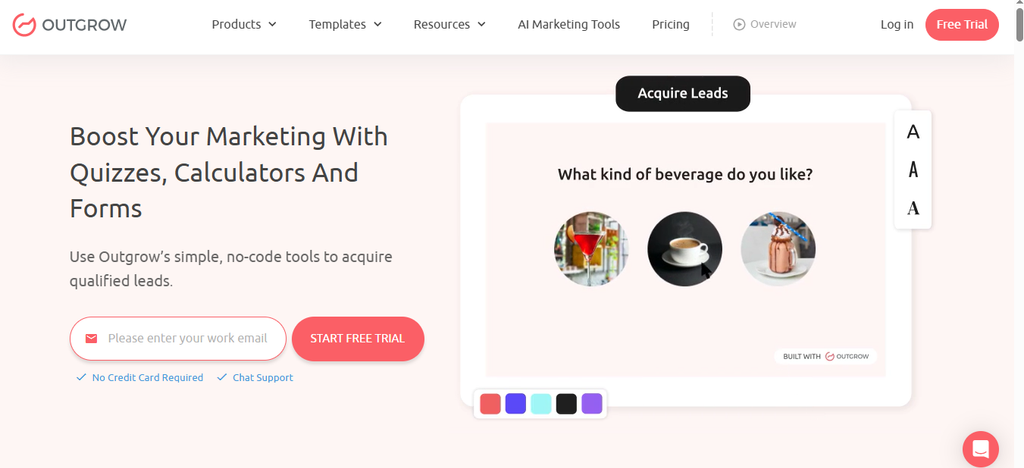
Several things matter in an assessment tool:
- Custom Outcome Logic – this allows you to determine which response gets what kind of result. A business founder with validation behind him and a precise target customer is not going to see the same thing that someone who hasn’t talked to a single customer sees.
- Branding – colors, fonts, the welcome screen, even the wording on the buttons.
- Use AI Assist to get a quick draft, or build out every screen manually. Either way, you’ll use the same editor, so switching midway is totally okay.
- Lead capture is automatic. Put a form above or below the answers, and you’ve got leads from everyone who took your quiz. Connect a CRM or email service and the data transfers automatically.
- Finally, there’s the Analysis tab. It lets you see how many people started, how many people finished, and how many dropped off. And that last one is more telling than you might think.
You don’t need any developer assistance. If you can ask a question and press a button, you can post your quiz.
Try Outgrow’s Product-Market Fit Survey Template
Before building anything, try the ready-made version. You’ll find it here.
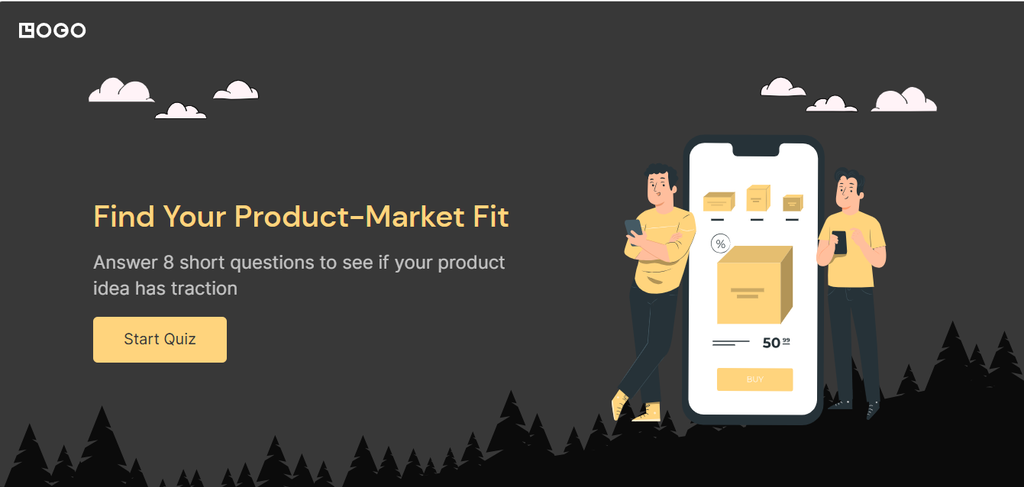
It opens with a welcome screen inviting you to find your product-market fit. Then come eight short questions, one screen each.
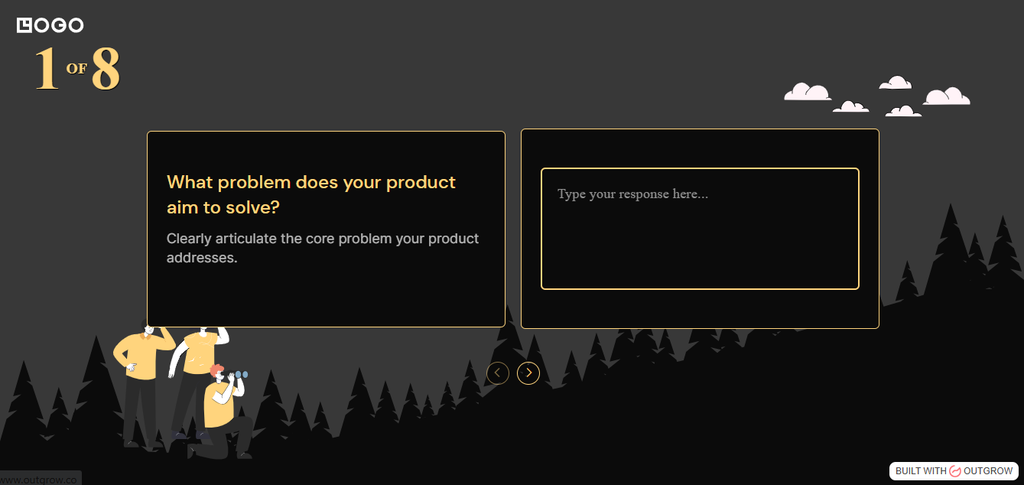
- What problem does your product aim to solve?
- How did you validate that this is a real problem customers face?
- What are the current alternatives customers use to solve this problem?
- How is your product better than those alternatives?
- Who is your ideal target customer?
- How many potential customers exist in your target market?
- How have you validated customer demand for your product?
- How will customers find out about and access your product?
There are seven open text boxes in which you enter responses in your own words. The sixth is the slider used for market size estimation. Under each question is a short line explaining the desired answer characteristics, useful in case you have doubts regarding the amount of information you should provide.
The outcome is either Poor Product-Market Fit (the problem you have identified may be too fuzzy, or existing solutions are just good enough for everybody), Promising Early Traction (you have identified a valid problem and seen certain demand for its solution, but still have much to do), or Established Product-Market Fit (validated need, competitive advantage, and a customer acquisition strategy). Every outcome has action items attached to it, so that nobody will be left to contemplate their result.
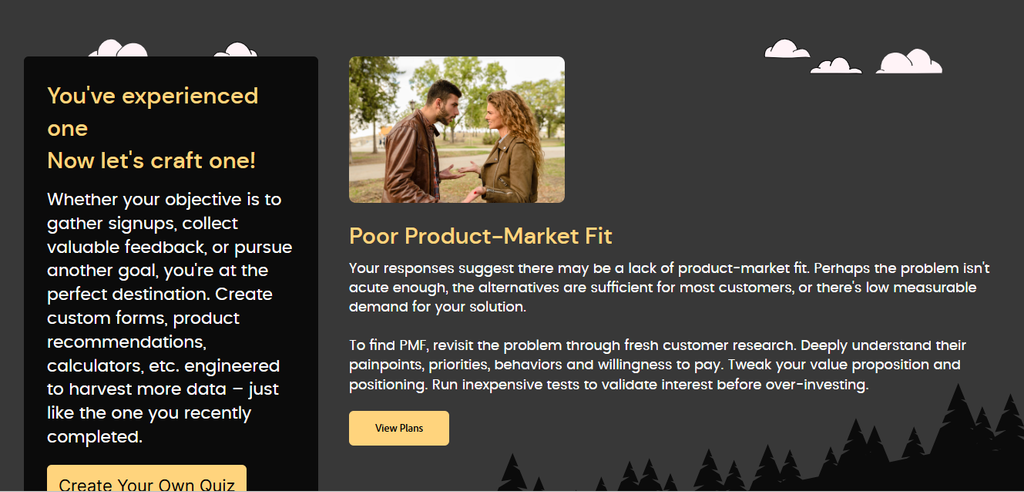
Do the test for your product. Do it once more using better answers and see how it affects the outcome. When you type ‘small businesses’ as your target customers, it’s quite different from ‘ecommerce stores with 5 to 50 employees using paid ads’. In the latter case, you show what you know about your potential customers. What you don’t know is even more important.
However, one warning. While the quiz points you in the right direction, only real traction comes from actual paying customers, money, and repeat visitors. It simply helps you choose which way to go first.
Founders could use it in its current form. The marketing team can embed the quiz in a blog post about validating startups, distribute it via a newsletter mailing list, or a landing page for their consulting service.
Building Your Own Business Assessment Quiz with Outgrow
Reserve thirty minutes for this task on building your business assessment quiz. From the template, you may edit it to fit your requirements, but if you are looking to measure something different, like market readiness or brand awareness, create a fresh quiz.
- Identify the objective first. What is the decision that you expect your participant to make after seeing the result? Depending on whether your decision revolves around whether to keep building or meet with other clients, you may choose validation-related questions. If it’s about picking the next marketing channel to invest in, ask about existing channels, budget, and successes.
- Now write the questions. Eight seems to be just about right: it is a decent number of questions but still not too many for most participants to finish them. Questions that are more than ten start being skipped. Use the vocabulary of your clients and omit jargon unless your audience is familiar with it.
- And finally, select the format. An open text box sounds friendly and makes people think, but scoring it is difficult. Multiple choices and sliders are fast and easy to score. A combination is usually best, which is the way the template goes.
- Next, design the outcome logic in the Build tab. Specify what each outcome represents and which responses lead to it. Keep it straightforward. You will need three outcomes; a fourth is optional and can be introduced once actual responses come in.
- Pay more attention to the result page, since this is the point at which prospects form an impression of you. Avoid using only a bare title. Describe what this means, how they might end up here, and provide two or three options for the next step. Finish the page with a proper call to action, depending on the result. It could be a guide for startups or a demo link for further-stage prospects.
- Lastly, integrate all the necessary components of your funnel. Route leads into your CRM or email marketing tool, mark them by result, and reach out to them with relevant content. The prospect who got a poor result is not interested in a growth strategy yet.
Industry Use Cases for a Business Assessment Quiz
- SaaS companies may deploy it as a top-of-the-funnel lead generation tool. Founders and product managers like seeing how good they are at their jobs, and the report tells them who is ready and who needs more time.
- Marketing agencies may deploy it on their website. The visitor understands what’s wrong with his marketing strategy, and he leaves contact information along with a lot of context for the agency.
- Business consultants can use it before making the first call to learn more about the client’s problems. Instead of repeating the same dozen questions, he starts from the answer.
- Start-up accelerators and incubators may include it in the application procedure to learn a little bit about founders’ mindset regarding their market.
- Business schools and business trainers may give it to students as a tool for testing their hypotheses on start-up development before the presentation.
- Financial institutions can give this tool to small business owners as a gift to make them think of this bank/fintech as something more than a money-lending company.
Getting Started: From Idea to Live Quiz
- Decide on an audience first. Founders, ecommerce business owners, and B2B marketing managers have their respective issues, and a quiz designed for all of them usually gets nowhere. Focus on one audience first, then branch out to others.
- Go into your template or create a new quiz and name it something memorable, so that later when your dashboard is crowded with quizzes, you know where one begins and another ends.
- Input your questions and select whether they will be text questions, sliders, or multiple-choice ones. Set your outcome logic and check it on the answers that you can predict. If, having answered correctly to every question, you land on the lowest possible outcome, there is a flaw somewhere in your logic, and you should fix it.
- And then try to break your quiz. Enter nothing in some of the fields, push the slider to the very end, enter one-word answers, input a long paragraph in a text field. Real users tend to do everything that they can.
- Publish with a link or an embed code and watch the numbers for a week. If lots of people quit at the same question, that question is probably confusing or too heavy. Rewrite it and check again.
Common Mistakes to Avoid
Too many questions. Each one uses up your completions. Eight questions give you the same insights? Stick with eight.
- Leading questions. “How awesome is your product?” is begging for flattery. Ask instead for evidence, like how many customers you’ve talked to or how many paid before the product even existed.
- Ensuring every answer is positive. When everybody knows they’re awesome, the quiz stops meaning anything – and they know it. The one with the bad outcome, delivered tactfully with actionable recommendations, is more likely to stick out.
- Not providing a next step. You’ll give them a meaningless quiz outcome without giving them instructions for how to improve their score.
- Requesting an email address too early. Asking for an email address in the form that leads to the quiz will scare them away. Most quizzes get better results when asking for email after people have gotten some value, or even emailing the quiz result.
- Ignoring the statistics on performance. Publishing the quiz and forgetting about it means missing the opportunity to improve. Check your completions and abandonment rates every few weeks.
Taking the quiz as truth. That is a snapshot of a few minutes of typing. Be sure to tell them so that it’s on the page.
Reading Your Results
A label, however, does not do anything. It is what you do with it that counts.
If Poor Product-Market Fit is your diagnosis, no need to panic. Probably one or two questions were poorly answered. Go back to the questions for which you could not produce more than a single sentence, because there lies the work. Talk to more customers and ask what they are doing right now and what their pain points are.
In case you diagnose Promising Early Traction, evaluate the strength of the answers you provided and find the weak link among them. There might be a clear problem but an unclear solution (distribution). Make sure to fix the weakest before you try to expand the strongest.
If you arrive at Established Product-Market Fit, keep some skepticism intact but healthy. First, check whether the evidence is fresh and unbiased (non-friends/non-supporters). Next, determine how to grow while preserving what works.
Regardless of the result, take the quiz again in three or six months. Your answers should reflect the changes within the company, and sometimes the change is even more important than the diagnosis.
Wrapping Up
In essence, the business assessment quiz transforms a hunch into actionable data. Within minutes, you will know where your ideas are strong, where they are weak, and what needs further exploration.
Feel free to try out the Product-Market Fit Survey template from the Outgrow website or create your own quiz by adding your branding and customizing questions and results. You don’t need any technical skills, and most quizzes go live in under one hour.
Looking to make your own quiz? Try the free 7-day trial today.
Frequently Asked Questions
It is a short quiz covering one specific aspect of your business, like product-market fit or marketing readiness. Outcome logic analyzes your answers and gives you an outcome with next steps.
No, it is not. The quiz will tell you where you have strong or weak evidence, so that you can focus on what needs to be done. But only real customers who buy, retain, and refer your business are your evidence of success.
It depends on the target audience. 6-10 is the range to go. The Outgrow template includes 8 questions, which is enough both to be meaningful and to be answered by the majority of respondents.
Absolutely, yes. Just include a form in your quiz so that you can get the contact information of your respondents and send it to your CRM or email service.
Yes. You can edit the questions, add or remove screens, rewrite the outcomes, and apply your own branding. You can also build a different assessment from scratch, like a marketing audit or a brand health check.

Muskan is a Marketing Analyst at Outgrow. She is working on multiple areas of marketing. On her days off though, she loves exploring new cafes, drinking coffee, and catching up with friends.