The Future of Interactive Content Marketing: Interactive, AI-Driven, and Personalized
Table of Contents
Last year, a SaaS company spent $40,000 on a content agency. Twelve blog posts a month, all beautifully written, all well-optimized. Their organic traffic went up. Know what didn’t go up? Leads. Demos booked. Revenue.
When we dug into why, the answer wasn’t complicated. People were reading the content and leaving. No form fills, no clicks to pricing, no reason to stick around. The content was doing what content is supposed to do on paper, but it wasn’t doing anything for the business.
That’s the trap a lot of companies are sitting in right now. Good content, terrible outcomes. And the fix isn’t writing better content. It’s rethinking what content is supposed to be in the first place.
The Format Problem Nobody Talks About
The problem is the model itself. You write something, publish it, someone reads it (maybe), gets zero value specific to their situation, and bounces. You learned nothing about them. They learned nothing they couldn’t get from the 47 other posts ranking on the same keyword. Everyone moves on.
This is where interactive content marketing breaks from the pack entirely. Instead of you broadcasting and them absorbing, you’re actually having a back-and-forth, even if it’s automated. A quiz asks them something. They answer. It asks again. They answer again. By the end, they get a result that’s specifically about them. Not about your industry. Not about trends. About their situation, their numbers, their problem.
I remember the first time I saw a well-built ROI calculator on a B2B website. I sat there for 20 minutes plugging in numbers and playing with variables. Did I buy? Not that day. But I remembered that company for months. No blog post has ever done that to me.
The 5 Interactive Formats Actually Working Right Now
People get confused about what “interactive content” even means. They picture some $80k scrollytelling microsite with custom animations. That’s not it.
Here’s what’s actually working, and why each one works, which matters more than just knowing the list:
Still the highest engagement format out there, by a wide margin. “What type of [X] are you?” sounds gimmicky until you see the completion rates. The reason quizzes work is simple: people are far more interested in themselves than they are in your brand. Give them a result about themselves, and they’ll finish every question.
Outgrow makes building these ridiculously fast. You describe your audience and goal, the AI drafts the questions and outcome copy, and you’re tweaking a finished structure instead of staring at a blank screen. The quiz builder has pre-built templates across industries, SaaS, e-commerce, finance, and healthcare, so you’re not starting from zero every time.
These are genuinely underused in B2B. A prospect who spends 10 minutes running their own numbers through your calculator has done more sales qualification on themselves than any cold email sequence could. By the time they submit, they’ve already done the math on why buying makes sense. These convert at a different rate than anything else on the page, not slightly different, meaningfully different.
Outgrow’s calculator builder lets you set up multi-variable ROI calculators without touching any code. The output page shows each prospect their personalized projection based on what they typed in, which lands very differently than a generic “customers save X%” claim. Every submission feeds into your CRM with the prospect’s actual inputs attached, so your sales rep knows their numbers before the first call.
Assessments and Graders
“Grade your current marketing strategy”, every marketer with any skin in the game wants to know where they stand. HubSpot’s website grader is still one of their best lead gen tools, and it’s been running for over a decade. Because an honest score with specific feedback builds credibility faster than any thought leadership article ever could.
With Outgrow, you can set weighted scoring across multiple categories, so instead of one generic number, your grader tells someone they scored 78% on strategy but 41% on execution, with specific feedback per section. That detail is what turns a passive lead into a real conversation.
Especially valuable in e-commerce and SaaS, where you have multiple SKUs or plan tiers. Decision fatigue is real, and it’s costing you, customers. A 5-question quiz that ends with “based on your answers, start with X plan” removes the friction that was making people close the tab.
Outgrow has a dedicated recommendation engine for exactly this. You map your products to answer combinations, the logic handles the routing, and customers get a recommendation that feels handpicked, without any dev work on your end.
Underrated for one specific reason: they generate content AND proprietary data simultaneously. You run a survey, you get a dataset nobody else has, you write content based on real answers from your actual audience. That loop feeds itself indefinitely.
Outgrow lets you embed polls inside existing interactive pieces, tack a 3-question survey onto the end of a quiz, and double the data from a single session. Responses aggregate in the dashboard in real time, segmented by how people answered earlier. You’re not just collecting opinions. You’re building an audience intelligence asset.
What every single one of these formats has in common: the person gets something back. That exchange, I give you some information, you give me something useful in return, is the whole mechanic. Interactive content marketing works because it respects people’s time by actually reciprocating their attention. Outgrow is built around exactly that idea, every format delivers something specific to the person on the other end, not just captures their email and moves on.
| Format | Best Funnel Stage | Primary Payoff |
| Quizzes | Top | Lead capture + segmentation |
| ROI Calculators | Bottom | Pre-sales objection handling |
| Assessments | Mid | Trust + nurture |
| Product Recommenders | Bottom | Reduced friction, higher conversion |
| Surveys & Polls | Top / Mid | Proprietary data + content fuel |
AI in Interactive Content: Real vs. Hype
“AI-powered” has become marketing noise. Everything is AI-powered now. My toothbrush is probably AI-powered. So I want to be specific about what AI is actually doing well in interactive content marketing right now, because there’s real value here if you look past the buzzwords.
Creation speed. Building a 10-question quiz with branching logic used to mean a full day of writing, reviewing, rewriting outcomes, and testing edge cases. AI gets you to a working first draft in an hour. You’ll still edit, but with a real structural foundation.
Outcome personalization. Instead of routing everyone into one of four generic outcome buckets, AI can generate result copy that’s specific to the actual combination of answers someone gave. Two people can take the same quiz and get meaningfully different result pages. That quality difference is immediately noticeable to anyone reading it.
Real-time lead scoring. Every answer someone gives carries a signal. AI can weigh those signals and surface a lead quality score before the contact ever hits your CRM. Your sales team stops sorting through every form fill and starts calling the people who are actually ready.
What Outgrow’s AI Marketing Tools Actually Do
Outgrow is built as an end-to-end platform for interactive content marketing, and the AI runs through the whole thing; it’s not a feature bolted on at the end to check a marketing box.
Here’s what that looks like in practice:
Drafting from a plain-language brief. You describe what you want: “a quiz for mid-market HR leaders to assess their current onboarding process,” and Outgrow’s AI drafts the question structure, the branching logic, and the outcome copy. You refine from there. Teams that used to spend a week on this are getting it done in an afternoon.
Personalized result pages that actually feel personal. Each person who completes a quiz or assessment gets results that reference their specific answers, not language written for a hypothetical persona. That level of personalization used to require custom dev work. On Outgrow, it’s how outcomes are generated by default.
Lead scoring baked in, not added on. As contacts move through your interactive content, their responses are being scored against criteria you set. By the time they land in your CRM, they’re already tagged by score, segment, and response data. First email out of the gate can be specific. So can the sales call.
Integrations that actually connect. HubSpot, Salesforce, Mailchimp, ActiveCampaign, Klaviyo, Zapier, the list is long. The point isn’t to build a new data silo. It’s to make the systems you already have smarter by feeding them better data.
Why “Personalization” From Most Brands Is Just Mail Merge
“[First name], we thought you’d like this.”
That’s not personalization. That’s a CRM doing a find-and-replace.
Real personalization in interactive content marketing works because users choose to tell you who they are. There’s no inference, no third-party data, no creepy cross-device tracking. Someone fills out your assessment, and they’ve told you their company size, their biggest challenge, their budget range, and what success looks like to them. You didn’t guess. They told you directly.
That declared data is cleaner than anything you could buy, and it’s gotten significantly more valuable as privacy regulations have tightened and third-party cookies have mostly disappeared. The brands with the best first-party data over the next three years are going to have a real structural advantage. Building interactive content is one of the fastest ways to accumulate that asset.
In practice, personalization from interactive content unlocks three things most brands can’t do otherwise:
Segmented email tracks based on actual answers. The person who said their biggest challenge is lead quality gets different emails than the person who said retention. Both gave you their email through the same assessment. But their paths after that point should look completely different, and now you have the data to make that happen automatically.
Sales outreach with real context before the first call. Instead of “Hi, I saw you downloaded our guide,” your rep can open with “Your assessment score came back at 42 out of 100, and your biggest gap was mid-funnel nurture, that’s where we usually find the fastest wins with companies at your stage.” That’s a fundamentally different conversation.
Retargeting that speaks to what someone actually said they care about. Not a generic brand awareness ad. An ad that references the specific challenge someone flagged 48 hours ago when they took your quiz.
The number that keeps coming up in this space: McKinsey research shows 71% of consumers expect personalized interactions, and 76% get frustrated when they don’t get them. Generic experiences aren’t just underperforming; they’re actively costing brands trust. For instance, every time someone gets a “Hi [First Name]” email after filling out a detailed assessment, that’s a missed opportunity to actually use the data you collected.
Which Format Fits Which Funnel Stage
You don’t need to rebuild your entire content strategy. Start with one stage of your marketing funnel, one problem, and one piece of interactive content marketing built around something your audience is already asking.
Top of Funnel- Awareness and Lead Capture
You’re trying to get someone’s attention and their email address. Quizzes and personality assessments are your best tools here. They’re low-commitment, high-engagement, and the segmentation data you collect tells you immediately who you’re talking to.
Example: “What’s your biggest content marketing blind spot?”, 6 questions, personalized result, email gate before results are revealed.
Middle of Funnel- Nurture and Education
The person knows you exist. They’re evaluating. Assessments and graders do heavy lifting here. You’re helping them understand their own situation more clearly, which positions you as the expert who can fix it.
Example: “Grade your current demand gen strategy”, scored assessment with specific feedback by category, delivered via email.
Bottom of Funnel- Conversion
The person is close to deciding. ROI calculators and product recommenders remove the last objections. They’re letting the prospect talk themselves into it using their own numbers.
Example: “Calculate your potential ROI with [product]”, input current metrics, see projected outcome, CTA to book a demo.
Three rules that apply to every piece you build:
- Build around a question your audience is already asking, rather than one you wish they were asking.
- From the start, connect to your CRM and email platform. Otherwise, an interactive piece that doesn’t feed automation is a missed opportunity every single time it loads.
- Finally, track completion rate obsessively. After all, views are vanity. If fewer than 40% of people who start your quiz are finishing it, something specific is killing the experience. Find it. Fix it. The conversion rate follows.
Try Outgrow Today!
Ultimately, the best way to understand why interactive content marketing performs differently from what you’re doing now is to actually build something, so that you can watch it run and see the difference firsthand.
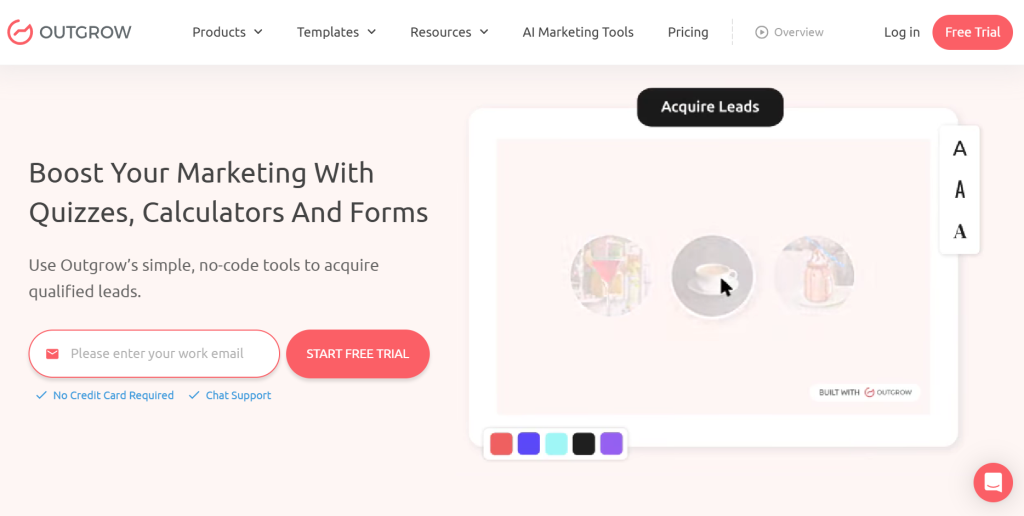
Outgrow’s 7-day free trial gets you into the full platform, no credit card required to start:
- Quizzes and personality assessments
- ROI and savings calculators
- Assessments and graders
- Product recommendation tools
- Chatbots and surveys
- AI drafting for questions, logic, and outcome copy
- Integrations with HubSpot, Salesforce, Mailchimp, ActiveCampaign, Klaviyo, and more
No developer needed. Likewise, no designer on call. In fact, most people get their first live piece up within the same day they sign up. And because of that, people do it in real time, it’s not a stretch.
Head to Outgrow and spend 20 minutes on it. If you’ve been putting budget into content that isn’t converting, this is the experiment worth running before you commission another blog post.
Conclusion
The era of treating every reader the same is wrapping up, not with a dramatic industry collapse, but rather with a slow bleed in results that becomes harder and harder to ignore.
As a result, static formats are increasingly underpowered for what brands actually need: engaged readers who convert, rather than traffic numbers that simply look good in a monthly report.
The tools are more accessible than they’ve ever been. The early-mover window is still open, but it won’t be forever. The only question is whether you build something now or spend another quarter watching traffic analytics and wondering why the leads aren’t following.
Frequently Asked Questions
It’s content that responds to the person using it rather than saying the same thing to everyone who lands on the page. Quizzes, calculators, assessments, and product recommenders are the main formats.
In just a few hours, from signup to going live, especially if you know what you want to build upfront. Meanwhile, Outgrow’s AI drafts the question structure, logic, and outcome copy from a plain-language description of your goal. From there, you can simply edit and refine.
When someone finishes an interactive piece, the platform uses their specific combination of answers to generate a result page that speaks to their situation, not a generic response written for a persona type. Two people who take the same quiz but answer differently get result pages that look and read differently.
Honestly, small teams often get more relative value out of interactive content marketing than large ones, because one well-built piece does the work of many static assets running simultaneously. A calculator or quiz runs 24/7, so it qualifies leads automatically, and then feeds your CRM, all without anyone touching it after it’s live.

Sakshi is a digital marketing enthusiast passionate about connecting brands with audiences. With a background in content strategy and social media, she loves turning trends into actionable strategies. Outside of work, you’ll find her reading a book or hunting for the perfect cup of coffee.