Summarize with :
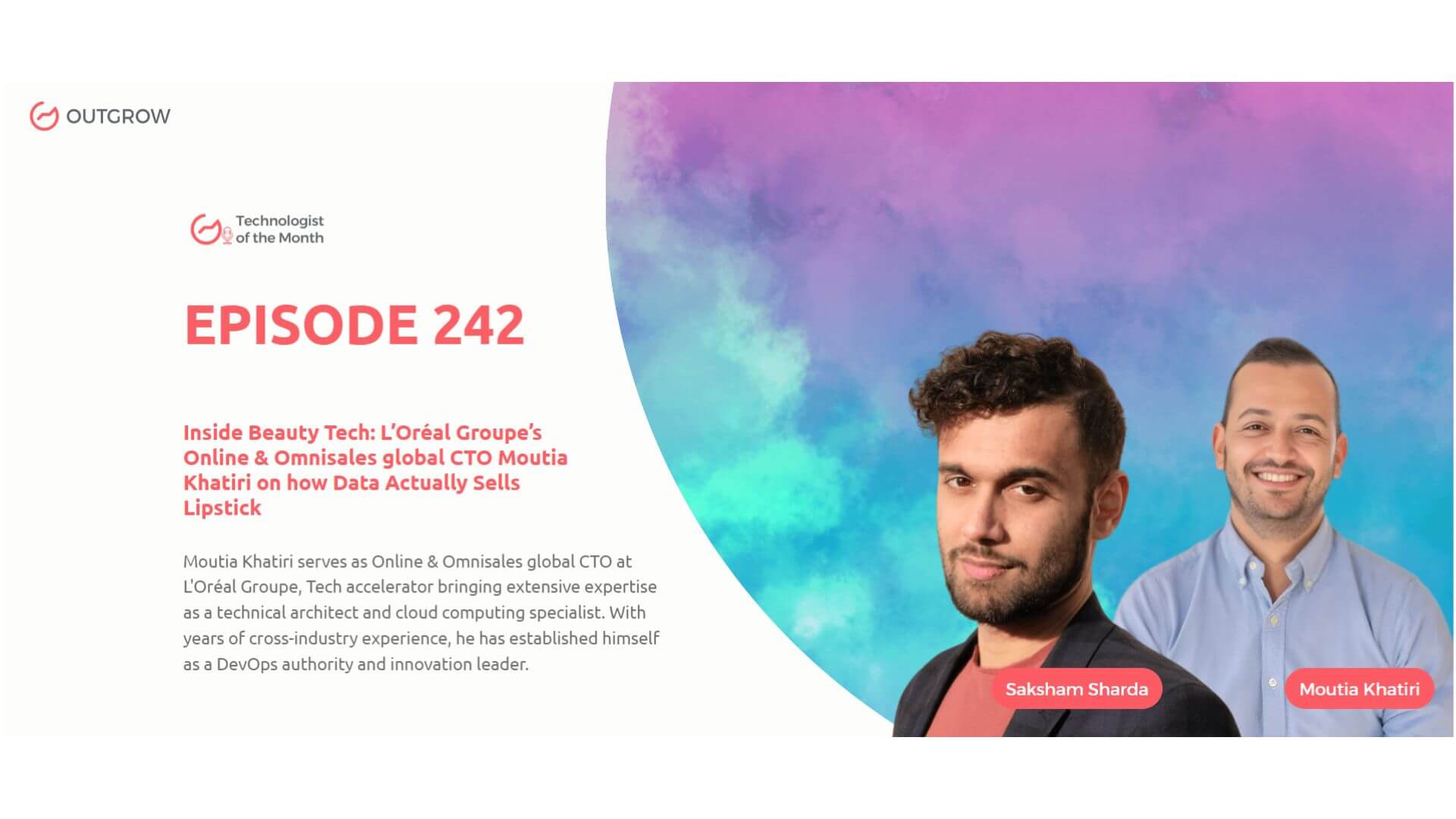
EPISODE 242: Marketer of the Month Podcast with Moutia Khatiri
Table of Contents
Hey there! Welcome to the Marketer Of The Month blog!
We recently interviewed Moutia Khatiri for our monthly podcast – ‘Marketer of the Month’! We had some amazing, insightful conversations with Moutia, and here’s what we discussed about-
1. Beauty Tech transformation program launched in 2018-2019.
2. AI products augmenting both employees and consumer experiences.
3. Virtual try-on technology developed with ModiFace startup.
4. Data governance crucial for maintaining quality and trust
5. Quantum computing poised to revolutionize model training
6. Generative AI still at beginning of the transformation wave
About our host:
Dr. Saksham Sharda is the Chief Information Officer at Outgrow.co He specializes in data collection, analysis, filtering, and transfer by means of widgets and applets. Interactive, cultural, and trending widgets designed by him have been featured on TrendHunter, Alibaba, ProductHunt, New York Marketing Association, FactoryBerlin, Digimarcon Silicon Valley, and at The European Affiliate Summit.
About our guest:
Moutia Khatiri serves as Online & Omnisales global CTO at L’Oréal Groupe, Tech accelerator bringing extensive expertise as a technical architect and cloud computing specialist. With years of cross-industry experience, he has established himself as a DevOps authority and innovation leader.
Inside Beauty Tech: L’Oréal Groupe’s Online & Omnisales global CTO Moutia Khatiri on how Data Actually Sells Lipstick
The Intro!
Saksham Sharda: Hi, everyone. Welcome to another episode of Outgrow’s Marketer of the Month. I’m your host, Dr. Saksham Sharda, and I’m the creative director at Outgrow. co. And for this month, we are going to interview Moutia Khatiri, who is the Online & Omnisales global CTO at L’Oréal Groupe.
Moutia Khatiri: Great to be here. Thank you.
Don’t have time to read? No problem, just watch the Podcast!
Challenge yourself with this trivia about the exciting topics Moutia Khatiri covered in the podcast.
Or you can just listen to it on Spotify!
The Rapid Fire Round!

Saksham Sharda: So let’s start with the rapid fire round, just to break the Ice.
Moutia Khatiri: Okay.
Saksham Sharda: So the first question is, at what age do you want to retire?
Moutia Khatiri: I’d say 60, 65.
Saksham Sharda: How long does it take you to get ready in the mornings?
Moutia Khatiri: Very quick. 20 minutes
Saksham Sharda: Most embarrassing moment of your life.
Moutia Khatiri: Maybe a slippery floor. When I was skiing.
Saksham Sharda: Favorite color?
Moutia Khatiri: Blue.
Saksham Sharda: What time of day are you most inspired?
Moutia Khatiri: By night. Late.
Saksham Sharda: How many hours of sleep can you survive on?
Moutia Khatiri: I need a lot. Seven, eight.
Saksham Sharda: The city in which the best kiss of your life happened?
Moutia Khatiri: Paris, of course. I live in Paris.
Saksham Sharda: Pick one. Mark. Zuckerberg or Elon Musk.
Moutia Khatiri: That’s a complicated one. Zuckerberg,
Saksham Sharda: How do you relax?
Moutia Khatiri: Sports.
Saksham Sharda: How many cups of coffee do you drink per Day?
Moutia Khatiri: Too much. Too many? Four or five?
Saksham Sharda: A habit of yours that you hate?
Moutia Khatiri: Maybe being too tough on myself.
Saksham Sharda: The most valuable skill you’ve learned in life.
Moutia Khatiri: Listening.
Saksham Sharda: Your favorite Netflix show.
Moutia Khatiri: Kazadi.
Saksham Sharda: Are you an early riser or a night owl?
Moutia Khatiri: Nightowl. Definitely
Saksham Sharda: One word. Description of your leadership style.
Moutia Khatiri: Human
Saksham Sharda: Coffee or tea to kickstart your day.
Moutia Khatiri: I already said it. Coffee.
Saksham Sharda: Top priority in your daily schedule?
Moutia Khatiri: My team.
Saksham Sharda: Ideal vacation spot for relaxation.
Moutia Khatiri: Anywhere with a beach.
Saksham Sharda: Key factor for maintaining a work-life balance.
Moutia Khatiri: Disconnect when you go out of work.
The Big Questions!

Saksham Sharda: Alright, that’s the end of the rapid fire. Now we’ll go on to the longer questions, which you can answer with as much ease and time as you like. This one is a bit towards you. So people keep talking about beauty tech and L’Oreal being the leader, but what does that actually mean in simple language?
Moutia Khatiri: In simple language? So, yeah, actually Beauty Tech is a transformation program that was launched in 2018, 2019. Basically, it tends to think about how to put technology at the service of our transformation from the inside. So that program actually started with a huge IT transformation, but it also gave birth to, you know, new teams that actually build AI or cutting-edge technologies into our digital products to augment our employees, but also our consumers to offer them the best experience they could have on our platforms while they are consuming our products.
Saksham Sharda: And what’s a real-world AI project you’re working on at L’Oreal right now?
Moutia Khatiri: So, yeah, as I said, there are too many of them, but I can talk about two different categories. The first one, to augment employees, as I said, we actually worked on different types of products, for example, with marketing, with legal, with research, and innovation. If I take one example of marketing, L’Oréal is actually the fourth biggest spender in advertising in the world. So when you’re putting that much money into advertising your products, you really wanna make sure that you are having the ROI of that spend, and each penny that you’re spending is bringing value. So we actually worked on a product that we call BETiq that actually helps the brands to split their advertising budget of advertisement and to optimize it to maximize the ROI. And let’s imagine you are one brand of L’Oréal. You have 1 million to spend when you come to the tool. We use this component called optimizer, which is built on top of some statistical technology called mixed marketing modeling. And it allows you actually to split your budget and put it on the right channel. Meta Instagram publicity over the bus, whatever, to maximize the ROI and the sellout that you’re gonna have. Second. So that, that was for the, to augment the employees. But the second part is to augment our consumers and their journey when they are on top of our platforms. And how do we actually enhance their experience? So we actually build a lot of services for consumers. It can go from virtual try-on, you know, these technologies that enable you to try makeup products or skincare or hair coloration on your phone directly without trying the real physical product.
Saksham Sharda: And I guess data is like the foundation for everything. AI. How do you actually build a system that works today but won’t fall apart when the future shows up?
Moutia Khatiri: So, as you said, you can’t build resilient, scalable, and great AI products if you don’t have the underlying layer, which is the data. It has been the biggest challenge, actually, when we started these kinds of use cases. We invested a lot in the group on our data platform that is fully deployed on GCP, Google Cloud. And the problem that we had was that you have multiple sources of data, different forms, different formats, and different quality levels. So before you start making any software, you need to make sure that you have the right data quality, and to start by assessing that before going forward. So what we’ve done there is we invested a lot into the platform, but also into the data governance team that owns those data concepts and those data pipelines and defines what the objects are, how we should collect them, and what the transformations are. And once you’ve done that, then you can build your models or fine-tune your models on top of that and create the real application you’re looking for. So yeah, we started from the beginning, which is like the data sources, the quality, how do you put that in a platform? And then what are the tools to create your AI layer that’s gonna augment your applications?
Saksham Sharda: Then what’s the secret to keeping data clean and trustworthy?
Moutia Khatiri: That’s a very tough question because until now, we have actually been facing challenges with that because there is always a human factor. And actually, I think personally that data governance is key to that. Having standards in how you process and how you actually put your data in the platform is also very important. So there is a huge human and governance factor, but also the fact that you’re gonna build your platform on top of some data engineering standards, replicate your data engineering pipelines, and have the same framework across use cases to make sure that you’re not gonna have multiple points of failure. But again, you can’t take out the human factor from that because data quality can be checked technically. But you need somebody who is an expert in that data domain to say, at the end of the pipeline, is my data accurate or not? So that’s why we have a huge data governance team that is doing an amazing job to make sure that it’s still happening.
Saksham Sharda: So we are living in the world of makeup, try-ons, augmented reality, virtual reality, and personalized skincare apps. The beauty industry is changing fast. How do you build tech that makes customers happy but still feels like L’Oreal and not just some random act?
Moutia Khatiri: So again, it’s about doing first things first. You’re not gonna be able to offer the best virtual try-on, for example, if I take this example, which is like one of our hero products and offer it to the different brands of the loreal group, if you don’t have the underlying layers, what were trying to do is that in these teams that build these products, for example, virtual Try-on is built in collaboration with Moody Face, which is a startup required base in Toronto, which is by the way, the board leader of virtual tryon. We are organized in the product mode. So we keep our iteration cycles very short. We need to enable these teams to be able to experiment, to fail, and to learn so that we can put something in the hands of the consumers and collect that feedback. So I’m gonna use this image of our CEO, or the loyal group is a kind of a dinosaur, but with a unicorn on its head, because we are a used group that has more than a hundred years old. But we are also having in some areas this agility that a unicorn can have to be able to create spot-on products and shape them very quickly on the market.
Saksham Sharda: And so, cloud’s been around for a while, but what’s new in 2025? What trends are really flipping how big companies run their infrastructure?
Moutia Khatiri: So, actually, the journey with cloud has been very interesting. And when I took that shift in my personal career in the 2000s, ten years where cloud was becoming a thing, and DevOps also was becoming a thing. So at the beginning, people were more worried about how I would move fast to the cloud. Because they were feeling that they were missing something. So a lot of people were just doing shift and lift projects, taking applications from their data centers and then migrating them to cloud platforms. What happened there is that people actually didn’t have the right benefits of the cloud because they ended up having more complex environments in the cloud. And specifically, it was super costly because you were using the same architecture on VMs, let’s say. So when you realize that you’re paying way too much, it’s already too late. So the key there, the second step was how do I architect my application in a cloud native way to take advantage of the high availability mechanism, the elasticity of the cloud, the pay-per-use mechanisms. So that’s what we have been shifting to. And then there was this time of, you know, having more and more platforms. So, if I take the example of the L’Oréal use case, and in my teams, I personally don’t have it in my technical strategy to use in EVMS anymore. Because our mission as a lawyer group is not to manage infrastructure, but to build, to provide the right products to our consumers, and to build the right services and the right tooling without consuming too much time on managing infrastructure. So now you have more and more offers for platform as a service that are super augmented. You can do a lot of stuff without managing the underlying technical layers. I’ll take all, like a few examples, like Cloud Run Elastic being on AWS, which allows you to actually focus on what matters for you. So, creating business value. So I would say that the trend is that more and more people are shifting up I would say to concentrate more on their applications and not on the underlying layers. Then you can, you’re gonna take more advantage of the cloud technologies, it’s gonna be more cost efficient because you’re on a model of pay per use, and you are actually going to concentrate on really building your software and not deploying infra, patching infra, securing infra.
Saksham Sharda: So, which cloud native tools are about to become must-haves?
Moutia Khatiri: Actually, it’s already there. So if you take any cloud provider, you have all types of services. But for me, the past services, so the platform as a service is a must-have for a company that is offering something that is not tech, as a business model. I’m not an infrastructure company, so I’m very happy to use those services. For me, it’s a must. The second thing is all the AI and engine AI features that have been integrated into the cloud provider. You can take the observability mechanism and the software and tooling that are being integrated directly into the cloud providers. So today, if you take any cloud provider, you can use their gene AI mechanism to help you, for example, solve a bug or track an incident very quickly. So that’s becoming a real must because you can’t do it today’s you don’t have the luxury to spend that much time to try to fight the root cause. And personally, I think that’s very promising because it’s really reducing the time to resolve our incidents.
Saksham Sharda: So, container orchestration and Kubernetes have become standard, but what advanced patterns of practices do you implement to maximize their potential?
Moutia Khatiri: I’m gonna surprise you. Maybe my pattern is not to use them. I’m not saying that we should not use them, but not use them directly. And back to the point I was stating earlier, I’m saying that because managing a Kubernetes cluster is very heavy, and it needs some specific skills. And actually, why I don’t want my team to spend 40%, 30% of their bandwidth and their energy managing a cluster. So yeah, that’s where you can shift up and concentrate on more application-oriented layers. Take the example of elastic beans or Cloud Run. It is a cluster of Kubernetes underneath, but you don’t see it because you don’t manage it. It’s managed for you. So my job is to create the best software, not to manage the best infrastructure. So yeah, I think that the pattern that we have been pushing in the group, and again, we should not have a general rule for everything. Of course, there might be some specific use cases where it’s smarter and more relevant to still use a Kubernetes cluster. But for 80% of the use cases, you don’t need it. You can use a Cloud Run elastic bean; it’s still Kubernetes beneath, but you don’t manage it directly, but containers, yeah, now you have multiple container technologies. Docker is not the only one on the landscape, but those are very, very important. All of our DevOps mechanisms, all of our scaling and high availability mechanisms are built around containers. So yeah, it’s gonna still be a trend in the coming years.
Saksham Sharda: How do you stop container costs from spiraling out of control?
Moutia Khatiri: Yeah, so actually, by doing what I just said, the question before, if you are using a platform as a service, it’s by design a platform where we are doing a pay-per-use concept. Uso if you if you are having a a, a cluster of Kubernetes that is running on so on infrastructure on VMs, you have the elasticity, but it’s limited to the number of nodes. You can scale extra nodes, but you don’t have, I mean, you can put some controls over it, but European, for those VMs, the minimum of them, either you’re using them or not. When you’re using a platform as a service, I can put my minimum and my maximum very wide, but actually, I’m gonna pay only for the containers that I’m spanning, not for the underlying VMs. So for me, that’s the key is the pattern of architecture you put behind.
Saksham Sharda: So this buzzword platform engineering keeps popping up. What’s your take? How do you build platforms that developers actually love using?
Moutia Khatiri: Yeah, totally. So platform engineering is becoming more and more, yeah, relevant. When you are doing and developing your own software, you’re gonna have more and more products, more and more squads, more and more dependencies, and interaction between those squads and the components they’re building. So imagine it this way, if you are a new developer, joining a squad in a team, when you are being onboarded, imagine this situation where you need to meet a few people. You need to get access to multiple repos, you need to get access to this IPA, and then the documentation is on this workspace, and that other documentation is on Confluence, and the IPA gateway is somewhere else. So the onboarding is very painful, so you’re losing some efficiency and you’re losing, and you’re having some friction between the different squads. So platform engineering is not only some tooling or patterns or reusable bleeding blocks. It’s also a mindset, and we should start from there. When you have the right mindset, you attract the right people, and the tooling and delivery will follow. So for me, it is the whole and having a a plat platform engineering being, you know, materialized in a platform portal, developer portal where your developer is gonna have access to every component he need, every standards he needs to read, every documentation, every a PA swagger, all the building blocks that the documentation and the access he need are gonna be centralized in the same area. So he’s gonna be very efficient and very quick to onboard. So one of the KPI I’m trying to moderate is what I call the time to first push, which is the time that passes between when you onboard the developer and the moment he’s able to push his first comment. And we can see that the more you’re gonna be oriented in a platform engineering approach, the more it’s that time is gonna shrink. So the more your developer is gonna be happy working on that software, and the less friction you’re gonna have with the team. So all of these are, are actually gonna have a very beneficial impact on your time to market, your consumer satisfaction, and also the business value that you’re creating with those teams.
Saksham Sharda: So, do you think the job of a technical architect has completely changed now that AI is everywhere? What shifts are you noticing in how systems are built?
Moutia Khatiri: Yeah, so the job of technical architects did change a bit. It didn’t change that much, but architects are more enabled now with AI, and they have some mindset shift to operate in their way of designing software. Designing software with AI is not the same as designing software without AI. So, two things on the architect’s work itself. He is augmented with multiple tooling, you know, to be able to iterate, to test fast, to prototype, and to make sure that his designs are relevant. And when it comes to what he is designing, you know, when you’re building an AI-based application or LLM-based application, when it comes to Gemini, there are some new blocks that he needs to integrate into his way of thinking and designing. Let’s take an example of an LM-based application, a chatbot; these kinds of applications cannot be delivered and tested the same way, you need to integrate the concept of LLM evaluations because it’s a non-deterministic application. Sowe used to, you know, to how to do our QA and how to design our, QA was just by, you know, when you give an input that is a, you expect an output that is B and when you test that, you know that you have a regression or not, you cannot apply that actually to a non-deterministic application. So all of these components that are brought in by AI need to be onboarded and shipped into the design phase. It also needs to apply the same agility and the same mindset that we require from developers. If you can release and ship fast two times a week, your architects need to be integrated also on that workflow to have the same mindset, to iterate fast, and to be onboarded with these squads. So it’s not a revolution, but that layer, transversal layer of AI, actually adds some new components that the technical architect needs to take into consideration.
Saksham Sharda: So, how do you chase all these innovations without breaking reliability?
Moutia Khatiri: I think that we are doing that pretty well at L’Oréal because we kind of give time and space to our teams for innovation. What I mean by that is you can either do it through your use cases or dedicate real time to pure research. We have a lab, for example, that is embedded in our multi-face team in Toronto. And these teams are working a hundred percent on elementary and fundamental research when it comes to to AI, to computer vision, to NLP. But you can also do it through your use cases. And for that, you need to be able to ship fast and to iterate fast. So you need to have all the products, mechanisms, and the DevOps mechanisms in place for your team to be able to fail fast, try things, not be afraid of breaking stuff because you know that you can iterate very easily, and that actually will help you try new approaches, new technologies, without breaking something in production. Because that’s what scares everyone.
Saksham Sharda: So L’Oreal talks a lot about sustainability as well. How do you make sure your tech strategy is green and still supports all the AI and personalization people want?
Moutia Khatiri: Yeah, that’s a very strategic question for us. We are super driven by the business value we can create with what we do, but we give a very high importance to sustainability topics and how we integrate that in our software design. So there are actually two things. What we call eco design is something that we assess our use cases on during our design authority’s enterprise architecture. So we need to make sure very early, in the design phase, that the way we’re building that architecture and that software is done with an eco design, meaning that, let’s take the example between having a cluster of Kubernetes on VMs and having a past platform that spans containers for you. It doesn’t have the same impact, and, it is directly correlated to the cost. So when you’re doing your FinOps directly, you’re also doing your green ops correctly. So by design in our tech strategy, we will always go for the green ops options, and the other options will be only exceptions when needed. Second, we also monitor very closely our electricity and our carbon consumption through dashboarding with the cloud providers. But we also pay attention to, you know, the regions where we host our applications. So if you compare, like, you know, if you take any cloud provider, all the regions doesn’t have don’t have the same carbon impact. So if you have two regions with the same catalog of services, we will by design, take the one that is consuming less. Sometimes it’s not always possible because, you know, all the regions are not equivalent in terms of service catalog, but when it’s possible, which is the kind, I think 60, 70% of the time we always take the greener one.
Saksham Sharda: So digital transformation sounds cool, but it often flops or fails. How do you make sure that shiny new tech actually delivers business value and people use it?
Moutia Khatiri: Good question. By doing it the other way, you know, we all made this mistake of starting from the tech innovation, trying to find use cases for it, but then you end up always with solutions looking for problems. As a colleague of mine says, I would quote Steve Jobs on this one because one of the biggest learning that he stated in his hisend-of-careerr is, you should always start from your consumer need and consumer journey and work backwards to the technology. That’s the only way to make sure that you will always build solutions that are spot on, answering a business need. It happens a few times in my career where, you know, everybody wants the new shiny toy, so I don’t care about the use case or the ROI, want to gemine this application. And then you try to find how you implement it. You can do that, you know, to implement some stuff to play with and have a POC and form your opinion. But if you’re looking to really be spot on and answer real business needs and have real business value augmented by tech, you should do it backwards.
Saksham Sharda: And how do you then explain this complex tech to marketing folks so that they get it?
Moutia Khatiri: I actually have to do that quite often in my job. And the thing I learned, you know, Loyal is becoming quite a big tech company now, but it’s still very marketing-oriented. And of course, sometimes we have some very interesting discussions with the marketing folks, and you know, we are very passionate about what we do and the way we put it in place. But you can speak as long as you want about the tech. If you don’t explain to the person in front of you what he has to gain in it, you’re not gonna impact him the right way. So if you’re talking to marketing people, you need to be very specific about what this solution is and what this tech is going to do for them in his process. What is the ROI behind? How is it gonna change his time to market? How is it going to make an uplift on his sellout, for example? So you always need to do that translation between the technical solution you’re implementing and the business value it’s creating. It’s not always easy to do, but it’s fundamental to communicate with marketing.
Saksham Sharda: So in beauty tech, you need to experiment fast, but also keep it reliable at enterprise scale. How do you pull that off?
Moutia Khatiri: So, actually, when I got into L’Oréal, my first job was to take care of the engineering for the tech accelerator, which was kind of a group startup that builds AI-based applications. And the first thing that we started with is to build what I call our technical foundations and platform engineering. That is actually all the tooling, all the architecture patterns, all the processes, all the building blocks, and assets that are gonna allow you to have a full DevOps and full product strategy in place. Meaning that I want to minimize the time spent between when my developer is pushing the code, how I’m gonna test that technically,y how I’m gonna test that functionally, doing my security audits, packaging, and then deploying this pipeline used to take multiple days before. Now with the right technologies and with the right architecture, with the DevOps principles, can to deploy to QA multiple times a day and to production up to two, three times a week, which allows you to iterate fast and you can put something in the hands of your consumers and then collect feedback or your business and then collect feedback. So that’s the key people mindset, the right tooling, and the right architecture in place to be able to iterate fast and fail fast, to learn fast.
Saksham Sharda: So I guess these days speed to market is everything. How do you design systems that lead to you test and learn super fast?
Moutia Khatiri: So it’s actually very related to what I said earlier, you always have three components. For me, it’s the mindset and the people, the tooling of having, you know, the DevOps mechanisms, your underlying strategy of DevOps. And third is the architecture. So if you have a huge monolithic with big dependencies, it’s always very complicated to ship and to spot, you know, the impact when you are touching an area of that software, you don’t know where it’s gonna break. So having the right modeler and cloud native architecture, having the right DevOps process,es and the right people with the right mindset.
Saksham Sharda: How do you protect privacy while doing all this advanced analytics?
Moutia Khatiri: So privacy is a very important component of our assessment processes. So whenever we are starting a new use case, it will always have the data, privacy involved in, so we proceed with an audit to check if it’s needed, you know, to take a deeper look into what we are doing to assess the kind of data we’re collecting. So yeah, we give a kind of big attention to data privacy before we start a use case. And when you are prototyping something, you know, our data platform has different tiers and different classifications for the creativity of data and confidentiality. So, some kind of data you’re not allowed to prototype with because you are in a prototype environment. We also have some strategies, you know, to not move data from a production environment to a non-production environment. So yeah, it comes with some governance, but also with some technical rules.
Saksham Sharda: So what does your typical day look like? You wake up in the morning and then,
Moutia Khatiri: And then I take a quick shower, as I say, 20 minutes to get ready, and I go to work. I usually take my priorities, which is like you having the hot topics with my teams. I always try to have one or two hours blocked in my agenda during my day to be hands-on. Personally believe that as a CTO, if you stop being hands-on, you will lose relevancy very quickly. And the rest of the day is multiple meetings with architects, with the head of engineering, sometimes with business, with the CIOs. So yeah, very busy day.
Saksham Sharda: So, quantum computing is creeping closer. How are you preparing for it in your strategy?
Moutia Khatiri: Good question. So it’s for sure one of the trends we are seeing coming. We know that it’s gonna be there at some point. Personally, I believe that all computing areas and computing power are gonna be revolutionized by this. What is gonna happen? There are two types of topics and they’re different. One of them is that it’s going to completely change our way of doing calculations and computing. So, for example, if you are fine-tuning a model or training a model and it’s taking you maybe a few days, you know, an LLM can take multiple days a week with a large cost, to train the model today that’s gonna be compressed a lot. So we might need to invent, because we still, we’re still not there to invent the middle layer between the infrastructure and the models with frameworks that are adapted to compute, to quantum computing, and not CPU-based computing. And a second topic is more about cybersecurity because main of our cybersecurity mechanisms and protection today, like SSL certificates, all the encryption mechanisms are built in a way where we, when we designed them, we were safe from brute force attacks because we knew that it’s gonna take thousands of years for a normal computer to break that. It’s not gonna be the case anymore with the content computing that’s gonna get down to multiple hours, maybe minutes, or something. So I know that there is a lot of cybersecurity research going on today, to, you know, invent the tw, mechanisms of tomorrow. I’m following that closely. For now, there are some ideas, but nothing with real applications, but we need to pay attention to that in the coming years because I mean, it’s gonna have an impact, an indirect impact on us, but I think that it’s gonna be diffused by our cloud providers because they’re gonna be the first ones to implement those mechanisms. So yeah, to be followed.
Saksham Sharda: Looking at the next five years, then what tech is going to totally reshape beauty, and how’s L’Oreal getting ready?
Moutia Khatiri: Well, quantum computing is one of them for sure. And it’s gonna change a lot in terms of use cases in terms of how you secure your application. There is also a use case that, forgot to mention with L’Oreal is, you know, today with our research and innovation teams, we also though we also do some, you know, formulation in the laboratory to find future molecules. And today these teams have, are already been augmented with some AI models to help them formulate molecules in the laboratory, that is gonna be augmented by quantum computing tomorrow for sure. I don’t know how, but it’s going to. The second trend is I think people think it’s the trend of now it is, but it’s, it’s gene ai. And actually, we’re still at the beginning. I’m personally convinced that we are still at the beginning of the wave of geAI ai. We start seeing, you know, some relevant applications, but a lot of companies are still struggling with the economic model and how to monetize those applications. But I’m pretty sure that with the speed of research we’re having on LLM with how those models are converging towards a GI, maybe in the coming years, I’m sure that it’s gonna be still in the center of our innovation, and there are a lot of areas that are going to be disrupted by this. When you think about L’Oréall as an example, our consumer journey needs for sure going to be totally disrupted. How do we follow up on our finances? How do we do our marketing? It’s starting, but I’m sure that we’re gonna keep seeing some good innovations coming in the next years.
Saksham Sharda: Alright, so the last question for you is of a personal kind: what would you be doing in your life, If not this?
Moutia Khatiri: Might surprise you, but I would be doing geeky stuff. Anyway. Yeah, I’m actually very lucky to do a job that I’m passionate about. So if I were not doing this job today, I’m for sure I would be building software with an idea with a friend or something. But yeah, it should stay around the techy areas.
Let’s Conclude!
Saksham Sharda: Thanks, everyone for joining us for this month’s episode of Outgrow’s Marketer of the Month. That was Moutia Khatiri, who is the Online & Omnisales global CTO at L’Oréal Groupe.
Moutia Khatiri: Great to be here. Thank you.
Saksham Sharda: Check out the website for more details, and we’ll see you once again next month with another marketer of the month.

I am a Digital Marketing Enthusiast with a passion for optimizing content and paid marketing strategies. Continuously seeking innovative approaches to boost ROI and engagement at Outgrow.