Summarize with :
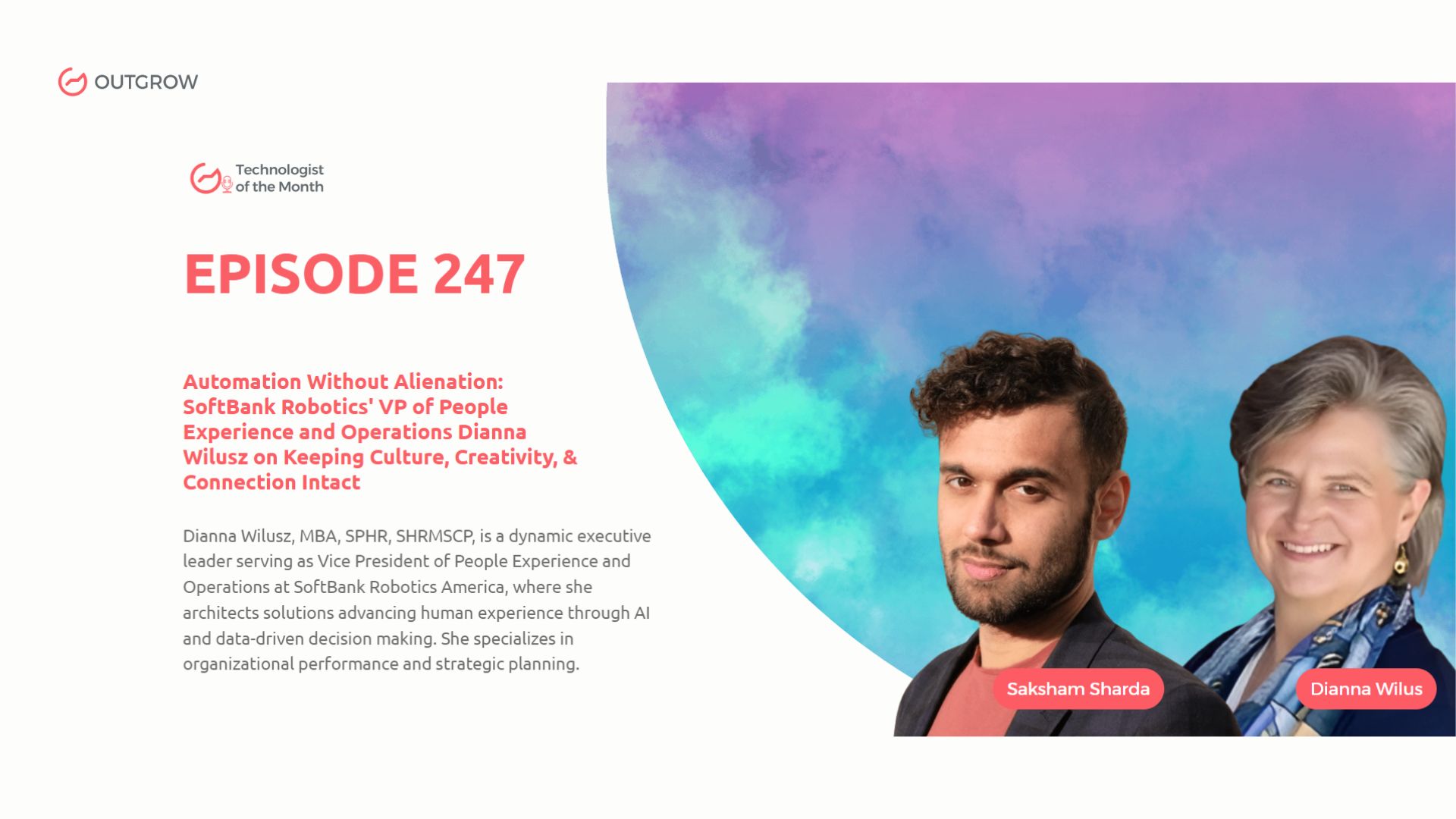
EPISODE 247: Marketer of the Month Podcast with Dianna Wilusz
Table of Contents
Hey there! Welcome to the Marketer Of The Month blog!
We recently interviewed Dianna Wilusz for our monthly podcast – ‘Marketer of the Month’! We had some amazing, insightful conversations with Dianna, and here’s what we discussed about-
1. The intersection of humanity, robotics, and emotional intelligence
2. Three levels of AI integration in organizational structures
3. Handling employee resistance to automated systems with empathy
4. The future of employee experience in AI-augmented workplaces
5. Building trust through transparent AI communication strategies
6. The importance of patience in AI adoption journeys
7. Emerging tech trends reshaping human potential in workplaces
About our host:
Dr. Saksham Sharda is the Chief Information Officer at Outgrow.co He specializes in data collection, analysis, filtering, and transfer by means of widgets and applets. Interactive, cultural, and trending widgets designed by him have been featured on TrendHunter, Alibaba, ProductHunt, New York Marketing Association, FactoryBerlin, Digimarcon Silicon Valley, and at The European Affiliate Summit.
About our guest:
Dianna Wilusz, MBA, SPHR, SHRMSCP, is a dynamic executive leader serving as Vice President of People Experience and Operations at SoftBank Robotics America, where she architects solutions advancing human experience through robotics, AI, and data-driven decision making. As CEO and Founder of The Pendolino Group since 2009, she specializes in organizational performance, leadership coaching, and strategic planning. With over 75 years of collective team experience in human resources and executive leadership, Dianna focuses on integrating AI technology with humanity while revolutionizing workplace culture and propagating excellence in leadership and innovation across diverse industries.
Automation Without Alienation: SoftBank Robotics’ VP of People Experience and Operations Dianna Wilusz on Keeping Culture, Creativity, & Connection Intact
The Intro!
Saksham Sharda: Hi, everyone. Welcome to another episode of Outgrow’s Marketer of the Month. I’m your host, Dr. Saksham Sharda, and I’m the creative director at Outgrow. co. And for this month, we are going to interview Dianna Wilusz, who is the VP of People Experience and Operations at SoftBank Robotics.
Dianna Wilusz: Great to be here. Thank you.
Don’t have time to read? No problem, just watch the Podcast!
Challenge yourself with this trivia about the exciting topics Dianna Wilusz Top Explores covered in the podcast.
Or you can just listen to it on Spotify!>
The Rapid Fire Round!

Saksham Sharda: Okay. Let’s start with the rapid-fire round, just to break the ice. Sure. First question is, at what age do you want to retire?
Dianna Wilusz: Now
Saksham Sharda: How long does it take you to get ready in the mornings?
Dianna Wilusz: About 30 minutes.
Saksham Sharda: Most embarrassing moment of your life.
Dianna Wilusz: Walking into the men’s restroom at my first job.
Saksham Sharda: Favorite color?
Dianna Wilusz: Yellow.
Saksham Sharda: What time of day are you most inspired?
Dianna Wilusz: That would probably be about 7:00 PM
Saksham Sharda: How many hours of sleep do you like to get?
Dianna Wilusz: I’d like to sleep more than I do.
Saksham Sharda: The city in which the best kiss of your life happened?
Dianna Wilusz: San Francisco.
Saksham Sharda: Pick one. Mark Zuckerberg or Elon Musk.
Dianna Wilusz: Mark Zuckerberg.
Saksham Sharda: How do you relax?
Dianna Wilusz: Reading.
Saksham Sharda: How many cups of coffee do you drink per day?
Dianna Wilusz: No caffeinated drinks.
Saksham Sharda: A habit of yours that you hate?
Dianna Wilusz: That’s a tough one.
Saksham Sharda: The most valuable skill you’ve learned in life?
Dianna Wilusz: To be curious.
Saksham Sharda: Your favorite Netflix show.
Dianna Wilusz: Can I go to Apple Plus? Ted Lasso
Saksham Sharda: Are you an early riser or a night owl?
Dianna Wilusz: Both.
Saksham Sharda: One-word description of your leadership style.
Dianna Wilusz: Inclusive
Saksham Sharda: Coffee or tea to kickstart your day.
Dianna Wilusz: Decaf coffee.
Saksham Sharda: Top priority in your daily schedule.
Dianna Wilusz: Having fun.
Saksham Sharda: Ideal vacation spot for relaxation.
Dianna Wilusz: My goodness. Name one
Saksham Sharda: Key factor for maintaining a work-life balance.
Dianna Wilusz: Reading.
The Big Questions!

Saksham Sharda: Great. That was the end of the rapid fire. Now we are gonna move on to the longer questions, which you can answer with as much time and ease as you like.
Dianna Wilusz: Alright.
Saksham Sharda: The first one is, how do you envision the evolution of human and robot collaboration in the workplace over the next decade? And what role does emotional intelligence play in this transformation?
Dianna Wilusz: From my perspective, I think that we’re in a very rapidly changing period of time, and it’s really a confluence of humanity and robotics that I see happening, that emerging of it and the emotional aspect, I think, is what really gives it that vibrancy and is a critical aspect for us to continue to develop as humans. And also just how we think about integrating robotics.
Saksham Sharda: And how do you measure the success of human-robot integration initiatives within an organization?
Dianna Wilusz: I would go about measuring it in terms of human productivity and engagement, and really go from that angle to the degree that the robotics helps spark more curiosity with humans. I think that’s an important aspect. So the more that we can measure that, I think that shows our progress.
Saksham Sharda: And what specific skills should HR professionals, for instance, develop to effectively manage hybrid teams that include both human workers and robotic systems?
Dianna Wilusz: Yeah, I think it’s really important for HR people to, one, get over their fear of robotics and stop thinking that robotics has a lot to do with technology, and really be thinking about it from that integration perspective. Also, what I call crossing the technology threshold and getting in and trying things out. So I’m a big proponent of utilizing generative AI, getting in, discovering, asking questions, learning, and being curious about it from that perspective. And, you know, don’t be afraid to try it.
Saksham Sharda: And what ethical frameworks should organizations adopt when implementing AI and robotic solutions? Does that directly impact human employment?
Dianna Wilusz: Yeah. You know the human overlay is a piece that I think is absolutely critical to keep in the framework. So that aspect of always having the human touch, always ensuring that there’s a human element or human review of information before anything goes out the door. Not relying too heavily on technology to do more than the first, second, and third pass. So always bringing that human element in, I think, is an absolutely critical piece of the ethical dilemma.
Saksham Sharda: Where are you headed next in terms of organizational structure as AI and robotics become more prevalent in traditional business functions?
Dianna Wilusz: I think it’s more the integration. So if I think about the AI integration into an organization, my framework is that there are really three levels of that. One is AI in the product, one is AI in terms of its ability to help us be more efficient and more effective, and then AI as a skill set for individuals. And so, just really looking at it from that perspective. And I think about the organizational development; it’s both the business strategy and market impact, as well as the human skill aspect. So I think about it from that perspective.
Saksham Sharda: What new organizational roles do you predict will emerge with AI and robotics integration?
Dianna Wilusz: Most definitely around the ethical component. How to utilize the tools inside the organization, again, from the human aspect, thinking about it from that perspective. So, compliance elements maintain the confidentiality of information when you’re using OpenAI systems. And then also the applications. And, you know, this is the spot where developing critical thinking, kind of that, that role set is being able, from a leadership standpoint, to spot those opportunities in encouraging people to explore new areas as well that are perhaps outside of their traditional professional genre, if you will. So really expand that. I think of it a little bit like a bridge between the technology and the human aspect. And the more that our leaders can continue to develop that level of understanding and awareness; I think that that’s incredibly powerful.
Saksham Sharda: So, from a business strategy perspective, then, how do you help organizations identify which processes are best suited for robotic automation versus those that require the human touch?
Dianna Wilusz: Yeah, you know, from a business strategy standpoint, I think the traditional ones that we tend to look at are customer success or customer service, if you will. Sales, internal operations, logistics. Those components, I think, are easy areas, if you will, or maybe low-hanging fruit in terms of bringing automation in. I think there are other areas that are internal service organizations that can even utilize AI much more. So you know, I guess from that perspective, there are really no functional areas or customer-facing or internal-facing roles that can’t benefit from AI, especially as we look at AI as a way to help accelerate us to decisions, right? Being able to get good information, test that information, apply critical thinking to it, and make decisions faster. I think there’s tremendous benefit from a customer value perspective as well as from an internal operational perspective.
Saksham Sharda: And how do you handle resistance from employees who feel they are being replaced by automated systems?
Dianna Wilusz: I’m a huge proponent of crossing the technology threshold. Being able to demystify the technology, demystify generative ai, agententic ai, showing how that can really help our employees be able to utilize the tools to take care of some of the more redundant activities and redundant tasks, or tier one, if you will, responses so that they can uplevel their game and, helping them again, you know, cross over that technology threshold, get their hands on it, and realize that it’s not the technology that’s going to take somebody’s role away from them. It’s people knowing how to use the technology that’ll take your role away. I think that’s really an important piece.
Saksham Sharda: So, how’s the entire future of employee experience itself going to change?
Dianna Wilusz: Yeah, I think it’ll become a lot more fun actually. Of course, I’m predisposed towards utilizing technologies myself. And so from that standpoint, I think that with the technologies, we’re going to see more and more technology coming into the work environment, and some of it will just naturally occur, from a disruptive perspective. I, you know, there will be some disruptive technologies. It will change the way that work. What that looks like remains to be seen. You know, I think that the way these organizations are handling their change management, where they’re literally creating a shadow organization that’s native AI as a way to evolve their business and then blending the historic organization into that new organization, I think it’s a really profound way to look at change management. Uso, you know as I said, there’ll be some disruptive pieces for people, but I truly believe AI is not here to replace; it’s here to augment, and there will always be the need for that human element. And that’s, that’s the thing that I get excited about.
Saksham Sharda: As AI becomes more augmented and sophisticated, and understanding consumer behavior. How should marketing strategies evolve to maintain authentic human connections while leveraging technological capabilities?
Dianna Wilusz: You know, the evolution of marketing I mean, we’ve all been affected by it, right? You know, our buying profile is well known. If we go on to any social media environment, for example or ad revenue as part of their revenue model, right? You know, just from that standpoint, we’ve been profiled, right? The evolution of that marketing, being able to really bring in the human aspenk, is important. And so having that layer of humanity, that layer of human connection, I think not only deepens and brings credibility to the marketing, but it also brings trust to that relationship. And at the end of the day, I believe the adage remains the same that people buy from you because they trust you. So to the degree that businesses can develop trust and really establish trust and demonstrate that they are not necessarily selling to the consumer, but they’re taking the consumer’s best interest in mind, those are some of the aspects that will really drive marketing in the future. So it’s almost like bringing the human element back into an environment where I think we’ve had a lot of data and analytics and driving marketing historically in the past.
Saksham Sharda: So speaking of trust, then, do you think the brand itself will play an important role going forward?
Dianna Wilusz: Yeah, most definitely. I think brand is absolutely critical. And what that brand represents, the history of that brand, how it positions itself to the consumer, not how it positions itself necessarily to a market, but how it positions itself to the consumer, to the individual. I think that brand is absolutely critical.
Saksham Sharda: In your experience with robotic solutions across industries like education, hospitality, and finance, what unique challenges does each sector present, and how do you tailor your people experience strategies accordingly?
Dianna Wilusz: Yeah, you know, well, I think in all of those sectors, there are disruptors as well. I’ll give you an example. In the financial management space, you know, historically, I would sit down with my financial advisor, and I would give certain parameters: here’s my age, here’s my current savings plan, you know, here are the numbers, so to speak. And it might take them a week or two to kind of crunch through the numbers and come back to me with a recommendation. Just last weekend, I spent a few hours with ChatGPT and just ran through a series of questions and developed my own model where I can project out for the next 30 years what my spending pattern looks like, what my savings pattern looks like, and what my assumed returns are, and I laid all of that out. And did that, built that in about three hours, and ultimately was able to change parameters and see how the results ended up with a 30-year projection, right? So that’s an example of a disruption in a certain market, in the financial planning market. However, from that standpoint, what it means is that now with my financial manager, I’m able to come to the table much better educated. So from that standpoint, as a consumer in that market, there’s a stronger education that I’m bringing to have a much more robust conversation. Similarly, that starts to apply internally in the employment environment, right? So to the degree that I’m able to help our teams really understand how to utilize the technologies at those three levels that I talked about earlier, understanding the applications starts to develop again, that critical thinking perspective, right? And so that critical thinking creates a much more robust environment for how we’re working together as colleagues and how we’re able to understand cross-functionally the different environments and really deepen that level and deepen that connection. So I think ultimately it has the potential of building much stronger cultures, and again, those cultures are around curiosity and innovation and how we use certain technologies. So I can see on multiple levels how it really has a positive impact from an employment perspective as well.
Saksham Sharda: Which industry has shown the most receptive receptiveness to robotic integration, and what factors contributed to that success?
Dianna Wilusz: That’s a great question. You know, from my perspective, I think the industries that have seen the most robotic integration are probably the manufacturing industries in those spaces. So, you know, when I get into the manufacturing environments, I think we’re seeing the robotics naturally integrated because we have more of the traditional structures, the assembly lines, for example. It’s the repetitive tasks and repetitive actions. In industries where we’re just starting to see more robotic adoption, I think we’re getting into industries kind of similar to what we’re involved with in the cleaning space. And so in that cleaning space, it’s a historic industry. It’s a historic broom, closet, and bucket industry. And being able to bring robotics into that space and truly start to transform it, I think, allows us to demonstrate what’s possible where we’re augmenting a workforce; we’re really being able to take an existing workforce, augment it with robotics, and upskill that team so that the end product, the result, is much more robust. And that’s an important measure as well, as we’re looking at those markets and where they can really evolve that way.
Saksham Sharda: So let’s invert the question. Which industry has shown the least receptiveness to robotic integration? And what factors contributed to that?
Dianna Wilusz: Absolutely. You know, I think that it’s probably more in the service space. So I’ll even reflect on the human resources industry, you know, if I will, from a professional standpoint. I think that where we’ve seen AI and technology be introduced has been more at the systems level, where we haven’t seen much in the way of robotics. It’s, you know, it just takes something simple like onboarding new employees. You know, why aren’t we utilizing robotics even more so in that environment? So short of automating or bringing onboarding online, for example, you know, why don’t we have a robot that’s sitting there side by side with a new employee and is helping to do orientation, helping to get them familiar? So literally in that environment, having robots working side by side with employees. So it’s something that I envision for the future again, if I think of HR as an industry.
Saksham Sharda: And how do regulatory differences across industries affect your approach to implementing robotics solutions?
Dianna Wilusz: I think that the regulatory elements of the data protection probably become even more robust or important. You know, when we look at places like the legal industry or the finance industry, or again, the people, industries, the human resources in those spaces, there’s such a deep level of data that’s being managed at the personal level that I think the data security and the trust that that data is secure. And the idea of robotics kind of being an extension of data management, you know, I think that probably has made it a little bit slower to introduce robotics into those environments. Similarly, you know, sitting side by side or across from a robot in that environment, a humanoid, you know, kind of working through those pieces again, you know, what does it take for me as a person to get comfortable with a humanoid and be able to sit and just have that conversation and share and trust that what I’m sharing is being held? Truth is probably, in a lot of cases, it’s beingwithheld with an even greater confidence than sitting across from another person. But, you know, it’s, be honest. It’s more comfortable for me to sit across from another person, the familiarity and having those kinds of conversations today, than it is for me to sit across the table from a robot and have those conversations. There’s still that little bit of cognitive dissonance that happens, if you will.
Saksham Sharda: How can organizations then effectively communicate their AI and robotics initiatives to both internal stakeholders and external customers to build trust and acceptance?
Dianna Wilusz: Yeah, I mean, you know, the communication,I think that theme of trust and reliability, confidentiality, and those themes are extremely important. The ability to be able to demonstrate that there are checks and double checks, really that robust backstop, as I call it make sure that that information is held in confidence regardless of the audience that’s being communicated to. It’s external; a customer truly understands that that relationship is most important, that relationship between the brand and the consumer, that’s the relationship that’s being protected. And to the degree that we can communicate that with all of our audiences, again, whether it’s a relationship internally with employees or a relationship externally with clients, that element of trust and reliability is important. You can trust our brand. We happen to utilize robotics integrated into the work that we do and the services that we deliver.
Saksham Sharda: How do you balance transparency about AI capabilities with maintaining a competitive advantage in marketing communications?
Dianna Wilusz: Yeah. You know, I think it’s the same story as it always has been, right? There’s just so much that you disclose. I think it’s also important in the world of robotics, and I’ve heard quite a bit of that here at the event about ensuring that you don’t oversell being grounded, being clear and realistic about what you are offering and what’s available today, and being clear about what the future might hold, what the future can hold. So, you know, in forecasting that, and, you know, we’re all here thinking about what the future holds? What are the opportunities that are ahead? And I think that’s really important in the languaging. Quite often, you know, in some of the circles and conversations here, you know, I’ve heard people talk about, you know, representation. Is it real? Can that robot really fold my shirt, for example? And, you know, there are certain things, and I think that’s always been true in technology. There’s the promise of, and then there is what’s available and what’s really here today. And then there’s an appreciation for where we’ve come from. And I think that there are some powerful stories to be told in all of that. And being really clear about what is real today and what is potential in that conversation, I think, is extremely important.
Saksham Sharda: So what does your typical day at work look like? You wake up in the morning and then?
Dianna Wilusz: So I wake up in the morning, and probably like most everybody else, I’m immediately on my iPhone. I’m immediately checking the email, mail, seeing what kinds of information might have come across, or what inquiries or requests might have come across from Slack, and having those conversations. And then it’s thinking about who we are bringing onto the team. Recruiting is a big aspect of my day, and, you know, who are we bringing onto the team? What does that profile look like? You know, the people that I’m talking to as potential new hires coming onto the team, what is their fluency in the world oAIai in the world of robotics? How comfortable are they in that environment? How curious are they, you know, do they ask really powerful questions? And how, and there’s the human element, right? How human are they, how connected are they?
Dianna Wilusz: So recruiting is a big aspect of what I spend my time doing. And then, you know, the internal reflection is on what are the things that I’m doing from an IT standpoint and from an HR standpoint, what are the things that I’m able to do to serve my internal clients to make sure that our systems are as robust as possible, to make sure that our response times are clear. You know, I really think about it as because I’m on the service side, I really think about it in terms of how well can I keep concerns about HR or IT or payroll or benefits, keep those concerns off the table so that the team’s able to focus on what they’re creating. And to the extent that things are quiet on the HR and the IT side, then I know that my teamise doing a good job.
Saksham Sharda: And how much of what you said about your work now can be augmented or replaced by AI or robotics?
Dianna Wilusz: I think it’s a great question. You know, I think that certain elements can be replaced. So for example, you know, I dream about that, that element of the onboarding rather than me sitting on the other side of a Zoom meeting with somebody and providing an overview of the team and our organization and all wouldn’t it be cool if, you know, a new hire that we just brought on and, you know, across the, across the states you know, I can send one of our bots over there, or, you know, one of our robots over there, one of our peppers or something like that, and, you know, and have that there with them side by side, and they actually have a sense of a connection, more of a connection that way, right? So I think that there are always opportunities. It’s just how fast we can move.
Saksham Sharda: How do you see the competitive landscape evolving for companies that embrace robotics early versus those that take a more cautious approach, particularly in customer-facing applications?
Dianna Wilusz: Yeah, I, you know, this is one of those areas where I just, I see things have shifted, and they’re moving so fast. I shared a story when I was speaking yesterday of a colleague from a whole othercompany stwho arted, had a startup. He and a friend spent two years developing a ChatGPT-typeenvironment, an LLM. And that environment was designed to house HR policies to help do queries, to be able to look at Slack conversations, and provide sentiment information, and really help leadership teams kinda move forward with that. And then to help employees be able to find answers quickly around unique policy sets. I share that with you because it took them two years to do that. Last week, a colleague of mine actually developed the same thing, a similar approach utilizing ChatGPTas the platform, and rolled that within one week. And so that’s how fast the technologies change. You know, which is why I think it’s really important for organizations to leap to embrace the technologies and to learn and to start trying things out. Confidentiality’s highly important. You touched on that earlier, one of the earlier questions. Maintaining that confidentiality is important. And you know, as you’re learning these tools, one of the things that I love about generative AI in particular is that it will teach you those tools, will teach you how to use them, and they will teach you how to write good prompts. So this is the first time that I can recall that the tools being introduced to us actually teach us how to use them. And I think that in itself is extremely powerful. Why? Because that means that the application, how quickly I can take a tool, learn it, and apply it to the work I’m doing today, has accelerated exponentially. So from that standpoint, my guidance is to jump in, start learning the tools, encourage the use of the tools, just get in there and try it. If we take too much of await-and-seee approach, the world will pass us by. And I think that things are moving so fast that companies just can’t, can’t afford to do that.
Saksham Sharda: How do you help companies develop realistic timelines and expectations for robotics implementation ROI?
Dianna Wilusz: You know, the realistic piece of things, things will always appear that they can go faster than in reality, right? And having patience, I think, is also extremely important. So while I encourage jumping in, crossing the threshold, getting in, start utilizing tools, see what they can do, see how they can help you, I think that it’s also important to have an element of patience. And especially, I mean, we’re talking about the human aspect. And so recognizing that we have people in the workforce today that are native AI, you know, they have been in that environment, they grew up in that environment. They certainly went to school in that environment. And so it’s much more ingrained as a matter of practice. And then we have others that are seeing this for the first time and are maybe just now learning that ChatGPT even exists. You know, there, there’s sometimes when I’m speaking, a d I’ll ask people, you know, did you use chat today or, or cloud or any of the other generative AI tools? Did you use it today? And it’ll still be three-quarters of the room raises their hand, and another quarter doesn’t. You know, and I ask the question, have you used it? Sometimes I’ll still get a fifth of the room that will not raise their hand because they just haven’t done it yet. You know, I haven’t gotten into it. Typically, that’s because of a fear factor. I don’t hear as much that it’s a fad. I think we’ve gotten past that phase, but still a fear factor. And that fear factor is more. My impression is that it’s more about simply not knowing what’s possible rather than a fear that somehow these tools are going to take over my job.
Dianna Wilusz: “So we can hear how we help people, and this is why I say patience is really important.” Have the roadmap, have the goals, encourage the use, and then have patience in terms of the adoption, as it is in many respects working side by side with bots and working side by side utilizing GenAI. So a lot of those tools sometimes are more habitual. Now, those technologies that you have embedded inside of your operations those technologies are a lot easier to roll out. You can take more of the approach of “This is something we’re doing as a company, and we roll it out, and then we train people on its use” or “It’s already embedded organically in the organization.” But I think the patience element is really important. Because in this environment, now we’re dealing with robotics, and we’re dealing with the human aspect. Historically, we might’ve been dealing more with the human aspect, right? So now we’re bringing in an element of the technology that I think, you know, from what I’ve observed, once people understand, they get past the threatening, quote unquote, threatening part, and they actually are fast, fast adopters because it becomes fun.
Saksham Sharda: So, looking toward the future, then, what emerging technologies or trends do you believe will have the most significant impact on how we think about the relationship between tech and human potential in the workplace?
Dianna Wilusz: You know, I think that it’s just the evolution of the technology; it’s ubiquitous. It’s already, you know, we are already becoming dependent on the technologies that we’ve built. We already are in many, many aspects. And, you know, I think that it’s an exciting time for us. So those are aspects of the technology where we can integrate robotics into environments that traditionally haven’t had robotics as a part of them, and really envision bringing together certain environments that historically, you know, mowing lawns, for example, historically have not had robots associated with them. Bring those robots in. We can start to see how that natural integration just kind of accelerates the humanity aspect.
Saksham Sharda: Alright, so the last question for you is of a personal kind. What would you be doing in your life, if not this?
Dianna Wilusz: Yeah. Traveling the world. I love traveling, getting out, and, you know, this is the human aspect for me. You know, being able to connect with different cultures, really seeing what the human experience is like. And, you know, let’s be honest. I mean, there are so many things that I’ve interacted with over the course of even just getting here today that have a robotics element built into them. They have an AI element built into them, and, you know, some of those things, you just don’t even realize. But when you pause and reflect on it, you realize how integrated so many technologies are. And I still get fascinated, you know, I walk through an airport, and I see, you know, a service delivery robot that’s, you know, cleaning the floor or, you know, maybe collecting dishes at the airline club. You know, I see that, and I still get fascinated. There’s that childlike wonder that comes about. So I’d be traveling the world and continuing to meet people and learn about cultures, and then, you know, seeing how robotics all bakes into it.
Let’s Conclude!
Saksham Sharda: Thanks, everyone for joining us for this month’s episode of Outgrow’s Marketer of the Month. That was Dianna Wilusz, who is the VP of People Experience and Operations at SoftBank Robotics.
Dianna Wilusz: Great to be here. Thank you.
Saksham Sharda: Check out the website for more details, and we’ll see you once again next month with another marketer of the month.

I am a Digital Marketing Enthusiast with a passion for optimizing content and paid marketing strategies. Continuously seeking innovative approaches to boost ROI and engagement at Outgrow.