2026 Lead Generation Trends Your Blog Can’t Ignore (And How Outgrow Helps You Win)
Introduction
Table of Contents
Let’s face it – many blogs are still using the exact lead gen techniques as 5 years ago. The blog banner “Download Our Free Guide”, a pop-up form after 30 seconds, and the same old CTA on each blog post. Then the question is asked – why doesn’t anything change, and conversions don’t improve?
The reality is that the interaction with your content is getting more complicated and requires you to adjust to the changes. In 2026, the leading blogs won’t be those that publish the most posts. Blogs with interactive lead-gen content will attract the most leads.
“Future of marketing lies not in humans versus AI. But in humans with AI,” the statement defines all trends in lead generation in 2026. Now it’s not necessary to have huge budgets and special marketing knowledge to create personalized and interactive lead gen. Tools for lead generation are becoming increasingly affordable for every blogger out there.
In this post, we talk about the top 5 lead generation and demand generation trends in 2026, which are worth considering for bloggers and content marketers, how the technology behind Outgrow leads gen helps to increase lead gen effectiveness, and provide some examples.
Why Lead Generation Trends in 2026 Are Hitting Differently
Recall the factors that made some lead generation strategies successful during their time. Email opt-in forms were highly successful during a time when people’s emails were not flooded with messages. Likewise, gated PDF lead magnets were effective when gated content was still seen as exclusive. Facebook Lead Ads were successful when audiences were new, and social media targeting was cheaper.

None of these strategies has become obsolete. Modern inbound marketing strategies now focus on delivering value through personalized experiences rather than relying only on gated content. However, their effectiveness has been reduced due to changes in how buyers behave. Specifically, three critical factors have caused such significant changes in buyer behavior:
First, modern blog readers are highly impatient. It would be highly unattractive for someone who landed on your blog through organic search to give away his/her email address in exchange for getting a response from a sales rep after two days.
Second, personalization became a norm. Modern consumers expect companies to know them even before they land on the website. So, if you are treating them as new visitors, you will lose their interest quickly.
Lastly, trust today can only be gained through interaction. This means that simply providing information does not work anymore. Companies must provide their potential customers with reasons to interact with their brand.
These three shifts are the foundation underneath every lead generation trend worth paying attention to this year.
Traditional vs Modern Lead Generation
Traditional vs Modern Lead Generation reflects how buyer expectations have evolved over the last few years. While traditional tactics like static forms and downloadable PDFs can still generate leads, Traditional vs Modern Lead Generation demonstrates that interactive experiences, AI-powered personalization, and real-time qualification consistently drive higher engagement and better conversion rates. For businesses looking to maximize blog performance, Traditional vs Modern Lead Generation is no longer a debate but a shift toward creating value before asking for visitor information.
The Big 4 Lead Generation Trends Shaping Blogs in 2026
2025 vs 2026 Trends
Comparing 2025 vs 2026 Trends makes it clear that lead generation has moved beyond basic automation. While 2025 focused on improving workflows, 2025 vs 2026 Trends highlight the growing importance of AI-driven personalization, interactive content, and buyer qualification within the blog experience. Businesses that adapt to 2025 vs 2026 Trends will be better positioned to convert blog traffic into qualified pipeline and long-term customer relationships.
1. AI-Driven Personalization Inside Blog Content
A few years ago, AI personalization on a blog meant showing related posts at the bottom of an article. In 2026, that’s barely scratching the surface.
The lead generation trends being driven by high-performing teams right now involve AI working inside the content experience itself. Content blocks that change based on where a visitor came from. Recommendations that adjust based on what someone has already read. Copy variations that test different messages across different audience segments without anyone manually setting up an A/B test.
The outcome isn’t just higher engagement numbers. It’s better-qualified leads arriving in your pipeline because the content they experienced was actually tailored to their situation. These personalized experiences also strengthen demand generation by creating trust before the first sales conversation. A visitor who reads three posts customized to their specific role and company size behaves very differently from someone who bounces off a generic article.
2. Interactive Content as the New Lead Magnet
Interactive tools have become a cornerstone of successful inbound marketing because they encourage participation instead of passive consumption. The PDF lead magnet was long-lasting. However, considering current trends in lead generation strategies within both B2B and SaaS companies in 2026, there can be no doubt that interactive content is going to dominate the industry when it comes to converting blog traffic leads.
This is due to several practical benefits that make it difficult to ignore:
- The visitor actually participates instead of downloading something they’ll open once and forget
- You get real buyer intent data: their choices, their budget range, their specific pain points
- The result feels personalized because the inputs came directly from them
- Opt-in rates trend higher because the value exchange feels fair and immediate
There is software out there that allows marketers to create high-quality interactive content even without a developer. This means that you create a quiz in the software, then copy a snippet of code, and just paste it into your blog post. And it’s ready.
3. Conversational Marketing That Lives on the Blog
One of the more interesting lead generation trends to watch in 2026 is how conversational marketing has moved from landing pages and sales pages onto the blog itself.
Instead of asking readers to click away to a separate page with a static form, conversational tools bring the interaction directly to where the reader already is. An embedded chatbot that asks a single qualifying question. It’s an interactive format that mimics natural conversation. A call-to-action like “Tell me what you’re looking for” that starts a dialogue and doesn’t necessitate any page navigation.
What really changes here is the amount of friction. Less friction between browsing and conversion. Real-time qualification ensures that your sales team receives fewer cold leads. And as this interaction takes place during active engagement with your content, it produces the warmest leads possible.
4. Qualifying Your Audience Before They Hit Your CRM
Of all the lead generation trends in 2026, this one has the most direct impact on sales team performance, and most blogs are still ignoring it completely.
The standard approach: visitor reads a post, sees a form, fills it out, becomes a “lead,” and then your team spends the next week trying to figure out if they’re worth calling. But this is costly, time-consuming, and demoralizing for a sales team trying to close deals.
The methodology that will take off in 2026 will reverse this order of operations. Quiz questions, assessment tools, and branching logic will collect qualification details organically as people interact with your content. Even before they hit submit on their contact details, you’ve collected insights into their firm size, budget range, job function, and the challenge they face. This information is especially valuable for account-based marketing teams that prioritize high-value prospects.
This doesn’t just improve lead quality. It changes how sales conversations start. Reps go in with context instead of cold-calling someone who downloaded a PDF and forgot about it.
Humans With AI: Why the Best Lead Gen in 2026 Is a Hybrid
Here’s where the nuance matters. The “AI will automate everything” take is overhyped, and the “AI can’t replace real marketing” take misses what AI is actually good at. The truth sits somewhere more practical.
AI is genuinely excellent at the parts of lead generation that are repetitive and data-intensive. Scoring leads based on behavior. Personalizing content variations at scale. AI also supports account-based marketing by helping teams personalize outreach using qualification data. Automatically triggering follow-up sequences based on their activity or inactivity. Doing this workflow manually would need a whole team. Now, a two-person marketing team can set it up in a week. Businesses are increasingly relying on AI Development Services to build smarter, faster, and more scalable lead generation systems that improve efficiency and conversion rates.

What AI still can’t replicate is the stuff that actually builds trust with real buyers. Your brand’s specific voice. The strategic judgment behind your content positioning. The empathy in a follow-up email that references something a prospect specifically mentioned. The story in a case study makes a potential customer see themselves in someone else’s success. Those still require a human.
The practical version of this on a blog: an AI-powered quiz surfaces the right product recommendation for each visitor based on their answers. A human sales rep follows up, referencing exactly what that visitor said they were struggling with. The AI creates the personalized moment. The human makes it feel real.
That’s the model behind every platform built for interactive lead generation right now, including Outgrow.
How Outgrow Fits Into the Lead Generation Trends of 2026
Outgrow is a no-code platform for building quizzes, calculators, chatbots, and assessments that live inside your blog. No developer needed, no technical setup headaches, no waiting on a sprint to get something live. Here’s what it actually does for blog-based lead gen:
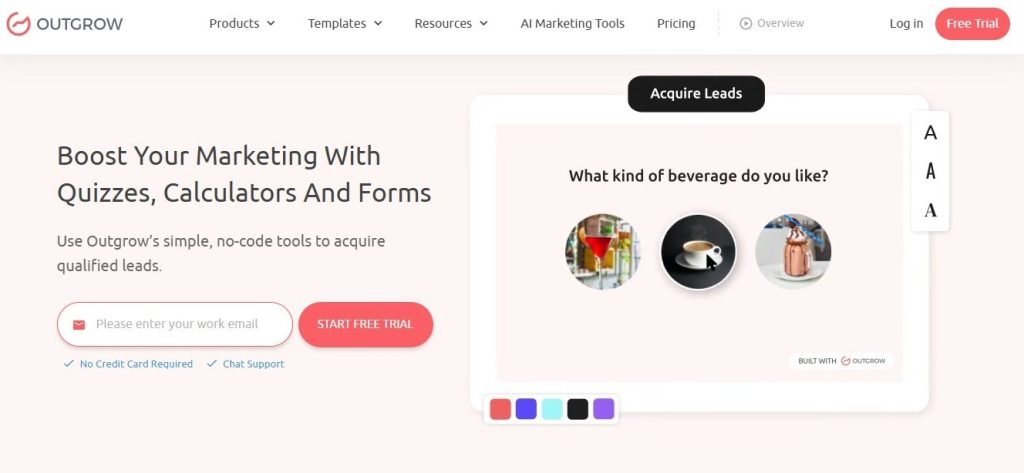
It converts a static blog post into something readers interact with. A post comparing marketing automation tools gets dramatically more useful when there’s a “Which tool fits your workflow?” quiz embedded right after the main content. Readers get a personalized recommendation without leaving the page. You get a lead with context attached.
It gathers qualification data before anyone submits a form. The responses also reveal strong buyer intent, helping sales prioritize the right opportunities. You define what a qualified lead looks like for your business, and Outgrow’s quiz or assessment collects that information through the experience itself. Company size, role, budget, primary use case, all of it surfaces naturally through a five-question quiz that readers actually want to complete. These insights make account-based marketing campaigns significantly more relevant from the very first touchpoint.
The solution seamlessly integrates into the existing platform of your choice. Be it WordPress, Webflow, HubSpot, or Salesforce – simply grab the embed code and you’re up and running. Leads come through to your CRM automatically, along with all the qualification information that goes along with them.
It gives your team real testing capability without dev involvement. Different quiz formats, different calculator inputs, different chatbot openers, you can test any of them without filing a ticket.
Outgrow is used by marketers and SaaS brands to turn blog visitors into high-intent leads through interactive, no-code tools that sit right on the page. For any team trying to act on the lead generation trends of 2026 without adding technical complexity, it’s one of the most direct paths from “blog that gets traffic” to “blog that generates pipeline.”
The Outgrow Calculator Maker: Why Calculators Convert So Well
Calculators don’t get enough credit in the interactive content conversation, and the Outgrow calculator maker is worth calling out specifically because this format consistently outperforms other interactive tools for certain types of blog content.
Here’s the core reason calculators work: they give visitors a specific, tangible number they actually care about. Not a generic recommendation. Not a “you scored 72 out of 100.” A real number that has direct relevance to a business decision they’re already thinking about. How much could they save? What would their ROI look like? What does their current approach actually cost them?
When someone gets a genuinely useful number from your blog, two things happen. They trust your brand more because you helped them with a real question. And you now have intent data that no standard form could capture, because the inputs they entered to get that number tell you exactly what their situation looks like. Those responses provide valuable buyer intent signals that traditional forms simply cannot capture.
Outgrow’s calculator maker handles all of this visually. You determine what the inputs are, the mathematical equation, and the output, and the calculator takes care of all the computations. It is entirely up to you whether you wish to present the calculation through email or not.
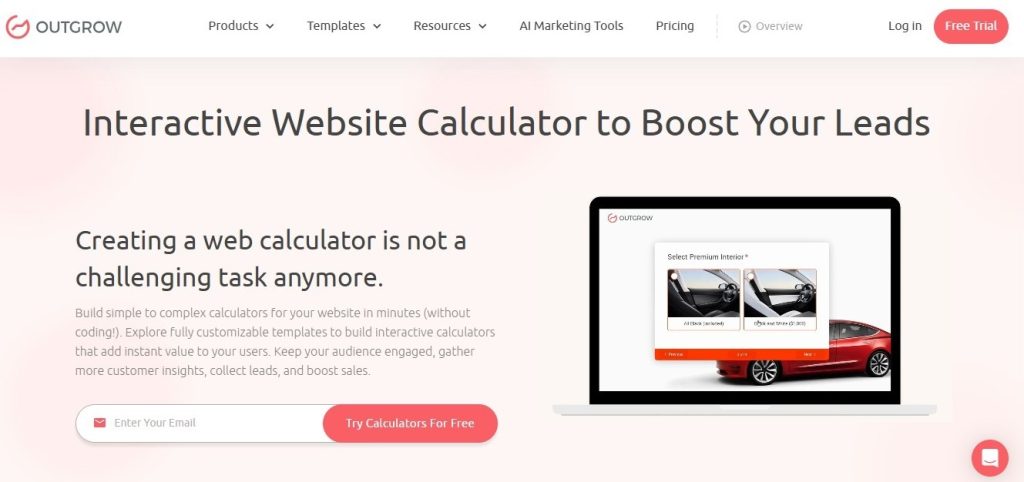
Some calculator formats that drive consistent lead gen results:
- “How much could you save switching to our tool?” on a SaaS comparison post
- “What’s your estimated cost per lead right now?” on a paid media strategy post
- “How much is employee churn costing your company?” on an HR software blog
- “What’s the ROI of adding interactive content to your blog?” on a content marketing post
Every one of those is a qualification tool wearing the clothes of a value tool. That combination is genuinely hard to beat.
Getting Your First Interactive Lead Magnet Live: A Practical Starting Point
If you’ve been reading this and thinking “okay, but where do I actually start,” here’s the honest answer: pick one blog post, pick one interactive format, and get something live this week. Not next quarter. This week.
Here’s a straightforward approach that applies no matter what tool you decide to go with, Outgrow, a free quiz creator, free survey creator, or free form builder that you have access to already:
Take the question your target audience is already asking in that particular piece of content. Not just any general subject, but the exact question they’re typing into Google before arriving at that page. “What marketing automation software should I choose?” “How many dollars am I wasting on paid traffic?” “Is my content marketing strategy paying off?”
Connect the result to something you offer. The quiz result or calculator output should naturally point toward the next step connected to your business.
Early-stage buyer?
Point them to a resource or guide. High-budget lead who just calculated significant potential savings? Point them toward a demo or a consultation.
Keep the process brief. Between five and seven questions is the sweet spot at which response rates remain high for the majority of blog readers. In cases where further information is required to make accurate recommendations, use branching questions that allow for customized follow-up rather than an extended questionnaire.
Ask for the email right before revealing the result. Build a bit of anticipation, show a progress bar, and then present the email capture as the final step before the result appears. Most visitors accept this trade when the quiz or calculator has already felt worth their time.
Get the data into your CRM from day one. The whole reason to use interactive content over a standard form is the richer data you capture. If that data doesn’t flow downstream, you’re leaving the most valuable part of the tool on the table.
This approach works whether you’re using a paid platform or a free online survey tool, a built online form solution, or free forms online. The format you choose matters less than the alignment between the question you’re asking and the offer waiting at the end.
5 Real-World Use Cases for Interactive Lead Generation
Use Case 1: SaaS Product Selection Quiz
A mid-market SaaS company published a blog post featuring comparisons between CRMs and included an embedded “Which CRM actually fits your team?” quiz. Five questions addressing team size, budget, use case, and existing tech stack. People received personalized recommendations, and, if the tool matched, were encouraged to request a demo or sign up for a trial.
Why It Worked: shortened sales cycle since qualified leads knew what was good for their business and why; blog post had better conversion than one with just a standard CTA.
Use Case 2: ROI Calculator Inside a “How to Choose” Post
A marketing agency created a post that compares the financial viability of producing in-house or outsourcing the creation of marketing content. In the post, the company included a tool that lets readers calculate costs based on existing expenditures and compare them side by side with a personalized report delivered to their email address.
What changed: the agency started attracting higher-budget leads because the calculator self-selected for prospects who were already thinking about ROI. Sales calls started with real numbers already on the table.
Use Case 3: Marketing Health Diagnostic for a Consulting Firm
A digital marketing consulting firm inserts a “How Healthy Is Your Marketing?” test on its website. Seven categories will be assessed: SEO, paid, email, content, social, analytics, and conversion. Visitors will receive their total score and CTAs depending on where their weaknesses lie.
Changes: leads were now segmented based on their needs. Calls for discovery were shorter since the test had already identified their needs.
Use Case 4: Qualifying Chatbot on a Comparison Post
A B2B software company puts a chatbot at the top of a three-tool comparison post. The opener: “What are you mainly trying to solve today?” Four answer options. Based on the selection, the chatbot highlights different sections of the post and shows a different offer at the end.
What changed: the post started functioning more like a personalized conversation than a static article. Leads that came through were more specific about what they needed, and the sales team reported higher quality across the board.
Use Case 5: Interactive Checklist Replacing a Static PDF
The consultancy for digital marketing uses the “How healthy is your marketing?” survey that is hosted on its blog. The following seven topics are covered in the assessment: SEO, paid media, email marketing, content marketing, social media, analytics, and conversions. The readers receive their overall score along with customized CTAs.
Changes that took place: clients came with their needs pre-segmented. The discovery call became shorter since the assessment identified the gaps.
Conclusion: What a Lead-Generating Blog Actually Looks Like in 2026
The blogs doing well at lead generation trends in 2026 are not the ones winning on volume. They’re winning because they built real interactivity into their content strategy, improving both demand generation and lead quality, and they’re capturing better data from the same traffic they were already getting.
AI personalization, quiz and calculator tools, conversational marketing, and pre-qualification logic are the four things making the biggest difference right now. None of them requires a big budget or a developer. They require a willingness to test something different from what you were doing in 2022.
Pick your best-trafficked post and use it to strengthen your inbound marketing strategy with one interactive experience. Add one interactive element using a no-code tool like Outgrow. Track what happens over a 7-day free trial here.

One real experiment will teach you more about your audience than a dozen strategy sessions about what you should theoretically be doing.
Frequently Asked Questions
The trends that are delivering real results at this moment are interactive content and AI-powered personalization. Static forms have already been replaced by interactive quizzes, calculators, and assessments, which are providing immediate value to users while also getting more information about them during the same action.
Certainly. There are special tools like Outgrow, designed for marketers who are not tech-savvy. They allow you to create the test visually, get its code snippet, and put it in the blog post. It will take you two hours or so.
This is the case due to the value exchange that is immediate and fair. A visitor is asked to answer a few questions and receives something valuable for himself after that. This way of dealing with the website visitors works better than usual lead forms.
Align the format with the primary question being answered by the post. “Which is the right solution for my case?” corresponds to a quiz. “How much can this help or hurt my budget?” corresponds to a calculator. “How well am I doing in this area?” corresponds to a self-assessment. Begin with whichever one suits your most trafficked post.
No. AI excels at personalization, scoring, and automation. However, the strategy behind what you’re creating, the brand voice in your copy, and the connection-building required to turn leads into customers require human intervention. The best-performing lead generation techniques for 2026 are those in which both play a part.

Muskan is a Marketing Analyst at Outgrow. She is working on multiple areas of marketing. On her days off though, she loves exploring new cafes, drinking coffee, and catching up with friends.