DISC PERSONALITY ASSESSMENT: What It Is, How It Works, and Why It Still Matters
Let’s be honest, most of us have taken some kind of personality quiz at least once in our lives. Maybe it was a fun BuzzFeed quiz, or maybe your HR department handed you a worksheet before a team offsite. But if you’ve never taken the DISC personality assessment, you might be missing one of the most practical, career-changing tools out there.
The DISC personality test isn’t just another trendy corporate exercise. It’s a research-backed behavioral framework that’s been used for decades by Fortune 500 companies, therapists, coaches, and individuals trying to understand themselves and the people around them better. And unlike some personality models that feel abstract or hard to apply in real life, the DISC model gives you direct, actionable insights you can use today, at work, at home, and everywhere in between.
In this guide, we’re going to break down everything you need to know about the DISC assessment: what it is, how it works, what your results mean, and how platforms like Outgrow let you build your own customized DISC test. We’ll also look at what the traffic data from one of the most visited personality testing sites, Truity, tells us about the massive demand for these kinds of self-discovery tools.
Ready to find out what your behavioral style really says about you? Let’s get into it.
What Is the DISC Personality Assessment?
Table of Contents
The DISC personality assessment is a behavioral profiling tool that measures how people respond to their environment, communicate with others, and approach challenges. The name DISC is an acronym that stands for four primary behavioral styles:
- Dominance (D): Direct, results-oriented, confident, and decisive
- Influence (I): Enthusiastic, optimistic, collaborative, and persuasive
- Steadiness (S): Reliable, patient, empathetic, and team-focused
- Conscientiousness (C): Analytical, precise, systematic, and detail-driven
The DISC model was first introduced by psychologist William Moulton Marston in his 1928 book Emotions of Normal People, and it’s evolved significantly since then. Today, the Truity DISC Personality Assessment is one of the most widely used behavioral assessment tools in the world, with millions of tests administered every year across industries ranging from healthcare to tech to education.
What makes the DISC assessment stand out from other personality frameworks is its laser focus on behavior, specifically, how people act rather than what they think or feel deep down. This makes it incredibly practical. You’re not being told who you are at your core; you’re being given a lens through which to understand how you naturally respond to stress, collaboration, challenges, and people.
Quick Fact: The DISC personality test is used by over 1 million people annually in corporate settings alone. It’s one of the top three most popular behavioral assessments in the world, alongside Myers-Briggs and StrengthsFinder.
How Does the DISC Assessment Actually Work?
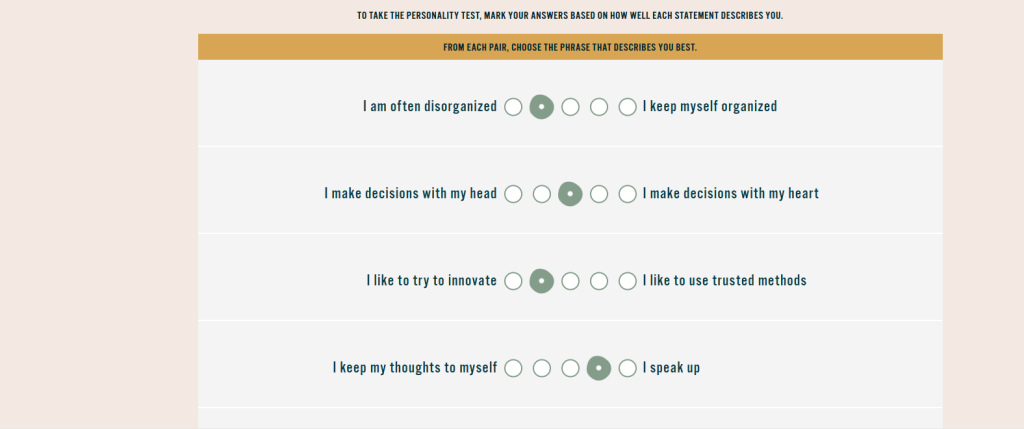
If you’ve never taken a DISC test before, here’s what you can expect. The assessment presents you with a series of questions or paired statements that ask you to choose the option that most, or least, accurately describes your natural behavior. There’s no right or wrong answer. The goal isn’t to catch you out; it’s to surface your genuine tendencies.
Most DISC personality tests take somewhere between 10 and 20 minutes to complete. Some versions use a Likert scale (where you rate how accurately a statement describes you), while others use a forced-choice format (where you pick one of two contrasting options). Both approaches are designed to minimize overthinking and social desirability bias, meaning it’s harder to ‘game’ the test.
Once you complete the DISC test, your results are presented as a behavioral profile that shows your relative scores across all four DISC dimensions. Most people have one or two dominant styles that define how they show up at work and in relationships. Some people are high-D and high-I, meaning they’re both driven and sociable. Others might be high-S and high-C, meaning they’re steady, careful, and methodical.
The DISC Wheel: Understanding Your Full Profile
One thing many people don’t realize is that the DISC model isn’t about boxing you into a single type. You actually score on all four dimensions, it’s just that some scores will be higher than others. This creates what’s called a DISC profile or DISC style, which is often visualized as a graph or wheel showing your behavioral pattern.
There are 12 primary DISC styles that emerge from different combinations of the four factors, ranging from the straightforward single-factor profiles (like a pure D or pure S) to blended profiles that combine two or three dominant factors. Each combination has its own strengths, blind spots, and ideal working conditions.
Quick DISC Personality Self-Check
Answer the following questions based on how often they happen to you.
Assessment Question 1: When you’re facing a brand-new challenge at work, which approach feels most natural to you?
Assessment Question 2: Think about how you communicate with coworkers or friends. Which of the following sounds most like how you naturally show up in conversations?

Assessment Question 3: When you’re working on a big project and something unexpected throws off the original plan, what is your gut reaction?

Breaking Down the Four DISC Personality Types
Let’s go deeper into each of the four DISC behavioral styles. Understanding these profiles isn’t just useful for you, it helps you decode the people around you and work with them more effectively.
D — Dominance: The Driver
People with a high Dominance score are natural leaders. They’re goal-oriented, decisive, and they thrive in environments where they have autonomy and the ability to make things happen. High-D individuals don’t like sitting still, they want results, and they want them now.
- Strengths: Bold decision-making, competitive edge, ability to cut through noise and focus on outcomes
- Blind spots: Can come across as blunt, impatient, or dismissive of others’ feelings
- Ideal work environment: Fast-paced, high-stakes, results-driven roles like sales leadership, entrepreneurship, or executive management
I — Influence: The Energizer
High-I individuals are the people who light up a room. They’re enthusiastic, charismatic, and naturally persuasive. They love connecting with others, sharing ideas, and inspiring action. In group settings, they’re often the ones generating excitement and keeping morale high.
- Strengths: Communication, networking, creativity, and team motivation
- Blind spots: May struggle with follow-through, disorganization, or overcommitting
- Ideal work environment: Roles that involve people interaction, storytelling, marketing, sales, or creative collaboration
S — Steadiness: The Supporter
People with a high Steadiness score are the glue that holds teams together. They’re calm, patient, reliable, and deeply loyal. They prefer stable environments and thrive when they can build consistent routines and strong relationships over time.
- Strengths: Dependability, empathy, listening, conflict resolution
- Blind spots: May resist change, avoid confrontation, or struggle to assert their own needs
- Ideal work environment: Roles that involve long-term relationships, support functions, counseling, education, or project coordination
C — Conscientiousness: The Analyst
High-C individuals are driven by accuracy, quality, and getting things right. They’re systematic thinkers who love diving into data, following processes, and solving complex problems. They set high standards for themselves, and often for others.
- Strengths: Analytical thinking, precision, thoroughness, critical evaluation
- Blind spots: Can be overly critical, perfectionistic, or slow to act when there’s too much uncertainty
- Ideal work environment: Research, engineering, finance, quality assurance, or any role that rewards careful, detail-oriented thinking
Why the DISC Personality Test Is So Widely Used
One of the most common questions people ask is: why DISC? With so many personality assessments out there, Myers-Briggs, Enneagram, Big Five, what makes the DISC model stand out?
The answer comes down to practicality. While other frameworks are excellent for self-exploration, the DISC personality test was specifically designed to improve communication, reduce workplace conflict, and help teams collaborate more effectively. It’s not about labeling people, it’s about understanding behavioral tendencies and using that knowledge to work smarter together.
DISC Assessment in the Workplace
Organizations use the DISC assessment for a wide range of purposes, including:
- Hiring and talent matching: identifying candidates whose behavioral style fits the role
- Team building: helping team members understand each other’s working styles and communication preferences
- Leadership development: giving managers insight into how their style impacts their team
- Conflict resolution: providing a shared language for addressing tension and misunderstanding
- Sales training: coaching salespeople to adapt their approach to different buyer personalities
According to various HR research studies, teams that have completed DISC training report significantly better communication, reduced friction, and improved performance outcomes. That’s a compelling case for any organization.
DISC Assessment for Personal Growth
Beyond the workplace, the DISC personality test has value for anyone who wants to understand themselves better. Are you someone who consistently feels drained after meetings? Your DISC profile might explain why. Do you frequently clash with a particular person in your life? Your DISC styles might be creating friction. Understanding your profile gives you a map, not a cage.
What Truity’s Traffic Data Tells Us About the Demand for Personality Tests
To understand just how popular personality assessments have become, and how significant the opportunity is for businesses and content creators in this space, let’s look at some real-world traffic data from Truity, one of the most well-known personality testing platforms on the internet.
According to SEMRUSH February 2026 data from a third-party web analytics report, Truity.com received the following traffic metrics:
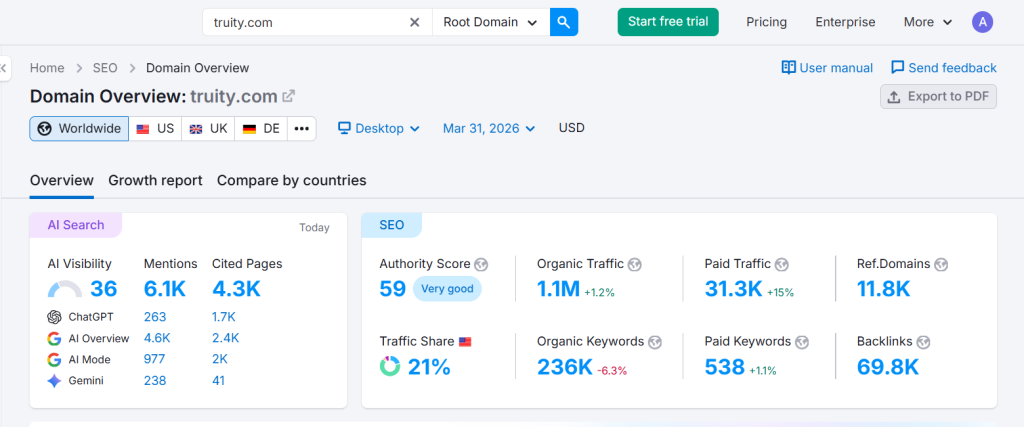
Source: SEMRush website traffic analytics report for Truity.com, February 2026. Traffic overview data used for educational and market research purposes.
Now, here’s what this data is really telling us. Even with a nearly 20% month-over-month traffic dip, Truity still pulled in 1.28 million visits in a single month with an average visit duration of nearly 12 minutes. That’s not passive browsing, that’s genuine, high-intent engagement. People aren’t just landing on personality test pages and bouncing; they’re spending meaningful time exploring their results, reading related content, and comparing different frameworks.
The traffic value of $378,000 is especially telling. That figure represents the estimated cost to acquire that same traffic through paid advertising, which means Truity is generating massive organic value through search engine rankings for personality-related keywords, including terms like ‘DISC personality assessment,’ ‘DISC test,’ and ‘DISC profile.’
💡 What This Means for You
If you’re a coach, HR professional, educator, or content creator, there is a proven, enormous audience actively searching for DISC personality content right now. Creating your own DISC assessment, especially using a tool like Outgrow, positions you directly in front of this high-intent, highly engaged audience.
How to Create Your Own DISC Personality Assessment with Outgrow
Here’s where things get really exciting. You don’t have to just take someone else’s DISC personality test, with the right tools, you can create your own fully branded, interactive DISC assessment that drives leads, builds engagement, and provides genuine value to your audience.
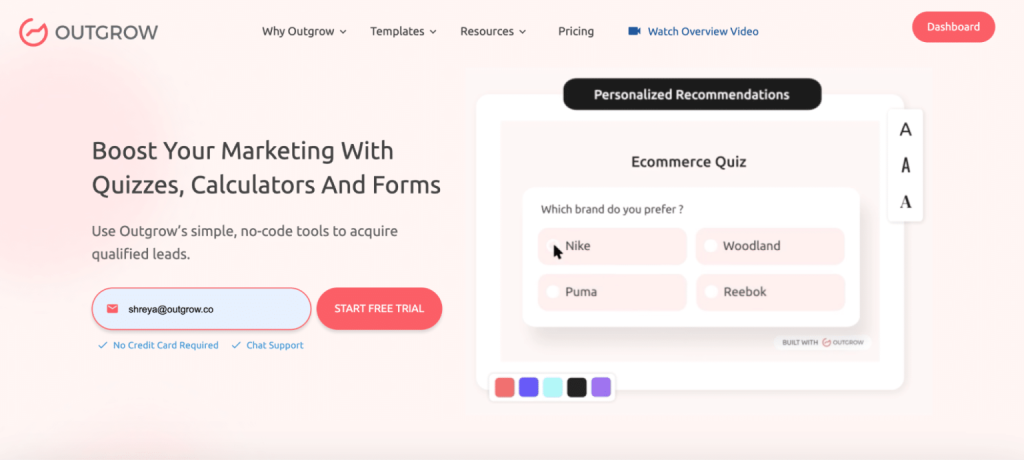
Outgrow is a no-code interactive content platform that makes it surprisingly easy to build professional-grade quizzes, assessments, and personality tests. Here’s how you’d go about building a DISC personality test on Outgrow from start to finish.
Step 1: Choose the Outcome Quiz Template
Create a free Outgrow account or log in if you already have one and navigate to the quiz builder. Select ‘Outcome Quiz’ as your content type, this is the format best suited for personality assessments like DISC, because it allows you to map specific answers to specific result profiles.
Step 2: Set Up Your DISC Outcome Types
Create four outcome profiles in the builder, one for each DISC style: Dominance, Influence, Steadiness, and Conscientiousness. Write compelling, personalized descriptions for each outcome that feel genuinely insightful rather than generic. This is your chance to build trust and provide real value to your audience.
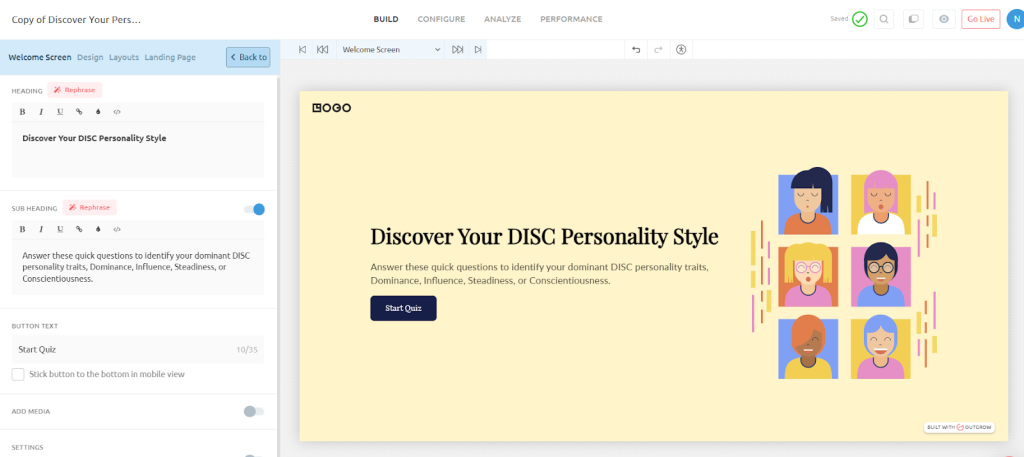
Step 3: Write Your Questions
This is the heart of your DISC test. Write 10 to 20 questions that reveal behavioral preferences across the four DISC dimensions. Use scenario-based questions (like the examples in this blog!) rather than abstract trait descriptions, as they tend to be more accurate and more engaging for test-takers.
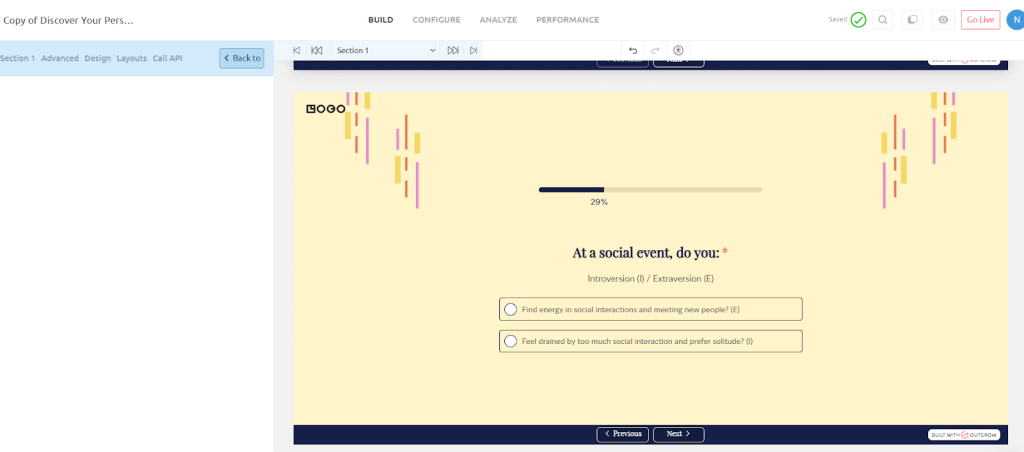
Step 4: Map Answers to DISC Profiles
For each answer option, assign point values that correspond to one or more of the four DISC outcome profiles. Outgrow’s scoring engine will automatically calculate which profile the user scores highest in and display the corresponding result.
Step 5: Design and Brand Your Assessment
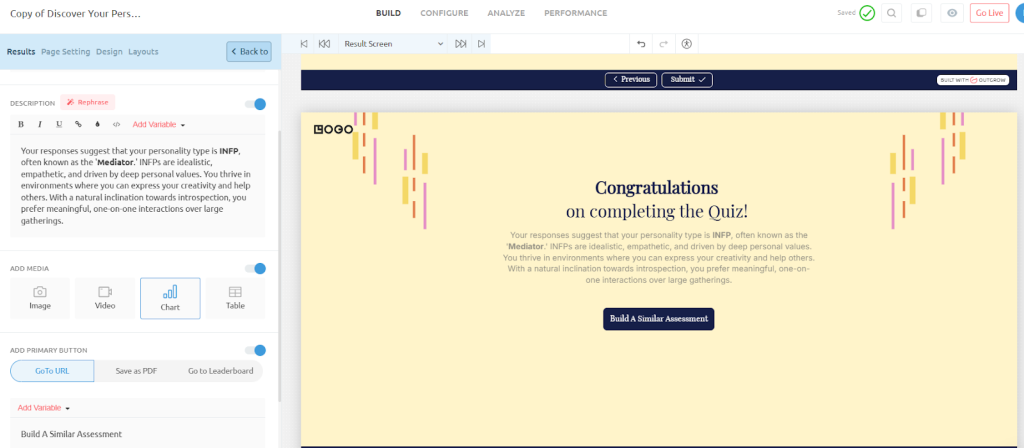
Customize the look and feel of your DISC personality test to match your brand. Outgrow gives you extensive design controls so your assessment feels like a native part of your website rather than a third-party plugin. Add your logo, colors, and custom imagery.
Step 6: Add a Lead Capture Form
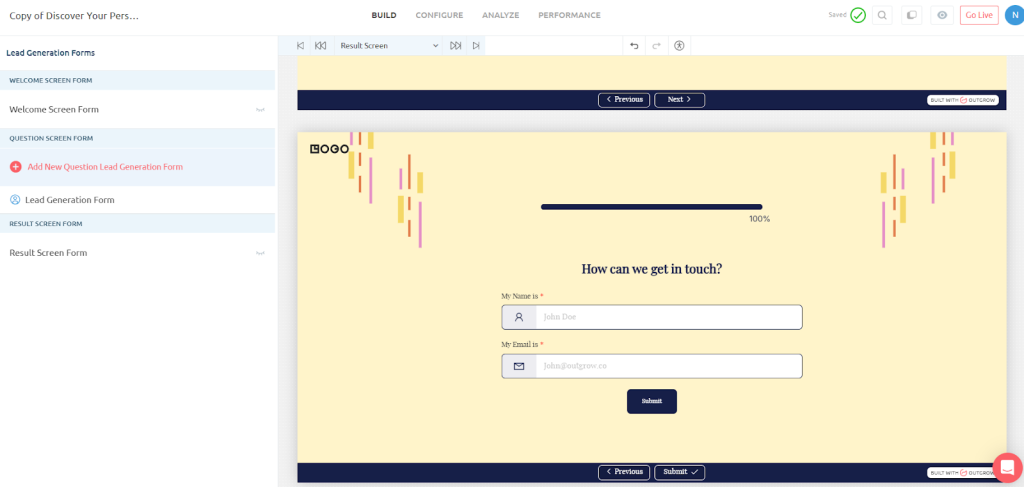
Before revealing results, include an optional (or required) lead capture form asking for the user’s name and email. This turns your DISC test from a standalone engagement tool into a lead generation machine. Integrate it directly with your CRM or email platform.
Step 7: Publish and Promote
Embed the DISC personality test on your website, share the link on social media, include it in email campaigns, or use it as a content upgrade in blog posts. The key is getting it in front of the right audience, and with DISC-related keywords ranking in the millions of monthly searches, organic traffic alone can drive significant results.
DISC Assessment vs. Other Personality Tests: How Does It Compare?
You might be wondering how the DISC personality test stacks up against other popular assessment frameworks. Here’s a quick comparison:
| Assessment | Focus Area | Time to Complete | Best For |
| DISC | Behavior & communication | 10–20 min | Teams & workplaces |
| Myers-Briggs (MBTI) | Cognitive preferences | 20–30 min | Self-discovery |
| Enneagram | Core motivations & fears | 20–40 min | Personal growth |
| Big Five (OCEAN) | Broad personality traits | 10–15 min | Research & hiring |
| StrengthsFinder | Talent themes & strengths | 30–45 min | Leadership coaching |
Each framework has its strengths, but the DISC model’s biggest advantage is its immediate, practical applicability. After completing a DISC personality test, most people can start applying their insights the very same day, in the next meeting they attend, the next email they write, or the next conversation they have.
Common Misconceptions About the DISC Assessment
For all its popularity, the DISC personality test is sometimes misunderstood. Let’s clear up a few of the most common myths:
Myth #1: The DISC test tells you what you’re capable of
False. The DISC model measures behavioral style, not ability, intelligence, or potential. A high-D score doesn’t mean you’ll succeed in every leadership role, and a high-C score doesn’t mean you can’t be creative. Your DISC profile describes your natural tendencies, not your ceiling.
Myth #2: You can only be one DISC type
Not quite. Most people are a blend of two or more DISC styles. You might score high in both D and C, giving you the profile of a driven, analytical problem-solver. The DISC model recognizes this complexity through blended profiles.
Myth #3: Your DISC profile never changes
Your core behavioral style does tend to be relatively stable over time, but research shows that people can develop and expand their behavioral repertoire, especially under sustained coaching or significant life changes. Your DISC profile is a snapshot of how you naturally show up, not a permanent fixture.
Myth #4: DISC is just a corporate buzzword
The DISC model has a solid evidence base going back nearly a century and has been validated through decades of real-world application across diverse industries and cultures. It’s not perfect, and no single personality framework is, but dismissing DISC as mere corporate jargon overlooks the genuine value it delivers for communication and team dynamics.
Who Should Take the DISC Personality Test?
The honest answer is: almost anyone can benefit from taking a DISC assessment. But here are some specific groups that tend to get the most out of it:
- Professionals who want to improve communication and reduce friction with colleagues
- Managers and leaders who want to understand their leadership style and its impact on their team
- HR professionals who want a behavioral framework for hiring, onboarding, and team development
- Sales professionals who want to adapt their approach to different buyer personalities
- Coaches and consultants who want a structured tool to help clients understand their behavior
- Anyone who feels like they keep clashing with certain people and can’t figure out why
If any of those descriptions sound like you, a DISC personality test is absolutely worth your time.
Final Thoughts: Why the DISC Personality Assessment Is Worth Your Time
The DISC personality assessment has stood the test of time for good reason. In a world where communication breakdowns, workplace conflict, and leadership challenges are constant realities, having a shared behavioral language, one that’s research-backed, accessible, and immediately applicable, is genuinely valuable.
Whether you take a DISC test yourself, introduce it to your team, or build your own customized DISC assessment with a platform like Outgrow, the key is using the insights you gain to actually show up differently. Self-awareness without action is just an interesting data point. But when you take what the DISC model reveals about your behavioral style and consciously apply it in your daily interactions, that’s when real change happens.
The traffic data from Truity makes one thing very clear: millions of people are already searching for personality assessment content every single month. Whether you’re a business owner, a content creator, a coach, or an HR professional, there has never been a better time to create, share, or use a DISC personality test.
Your behavioral profile is already shaping how you work, communicate, and lead, the only question is whether you know it. Take the DISC assessment, build your own, or share one with your team. You might be surprised by what you discover.
🚀 Ready to Build Your Own DISC Personality Assessment?
Outgrow makes it easy to create fully branded, interactive DISC tests that generate leads, build engagement, and deliver real value to your audience, no coding required. Start your free trial today and launch your first DISC assessment in under an hour.
Frequently Asked Questions About the DISC Assessment
The DISC model has been in use for nearly 100 years and has a substantial body of research supporting its reliability and validity as a behavioral assessment tool. While it’s not without critics (no personality framework is), it consistently demonstrates strong test-retest reliability and has been validated across diverse cultures and contexts.
Most DISC personality tests take between 10 and 20 minutes to complete. Some shorter versions can be done in as little as 5 minutes, while more comprehensive DISC profiles designed for organizational use may take 25 to 30 minutes.
Yes, there are free versions of the DISC personality test available online, though they tend to be shorter and offer less detailed results than paid versions.
Accuracy in personality assessments depends heavily on how honestly the test-taker responds. In terms of psychometric quality, professionally administered DISC tests with validated question sets tend to produce the most reliable results. Outgrow-built DISC assessments, when designed with well-crafted scenario-based questions, can deliver highly accurate and actionable results.
Start by reading your full profile description carefully. Then, consider how your natural behavioral style might be showing up in your current work and relationships. Are there patterns that explain some of your recurring challenges? Share your results with your manager or team to open a dialogue about communication styles.

Ankit Upadhyay is a Digital Marketing and SEO Specialist at Outgrow. With a passion for driving growth through strategic content and technical SEO expertise, Ankit Upadhyay helps brands enhance their online visibility and connect with the right audience. When not optimizing websites or crafting marketing strategies, Ankit Upadhyay loves visiting new places and exploring nature.

![4 Best eCommerce Personalization Software [+Free Templates]](https://outgrow.co/blog/wp-content/uploads/2023/05/Blogs-min-1536x768-1-1-1.png)