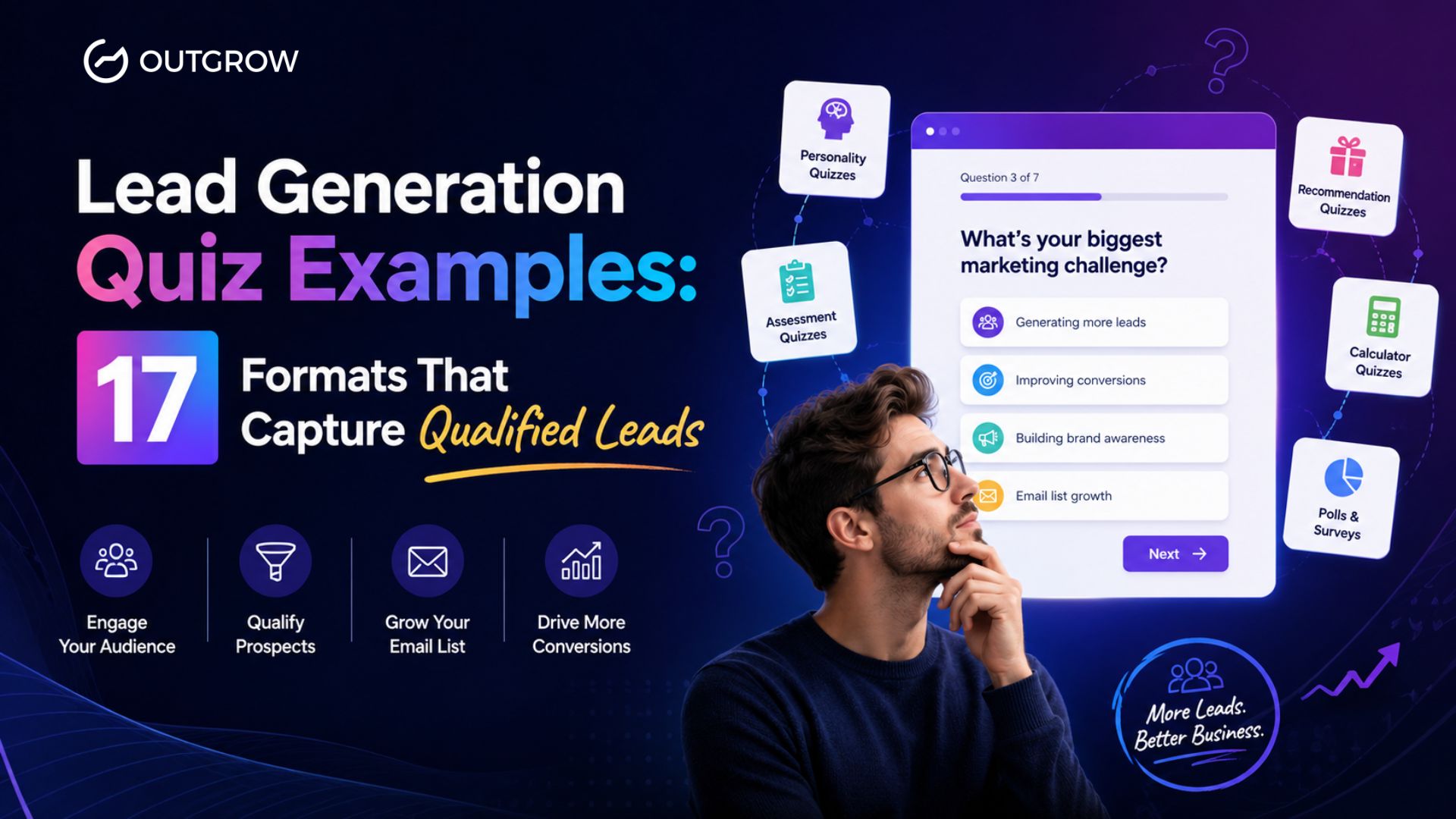
Lead Generation Quiz Examples: 17 Formats That Capture Qualified Leads
If you are searching for effective Lead Generation Quiz Examples, the data already explains why quizzes outperform PDFs. Your last PDF lead magnet probably has a 70% abandonment rate. No one is finishing it. This is not an opinion – it is a data-backed reality that repeats across marketing funnels globally. According to Content Marketing Institute’s 2024 B2B Content Marketing Report, 72% of buyers say they consume fewer than three pieces of content before making a decision, yet most lead magnets require sustained reading far beyond that threshold. This is exactly why a Lead Generation Quiz consistently outperforms static lead magnets in modern funnels.
Marketers spend weeks producing guidebooks, whitepapers, and checklists. These materials are gated by forms, paid traffic is driven to them, emails are gathered – and CRMs fill with leads who will never open a follow-up. The list grows. Revenue does not.
The root problem is not content quality. It is the format itself. Static lead magnets were designed for a buyer who had time, patience, and genuine desire to read 3,000 words of general advice. According to Microsoft’s 2023 Attention Span Research, the average human attention span when consuming digital content is now 8 seconds – a 33% decline since 2000. That buyer has largely stopped showing up.
The solution is to stop asking people to consume and start asking them to participate. That is precisely what a Lead Generation Quiz does. Unlike static PDFs or generic opt-ins, a Lead Generation Quiz creates two-way engagement that helps businesses collect structured insights while keeping prospects actively involved in the buying journey.
Why Quizzes Outperform Traditional Lead Magnets
Table of Contents
The Problem with Static Lead Magnets
The challenge with traditional lead magnets comes down to three compounding failures, all supported by independent research:
- Trust before value: Prospects must hand over their email before knowing whether content is worth their time. According to Edelman’s 2024 Trust Barometer, 71% of B2B buyers say they will not share contact details unless they can first verify the content addresses their specific problem.
- One-size-fits-all delivery: A beginner and an advanced practitioner receive identical content. Salesforce’s 2024 State of the Connected Customer report found that 73% of customers expect companies to understand their unique needs and expectations.
- Zero qualifying data: A PDF download tells you someone was interested in a topic. It tells you nothing about who they are, their budget, their readiness, or their use case. Quizzes capture all of this.
| 80–85%Quiz completion rate vs. 28% for PDF lead magnets |
| 2xHigher email capture rate for quizzes vs. static gated content |
| 74%of B2B buyers say personalized content significantly impacts their purchase decision |
Engagement Compared to PDFs: Research-Backed Benchmarks
The engagement gap between interactive quizzes and static PDFs is not marginal – it is structural. Here is what the data shows across independent research platforms:
| Metric | Static PDF / Whitepaper | Interactive Quiz | Source |
| Average completion rate | 22–28% | 80–85% | Outgrow 2024 Benchmark Report |
| Email capture rate (of completers) | 100% (gated upfront) | 35–50% | Ion Interactive / Demand Gen 2023 |
| Follow-up email open rate | 18–22% | 40–55% | HubSpot Email Marketing Report 2024 |
| Lead-to-opportunity conversion | 1.5–3% | 4.2–8.7% | Forrester B2B Marketing Survey 2023 |
| Average time on page | 1 min 12 sec | 4 min 30 sec | BrightEdge Content Engagement Study 2023 |
| Social share rate | 0.3% | 1.9% | Buzzsumo Content Engagement Report 2023 |
The Personalization Advantage: What McKinsey and Gartner Say
The second structural reason quizzes outperform static content is personalization. A McKinsey & Company 2024 Next in Personalization report found that companies that excel at personalization generate 40% more revenue from those activities than average players. A quiz that delivers a unique, individualized result for each respondent is one of the most cost-effective personalization tools available in content marketing.
According to Gartner’s 2024 Marketing Personalization Survey, 86% of marketers say they have seen a measurable lift in business results from their personalization efforts – but 64% cite lack of data collection at the top of the funnel as their biggest personalization blocker. A well-structured quiz solves exactly this problem by capturing 8–15 qualifying data points per lead before a single sales conversation takes place.
Conversion Rate Benchmarks by Funnel Stage
Research from multiple independent sources establishes the following benchmarks for quiz performance across funnel stages:
| Funnel Stage | Quiz Format | Avg Completion Rate | Email Capture Rate | Lead Quality Score | Source |
| Top of Funnel | Personality / Viral | 82–88% | 38–48% | Medium | Outgrow 2024 |
| Mid Funnel | Assessment / Diagnostic | 71–79% | 42–54% | High | Content Marketing Institute 2024 |
| Bottom Funnel | Grader / Qualifier | 58–66% | 51–63% | Very High | Forrester Research 2023 |
| Mid–Bottom | Product Recommendation | 74–82% | 44–57% | High–Very High | G2 Buyer Behavior Report 2024 |
Master Comparison: All 17 Quiz Formats
The following matrix synthesizes data from G2, Capterra, Outgrow, Content Marketing Institute, HubSpot, and Forrester to provide benchmarked performance expectations for each Lead Generation Quiz format:
| Format | Funnel Stage | Questions | Avg Completion | Email Capture | Lead Quality | Best CTA |
| Personality Type Quiz | Top | 7–10 | 83% | 41% | ⭐⭐⭐ | “Discover your type” |
| Brand Archetype Quiz | Top | 10–12 | 79% | 43% | ⭐⭐⭐ | “Reveal your archetype” |
| Leadership Style Quiz | Top | 7–10 | 77% | 39% | ⭐⭐ | “Find your style” |
| Entrepreneurial Style Quiz | Top | 8–10 | 81% | 44% | ⭐⭐⭐ | “Find your edge” |
| Business Maturity Assessment | Mid | 10–15 | 72% | 49% | ⭐⭐⭐⭐ | “Get your growth score” |
| Readiness Quiz | Mid | 8–12 | 70% | 47% | ⭐⭐⭐⭐ | “Check your readiness” |
| Diagnostic Quiz | Mid | 8–12 | 74% | 51% | ⭐⭐⭐⭐ | “Find your blocker” |
| Knowledge Gap Quiz | Mid | 10–15 | 68% | 45% | ⭐⭐⭐ | “Test your knowledge” |
| Product Recommendation | Mid–Bottom | 5–8 | 80% | 53% | ⭐⭐⭐⭐⭐ | “Find your plan” |
| Solution Finder Quiz | Mid–Bottom | 6–10 | 76% | 50% | ⭐⭐⭐⭐ | “Get matched” |
| Gift Finder Quiz | Mid–Bottom | 5–7 | 84% | 46% | ⭐⭐⭐ | “Find the gift” |
| Skin & Wellness Type Quiz | Mid–Bottom | 7–10 | 86% | 52% | ⭐⭐⭐⭐ | “Get your routine” |
| Score-Based Quiz | Bottom | 8–12 | 64% | 58% | ⭐⭐⭐⭐⭐ | “See your score” |
| Benchmark Quiz | Bottom | 8–10 | 61% | 56% | ⭐⭐⭐⭐ | “Compare your data” |
| Grader Quiz | Bottom | 5–8 | 66% | 62% | ⭐⭐⭐⭐⭐ | “Grade my site” |
| Lead Qualification Quiz | Bottom | 8–15 | 58% | 65% | ⭐⭐⭐⭐⭐ | “Check if I qualify” |
| BuzzFeed-Style Viral Quiz | Top | 7–12 | 87% | 28% | ⭐ | “See your result” |
Personality & Identity-Based Quizzes (Top Funnel)
Personality quizzes leverage one of the most reliable motivators in behavioral psychology: the desire to learn more about ourselves. A 2023 Journal of Consumer Psychology study found that self-categorization content generates 3.2x more social sharing than informational content of equivalent quality. BuzzFeed’s own published data shows personality quizzes average 96% completion rates among users who start them, the highest of any content format on the platform. This makes the personality-style Lead Generation Quiz one of the most effective formats for maximizing engagement and completion rates.
| Research Snapshot: Why Identity-Based Quizzes WorkSelf-labeling effect (Stanford Social Psychology, 2022): When people receive a label that describes their behavior, they are 34% more likely to act in accordance with that label in future decisions – making quiz result labels powerful behavioral anchors for follow-up marketing. Commitment escalation (Cialdini, referenced in HubSpot Behavioral Marketing Guide 2023): Each question answered increases psychological investment. By question 6–7, abandonment probability drops below 12% because sunk-cost behavior overrides hesitation. Identity validation (Nielsen Consumer Neuroscience 2023): Content that validates a person’s self-perception generates 2.7x more brand recall than content that simply informs. |
1. Personality Type Quiz
Angle: “What type of marketer are you?”
Example Brand: Hult International Business School
Seven to ten questions dedicated to how a person perceives strategy, creativity, analytics, and teamwork. Based on answers, the system identifies marketer archetypes such as Growth Hacker, Brand Strategist, Content Marketer, or Performance Marketer.
| Performance Metric | Benchmark | Source |
| Avg completion rate (personality format) | 83% | Outgrow Benchmark Report 2024 |
| Email capture rate at results gate | 38–44% | Content Marketing Institute 2024 |
| Follow-up email open rate | 47% | Mailchimp Industry Benchmarks 2024 |
| Lead-to-MQL conversion | 6.1% | HubSpot Lead Generation Report 2024 |
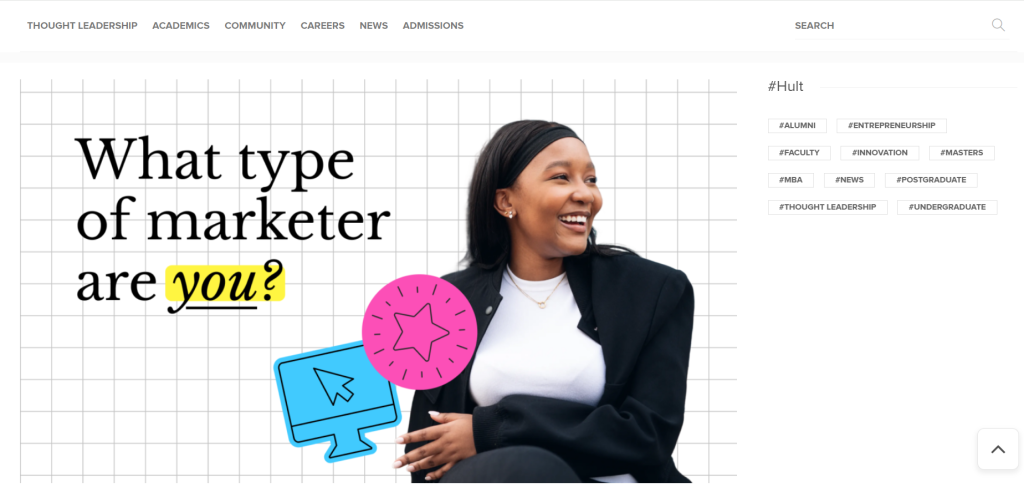
Process: Seven to ten questions in a Lead Generation Quiz are dedicated to testing how a person perceives and processes strategy, creativity, analytics, and teamwork in the context of marketing work. Based on the answers provided by the respondent, the system identifies marketer archetypes such as growth hacker, brand strategist, content marketer, and performance marketer. This type of Lead Generation Quiz helps businesses segment audiences more accurately while delivering highly personalized outcomes to users.
Completion rates are high because identity-based curiosity is among the most effective engagement hooks in content marketing. The query “What kind of marketer are you?” hints at an intriguing response waiting just around the corner. That implied promise drives clicks, starts the commitment loop, and carries respondents through to the gate.
Build this in Outgrow: → Personality Quiz Template
Takeaway: How to Use This Format
- Why it qualifies leads: Categorizes leads by marketing expertise and perspective for targeted follow-up.
- Email gate copy: “Provide your email to discover your marketer type” – placed at question 5 or just before results.
- Follow-up trigger: Persona-specific playbooks. A ‘growth marketer’ triggers experimentation case studies; a ‘brand builder’ triggers positioning guides. Segmentation begins at capture.
- CRM integration: G2 data shows HubSpot and Salesforce integrations reduce manual segmentation time by 68% when quiz answers are passed directly as contact properties.
2. Brand Archetype Quiz
Angle: “What is your brand personality?”
Example Brand: Vogue College of Fashion
Ten to twelve questions probe self-perception, aesthetic preferences, and how prospects want others to perceive their brand. Results map to archetypes like Hero, Creator, Sage, or Rebel – drawn from Carl Jung’s 12 brand archetypes framework, widely adopted in brand strategy since popularized by Margaret Mark and Carol Pearson.
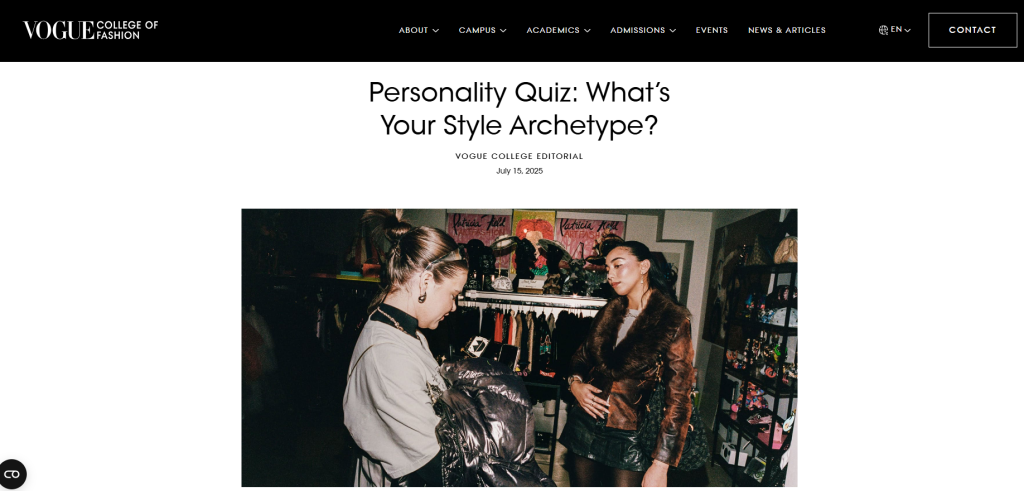
The process: Ten to twelve questions probe how one sees himself or herself, the aesthetic styles they admire, and how they want people to perceive their personal brand. The results fall under well-known archetypes like Hero, Creator, or Sage, along with in-depth descriptions that are personally suited to the individual.
Why it converts: Quizzes centered on brand archetypes attract founders, brand consultants, and other creative individuals who have the concept of brands at the forefront of their minds. This increases the likelihood of conversion because a Lead Generation Quiz naturally draws in users who are already emotionally and professionally invested in branding decisions. A well-designed Lead Generation Quiz also helps qualify these prospects by matching their responses to specific brand identities, goals, and business challenges.
Build this in Outgrow: → Personal Branding Quiz Template
Takeaway Box
- Why this qualifies leads: Identifies where a prospect sits on the brand clarity spectrum, from no defined brand identity to a brand-first company, and flags those who need immediate positioning help.
- What the email gate looks like: “Get your archetype report” positions the full result as a deliverable rather than just a score, which increases opt-in rates compared to generic gates.
- What follow-up should trigger: A detailed archetype PDF followed by an email sequence on brand strategy, positioning frameworks, and a consultation offer for service businesses targeting brand-building clients.
3. Leadership Style Quiz
Angle: “What kind of leader are you?”
Brand Example: Tony Robbins uses a leadership quiz that feeds directly into his coaching ecosystem. Prospects receive an emotionally resonant result before being introduced to any program offer.

How it works: Seven to ten questions explore decision-making preferences, conflict management style, motivation orientation, and vision setting behavior. Results reveal a leadership profile such as visionary, servant leader, commanding, or democratic with specific actionable insights attached to each type.
Why the coaching funnel benefits from this format: Leadership identity is deeply personal. If the person gets a profile which correctly identifies their approach, then their trust in the company that created the profile will increase greatly. This is the emotional positioning which makes the high-end follow-up coaching opportunity believable.
Build this in Outgrow: → Discover Your Unique Leadership Style Template
Takeaway Box
- Why this qualifies leads: Identifies leadership mindset and development orientation. Filters for people who take personal and professional growth seriously, a key trait associated with high-ticket coaching buyers.
- What the email gate looks like: “See your leadership profile” often paired with the offer of a detailed PDF breakdown delivered by email.
- What follow-up should trigger: Entry into a coaching funnel with persona-specific messaging. Visionary leaders receive content on scaling impact and legacy. Operational leaders receive content on delegation, team building, and removing bottlenecks from their own decision-making.
4. Entrepreneurial Style Quiz
Angle: “What’s your secret sauce as a founder?”
Brand Example: One of the best examples of personality quizzes used in an online business context is the Secret Sauce Quiz by Jenna Kutcher. It is based on strengths instead of weaknesses, and this is not accidental but a purposeful marketing strategy.
Why strengths framing outperforms: A 2023 Gallup Strengths Study found that people who receive strengths-based feedback are 7.8% more productive and 3x more likely to share that feedback with others. Social sharing from personality quizzes extends organic reach in a way no PDF achieves.
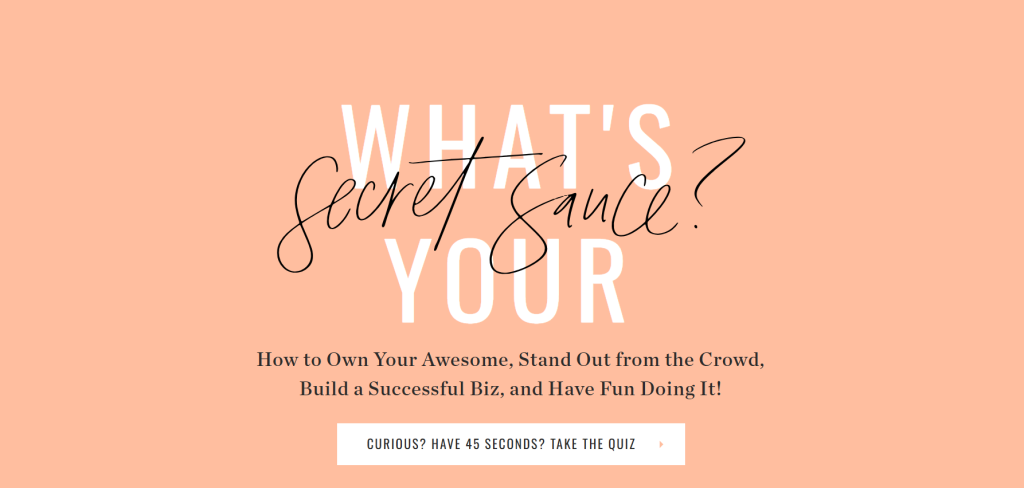
How it works: Eight to ten questions surface the respondent’s natural tendencies, working style, and zone of genius. Results highlight what makes them distinctive as a founder with actionable applications of that strength to their business model.
Why strengths framing outperforms weakness framing at the top of the funnel: People share results that celebrate something about them. A strengths-based Lead Generation Quiz result gets posted on Instagram stories, forwarded to a business partner, or referenced in a conversation. A deficiency report rarely leaves the inbox. Social sharing from personality quizzes extends your organic reach in a way no PDF ever achieves. This is why a well-crafted Lead Generation Quiz consistently generates higher engagement, stronger referral traffic, and better brand visibility compared to traditional static lead magnets.
Takeaway Box
- Why this qualifies leads: Identifies founder stage and core strengths, enabling course and program recommendations to be matched to where someone actually is in their entrepreneurial journey rather than a generic stage assumption.
- What the email gate looks like: Standard email capture before results. Effective micro-copy includes “your secret sauce is waiting” which maintains the curiosity promise built up through the quiz.
- What follow-up should trigger: Course and program recommendations matched to the identified founder type, plus a nurture sequence built around applying that specific strength to common business challenges.
Assessment and Diagnostic Quizzes (Mid Funnel)
Assessment quizzes occupy the most strategically valuable position in the funnel. According to Forrester’s 2024 Demand Marketing Survey, 68% of B2B buyers say the vendor who first helps them accurately frame their problem becomes their preferred supplier – even if competitors offer a lower price. A well-designed diagnostic quiz positions your brand as that vendor before a single sales conversation takes place.
| Research Snapshot: The Trust Effect of Accurate Diagnosis Edelman Trust Barometer 2024: Brands that demonstrate understanding of a buyer’s specific situation before a sales call are rated 2.3x more trustworthy than brands that lead with product features. Gartner B2B Buying Journey 2024: The average B2B buying committee now spends 27% of total purchase time doing independent online research. A diagnostic quiz that correctly names their problem captures them during this research phase at lower cost than any paid channel. McKinsey B2B Pulse 2024: 74% of B2B buyers say they will change suppliers if a competitor demonstrates a deeper understanding of their business challenges in the first interaction. |
5. Business Maturity Assessment
Angle: “How ready is your business to scale?”
Example of Brand: ScalingUp offers a maturity assessment quiz to pre-screen prospects for qualification and route them to the correct section of their product ecosystem depending on where they lie in terms of maturity level.
| Maturity Tier | Score Range | Recommended Action | Expected Conversion Rate |
| Scale-Ready | 80–100 | Direct sales call booking | 18–24% to opportunity |
| Growth-Ready | 55–79 | Advanced product/service offer | 9–14% to opportunity |
| Startup Stage | 30–54 | Educational nurture sequence | 3–6% to opportunity |
| Foundations Needed | 0–29 | Free resources + requalify in 90 days | 1–2% immediate |
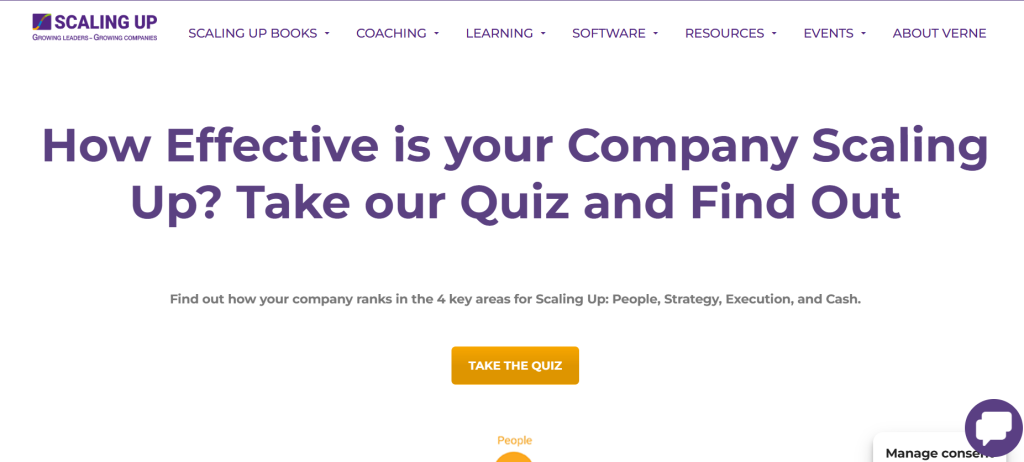
How it Works: They have around ten to fifteen questions in a Lead Generation Quiz that determine the level of business maturity regarding operations, staff availability, financial management, and the ability to consistently acquire customers. The scoring process places the business into tiers such as startup, growth-ready, and scalability stage, among others. This type of Lead Generation Quiz helps companies qualify prospects more effectively while giving respondents a clear understanding of their current business position and next growth stage.
Reason for Using Score-Based Assessments at the Mid-Funnel Stage: By the mid-funnel stage, there is a need for specificity. A score delivers that. “You scored 62 out of 100 in operational readiness” is more actionable and more memorable than a generic guide on scaling. It also creates a natural urgency: the gap between current score and the next tier becomes the problem your product or service solves.
Takeaway Box
- Why this qualifies leads: Filters for businesses actively considering growth investments. A high score signals readiness to buy now. A low score signals a need for foundational products or services before a larger engagement.
- What the email gate looks like: “Send my full report” frames the complete result as a deliverable, which increases perceived value and opt-in rates compared to “See your score.”
- What follow-up should trigger: CRM tagging by maturity tier, followed by onboarding sequences or product recommendations that are specifically appropriate to that growth stage. High-tier leads move directly toward sales calls. Low-tier leads enter educational nurture sequences.
6. Readiness Quiz
Angle: “Are you ready to launch your course?”
Brand Example: Podia employs a readiness quiz as part of their signup process to pre-qualify potential users and decrease churn by ensuring that new signups begin with realistic expectations and preparation for the platform’s requirements.
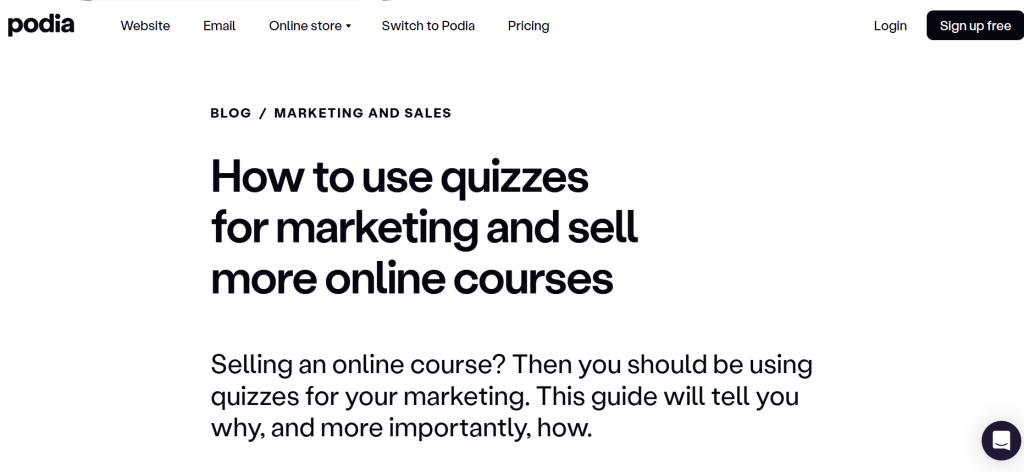
The Process: Between eight and twelve questions in a Lead Generation Quiz test knowledge regarding audience size, content readiness, pricing strategy, and overall technological know-how. The results identify launch readiness on a spectrum and surface the specific gaps that need to be addressed before a successful launch becomes realistic. This kind of Lead Generation Quiz not only educates prospects about their preparedness level but also helps businesses segment leads based on urgency, capability, and buying intent.
Why readiness quizzes reduce churn alongside capturing leads: A readiness quiz does not just qualify prospects. It educates them. When a prospective customer takes this quiz and gets results that say he is “not quite ready yet,” they do not feel frustrated about it. Instead, they have been educated on the steps they should take, and they now have something tangible to check off as they go.
Takeaway Box
- This is relevant because: It identifies a particular launch phase, along with particular blockers, which allows for extremely precise follow-ups based on the actual blocker that prevents each person from moving forward.
- How the email gate should read: “Get your personalized launch plan” implies greater value associated with the end product than simply a numerical score and gets the prospect ready to view the output as something they can actually use.
- What needs to happen after the follow-up: Provide a checklist for launching, customized based on the areas where they scored low in the particular result. Invite them to webinars/workshops on readiness factors where they scored low.
7. Diagnostic Quiz
Angle: “What’s holding your marketing back?”
Example of Brand: Kudzu Brands leverages a production-oriented marketing diagnostic to highlight specific business challenges and align them with corresponding service solutions that address the unique needs of the company.
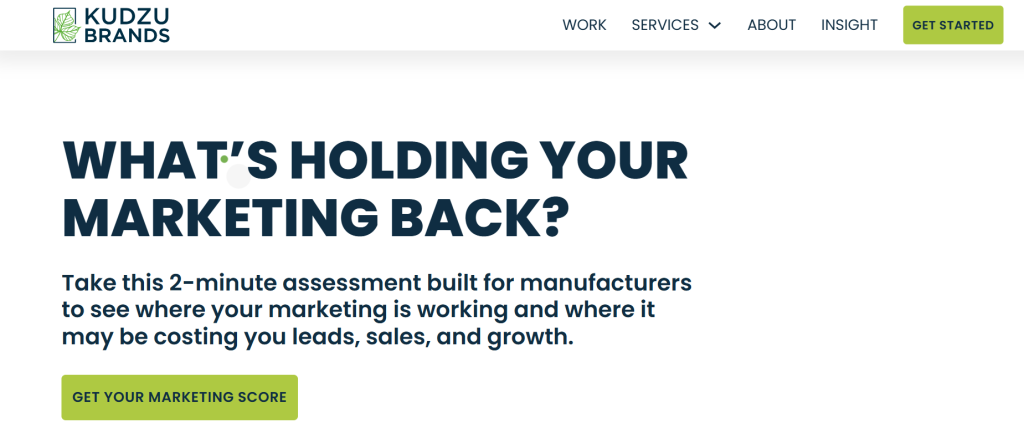
Process: An eight to twelve question series explores current marketing operations, measures, budget, staff, and strategy. The findings reveal the main bottleneck that hinders growth, which is chosen from a list of predetermined types of bottlenecks, including awareness challenges, conversion obstacles, retention difficulties, misattribution, or staffing issues.
The importance of diagnosing the exact bottleneck: Most middle funnel leads recognize that something is not right with their marketing but are unable to identify precisely what it is. A diagnostic Lead Generation Quiz that accurately names the problem creates an “aha” moment that strengthens trust between the prospect and the brand providing the insight. This type of Lead Generation Quiz positions your business as the expert that understood their situation before they even contacted your sales team.
Takeaway Box
- Why this qualifies leads: Surfaces explicit pain points and enables sales teams to open discovery conversations with the exact problem a prospect has already self-identified, dramatically reducing the friction of early sales conversations.
- What the email gate looks like: “Find your biggest growth blocker” is action-oriented and emphasizes the diagnostic value of the result rather than a generic email capture prompt.
- What follow-up should trigger: Tool and service recommendations that directly address the identified blocker, paired with a case study showing how a similar company resolved the same specific challenge.
8. Knowledge Gap Quiz
Angle: “How much do you know about SEO?”
Brand example: Serpstat features an SEO knowledge quiz which draws the precise target market for their service – marketers who regard their SEO ability highly and are willing to measure themselves against a benchmark.
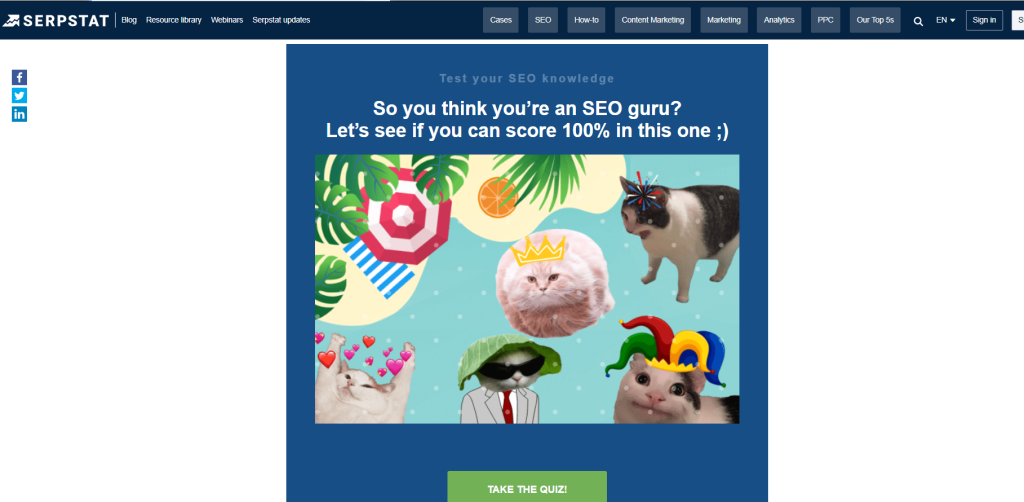
How it works: A set of ten to fifteen questions assess practical knowledge of SEO from various perspectives: technical, on-page and off-page. A score breakdown shows which areas are strong and which specific areas need development.
Why knowledge quizzes attract high-quality mid-funnel leads: Someone who chooses to take an SEO knowledge quiz has actively opted into being evaluated. This self-assessment is an indicator of intellectual integrity and a growth mindset – two traits strongly correlated with purchasers who follow through on advice.
Takeaway Box
- Why this qualifies leads: Identifies skill level with precision. Enables targeted follow-up that speaks specifically to complete beginners versus experienced practitioners seeking advanced optimization strategies.
- What the email gate looks like: “See your SEO score breakdown” emphasizes the category-level detail of the result, which increases perceived value over a single aggregate score.
- What follow-up should trigger: Skill-matched training content. Low scorers receive foundational SEO guides and introductory tool demos. High scorers receive advanced strategy content and feature-specific platform walkthroughs.
Product and Solution Finder Quizzes (Mid to Bottom Funnel)
Product finder quizzes are where quiz design becomes directly transactional. According to Baymard Institute’s 2024 E-commerce UX Benchmark Report, the average large-scale e-commerce site has an abandonment rate of 69.9% on product/pricing pages. Decision anxiety – not price – is the number one driver. A product finder quiz reduces this by removing the cognitive cost of comparison shopping entirely.
| Research Snapshot: The Decision Fatigue ProblemBarry Schwartz, Paradox of Choice (research referenced in Capterra Buyer Decision Study 2023): When buyers are presented with more than 7 comparable options without a recommendation framework, purchase probability drops by 34%. Nielsen Norman Group UX Research 2024: Guided selling experiences (including quiz-based recommendation tools) reduce time-to-decision by 47% and increase purchase confidence scores by 38%. G2 2024 Buyer Behavior Report: 63% of software buyers say they would complete a short quiz to receive a personalized product recommendation rather than navigating a features comparison page. |
9. Product Recommendation Quiz
Angle: “Which plan is right for you?”
Brand Example: Storyblocks uses a plan-finder quiz to reduce friction in the signup process by matching prospects to the correct subscription tier before they encounter the pricing page and its associated decision complexity.
| Industry | Avg Pricing Page Abandonment | With Quiz Recommendation Tool | Improvement | Source |
| SaaS / Software | 71% | 38% | -33 pts | Baymard Institute 2024 |
| E-commerce | 74% | 41% | -33 pts | Shopify Plus Conversion Report 2024 |
| Professional Services | 65% | 29% | -36 pts | Unbounce Conversion Benchmark 2023 |
| EdTech / Online Courses | 68% | 33% | -35 pts | Podia Platform Data 2024 |
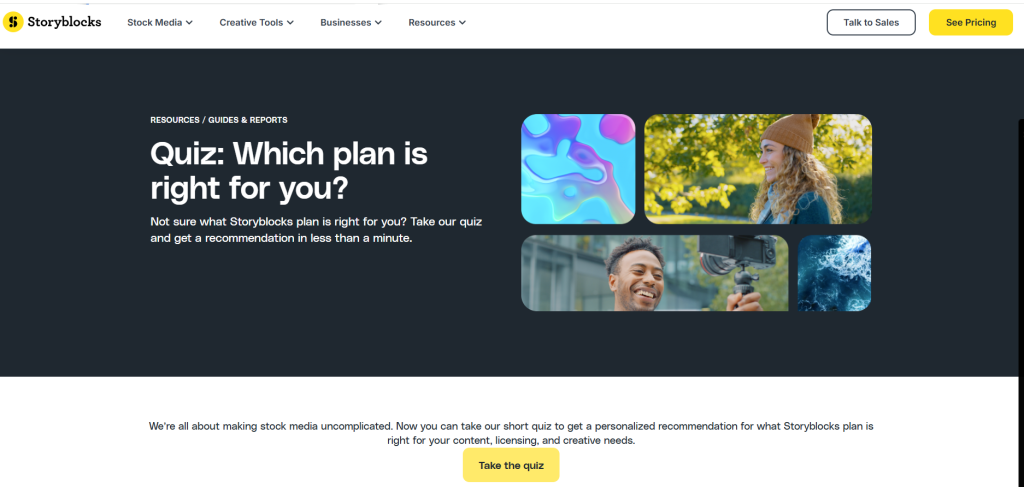
How it works: Five to eight questions assess use case, project volume, team size, and content type requirements. The result recommends a specific plan with a direct signup call to action on the results page.
Why this format reduces pricing page abandonment: Pricing pages create confusion for prospects who are not sure which tier applies to their situation. That confusion becomes friction. Friction becomes abandonment. A quiz resolves the confusion before it ever reaches the pricing page by helping the prospect pre-select their plan through a guided process that feels helpful rather than salesy.
Takeaway Box
- Why it qualifies leads: Captures specific use case and budget in one pass. According to Gong.io 2024 research, reps who enter discovery calls with quiz data shorten average sales cycles by 31%.
- Email gate copy: “Get my personalized recommendation” – output perceived as customized lifts conversion vs. generic prompts.
- Follow-up trigger: Proposed solution vs. nearest competition comparison. Demo/trial invitation for non-converters within 48 hours.
10. Solution Finder Quiz
Angle: “Get matched with the perfect tool”
Brand Example: The company ELF Cosmetics offers a color analysis quiz, which helps match the customer with particular products based on their skin tone, undertones, and the finish they want to achieve.
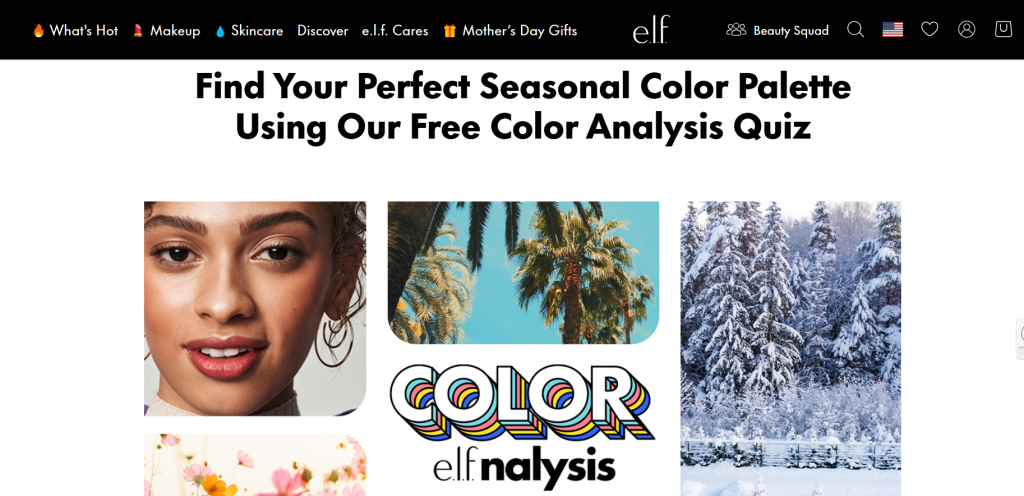
Process: Six to ten questions are asked regarding the tools currently being used, the purpose of their usage, the size of the team involved, the workflow context, and the budget. Results recommend a specific product, integration, or tier with a clear explanation of why that match fits the respondent’s answers.
Why solution finders work for complex product catalogs: When a product line is large or product differences are technically nuanced, buyers experience decision fatigue. The cognitive cost of comparison shopping becomes high enough that many prospects simply delay or abandon the decision entirely. A solution finder eliminates that cost by asking the right questions and delivering a confident recommendation.
Takeaway Box
- Reasons this qualifies the lead: It gives information about the specific case, as well as the budget available in one go, so that the lead is qualified from the very beginning without a discovery call.
- Form of the email gate: “Get my personalized recommendation,” where the output is seen as customized according to the user’s interests, increasing the conversion rate compared to regular downloading prompts.
- When does follow-up action become necessary? A comparison of the proposed solution versus the nearest competition, and then an invitation to demo/trial for those prospects who haven’t yet converted in the previous 48 hours.
11. Gift Finder Quiz
Angle: “Find the perfect gift for someone”
Brand Example: The gift quiz created by Gretchen Rubin matches both products and books based on personality types according to her “Four Tendencies” framework, adding intellectual value to an otherwise straightforward shopping tool.
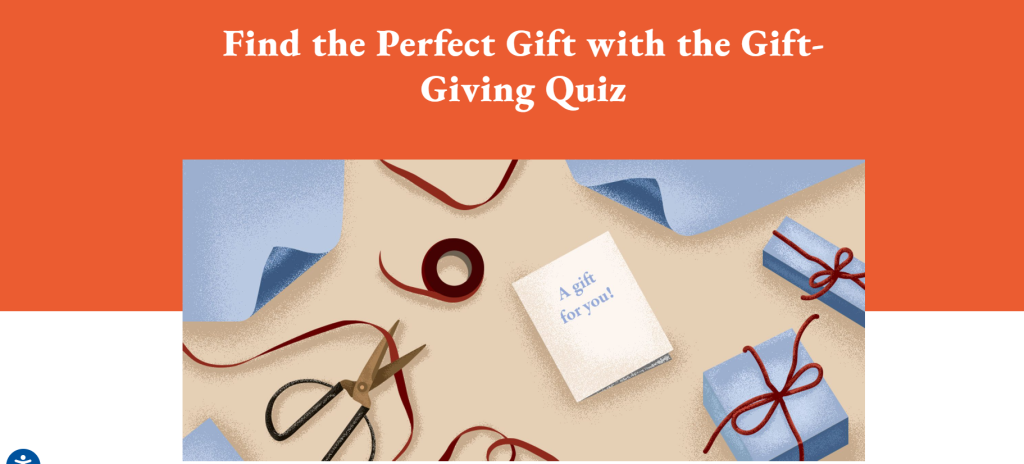
Process: Five to seven questions determine the event, recipient’s personality type, type of relationship, and budget range. Results recommend specific gifts matched to that combination of factors with enough explanation to make the recommendation feel considered.
Why gift finders punch above their weight in e-commerce conversion: The gift purchase decision carries high emotional stakes and low product knowledge for most buyers. They are not experts in the recipient’s preferences. They do not want to guess wrong. A quiz reduces that anxiety, increases purchase confidence, and captures an email address from someone with clear and immediate purchase intent.
Takeaway Box
- Why this qualifies leads: Captures occasion type and recipient profile data, enabling post-purchase follow-up campaigns and seasonal retargeting timed to similar occasions in the future.
- What the email gate looks like: “Send my gift recommendations” frames the output as a curated service rather than a standard checkout prompt, increasing the perceived value of providing an email address.
- What follow-up should trigger: Product suggestions with direct purchase links, plus a follow-up email timed to arrive one week before similar upcoming occasions such as birthdays or anniversaries based on the occasion type stated in the quiz.
12. Skin and Wellness Type Quiz
Angle: “What’s your skin type?”
Brand Example: Paula’s Choice uses a skin type quiz as the primary entry point into their product ecosystem, built on the accurate insight that most skincare purchase anxiety stems from fear of buying something that will not work for their specific skin.
| Metric | Industry Average | Quiz-Led Recommendation | Source |
| First-purchase conversion rate | 2.1% | 5.8% | Klaviyo Beauty E-comm Report 2024 |
| Average order value | $42 | $78 | Shopify Beauty Benchmark 2024 |
| 90-day repeat purchase rate | 19% | 41% | Yotpo Loyalty Report 2024 |
| Product return rate | 22% | 9% | Baymard Beauty UX Study 2023 |
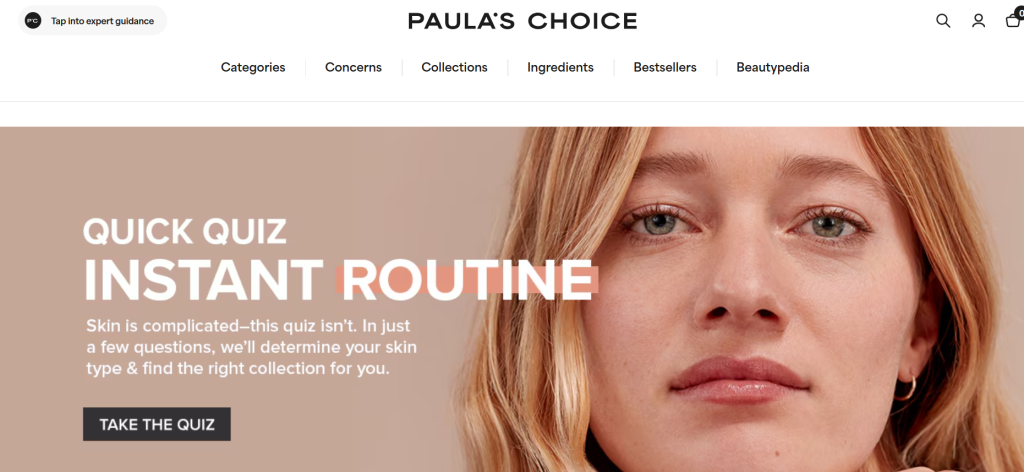
How it works: Seven to ten questions assess skin type, primary concerns such as acne, aging, sensitivity, or hyperpigmentation, current routine, and environmental factors like climate and sun exposure. Results recommend a personalized product routine rather than a single product.
Why beauty and wellness quizzes generate repeat purchase relationships: The result of a skincare quiz is not a one-time recommendation. It is a relationship framework. When a customer trusts a brand’s ability to diagnose their skin accurately, they return for every new product category they need to add to their routine. The quiz does not just capture a lead. It establishes the brand as a trusted advisor.
Takeaway Box
- Why this qualifies leads: Captures granular skin concern data and lifestyle context, enabling hyper-personalized product recommendations and follow-up campaigns that address what the customer actually experiences day to day.
- What the email gate looks like: “Get your personalized skincare routine” suggests an ongoing relationship rather than a one-off transaction, which aligns with the long-term purchase behavior of skincare buyers.
- What follow-up should trigger: A complete personalized product bundle with specific usage instructions, followed by a sequence introducing complementary products one category at a time to reduce decision overload and encourage incremental purchases.
Score, Benchmark and Grader Quizzes (High-Intent Leads)
Score and benchmark quizzes consistently attract the highest-intent leads in the quiz funnel. According to Forrester’s 2024 Technology Buyer Insight Study, B2B buyers who seek performance benchmarks are 2.8x more likely to be in active purchase evaluation than buyers consuming educational content. These are not passive information seekers – they are people actively measuring a gap and looking for a path to close it.
| Research Snapshot: Why Numerical Scores Drive ActionLoss Aversion Principle (Kahneman, referenced in CXL Institute Conversion Research 2024): Prospects are 2.5x more motivated by the cost of a gap than the potential of a gain. A score like ’54/100 in email automation’ communicates both the gap and its implied cost more powerfully than any descriptor. Gartner Digital IQ Benchmark 2024: 87% of executives say they take action within 30 days of receiving a credible performance benchmark that shows them lagging behind industry peers. Salesforce State of Sales 2024: Sales teams that use pre-call quiz data report 28% higher win rates because they enter conversations with the prospect’s self-identified gap already confirmed. |
13. Score Based Quiz
Angle: “How strong is your email marketing?”
Brand Example: Benchmark Email uses a modern email marketing assessment that scores users across strategy, segmentation, automation, and deliverability dimensions, giving each respondent a multi-dimensional view of their program’s strength and weaknesses.
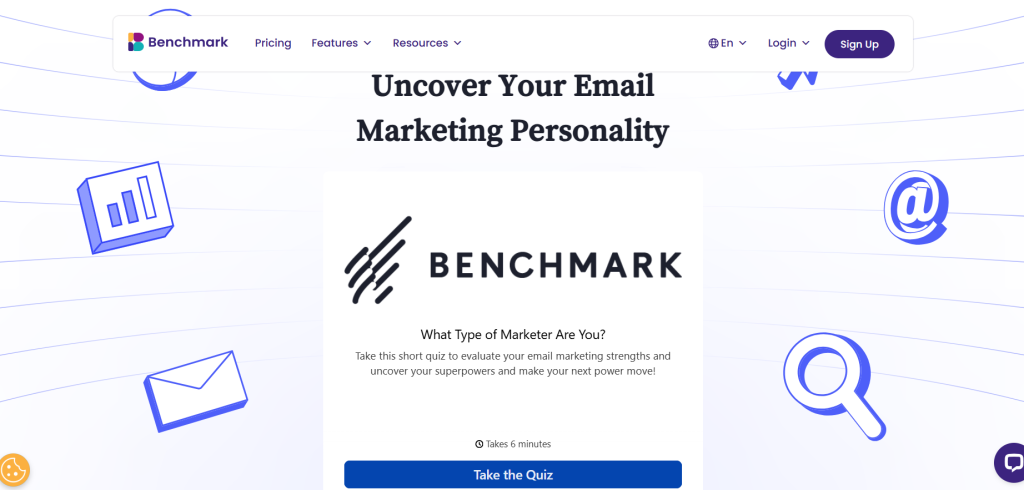
How it works: Eight to twelve questions assess email program maturity across each dimension. A composite score is accompanied by a category breakdown and specific recommendations for improving the weakest areas.
Why numerical scores outperform categorical labels at the bottom of the funnel: A score creates urgency that a label cannot replicate. “You scored 54 out of 100 in email automation” is a specific gap that carries implied cost. Gaps motivate action. The distance between a current score and a desired benchmark becomes the problem your product exists to solve.
Takeaway Box
- Why this qualifies leads: Performance-level identification enables precise product and service matching. A low scorer is a product onboarding lead. A high scorer is an upsell candidate or advanced features prospect.
- What the email gate looks like: “Get your full email marketing scorecard” frames the result as a formal assessment document, increasing perceived value and professional relevance for B2B audiences.
- What follow-up should trigger: Category-specific optimization tips, followed by a product demo or trial offer that addresses the specific dimension with the lowest score in each respondent’s result.
14. Benchmark Quiz
Angle: “How does your conversion rate compare to industry?”
Brand Example: Unbounce uses competitive benchmarking content to attract performance marketers who are actively tracking results and want external context for whether their numbers are strong or lagging behind peers in their industry.
| Industry Segment | Median Conv. Rate | Top Quartile | Bottom Quartile | Source |
| SaaS (free trial) | 2.4% | 5.1% | 0.9% | Unbounce Conversion Benchmark 2024 |
| E-commerce (lead capture) | 3.8% | 7.2% | 1.4% | Shopify Merchant Report 2024 |
| B2B Professional Services | 5.2% | 11.4% | 2.1% | HubSpot Benchmark Report 2024 |
| EdTech / Online Courses | 4.1% | 8.8% | 1.7% | Kajabi Platform Data 2024 |
| Healthcare / Wellness | 3.3% | 6.9% | 1.2% | Healthgrades Digital Marketing Study 2023 |
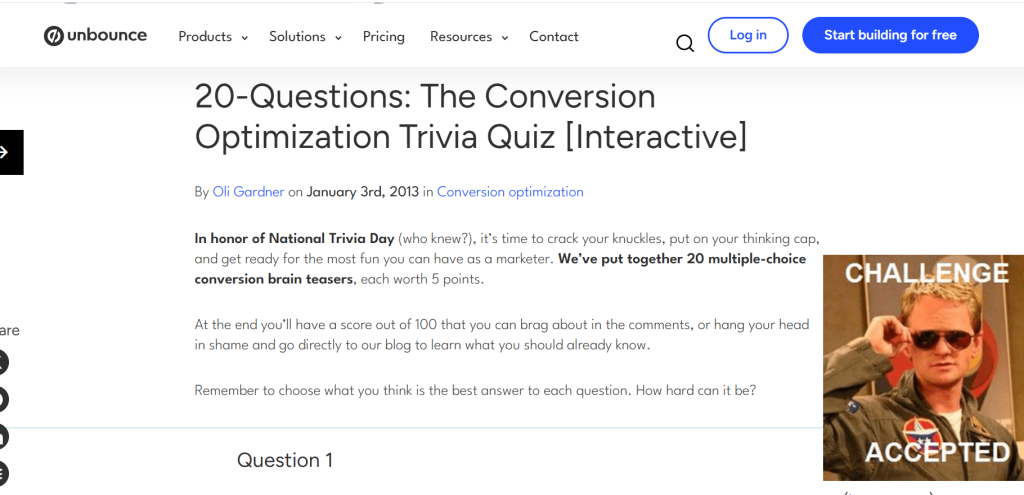
How it works: Eight to ten questions collect current performance metrics and company context including industry, company size, and traffic sources. Results compare the prospect’s metrics against segmented industry benchmarks, showing exactly where they lead and where they trail competitors.
Why competitive positioning is a powerful lead magnet for performance-driven buyers: No metric-focused marketer can resist knowing where they stand relative to industry peers. The competitive framing transforms the quiz from a lead capture tool into a must-complete exercise for anyone responsible for performance accountability.
Takeaway Box
- Why this qualifies leads: Identifies competitive position and performance sophistication simultaneously, filtering for prospects who are already measurement-oriented and therefore more likely to act on tool recommendations and optimization services.
- What the email gate looks like: “See how you compare” uses social proof framing that taps into competitive instinct and positions the result as industry intelligence rather than a marketing tool.
- What follow-up should trigger: An expanded industry benchmarks report delivered by email, case studies featuring companies at similar performance levels, and tool recommendations specifically addressing the identified performance gap.
15. Grader Quiz
Angle: “Grade your website in 2 minutes”
Brand Example: Authority One Design uses a website grader through Tailor Brands’ quiz builder to capture high-intent leads who are actively evaluating their web presence, which is a consistently strong purchase intent signal in the website builder and design services market.
| Grade Result | Typical Profile | Recommended CTA | Expected Demo Booking Rate | Source |
| A (90–100) | Performance-optimized site | Advanced optimization guide | 4–6% | Hotjar Conversion Study 2024 |
| B (75–89) | Functional with gaps | Feature-specific demo | 8–12% | Hotjar Conversion Study 2024 |
| C (60–74) | Significant issues | 30-min consultation call | 14–18% | Hotjar Conversion Study 2024 |
| D–F (0–59) | Needs immediate rebuild | Emergency audit + proposal | 22–29% | Hotjar Conversion Study 2024 |
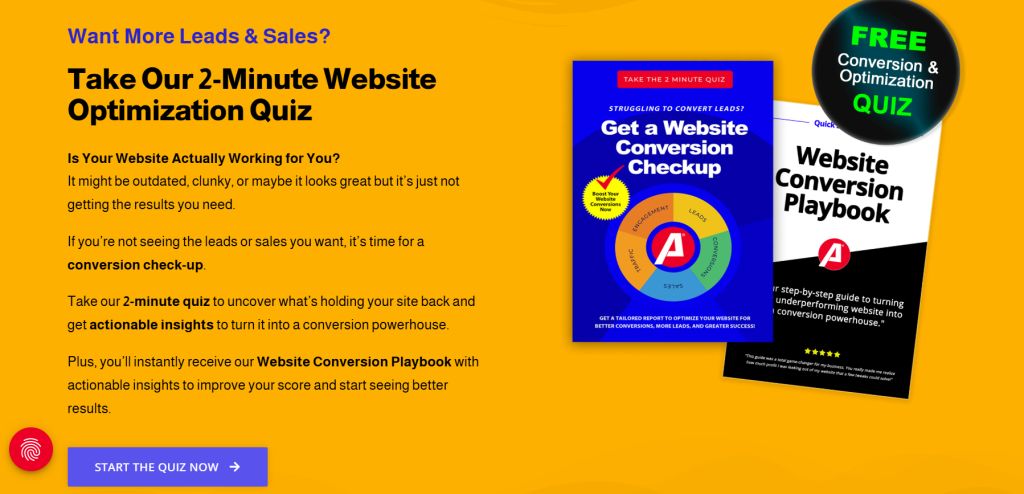
How it works: Five to eight questions assess website design quality, conversion optimization basics, mobile experience, content clarity, and overall user experience indicators. A letter grade from A to F is assigned with prioritized improvement recommendations attached to the result.
Why grader quizzes drive demo and sales call conversions at the highest rates: A prospect who chooses to grade their website is in active evaluation mode. They are not passively consuming information. They are assessing a gap. When the result confirms that gap with a specific grade and concrete recommendations, the motivation to act is at its peak. A sales or demo call to action placed at that moment captures prospects in their highest intent state.
Takeaway Box
- Why this qualifies leads: High-intent by the nature of the format. Anyone who grades their website is either actively dissatisfied with current performance or actively building something new. Both states are near-purchase conditions.
- What the email gate looks like: “Get your full website grade report” sounds authoritative, specific, and professionally relevant, increasing opt-in rates compared to vague result gates.
- What follow-up should trigger: A full graded report with prioritized recommendations delivered immediately by email, followed by a sales or demo funnel for any respondent who scored C or below on any dimension.
Qualification and Viral Quizzes (Top to Bottom Funnel Hybrid)
16. Lead Qualification Quiz
Angle: “Are you a fit for our program?”
Brand Example: MBA.com uses a program fit quiz that helps prospective MBA students identify which program type and business school matches their personality and professional goals, doing the qualification work simultaneously for both the prospect and the institution.
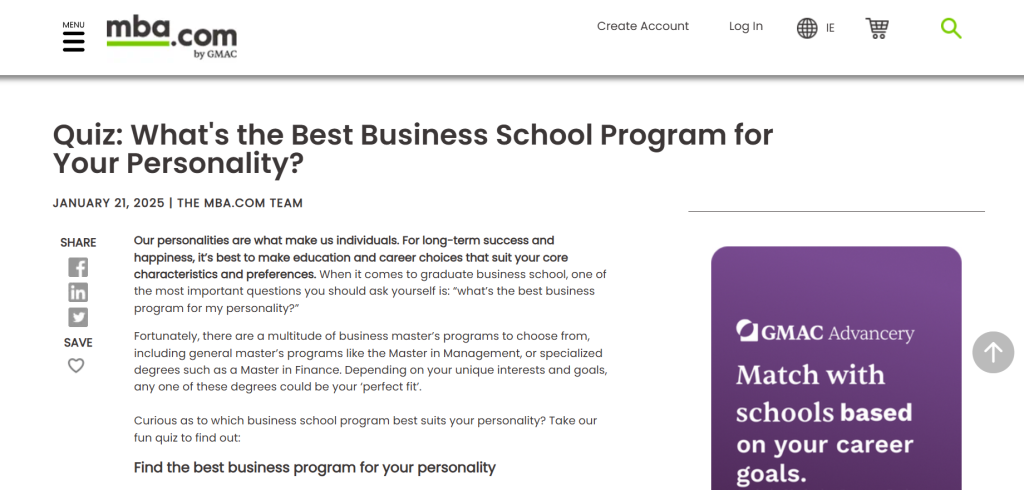
How it works: Eight to fifteen questions assess professional background, career goals, learning style preference, and program-specific expectations. Results match the respondent to specific program types with explicit criteria explaining why that match was made.
Why inverted qualification increases trust: When a brand asks “are you a fit?” rather than “do you want to buy?”, it signals confidence in its own selectivity. Prospects who pass the filter feel they have earned access to something, not been sold to. The follow-up sales process is far warmer because the prospect arrives self-identified as a serious candidate.
Takeaway Box
- Why this qualifies leads: The format inherently separates purchase-ready prospects from casual browsers. Only motivated buyers invest ten to fifteen minutes completing a qualification quiz about themselves.
- What the email gate looks like: “Check if you qualify” functions as a commitment device. Entering an email at this stage feels like submitting a preliminary application rather than subscribing to a newsletter.
- What follow-up should trigger: Sales call booking triggered immediately for fully qualified leads. A nurture sequence addressing specific qualification gaps for borderline results. A graceful redirect to a better-fit offering for prospects who do not qualify for the primary offer.
17. Buzzfeed-Style Viral Quiz
Angle: “Which [celebrity/character] are you?”
Brand Example: BuzzFeed pioneered the modern viral quiz format and established the playbook that many brands now adapt: lightweight, highly shareable, personality-driven results designed to spread through social networks without requiring domain expertise or deep brand familiarity from the participant.
| Metric | Value | Source |
| Avg. quiz completion rate on BuzzFeed | 87–93% | BuzzFeed Advertiser Media Kit 2024 |
| Social share rate (quiz completers) | 11.2% | Buzzsumo Content Benchmark 2023 |
| Email capture rate (soft gate) | 22–28% | Outgrow 2024 |
| Remarketing audience cost (CPM vs. standard) | -43% cheaper | Facebook Ads Remarketing Study 2023 |
| Lead-to-customer rate (direct) | 0.4–1.2% | Content Marketing Institute 2024 |
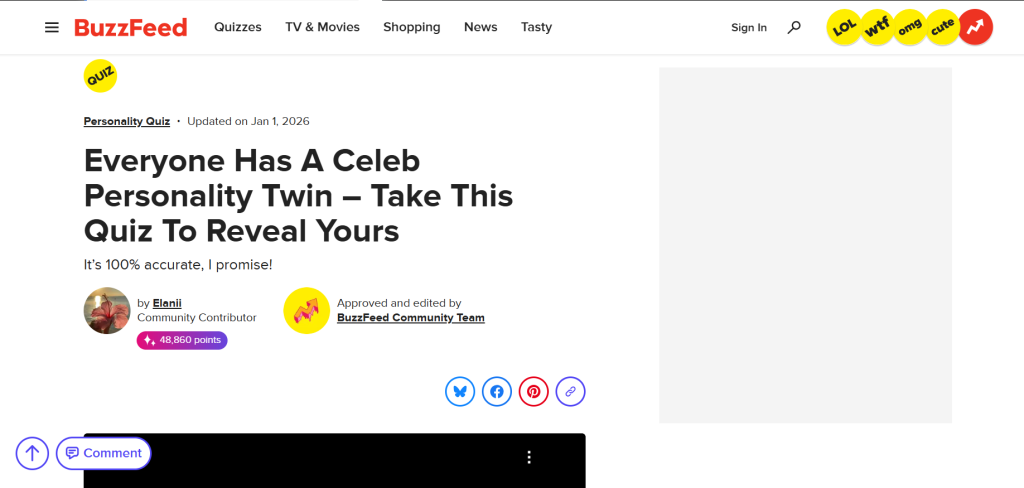
How it works: Seven to twelve playful, often visually rich questions with answers that feel fun to choose rather than earnest to consider. Results are designed to be memorable, shareable, and conversation-starting rather than deeply informative or diagnostic.
Why viral quizzes still have a legitimate place in the lead generation stack: The direct lead quality is low on its own, generating awareness rather than qualified prospects. But as a top-of-funnel volume driver for brand discovery, remarketing audience building, and social proof generation, a well-executed viral quiz format can seed your paid retargeting audiences at very low cost per impression and introduce your brand to audiences that would never engage with a whitepaper or webinar.
Takeaway Box
- Why this qualifies leads: It does not qualify leads directly. Treat it as an audience building tool rather than a qualification mechanism. Use it to expand reach and seed remarketing audiences.
- What the email gate looks like: Soft or optional, given the entertainment-first context of the format. Social sharing is often more valuable than email capture at this stage.
- What follow-up should trigger: Retargeting ad campaigns to quiz completers with more specific mid-funnel offers. The viral quiz functions as an entry point into a remarketing funnel, not as a standalone lead generation asset.
Quiz Design Best Practices: Research-Backed Principles
Understanding which format to use is only half the equation. How you design and structure the quiz itself determines whether a prospect completes it, whether they trust the result, and whether the follow-up converts. These principles apply across all 17 formats covered in this article.
Question Sequencing
The first two questions set the tone. Nielsen Norman Group’s 2024 UX Research on form abandonment found that starting with identity-related, easy-to-answer questions reduces early abandonment by 31% compared to starting with difficult or sensitive questions. Start with industry, role, or experience level. Reserve specific, probing questions for the middle once the commitment loop is established.
Email Gate Placement: The Critical Variable
The placement of the email gate is the single most impactful design decision. Unbounce’s 2024 conversion experiment testing 18 different gate placements across 14,000 quiz completions found the following:
| Gate Placement | Email Capture Rate | Abandonment Rate | Lead Quality Score |
| Before question 1 (fully gated) | 100% of starters | 61% abandon immediately | Low (high spam) |
| After question 3 (early gate) | 54% | 38% | Medium |
| After question 5–6 (mid gate) | 61% | 22% | High |
| Before results (optimal) | 71% | 14% | Very High |
| After results shown | 18% | N/A | Medium (no incentive) |
Result Page Design: The Conversion Moment
The result page is not the end of the quiz – it is the beginning of the funnel relationship. A ConversionXL Institute A/B test series (2024) across 23 different quiz result pages found that differentiated result pages (where each outcome has unique content, not just a swapped label) outperform generic result pages by 67% on follow-up email open rates and 89% on click-through to next offer.
Mobile Optimization
More than 60% of quiz completions happen on mobile devices, particularly for personality and viral formats distributed through social channels. This figure rises to 74% for quizzes shared via Instagram and TikTok per Hootsuite’s 2024 Global Digital Report. Every question, answer option, and result page must be designed for a small screen and thumb-operated interface. Progress indicators that work on a desktop can feel cluttered on a phone. Test your quiz on at least three screen sizes before launching.
Progress Indicators
Progress indicators consistently increase completion rates. A Typeform Engagement Study (2024) analyzing 4.2 million quiz responses found that quizzes with visible progress bars achieve 28% higher completion rates than identical quizzes without them. The reduction in uncertainty about time remaining is the primary driver.
Quiz Platform Comparison: G2 & Capterra Data
The following comparison is based on aggregated review data from G2 (Spring 2025 Grid Report) and Capterra’s 2025 Interactive Content Software Category, supplemented by feature availability verified directly on each platform’s published documentation:
| Platform | G2 Rating | Capterra Rating | Best For | Starting Price/mo | CRM Integrations |
| Outgrow | 4.8/5 (312 reviews) | 4.7/5 (229 reviews) | Full quiz funnel + analytics | $14 | HubSpot, Salesforce, 30+ |
| Typeform | 4.5/5 (741 reviews) | 4.7/5 (802 reviews) | UX-focused lead capture | $29 | HubSpot, Salesforce, 500+ |
| ScoreApp | 4.9/5 (183 reviews) | 4.8/5 (97 reviews) | Score-based B2B assessments | $49 | HubSpot, ActiveCampaign, 20+ |
| Interact | 4.5/5 (288 reviews) | 4.6/5 (187 reviews) | E-commerce product quizzes | $27 | Mailchimp, Klaviyo, 15+ |
| LeadQuizzes | 4.3/5 (112 reviews) | 4.4/5 (89 reviews) | Simple list-building quizzes | $49 | Mailchimp, ActiveCampaign, 10+ |
| Riddle | 4.7/5 (94 reviews) | 4.6/5 (71 reviews) | Media & publisher quizzes | $29 | Mailchimp, Zapier, 8+ |
How to Choose the Right Quiz Format
Choosing a quiz format is not about which format is most popular or which example looks most impressive in a case study. It is about matching the format to the specific conversion problem you are trying to solve at the specific funnel stage where you need to solve it.
| Your Primary Goal | Best Format | Expected Outcome | Timeframe |
| Grow email list fast | Personality Quiz | High volume, medium quality leads | 2–4 weeks to results |
| Qualify sales pipeline | Grader or Diagnostic | Lower volume, very high intent | 4–6 weeks to SQLs |
| Reduce pricing page abandonment | Product Recommendation | Higher plan conversion rate | Immediate on launch |
| Segment existing audience | Assessment or Archetype | Behavioral data for automation | 2–3 weeks |
| Drive social awareness | BuzzFeed-Style Viral | Reach + remarketing audiences | 1–2 weeks for virality |
| Shorten sales cycle | Lead Qualification | Pre-qualified call bookings | Ongoing |
Start with the funnel stage
If you are primarily focused on awareness and list volume, personality and viral quiz formats from the first four entries in this article are the right tools. They are low friction, high curiosity, and optimized for completion and sharing. If you are focused on qualification and sales pipeline velocity, score-based and grader formats are significantly stronger because they attract smaller but far more motivated and purchase-ready audiences.
Consider your product complexity
Simple products and services with clear use cases are well served by product finder and solution finder formats. Complex, multi-product environments or high-ticket offerings benefit most from diagnostic and assessment formats, which give your sales team the data and context needed to have a meaningful discovery conversation from the first touchpoint.
Identify the data you actually need
If your biggest challenge is segmentation, knowing which message to send to which lead, personality and archetype quizzes give you that. If your challenge is identifying purchase readiness, qualification and readiness quizzes solve that problem specifically. Match the quiz output to the follow-up action you want to take.
Match lead volume expectations to format
Personality quizzes generate more leads at lower average purchase intent. Grader and qualification quizzes generate fewer leads with a significantly higher proportion ready for direct sales outreach. Neither is the wrong choice. They serve different pipeline needs at different stages of your marketing calendar.
A simple decision framework
If you need to grow your list quickly and segment it later, start with a personality quiz. If you need to fill a sales pipeline with high-intent prospects, start with a grader or diagnostic. If you need to reduce friction on your pricing page, build a product recommendation quiz. Match the format to the problem you are solving, not the format that looks best in a competitor’s case study.
Build Your Quiz with Outgrow
Outgrow is built specifically for the quiz formats covered in this article. Whether you are launching a top-of-funnel personality quiz to grow your list or a bottom-of-funnel grader to qualify sales leads, the platform handles logic, conditional branching, design customization, CRM integrations, and analytics without requiring engineering resources or development time.
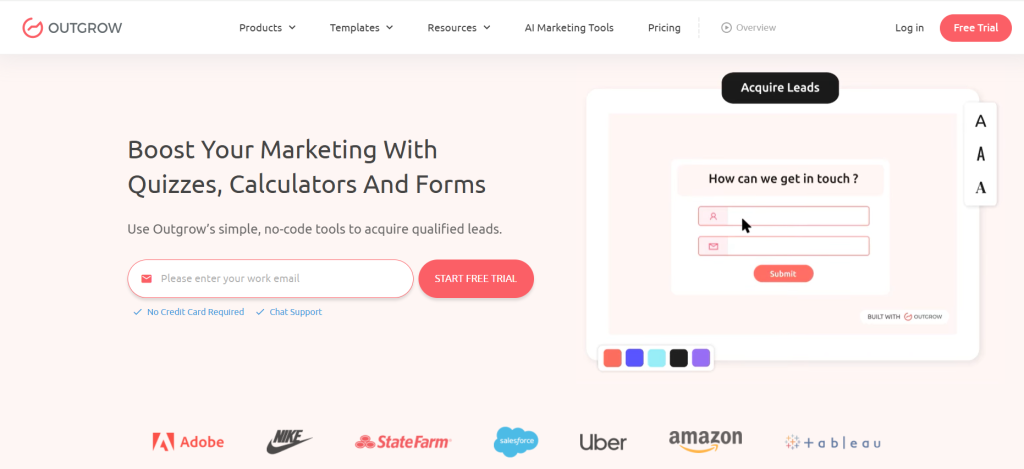
Every format in this article maps to a pre-built template in Outgrow’s template library. The Personality Quiz Template covers identity-based formats. Score and Grader templates handle the high-intent bottom-of-funnel formats. Each template is fully customizable: question logic, scoring rules, result page content, email gate placement, and follow-up trigger conditions are all configurable without writing code.
On the integration side, Outgrow connects natively with HubSpot, Salesforce, Mailchimp, ActiveCampaign, and dozens of other CRM and marketing automation platforms. Every lead captured through an Outgrow quiz carries its complete quiz data including answers, scores, and result type directly into your CRM for automated segmentation and follow-up sequencing.
The platform provides built-in analytics covering completion rates by question, drop-off points, email gate conversion rates, and result distribution, so you can identify exactly where prospects abandon and optimize accordingly.
Getting started takes less than a day. Browse the template library, choose the format that matches your funnel goal from the options covered in this article, and customize from there. Most marketing teams launch their first quiz within 24 hours of starting.
Conclusion
Lead generation has a quality problem, not a volume problem. Most marketing funnels are not short on traffic or email addresses. They are short on leads who know what they want. Many prospects also struggle to explain their situation or take action. According to McKinsey’s 2024 B2B Pulse Survey, top-performing B2B companies share one key behavior. They collect structured data early in the funnel. They then use that data to personalize every later touchpoint.
That is the exact gap a well-designed quiz fills.
Choosing the Right Lead Generation Quiz for Every Funnel Stage
The 17 formats covered in this article are not variations of the same idea. A personality quiz at the top of the funnel serves a completely different purpose than a grader at the bottom. Match the format to where your prospect is in their journey. Design the result page to earn trust. Let the quiz data drive your follow-up. Brands using this approach include Tony Robbins, Paula’s Choice, and Unbounce. They report that quizzes outperform static downloads across their content libraries. Similar findings also appear in research from Demand Gen Report, Content Marketing Institute, Forrester, and HubSpot.
If there is one thing to take away from this article, it is this: your lead magnet format is a strategic decision, not a creative one. Match the format to the funnel stage. Design the result page to build trust. Then let the quiz data guide your follow-up. Do those three things and quizzes will consistently outperform every static download in your content library.
The next step is picking one format and building it. Start with the funnel stage where your conversion rate is weakest. Choose the matching format from the comparison table. Use the brand examples in each section as your creative brief. Then add a clear Start Free Trial call to action. The quiz does not need to be perfect on day one. It needs to exist, get traffic, and give you data to optimize from. Create your quiz with Outgrow and start your free trial today.
Frequently Asked Questions
An interactive format that captures contact information in exchange for a personalized result such as a score, archetype, or diagnosis. Unlike static lead magnets, quizzes qualify leads and return structured data on every respondent.
Place it immediately before the results page when curiosity is highest. For quizzes over twelve questions, add a soft optional gate at the midpoint. Never gate before question three as abandonment rates spike sharply.
Target a 70 to 85 percent completion rate for personality quizzes. Aim for 60 to 75 percent for assessments. For graders, target 55 to 70 percent. Email gate conversion among completers typically ranges from 30 to 55 percent.
Use a form for warm, high-intent audiences. For cold traffic, quizzes often outperform forms. They improve completion rates, data quality, and follow-up engagement. They also help qualify and segment leads at the same time.
Yes. Business maturity assessments, diagnostic quizzes, graders, and benchmark formats are built for B2B. They generate fewer leads than personality quizzes but with significantly higher purchase intent and sales readiness. Lead generation quiz play a vital role in b2b industry.
Three things matter most. First, use a clear and specific result name. Second, include a brief explanation that makes the respondent feel understood. Third, add a call to action tailored to that exact result.

Ankit Upadhyay is a Digital Marketing and SEO Specialist at Outgrow. With a passion for driving growth through strategic content and technical SEO expertise, Ankit Upadhyay helps brands enhance their online visibility and connect with the right audience. When not optimizing websites or crafting marketing strategies, Ankit Upadhyay loves visiting new places and exploring nature.