The Psychology Behind High-Converting Interactive Content (And How to Apply It)
Table of Contents
Quizzes go viral. Calculators pull in leads at 2 AM. Assessments close deals, a PDF never touched. Here’s what’s actually going on under the hood.
Last year, a SaaS company replaced its “Download Our Guide” CTA with a 6-question ROI calculator. Same traffic. Same page. Lead capture went from 3% to 19% in three weeks.
No redesign. No new ad spend. Just a different psychological experience.
That’s not a growth hack. That’s the brain doing what it always does, responding to content that feels relevant, immediate, and personal. The guide asked nothing and gave nothing back. The calculator created a loop: you put something in, you get something specific out. That loop is why interactive content marketing outperforms every passive format on the same page, with the same traffic, every time.
Three psychological mechanisms run this show. Once you see how they work and how real brands use them, you’ll look at your content calendar differently.
What Is Interactive Content?
Interactive experiences have become a major part of digital marketing, leading many brands to ask, what is interactive content and why does it perform so well? At its core, interactive content encourages active participation instead of passive consumption. Rather than simply reading a blog or watching a video, users answer questions, enter information, or make selections to receive personalized outcomes. Quizzes, calculators, assessments, and polls are all examples of this approach. Understanding what is interactive content is important because it highlights the shift toward experiences that are engaging, relevant, and tailored to individual users.
Why Interactive Content Works
To understand why interactive content works, it helps to look at human psychology. People are naturally curious and are more likely to engage with experiences that feel personal and rewarding. Interactive experiences provide immediate feedback and create a sense of participation that static content often lacks. They also deliver information that is directly relevant to the user’s needs or interests. When marketers examine why interactive content works, they often find that personalization, instant gratification, and active engagement are the key drivers behind higher conversion rates and stronger audience connections.
1. The Curiosity Gap: The Tension That Gets the Click
Interactive content marketing is the only format where you can manufacture this feeling at scale.” In 1994, Carnegie Mellon economist George Loewenstein published research arguing that curiosity isn’t a soft feeling; it’s a specific response to an information gap. When you sense there’s something you should know but don’t, your brain registers that as discomfort. Real discomfort. The kind that drives behavior.
Every quiz title that’s ever worked is built on this. “Which City Should You Actually Live In?” doesn’t succeed because people urgently need relocation advice. It succeeds because it implies there’s an answer specific to you, and you don’t know it yet. That gap is uncomfortable. Clicking is how you close it.
Interactive content is the only format where you can manufacture this feeling reliably. Static content can create curiosity, too, but it can’t close the loop with a personalized result. That closing moment, where someone gets their specific answer, is where conversion happens.
BuzzFeed turned this into a content operation
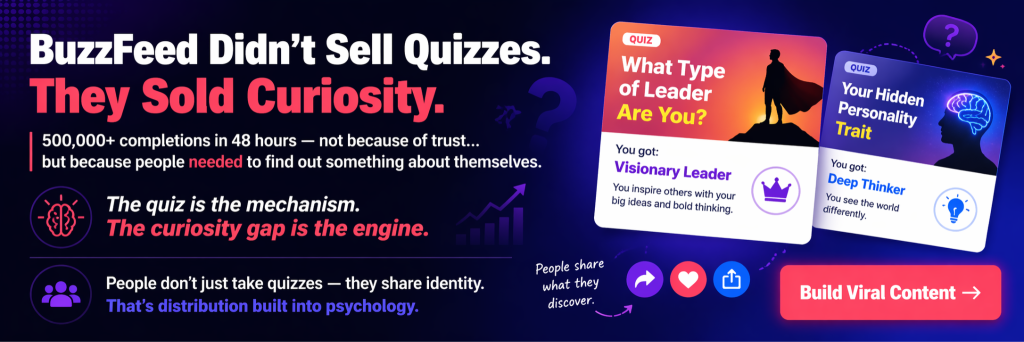
BuzzFeed’s quiz machine gets 500,000+ completions on top formats within 48 hours, and none of those people click because they trust BuzzFeed’s research methodology. They click because the title made them feel like there was something specific to find out about themselves. The quiz is just the mechanism. The curiosity gap is the engine.
The side effect: people share their results. Sharing a quiz result is a way of saying something about yourself without directly saying it. That’s distribution built into the psychology of the format.
Write the title before you build anything
Your title has one job: make someone feel like they’re missing a specific piece of information about their own situation. “Content Strategy Quiz” is a label. “Is Your Content Strategy Actually Making You Money?” is a gap. One describes a thing. The other creates tension.
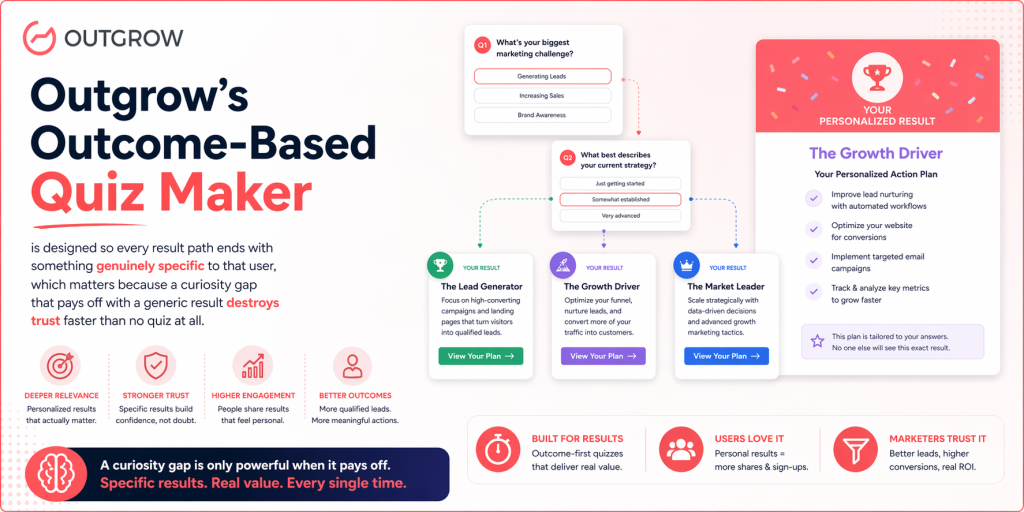
Outgrow’s outcome-based quiz maker is designed so every result path ends with something genuinely specific to that user, which matters because a curiosity gap that pays off with a generic result destroys trust faster than no quiz at all.
2. Instant Gratification: The Brain Doesn’t Want to Wait
Here’s what’s actually happening when someone bounces from a long-form asset: they’re not lazy. They’re running a real-time cost-benefit calculation, and the expected wait time before they get something useful is longer than their current attention budget.
Your prefrontal cortex handles delayed reward. Your limbic system handles right now. Online, in a browser, with 14 other tabs open, the limbic system wins almost every time. This isn’t a character flaw. It’s just how the hardware works.
Interactive content sidesteps this entirely. You answer 6 questions, and you get your result. You type in your numbers, and you get your calculation. The gap between effort and reward collapses to near zero, and the brain’s reward system fires right at the moment you wanted it to, conversion.
88% of marketers say interactive content helps them differentiate from competitors (Content Marketing Institute). That’s not about design. It’s about being the thing that actually answers the question instead of promising to answer it later. That gap only widens when interactive content marketing is built around psychology instead of format.
Interactive Content Statistics
Recent interactive content statistics show that audiences are increasingly drawn to experiences that allow them to participate rather than simply consume information. Studies have found that interactive formats often generate higher engagement rates, longer time on page, and improved lead conversion compared to traditional content. These interactive content statistics also indicate that marketers view quizzes, assessments, and calculators as valuable tools for differentiating their brands and delivering personalized experiences. The data makes it clear that interactive experiences have moved from being optional additions to becoming essential components of modern marketing strategies.
Types of Interactive Content
There are numerous types of Interactive Content available for businesses looking to improve audience engagement and lead generation. Common types of Interactive Content include quizzes, calculators, assessments, surveys, polls, contests, interactive infographics, chatbots, and product recommendation tools. Each format serves a different purpose depending on the user’s needs and stage in the customer journey. Quizzes are ideal for self-discovery and engagement, while calculators provide data-driven insights. Assessments help users evaluate their situation, and surveys collect valuable feedback. Choosing the right format can significantly improve user experience and help businesses achieve their marketing objectives more effectively.
Interactive Content Examples
Some of the most successful interactive Content Examples come from globally recognized brands that prioritize personalization and engagement. Popular interactive Content Examples include Spotify Wrapped, which gives users a customized summary of their listening habits, and HubSpot’s Website Grader, which instantly analyzes website performance. BuzzFeed quizzes are another well-known example, using curiosity and self-discovery to drive millions of completions and shares. Many B2B companies also use assessments and ROI calculators to generate qualified leads while providing immediate value. These examples demonstrate how interactive experiences can attract attention, build trust, and encourage users to take meaningful actions.
HubSpot’s Website Grader: a lead gen machine built on a simple promise
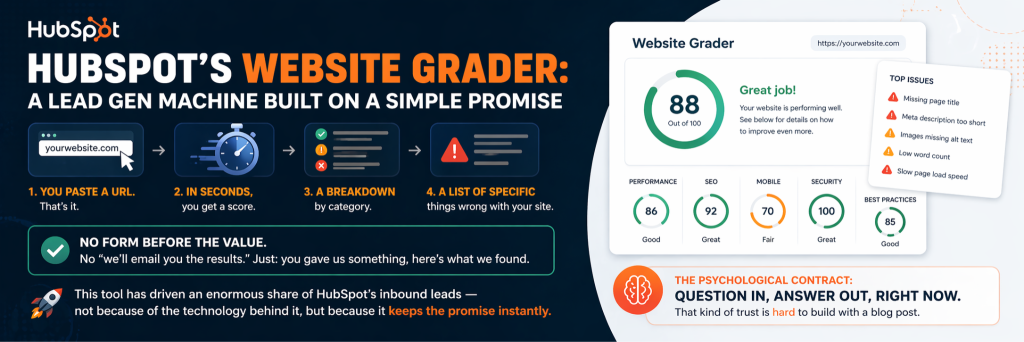
You paste in a URL. Within seconds, you have a score, a breakdown by category, and a list of specific things wrong with your site. No form before the value. No “we’ll email you the results.” Just: you gave us something, here’s what we found.
That tool has driven an enormous share of HubSpot’s inbound leads over the years — not because of the technology behind it, but because it keeps the promise instantly. The psychological contract is: question in, answer out, right now. That kind of trust is hard to build with a blog post.
The 60-second rule
If someone can’t get something meaningful from your interactive content in 60 seconds, you’re fighting a losing battle with attention. Cap quizzes at 8 questions. Deliver results on the same page. Make the output feel like a real answer, not a reason to schedule a demo. If the result is “thanks for completing this, a member of our team will be in touch,” you’ve wasted everyone’s time, including your own.
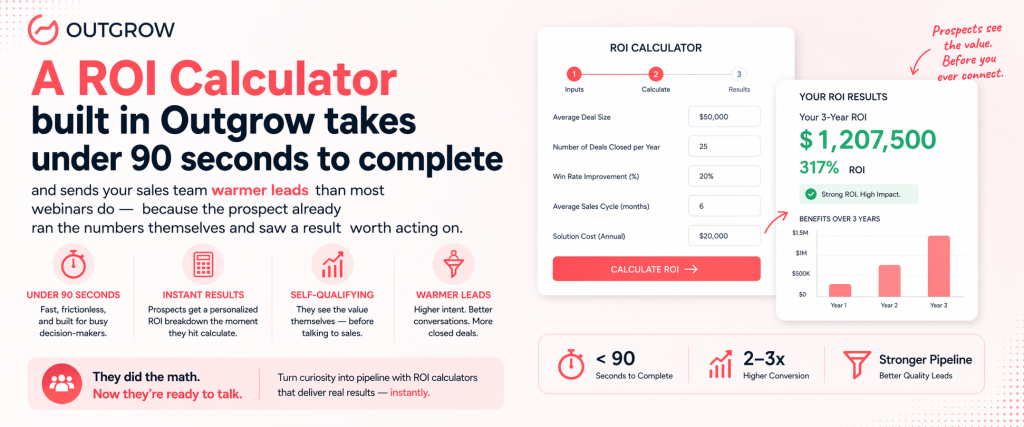
A ROI calculator built in Outgrow takes under 90 seconds to complete and sends your sales team warmer leads than most webinars do, because the prospect already ran the numbers themselves and saw a result worth acting on.
3. Personalization: “You” Still Beats Every Other Word in Marketing
There’s a reason people re-read emails that mention their name. The self-reference effect, documented in psychology research going back decades, shows that information connected to your own identity gets processed more deeply, retained longer, and acted on more readily than information about other things.
Generic content tells everyone the same thing. Interactive content tells one person something specific about their situation, using the answers they just gave you. That’s a completely different cognitive experience. One gets skimmed. The other gets read word for word.
When a result page opens with “Based on your answers, you’re a lean B2B team over-indexing on awareness content and under-investing in mid-funnel conversion…”, that person is not skimming. That sentence is about them. The self-reference effect kicks in, and suddenly your content has their full attention.
Generic content says something to everyone. Personalized interactive content says everything to someone.
Spotify Wrapped: personalization as distribution
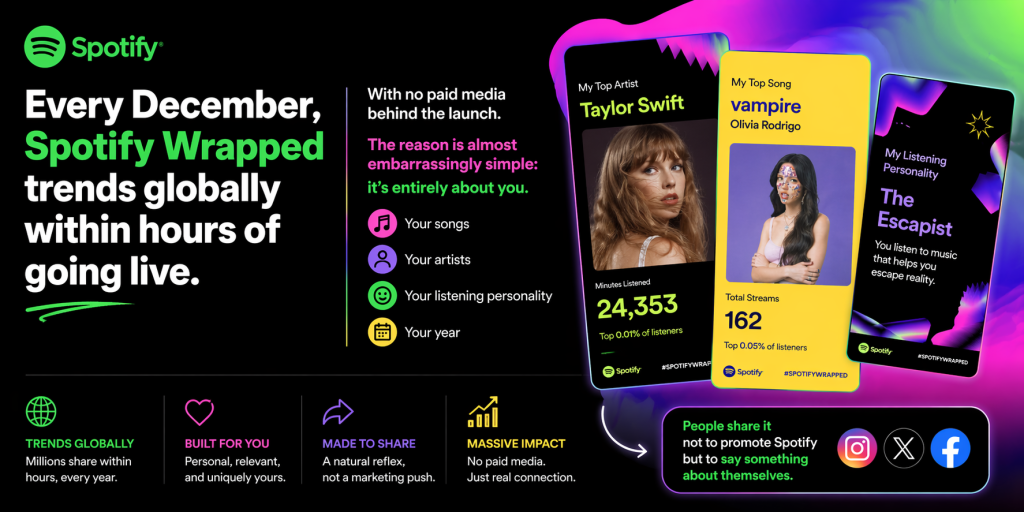
Every December, Spotify Wrapped trends globally within hours of going live, with no paid media behind the launch. The reason is almost embarrassingly simple: it’s entirely about you. Your songs, your artists, your listening personality, your year. People share it not to promote Spotify but to say something about themselves.
That’s personalization functioning as a distribution mechanism. The product is the mirror. The sharing is the marketing.
Outgrow: How a SaaS Company Turned Blog Traffic Into Qualified Leads
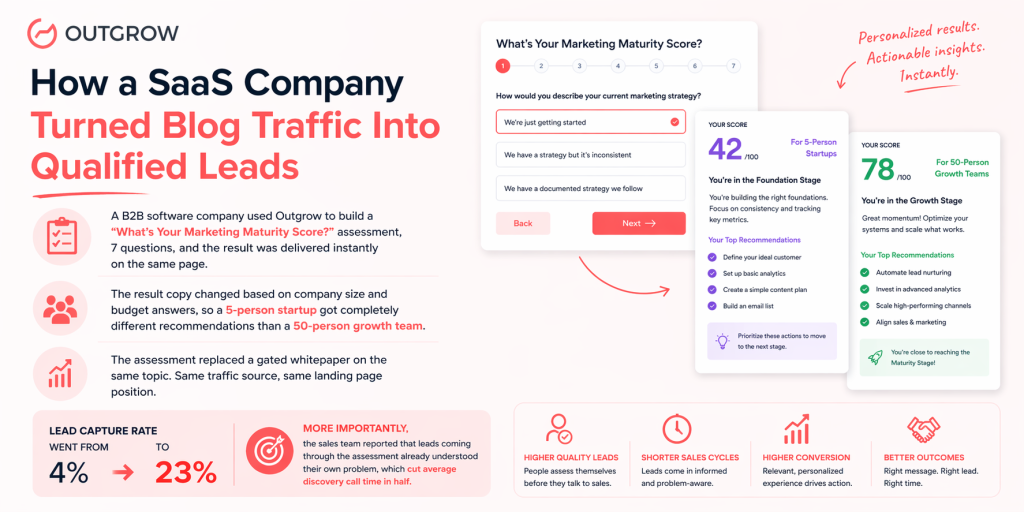
A B2B software company used Outgrow to build a “What’s Your Marketing Maturity Score?” assessment, 7 questions, and the result was delivered instantly on the same page. The result copy changed based on company size and budget answers, so a 5-person startup got completely different recommendations than a 50-person growth team.
The assessment replaced a gated whitepaper on the same topic. Same traffic source, same landing page position. Lead capture rate went from 4% to 23%. More importantly, the sales team reported that leads coming through the assessment already understood their own problem, which cut average discovery call time in half.
That’s what personalized interactive content does that a PDF never can: it makes the prospect do the diagnostic work themselves, so by the time they talk to you, they’re not starting from zero.
Conditional logic is all you actually need
You don’t need a machine learning team to deliver personal results. You need branching paths and a result copy written to speak to the person who took that specific path.
“Since you’re a solo founder running under $5K/month in paid acquisition…” lands in a completely different part of the brain than “Here are some tips for marketing on a budget.” Same information, radically different experience.
Outgrow’s conditional logic builder lets you create multiple outcome paths without writing code. A two-person marketing team can deliver the same level of output personalization that enterprise companies spend months building.
How to Create High-Converting Interactive Content
Learning How to Create High-Converting Interactive Content begins with understanding your audience’s challenges, goals, and motivations. The most effective interactive experiences solve a specific problem or answer a question users genuinely care about. How to Create High-Converting Interactive Content also involves selecting the right format, whether it’s a quiz, calculator, assessment, or survey. Keep the experience concise and easy to complete, as lengthy interactions often lead to drop-offs. Personalized results should provide actionable insights that users can immediately apply. Finally, include a clear next step, such as downloading a resource, scheduling a demo, or exploring a product, to maximize conversions and business impact.
What Stacking All Three Looks Like in Practice
Used separately, each trigger lifts performance. Used together, the effects compound.
Here’s a concrete example: a B2B company selling sales software.
Title: “Is Your Sales Follow-Up Process Costing You Deals?” That’s the curiosity gap. It implies there’s a specific answer about your sales process you don’t currently have.
Structure: 7 questions, result on the same page immediately, that’s instant gratification. No waiting, no email, no form wall before value.
Result copy: “Teams with your profile, inside sales, 8-20 reps, product-led motion, typically lose deals between day 3 and day 7 of follow-up. Here’s what the data shows for teams like yours.” That’s personalization. It’s using their answers and speaking to their exact context.
That single piece of interactive content qualifies leads, opens the sales conversation, and positions the brand as the expert, before any human being picks up the phone.
Why Most Interactive Content Doesn’t Convert
The format isn’t enough. Most interactive content that underperforms makes the same predictable mistakes:
Too many questions. Completion rates drop off significantly after question 10. If you can’t diagnose someone’s situation in 8 questions, the problem is your question design, not the quantity.
Generic results. A result page that says “Great job! Want to try our product?” isn’t personalization. It’s the curiosity gap paying off with nothing, and people feel that. They feel cheated, and they don’t come back.
Titles that describe instead of provoke. “Sales Readiness Assessment” tells someone what the thing is. “Are Your Sales Reps Actually Ready for Enterprise Deals?” makes them feel something. The second one gets clicked. The first one gets ignored.
Built for desktop, broken on mobile. More than 60% of quiz completions happen on a phone. If you designed the experience on a laptop and never tested it on a 390px screen, you’re delivering a broken experience to the majority of your audience.
Start With the Psychology, Not the Format
Most teams start by picking a format, “let’s do a quiz,” and end up with something that technically counts as interactive content but doesn’t do any psychological work.
The better starting point is three questions: What information gap am I opening with the title? How fast can someone get a useful result? Whose specific situation will the result speak to?
Once those three are answered, the format choice becomes obvious. A calculator is right when someone needs a specific number. An assessment works when they want a diagnosis of their situation. A quiz works when identity or comparison is the hook.
Build that experience first. Then pick the tool that lets you execute it without spending three weeks in development.
See It Work: Free for 7 Days
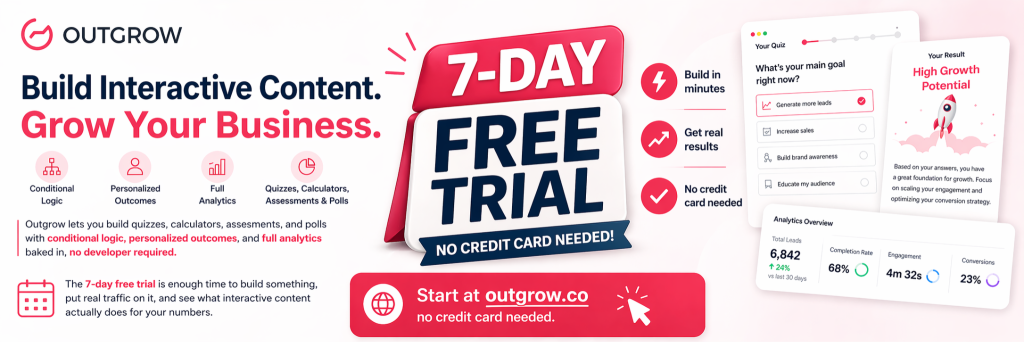
Outgrow lets you build quizzes, calculators, assessments, and polls with conditional logic, personalized outcomes, and full analytics baked in, no developer required. The 7-day free trial is enough time to build something, put real traffic on it, and see what interactive content actually does for your numbers.
No credit card needed.
Frequently Asked Questions
Because it requires participation, and participation creates investment. People trust conclusions they reach themselves more than conclusions handed to them. The result also arrives immediately, no waiting, no inbox, no “we’ll follow up”, which removes the biggest drop-off point in most content funnels.
Between 5 and 8 questions for most use cases. Fewer than 5, and the result feels arbitrary. More than 10 and you’re asking for effort the person didn’t agree to. The question isn’t how many questions you need; it’s what’s the minimum number that makes the result feel earned and specific.
No. Platforms like Outgrow handle the conditional logic, mobile layout, and result delivery. You need to know what experience you want to create and what questions get you the information to personalize the result. Most people have something live within a few hours of starting.
Assessments and calculators, because they attach directly to a business problem someone is actively trying to solve. A “Sales Process Efficiency Calculator” or a “Content ROI Assessment” attracts visitors with real intent and qualifies them through their answers, before your sales team spends a minute with them.
Often better, actually. Large brands default to awareness-level interactive content with watered-down results because too many people have to approve everything. A small team can build a highly specific calculator or assessment that answers exactly the question their best-fit customer is searching for, and iterate on it in a day. Speed and specificity beat budget in this format.

Sakshi is a digital marketing enthusiast passionate about connecting brands with audiences. With a background in content strategy and social media, she loves turning trends into actionable strategies. Outside of work, you’ll find her reading a book or hunting for the perfect cup of coffee.