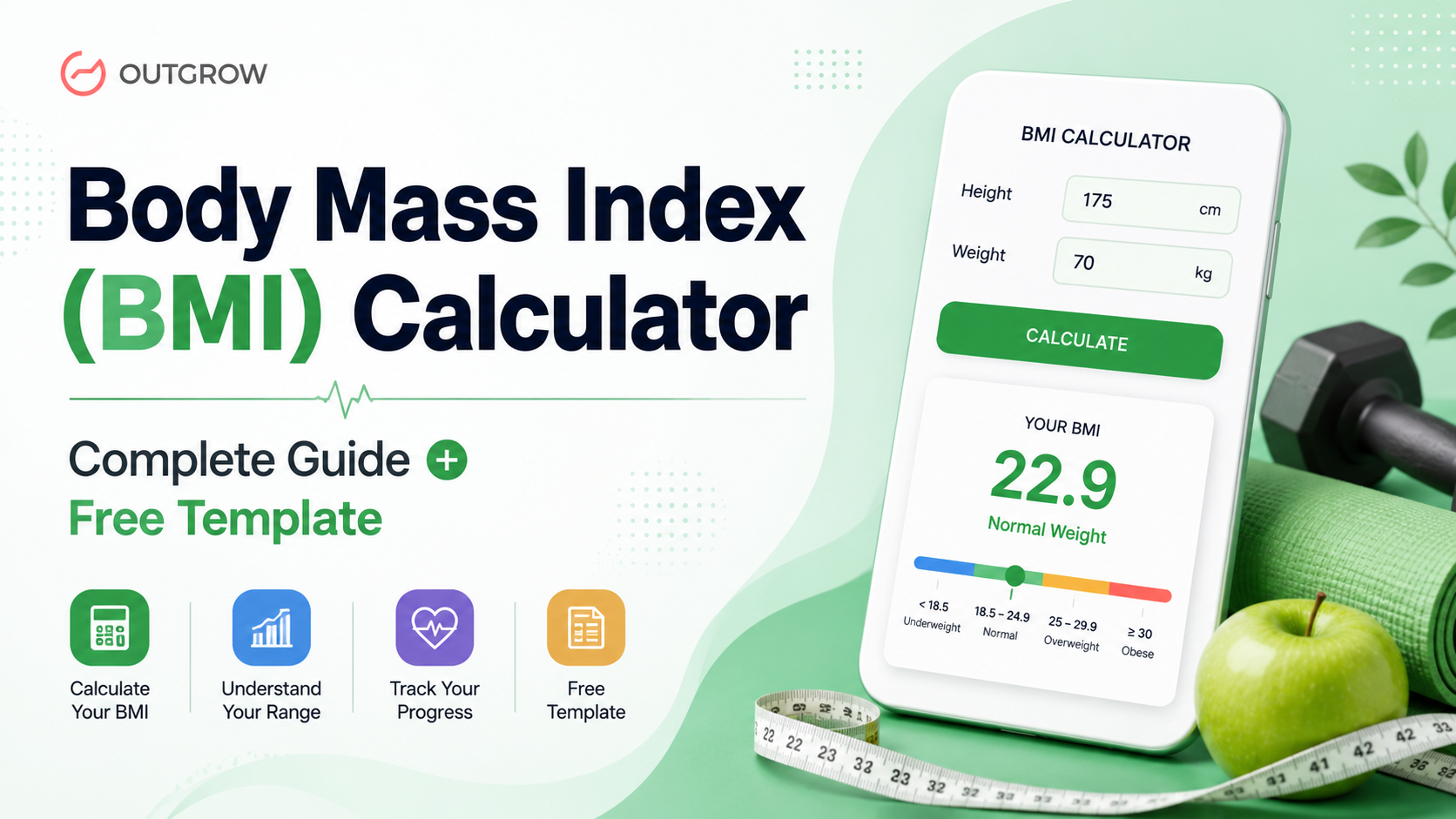
Body Mass Index (BMI) Calculator: Complete Guide + Free Template
Understanding your body weight status has never been easier. With Outgrow’s interactive BMI calculator, you can enter your height and weight and receive instant, personalized results within seconds. The calculator displays your BMI score, your corresponding health category, and your healthy weight range, all in one seamless experience.
What makes a great BMI calculator is not just the math behind it. It is the experience around it. Outgrow’s BMI calculator template includes a smooth progress bar that guides users through the input process, a well-designed result page that breaks down what the score means, and personalized recommendations tailored to each user’s specific output. Whether you are building a tool for a healthcare platform, a fitness brand, or a wellness coaching business, these interactive elements turn a simple calculator into a powerful lead generation and engagement machine.
What Is Body Mass Index (BMI)?
Table of Contents
Body Mass Index, commonly known as BMI, is a numerical value derived from a person’s height and weight. It is used as a screening tool to categorize individuals into different weight status groups, ranging from underweight to obesity. BMI provides a quick and standardized way to assess whether a person’s weight is in proportion to their height.
BMI is used worldwide by healthcare providers, public health organizations, and fitness professionals because it requires no specialized equipment, is easy to calculate, and allows for large-scale health assessments across populations. The World Health Organization uses BMI as one of its primary indicators for monitoring population health trends globally.
The science behind BMI is relatively straightforward. It works on the principle that body weight, when adjusted for height, correlates reasonably well with body fat levels in most adults. However, it does not directly measure fat. Instead, it serves as a proxy that helps flag individuals who may be at risk of weight-related health conditions.
The formula was developed in the 19th century by a Belgian mathematician named Adolphe Quetelet. His original work aimed to define the “average man” statistically, and the resulting index, called the Quetelet Index at the time, was later adopted by medical and public health communities and renamed the Body Mass Index.
BMI Formula: How Is BMI Calculated?
The BMI formula differs slightly depending on whether you are using the metric system or the imperial system, but the underlying concept is the same in both.
Metric Formula
In the metric system, BMI is calculated by dividing a person’s weight in kilograms by the square of their height in meters.
BMI = Weight (kg) divided by Height (m) squared
For example, if a person weighs 70 kilograms and is 1.75 meters tall, the calculation would be: 70 divided by (1.75 x 1.75), which equals 70 divided by 3.0625, giving a BMI of approximately 22.9.
Imperial Formula
In the imperial system, the formula multiplies weight in pounds by 703, then divides that result by the square of height in inches.
BMI = (Weight in pounds x 703) divided by Height in inches squared
For example, a person who weighs 154 pounds and is 5 feet 9 inches tall (69 inches) would calculate: (154 x 703) divided by (69 x 69), which equals 108,262 divided by 4,761, giving a BMI of approximately 22.7.
Common BMI Calculation Mistakes
Many people make errors when calculating BMI manually. The most frequent mistakes include using the wrong unit system (mixing pounds with meters, for instance), forgetting to square the height value, and entering height in centimeters instead of meters in the metric formula. An interactive BMI calculator built with Outgrow eliminates all of these errors automatically, since it handles the computation behind the scenes while the user simply inputs their values.
BMI Categories Explained
Once your BMI is calculated, it falls into one of several categories established by health authorities. These categories help interpret whether your weight may pose a health risk.
Underweight refers to a BMI below 18.5. Individuals in this range may be at risk of nutritional deficiencies, weakened immune function, and bone density loss.
Healthy Weight is the range between 18.5 and 24.9. People who fall in this range generally have a lower risk of weight-related health conditions, though other lifestyle factors still play a significant role in overall health.
Overweight covers BMI values from 25 to 29.9. This range indicates that a person carries excess body weight relative to their height, which may increase the risk of conditions such as high blood pressure, type 2 diabetes, and cardiovascular disease.
Obesity Class I spans from 30 to 34.9. At this level, health risks become more pronounced, and medical guidance is typically recommended.
Obesity Class II covers BMI values from 35 to 39.9. This range is associated with significantly elevated health risks and often warrants clinical intervention.
Obesity Class III, sometimes referred to as severe or morbid obesity, is defined as a BMI of 40 or above. This category carries the highest risk of serious weight-related health complications.
A well-designed BMI calculator uses dynamic category visualization and color-coded results to help users immediately understand where they stand and what their result means for their health.
What Your BMI Result Means
Your BMI result is a starting point for understanding your weight status, not a final verdict on your health. Each category carries its own set of health implications.
Health Risks of Low BMI
A BMI below 18.5 can indicate that a person is not getting adequate nutrition. Low BMI is associated with risks such as anemia, osteoporosis, fertility issues, weakened immunity, and in severe cases, organ failure. It is important to understand that low BMI is not always a sign of healthy eating or fitness. It can sometimes reflect underlying medical conditions.
Health Risks of High BMI
A BMI in the overweight or obese range increases the likelihood of developing chronic conditions such as type 2 diabetes, high blood pressure, heart disease, sleep apnea, joint problems, and certain types of cancer. The higher the BMI, the greater the risk tends to be, though individual health profiles vary significantly.
When BMI Indicates Healthy Weight
A BMI between 18.5 and 24.9 is generally considered to fall within a healthy range. However, even individuals with a healthy BMI can carry excess visceral fat or lack adequate muscle mass, which means other health markers should also be evaluated regularly.
Factors That Can Affect Interpretation
Several factors can influence how BMI results should be interpreted. Age, sex, ethnicity, muscle mass, and body composition can all affect how accurately BMI reflects a person’s actual health status. This is why many health professionals use BMI alongside other assessments rather than in isolation.
For the best experience, a BMI calculator should offer result-specific recommendations and conditional outcomes based on the user’s score, helping them understand what steps to take next.
Is BMI Accurate? What Experts Say
BMI is a widely used metric, but it is not without its limitations. Understanding both its strengths and weaknesses helps put its results in the right context.
Benefits of BMI
BMI is free, non-invasive, and easy to measure. It has been validated across large population studies and correlates reasonably well with body fat in most adults. It provides a quick screening tool that can flag individuals who may benefit from further assessment. Public health agencies and clinicians appreciate its scalability and consistency.
Limitations of BMI
BMI does not distinguish between fat mass and muscle mass, which can lead to misclassification. A highly muscular athlete might have a BMI in the overweight or obese range despite having very low body fat. On the other hand, an older adult with low muscle mass but high fat may fall in the healthy BMI range while actually carrying a disproportionate amount of fat.
Additionally, BMI does not indicate where fat is distributed on the body. Visceral fat, which accumulates around the abdominal organs, is considered more dangerous than subcutaneous fat, but BMI cannot differentiate between the two.
BMI vs Body Fat Percentage
Body fat percentage is a more precise measure of a person’s actual fat composition. It can be measured through methods such as DEXA scans, hydrostatic weighing, or bioelectrical impedance. While more informative than BMI, it requires more specialized tools and is less accessible.
BMI vs Waist-to-Height Ratio
Waist-to-height ratio is gaining attention as an alternative screening tool because it captures central obesity, which is a stronger predictor of cardiovascular risk than total body weight.
BMI vs Waist Circumference
Waist circumference is another complementary metric. Health guidelines suggest that waist measurements above 35 inches for women and above 40 inches for men indicate increased risk, regardless of BMI.
Despite its limitations, BMI remains a valuable first-line screening tool when used alongside other assessments and interpreted by qualified professionals.
Who Should Use a BMI Calculator?
BMI calculators are versatile tools with a wide range of users across personal health and professional settings.
Adults benefit from BMI calculators as a quick way to gauge their weight status and identify whether lifestyle changes might be beneficial.
Fitness Enthusiasts can use BMI as a baseline metric, though they should pair it with other body composition tools given that high muscle mass can skew results upward.
Weight Loss Programs incorporate BMI calculators to help clients set meaningful starting points and track progress over time.
Healthcare Providers use BMI as part of routine assessments during check-ups and preventive care consultations.
Wellness Coaches leverage BMI calculators to initiate health conversations with clients and tailor their programs accordingly.
Who Should Not Rely Solely on BMI?
Certain groups should be cautious about using BMI as their primary health metric.
Athletes often have significantly higher muscle mass, which inflates their BMI without reflecting actual body fat levels. Pregnant women experience natural and necessary weight changes that make BMI an unreliable measure during pregnancy. Elderly adults tend to lose muscle mass with age, which can cause BMI to underestimate actual fat percentage. Children and teenagers should not use adult BMI categories since children’s bodies change significantly during development, and age and sex-specific growth charts or BMI-for-age percentiles are used instead.
Healthy BMI Range by Age and Gender
While the standard BMI categories apply broadly to adults, research has shown that ideal BMI ranges can vary by age, gender, and ethnicity.
BMI Guidelines for Men
For adult men, a BMI between 18.5 and 24.9 is generally considered healthy. However, men tend to carry more muscle mass than women, which means that a slightly higher BMI may not necessarily reflect excess fat. Some guidelines suggest that older men may have acceptable BMI values that fall slightly above 25 without significantly elevated health risk, depending on their overall health profile.
BMI Guidelines for Women
For adult women, the standard healthy BMI range of 18.5 to 24.9 applies, though hormonal differences and natural variations in body composition mean that interpretation should account for age, reproductive history, and other individual factors.
BMI Considerations for Older Adults
For people over 65, some research suggests that a slightly higher BMI may actually be protective. Studies have observed that older adults with BMI values between 25 and 29.9 sometimes have better health outcomes than those with BMI values below 23. This is thought to relate to the role of body reserves in recovery from illness or surgery. However, healthcare providers should evaluate this on an individual basis.
BMI for Different Ethnic Populations
Research has demonstrated that the relationship between BMI and health risk differs across ethnic groups. For example, several Asian health organizations recommend lower BMI cutoffs for defining overweight and obesity in Asian populations. The WHO itself has acknowledged these differences and encourages region-specific adjustments to standard BMI thresholds.
A BMI calculator that incorporates comparison charts and personalized recommendations by demographic group provides far more value than one that simply returns a raw number.
BMI Calculator for Weight Loss Planning
BMI calculators are not just diagnostic tools. They can serve as powerful starting points for practical weight management planning.
Set Realistic Weight Goals
Knowing your current BMI gives you a concrete reference point. If your BMI places you in the overweight category, for example, you can use it to determine how much weight you would need to lose to reach the healthy range. This kind of goal-setting is motivating and specific.
Estimate Healthy Weight Range
An effective BMI calculator can work in reverse, calculating the weight range that corresponds to a healthy BMI for your specific height. This gives users a tangible weight goal rather than a vague aspiration.
Track Weight Progress
When used consistently over time, a BMI calculator becomes a progress tracking tool. Recalculating your BMI periodically helps you see whether your lifestyle changes are moving you toward your goals.
Create Action Plans
BMI results can trigger personalized action plans within your calculator. For example, a user in the obese range might receive guidance on consulting a healthcare professional, adjusting dietary habits, and beginning a structured physical activity program. Depending on their individual goals and health needs, that conversation may also cover different approaches to weight management, including prescription treatment options such as zepbound online prescription services. Meanwhile, users in the healthy range might receive maintenance tips and recommendations for supporting their current lifestyle.
This is also a prime opportunity for lead generation. You can invite users to email their results, download a personalized health report, or access a goal tracker, all of which help build your subscriber list and deepen engagement.
BMI Calculator for Fitness Professionals and Coaches
For professionals who work in fitness, wellness, and healthcare, a BMI calculator built with Outgrow can become a central tool in client-facing workflows.
Client Assessments
During initial consultations, a BMI calculator provides a structured, data-driven starting point for understanding a client’s current weight status. It creates an objective foundation for setting health goals without relying on subjective impressions.
Progress Monitoring
Coaches can track BMI changes over time alongside other metrics such as body fat percentage, waist circumference, and fitness benchmarks. Seeing measurable progress keeps clients motivated and gives professionals evidence of program effectiveness.
Health Consultations
In healthcare settings, BMI is frequently one of the first metrics recorded during patient visits. An embedded BMI calculator on a clinic or wellness website can prepare patients before they arrive, making consultations more efficient.
Wellness Programs
Corporate wellness programs, group coaching packages, and community health initiatives can use BMI calculators as entry points to larger programs. Participants complete the calculator, receive personalized results, and are then guided into the appropriate program tier or service.
How to Create a BMI Calculator in Outgrow

Building a professional BMI calculator with Outgrow requires no coding expertise. The platform provides a ready-to-use BMI calculator template that you can fully customize to match your brand and audience.
Choose a BMI Calculator Template
Start by selecting a BMI calculator template from the Outgrow template library. These templates are pre-built with the BMI formula already configured, so you can go live quickly without setting up calculations from scratch.
Customize Input Fields
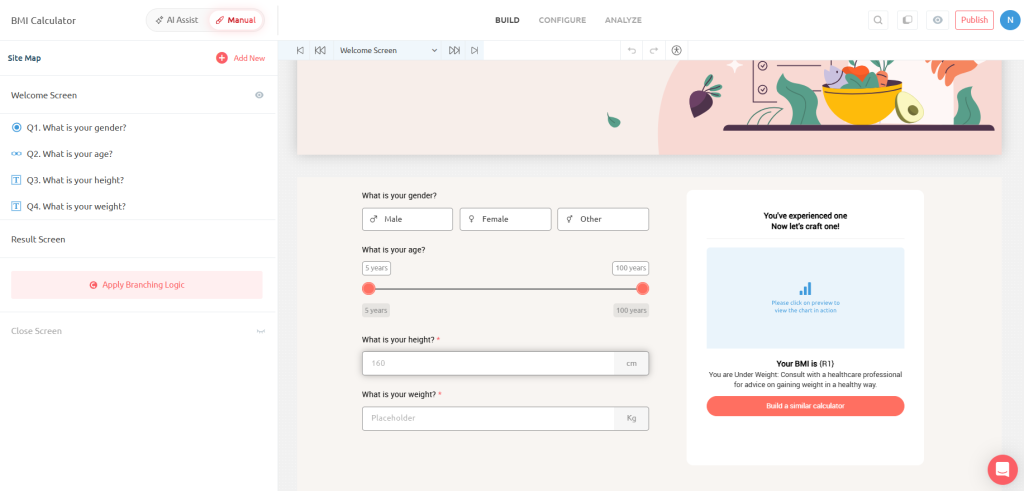
Modify the input fields to match your audience’s needs. You can offer metric and imperial unit options, add fields for age and gender, and include optional goal-based questions.
Add Conditional Logic
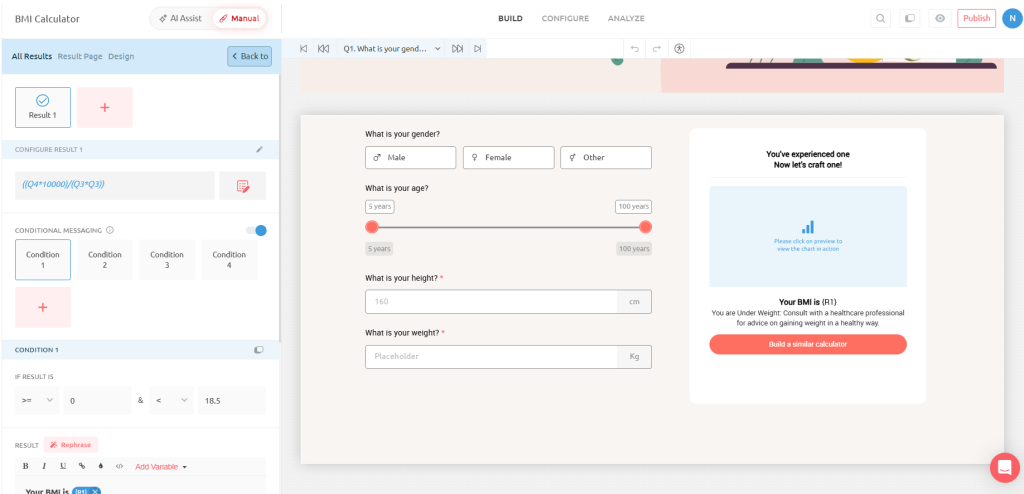
Outgrow’s conditional logic feature allows you to show different result pages, recommendations, and calls to action based on each user’s specific BMI score. A user in the underweight range can receive entirely different guidance than a user in the obese range.
Configure Result Pages
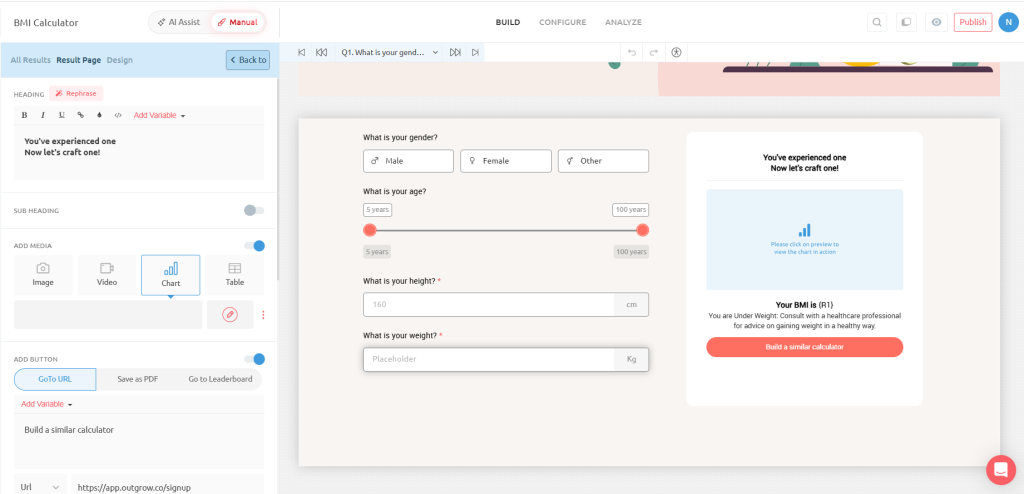
Design result pages that go beyond simply displaying a number. Include a health interpretation, a recommended weight range, and tailored suggestions for nutrition, exercise, and next steps.
Design Mobile-Friendly Experiences
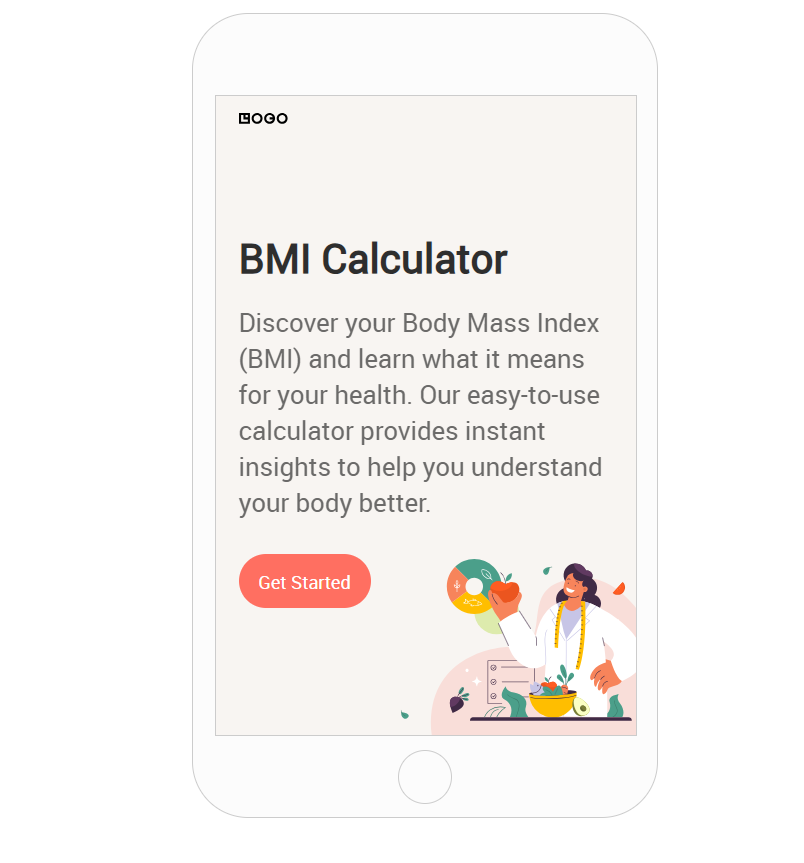
Outgrow’s BMI calculator templates are fully responsive, ensuring that users have a smooth experience on smartphones and tablets as well as desktop devices.
The core components you will configure include a height input field, a weight input field, a unit selector to toggle between metric and imperial, the BMI calculation formula, and result category displays.
Recommended Questions to Include in Your BMI Calculator
The questions you include in your BMI calculator determine how personalized and useful the results will be. Here is a breakdown of the most effective questions across different levels of depth.
Basic Questions
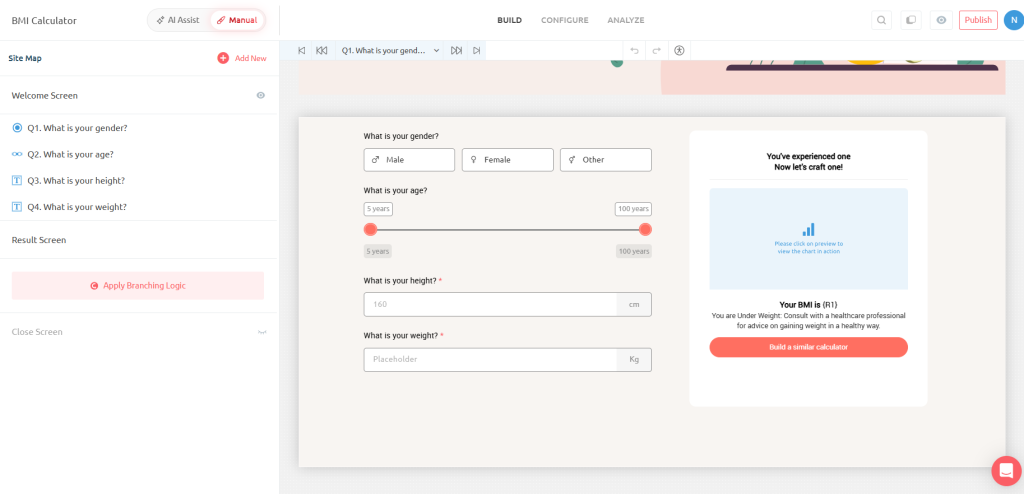
These are the foundational inputs needed to calculate BMI and provide relevant context.
What is your age? Age affects how BMI results should be interpreted and helps tailor recommendations accordingly.
What is your gender? Sex influences body composition norms and healthy weight ranges.
What is your height? This is one of the two core inputs required for the BMI formula.
What is your weight? This is the second required input, and you should allow users to select their preferred unit of measurement.
Goal-Based Questions
These questions help personalize the result and guide users toward relevant next steps.
What is your primary fitness goal? This allows you to show results that align with whether the user is focused on weight loss, muscle gain, endurance, or general wellness.
Are you trying to lose, maintain, or gain weight? This shapes the tone and content of the recommendations on the result page.
How active are you? Activity level context helps make the output feel relevant and realistic rather than generic.
Advanced Personalization Questions
These questions create a richer experience for users who want deeper engagement.
Do you exercise regularly? This can inform whether to recommend beginner or intermediate fitness suggestions.
Do you have any health concerns? Users who flag existing conditions can be directed toward consulting a professional rather than following self-guided tips.
What is your target weight? Entering a goal weight allows the calculator to show how far the user is from their desired healthy weight range.
The best input formats for a BMI calculator include multiple choice fields, number entry fields, sliders for weight and height, and dropdown menus for categorical selections.
Best Result Pages for a BMI Calculator
The result page is where your BMI calculator delivers its real value. A strong result page does more than display a number. It provides context, guidance, and a clear next step.
Personalized BMI Score
Display the user’s BMI value prominently, styled with color coding that matches their category. This immediate visual feedback is engaging and memorable.
Health Interpretation
Explain what the score means in plain language. Avoid jargon and keep the tone supportive rather than alarming. Let the user know whether their score falls in a healthy range and what that means for their overall wellbeing.
Recommended Weight Range
Show the user the weight range that corresponds to a healthy BMI for their height. This gives them a concrete, actionable target if they are working toward a weight goal.
Fitness Suggestions
Provide brief, practical suggestions based on the result. These might include walking targets, strength training ideas, or flexibility routines. Keep recommendations general enough to be broadly applicable but specific enough to feel meaningful.
Nutrition Guidance
Offer high-level dietary tips relevant to the user’s BMI category. Someone in the underweight range might receive guidance on caloric density and protein intake, while someone in the overweight range might receive tips on portion control and balanced meal composition.
Call-to-Action Examples
Every result page should end with a clear call to action. Strong options include inviting users to book a consultation with a health professional, download a personalized health or fitness guide, join a newsletter or community, or request coaching services. These conversion elements transform your BMI calculator from an informational widget into a business growth tool.
BMI Calculator Examples and Use Cases
BMI calculators built with Outgrow have proven effective across a wide range of industries and use cases.
Healthcare Websites
Clinics and hospital networks use BMI calculators to engage patients between appointments, educate them about weight-related health risks, and encourage them to schedule consultations when their score falls outside the healthy range.
Fitness Businesses
Personal trainers, gyms, and online fitness coaches embed BMI calculators on their websites as lead generation tools. A visitor who completes the calculator and receives their results is much more likely to opt in to an email list or inquire about services than someone who simply browses a static page.
Weight Loss Programs
Structured programs for weight management use BMI calculators to help participants assess their starting point, understand their goals in quantitative terms, and track their progress over the course of the program.
Corporate Wellness Programs
Companies that run employee wellness initiatives use BMI calculators as part of health awareness campaigns. Employees can complete the tool privately and receive guidance without any judgment or pressure, which increases participation and engagement.
Nutrition Consultants
Registered dietitians and nutrition coaches use BMI calculators to help clients contextualize their weight status and open conversations about dietary habits, lifestyle factors, and realistic health goals.
Common BMI Calculator Mistakes to Avoid
When building a BMI calculator, several common missteps can undermine its effectiveness and user experience.
Using Incorrect Units
If your calculator does not clearly indicate the unit of measurement or does not offer the option to switch between metric and imperial, users will frequently enter values in the wrong unit and receive inaccurate results. Always provide a clear unit selector and validate inputs before calculating.
Ignoring BMI Limitations
A BMI calculator that presents results as definitive health diagnoses does a disservice to users. Always include language that contextualizes the result within the broader picture of individual health, and remind users to consult a healthcare professional for a comprehensive assessment.
Poor Result Explanations
A result page that simply displays a number with no context or guidance leaves users confused and disengaged. Invest time in crafting result page content that is informative, empathetic, and actionable.
Lack of Personalization
A one-size-fits-all result page fails to take advantage of what interactive content does best. Use conditional logic to tailor results based on the user’s specific score, goals, and inputs. Personalization dramatically increases the relevance of the experience and the likelihood that users will engage with your calls to action.
Missing Mobile Optimization
A significant portion of web traffic comes from mobile devices. If your BMI calculator is not fully optimized for smaller screens, users will abandon it before completing it. Outgrow’s templates are designed to be responsive by default, but always preview your calculator on multiple screen sizes before publishing.
Conclusion: Use the BMI Calculator to Understand Your Weight Status
BMI is one of the most widely recognized health metrics in the world, and for good reason. It offers a fast, accessible, and standardized way to understand where your weight stands relative to your height. While it is not a perfect measure and should always be considered alongside other health indicators, it provides a meaningful starting point for health awareness, goal setting, and professional assessment.
The key takeaways from this guide are straightforward. BMI is easy to calculate using either the metric or imperial formula. Standard categories range from underweight to severe obesity. Your BMI result can inform practical decisions about nutrition, fitness, and medical care. And while BMI has limitations, particularly for athletes, older adults, and certain ethnic populations, it remains a valuable first-line tool when used appropriately.
If you are ready to put this knowledge into action, use the BMI calculator at the top of this page to get your results instantly. And if you are looking to build your own BMI calculator for your website, Outgrow’s ready-to-use templates make it simple to create a professional, personalized, and conversion-ready experience for your audience. Create a BMI Calculator for your business with Outgrow. Start your 7-day free trial today.
Frequently Asked Questions
A healthy BMI for most adults falls between 18.5 and 24.9. However, the ideal range can vary based on age, sex, ethnicity, and individual health factors.
BMI is reasonably accurate as a population-level screening tool, but it is less precise at the individual level. It does not account for muscle mass, fat distribution, or other factors that influence health risk.
BMI does not directly measure body fat. It estimates a weight-to-height ratio that correlates with body fat in many people, but it is not a precise measurement of fat percentage.
The standard BMI formula is the same for men and women. However, because men and women naturally carry different proportions of muscle and fat, the health implications of a given BMI score can differ.
Age does not affect the BMI calculation itself, but it does affect how results should be interpreted.
Athletes tend to have higher muscle mass than the general population. Since muscle is denser than fat, a muscular person may weigh more than someone of the same height with a higher fat percentage.
BMI can be a helpful starting point and progress tracking tool for weight loss, as it gives users a quantitative goal.
A BMI of 30 or above is classified as obese according to standard WHO and CDC guidelines. Obesity is further divided into Class I (30 to 34.9), Class II (35 to 39.9), and Class III (40 and above).
Children and teenagers should not use adult BMI categories. For individuals under 20, BMI-for-age percentile charts are used, which account for normal growth and development patterns.
If your BMI falls in the overweight or obese range, the first step is to consult a healthcare provider for a full assessment.

Ankit Upadhyay is a Digital Marketing and SEO Specialist at Outgrow. With a passion for driving growth through strategic content and technical SEO expertise, Ankit Upadhyay helps brands enhance their online visibility and connect with the right audience. When not optimizing websites or crafting marketing strategies, Ankit Upadhyay loves visiting new places and exploring nature.